Displaying items by tag: Mathieu Amalric
Vie Privee/ Private Life
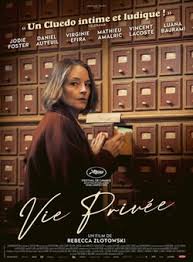
VIE PRIVEE/ A PRIVATE LIFE
France, 2025, 109 minutes, Colour.
Jodie Foster, Daniel Auteuil, Virginie Efira, Mathieu Amalric, Vincent Lacoste, Luana Bajrami, Noam Morgensztern, Sophie Guillemin, Frederick Wiseman, Aurore Clement, Irene Jacob, Park Ji-min.
Directed by Rebecca Zlowtoski.
Jodie Foster, very American in her award-winning career for over 50 years, nevertheless had quite an education in French and has appeared previously in French films. Here is a star vehicle for her, working along some of the most prominent of contemporary French actors.
She is Lillian, divorced from a Frenchman, and eye-doctor, Gabriel (Daniel Auteuil) with a son she does not communicate well with who is married with a baby son (Vincent Lacoste). She is a psychiatrist, quite a clientele, working with some of her patients for many years – and glimpses of her at work, with an angry client who wanted to give up smoking and failed after so many years and has gone to see a hypnotist with an instant cure and he wants his money back! So, serious themes with touches of humour.
But, she is visit by the daughter of one her long-term clients with the news that her mother has died. Lillian goes to the memorial but is angrily rejected by the dead woman’s husband (Mathieu Amalric), her being blamed for the death which turns out to be a suicide.
Which means then that the film turns into something of a detective story, Lillian worried about the suicide, coming to the conclusion that it was really murder, suspicions on the husband, and then the erratic behaviour of the daughter. And she enlists her genial ex-husband to help her find evidence. Thedead woman, Paula (Virginie Efira) appears in flashbacks.
At one stage, Lillian also visits the hypnotist because she has started to weep cannot prevent the tears. The therapy includes quite a startling episode, imagining a former life, 1942, Lillian with the dead woman, musicians in Orchestra, the husband the conductor drawing a gun, and the police arriving, led by her son. Which seems to indicate that Lillian herself is in serious need of some kind of therapy.
While Jodie Foster is a strong screen presence, her character here is rather superior in the American way, sometimes alienating the other characters and, sometimes, the audience.
With all the investigations, the complexity of relationships, and, it should be mentioned, strong Jewish background, there are many threads to be followed. With its complexity, the temptation is to say that it is all very much psychologised or, more accurately, psychiatrised.
- The title? For Lillian and, for Paula, the other characters?
- The French setting, atmosphere, psychiatrists, opticians, the range of clients, sessions? Background, apartments, restaurants, the home invasion, the countryside? The musical score?
- The film’s perspective on psychiatrists, their patients, years in sessions, effective, not effective, listening, hypnosis, special techniques? Psychiatrists and their personal life interfering with their practice?
- Lillian, American, American superiority, her skills as a psychiatrist, interactions with her patients, the patient and smoking, hypnosis, wanting his money back? The sketches of other clients and their talking, on the couch? Lillian and her life, marriage to Gabriel, her professional work, the separation, her relationship with her son, the grandchild, offhand? Superior?
- Valerie, the visit, Paula’s death, Lillian going to the wake, Jewish ceremony, Simon and his hostility, ousting Lillian? Valerie explaining the suicide? Lillian and the long years of therapy, the relationship with Paula? Not listening to her final tape? Suspicions, the psychiatrist mind, questioning, suspecting Valerie and her motivations, suspecting Simon, the visit to the funeral, his hostility, the decision to go with Gabriel to find the stolen tape? His coming to her office, making her lie down, his speech explaining the situation, all, Paula, choosing him as the father of her child, the death of the hunt?
- Paula, seen in flashbacks, character, relationship to Simon, relationship to Valerie, the long years of therapy, her aunt and the death, the issue of the medication, ending her suffering, the repercussions, her suicide? Or murdered by her daughter, Simon using the medication to kill her?
- Gabriel, working with eyes, love for Lillian, the marriage, the separation, her going to him for advice, her weeping, the meetings, the meals, the friendship and response, going to Simon’s house, pretending to be out of petrol, the aftermath?
- The ransacking of the office, the stealing of the tapes, and a confession of the patient with the smoking problem, apology?
- Lillian going to see her son, the technical issues, her using old-fashioned tapes, her set? Difficulties with her son, the glimpse and her grandchild? The later visit, the apologies? Her daughter-in-law?
- Going to see the hypnotist, the session, going to the imagination, a past life, the war, the orchestra, relationship with Paula, Simon is the conductor, her son as the military presence? Her escaping? The hypnotist, not wanting to see her again, Lillian listening to the tape, the imagination?
- The resolution of the issues, Lillian and her problems, needing some kind of therapy, the contribution of all of the characters? And peaceful ending with the family?
Phoenician Scheme, The
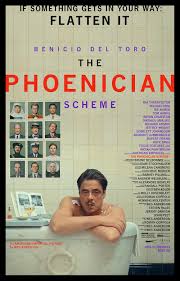
THE PHOENICIAN SCHEME
US, 2025, 101 minutes, Colour.
Benicio del Toro, Mia Threapleton, Michael Cera, Riz Ahmed, Tom Hanks, Bryan Cranston, Mathieu Amalric, Richard Ayoade, Jeffrey Wright, Scarlett Johansson, Benedict Cumberbatch, Rupert Friend, Hope Davis, Bill Murray, Charlotte Gainsbourg, Willem Dafoe, F. Murray Abraham, Stephen Park, Alex Jennings, Donald Sumpter, Scott Shepherd.
Directed by Wes Anderson.
A significant part of the review for The Phoenician Scheme is to look at the huge credits list, many of the cast having appeared in a number of Wes Anderson films. And, of course, expectations from writer-director, Wes Anderson. Anderson has been writing and directing films, including two animation films, for more than a quarter of a century. His tyle and his exploration of themes is, to say the least, highly distinctive.
And, The Phoenician Scheme, is quite idiosyncratically distinctive. It is very stylised in the visuals, the traditional box screen frame, the framing of action, the references to paintings and the staging looking like 20th century paintings. Then there are the performances, also stylised, often life theatre performances, eccentric and clipped delivery of lines, postures and posing. And, for those audiences ready to surrender to Anderson, there are many who do, these visuals and the performances are readily engaging.
There is a plot. The setting is 1950, an entrepreneurial businessman from Hungary, Korda, played perfectly, both seriously and ironically, by Benicio del Toro. He has survived several plane crashes, assassins out to get him and sabotage his plan for development, rails and tunnels in Phoenicia. We are presented with a chart indicating his plans as well as the contacts he must make to improve a shortfall in income project. They serve as chapters for the film.
Korda has many children, his own and adopted, hoping for an Einstein for the future. But his only daughter, Liesl, a novice nun, played by Mia Threapleton, is seconded, initially unwillingly and firmly committed to her vocation, to be his heir. (Mia Threapleton is following in the footsteps of her mother, Kate Winslet, a very interesting role.) And, there is Kord’a new assistant, expert on insects, played with accent by Michael Cera.
Interspersed throughout it is round table conference of elders who are monitoring Korda’s behaviour judging him and his morality accordingly.
The encounters with the various characters for financial help are highly entertaining, eccentric and satirically humorous in their way, incorporating the various stars listed above until a culmination in the fearsome presence of Benedict Cumberbatch Korda’s brother.
Then there are Korda’s memories and dreams, flashbacks in black-and-white, some of his near death, or momentary post-death, experiences, some ecclesiastical in an Orthodox style, others with biblical overtones, again with a number of stars – and a cameo by Bill Murray, who has been working with Anderson for a long time, culminating in his presence as God.
Anderson has a wry and offbeat sense of humour, so often the unexpected, some realism and then some surrealism, farcical moments, deadly serious moments, tantalising the audience, a treat for those who are willing to be tantalised.
- A Wes Anderson film, style, visual, verbal, humorous, satirical, ironic? Underlying serious themes? The strengths of his casts, many actors reappearing in his films?
- The visual style of the film, but colour like 20th century contemporary paintings? Sets and decor? Photography, the black and white flashbacks? Staging of the action, like stage performance, all postures and posings? The stylised action sequences? The performances, stylised and realism? The language of the screenplay, the particular style of delivery? The overall effect and response?
- The setting in 1950, memories of World War II, business enterprises after the war, international entrepreneurs, international projects and finance?, Double dealing?
- The explanation of Korda, his business acumen, the 5%? The background of his marriages? Children and adopted children, hoping for an Einstein? His relationship with his daughter, novice nun, seconding her, naming her as his heir? His staff, his planes, the plans to kill him, his surviving the various crashes?
- The plane ride, his assistant cut in half and swept away, the crash, surviving? Meeting his daughter, her personality, severe, dedicated to the convent, contact with the mother superior, wanting to make her vows? Her not knowing her father, his reputation with her? Her unwillingness to be part of his empire? The plan, her observing his behaviour, learning more about him, her beads, images, sign of the cross, holy water?
- Bjorn, Scandinavian background, accent, present on the plane, his role as assistant, his expertise on insects, his attraction to Liesl, declarations? The comic style of his character, interactions?
- The Phoenician scheme itself, tunnels and railway, the finance, the image on the screen with the various contacts for making up the gap in finance? The structure of the film, the various contacts?
- The background of the assembly, the business discussions, the following of Korda, the decisions about his business and morality?
- The Americans, in the tunnel, on the train, the discussions, suspicions, the meeting with the Prince of Phoenicia, the attack by the camel riders, the Prince saving Korda? The financial discussions, the proposal of the basketball competition, the Prince and his ignorance of the game, Korda hopeless, the skill of the two Americans, yet the Prince succeeding? Getting a grant?
- Going to Marseille Bob, the manager of the club, past relationship with Korda, Liesel and Bjorn observing, the raid on the club, the freedom fighters, the personality of Sergio, Bob upset about the roof, and Korda taking the bullet for Bob? Getting the grant?
- Marty, fast talking American, suspicious of Korda, Korda shot, Marty providing the blood transfusion, making an agreement?
- Going to see Hilda, the distant cousin, her financial knowledge, the prospect of the marriage, her place in the family, with Liese?
- The flight, going to see Nubar, the crash, the jungle, Bjorn and his being unmasked as an agent, his siding with Korda, Korda in the quicksand, Bjorn rescuing him, the arrival of Sergio and his revolutionaries, taking the group to safety?
- The encounter with Nubar, looking sinister, the relationship, the mastermind behind the assassination attempts, discussing the family, the finance, the satirical physical fight between Nubar and Korda?
- Korda, death experiences, near death, his life before him, black-and-white photography, the bearded Orthodox-like sequences, the characters, judgements? The biblical sequences, the personalities, the pageantry, Bill Murray as God?
- Liesl, the contact with the mother superior, her being present for the business deals, the money for the community? Liesl opting to leave the convent?
- The finale, Korda and his being honest, losing everything, restaurant, the working in the kitchen, father and daughter, reconciled, and a happy life?
- The Phoenician Scheme movie
- Wes Anderson
- Peter Malone's Movie Reviews
- Benicio del Toro
- Mia Threappleton
- Michael Cera
- Riz Ahmed
- Tom Hanks
- Brian Cranston
- Jeffrey Wright
- Richard Ayeode
- Benedict Cumberbatch
- Scarlet Johansson
- Charlotte Gainsbourg
- F Murray Abraham
- Willem Dafoe
- Rupert Friend
- Donald Sumpter
- Mathieu Amalric
- Bill Murray
- Hope Davis
- Alex Jennings
