Displaying items by tag: Bob Monkhouse
Dentist on the Job
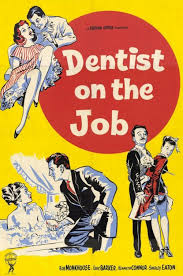
DENTIST ON THE JOB
UK, 1961, 88 minutes, Black-and-white.
Bob Monkhouse, Kenneth Connor, Shirley Eaton, Eric Barker, Richard Wattis, Ronnie Stevens, Reginald Beckwith, Graham Stark, Charles Hawtrey.
Directed by C.M. Pennington-Richards.
A star vehicle for Bob Monkhouse, popular film and television star. Good-looking, presentable, but playing characters who seem rather smugly satisfied with themselves.
This is a sequel to Dentist in the Chair. It was released in 1961, the years when the Carry on series was emerging. And, quite a number of Carry on stars appear, especially Kenneth Connor, in the central role, along with a cameo by Charles Hawtrey, and key roles by Eric Barker and Shirley Eaton. The other main character is played by Ronnie Stevens.
The film could have been called Carry on Dentist, Carry on Advertising, or, even, Carry on Toothpaste!
The film is about a campaign for a new toothpaste which is not doing very well, Richard Wattid the very prim executive, Reginald Beckwith one of the sales representatives. Because a dentist, qualified, will be taken off the register for promoting a product, Monkhouse and Stevens are tricked into signing up to promote this toothpaste. So, all the usual shenanigans, quite some ogling, lots of sexual innuendo.
However, Kenneth Connor, is an ex-convict has plenty of opportunities to do his impersonations, projects and, then American accent. Shirley Eaton obviously enjoys this kind of role. And, Eric Barker, has two roles, two cousins.
Lots of knockabout comedy, parody of filming commercials, and a completely impossible situation whereby the doctors prepare take to a recorded message substituted for one going into space which will advertise the toothpaste all over the universe! There is some comment on security but, a more security-conscious public will think that these episodes, because not to be taken too seriously, are absolutely impossible.
Along with the Carry on series and other small comedies, this was British comedy on screen in the early 1960s.
Carry on Sergeant
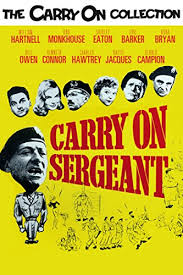
CARRY ON SERGEANT
UK, 1958, 84 minutes, Black-and-white.
William Hartnell, Shirley Eaton, Bob Monkhouse, Eric Barker, Dora Bryan, Bill Owen, Charles Hawtrey, Kenneth Connor, Kenneth Williams, Terrence Longden, Norman Rossington, Hattie Jacques, Terry Scott, Ed Devereaux.
Directed by Gerald Thomas.
The first of the Carry on films which were to continue into the 60s and 70s, all of them directed by Gerald Thomas. This film was typical enough of the comedy of the 1950s, a focus on the military, a group of national service for 10 weeks training, a motley and comical group, as well as a focus on the sergeant who wants to win an award for the best company, his corporal assistant and the commanding officer. Very much focus on the male characters.
However, Shirley Eaton, some years before Goldfinger, is the just married wife of one of the recruits, Bob Monkhouse, and Dora Bryan does her usual comic thing as a rather flighty cook.
In many ways, this is a straightforward British comedy, a basis for the future Carry on films, but very different from the jokey, sometimes a leering style of the subsequent films. (Comparison can be made with Operation Bullshine of 1959, the army, much more in the vein of the later Carry on films.)
Which means that this film is enjoyable for audiences of British comedy of the 1950s.
Interestingly, in view of the later Carry on films, the first list of cast seen in the opening credits highlights stars who were not regulars in most of the Carry on films (William Hartnell as the sergeant having top billing, Eric Barker, in some of the films, as the commander and the later top-rated billing of Bob Monkhouse). Then, the next list has the regulars who are there right from the beginning, Kenneth Connor, Kenneth Williams, Charles Hawtrey, then Hattie Jacques and even a glimpse at the beginning of Terry Scott, conversing with Ed Devereaux.
Kenneth Connor is an extreme hypochondriac, Hattie Jacques the doctor, Charles Hawtrey as usual, but enjoyable to see Kenneth Williams as an intellectual soldier, helping others, but his usual speaking style.
No Sid James until the third Carry on film. No Joan Sims, but she appeared in the next one.
For fans of the Carry on series, instructive and perhaps surprisingly enjoyable, especially with its reticence, reminding us how the series began.
She'll Have to Go
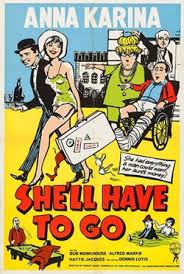
SHE'LL HAVE TO GO
UK, 1962, 89 minutes, Black-and-white.
Bob Monkhouse, Alfred Marks, Hattie Jacques, Anna Karina, Dennis Lotis, Graham Stark, Clive Dunn, Hugh Lloyd, Peter Butterworth.
Directed by Robert Asher.
A very broad British farcical comedy, based on a play, typical of popular comedies in Britain in the early 1960s – and, with some of the humour that characterises the Carry On comedies.
Bob Monkhouse was a popular film and television personality, Alfred Marks more serious. The Carry On the connection can be seen with the presence of Hattie Jacques, much more dominating and posh as an intrusive journalist. A number of popular British comedians of the time have comedy cameos, Graham Stark, before the Pink Panther films, as the journalist’s cameraman, Clive Dunn as a bumbling chemist, Hugh Lloyd as a pompous lawyer, Peter Butterworth as a shortsighted doctor getting himself into tangles.
However, the surprise for many cineastes who come across this comedy is the presence of Anna Karina, the Danish born actress who appeared in films for many decades, a variety of films in the UK, US, European countries – but is still best known as the wife of Jean-Luc Godard in the 1960s and starred in a number of his memorable films of the 1960s. Most would not associate her with this kind of British comedy.
Two brothers, novelists, live in a mansion, little income, manservant played by Dennis Lotis, getting news that a remote cousin was going to inherit the house and probably oust them. The title indicates the tone of the film, the option of marrying her and retaining the money or of murdering her. Which means there are some romantic scenes and several attempts on her life. She arrives, charms the journalist, charms the man servant, escapes all the attempts on her life, then turns the tables on them.
A great number of farcical situations, puns and quips, exaggerations all round. Nowadays mainly for film historians.
