Displaying items by tag: Peter Malone's Movie Reviews
Private Secretary, The
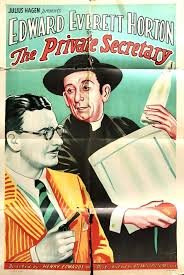
THE PRIVATE SECRETARY
UK, 1935, 70 minutes, Black-and-white.
Edward Everett Horton, Barry MacKay, Judy Gunn, Oscar Asche, Sydney Fairbrother, Michael Shepley, Alistair Sim, Aubey Dexter.
Directed by Henry Edwards.
A curiosity item from Britain in the 1930s. The film was based on a story by Charles Hawtrey (not the Carry on actor).
The IMDb gives a very neat overview of the plot, and the choice of words to describe the central character: A timid and dim-witted clergyman is duped into helping a playboy avoid his creditors, inherit his uncle's fortune and get the girl. Timid and dim-witted seems an understatement!
The film shows the wealthy classes in London, playboys and nightclubs, drinking, smashing glasses for the fun of it, arriving home in the morning, loyal servants looking after them – but severe creditors also early on the doorstep.
But the film opens in India, showing a very superior British colonialist in his treatment of the locals – which he then shows to everybody when he returns to England. His played by Australian actor, dramatist, Oscar Asche.
There is a situation where the central playboy’s best friend’s uncle has a private secretary, a clergyman from the counties, coming to the country estate. He turns up at the playboy’s house, encounters the imperious uncle who mistakes him for his nephew. Consequently, all kinds of mixups, the clergyman travelling by bus in London, comic misapprehensions, his turning up at the country estate with a playboy his impersonating the private secretary, but attracted by his employer’s daughter. Obvious where this is going.
However, it is all the shenanigans on the way that are important, the daughter discovering the impersonation but carrying on as if not, creditors coming to the country and getting drunk, the elderly lady of the house caught up in belief in mediums and the afterlife. And, surprisingly, a young Alistair Sim, looking and acting very much like his films during the 1950s, portrays a bogus medium.
But, the star of the piece is American Edward Everett Horton, playing the butler in so many films, variations on timid variations on dimwitted. He is a master of this kind of character on screen.
An example of farcical comedy enjoyed in the mid 1930s.
Carry on Jack
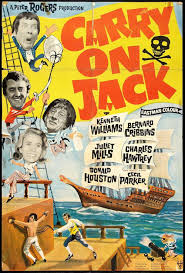
CARRY ON JACK
UK, 1964, 91 minutes, Colour.
Kenneth Williams, Charles Hawtrey, Bernard Cribbins, Juliet Mills, Donald Houston, Percy Herbert, Jim Dale, Patrick Cargill, Cecil Parker, Ed Devereaux, Peter Gilmore, George Woodbridge, Anton Rodgers.
Directed by Gerald Thomas.
This Carry on comedy came immediately after Carry on Cleo. One of the three Carry on films of 1964.
The film has a naval theme, even starting with the death of Nelson and the episode of “Kiss me, Hardy”. It is the first film completely written by Talbot Rothwell who was to continue the series into the 80s. He took over from Norman Hudis.
The first comment to be made is to note the absence of Sid James, Joan Sims, Kenneth Connor, Hattie Jacques. Since most of the action is at sea, no major roles for Joan Sims or Hattie Jacques. The main serious role is taken by Donald Houston, a serious actor rather than a comedian, but it might have been taken up by Sid James but with much more irony than the straightforward anger of Houston. Bernard Cribbins has the central role which is very much a variation on a lot of the characters played by Kenneth Connnor.
But, Kenneth Williams and Charles Hawtrey are there, William is the captain of the ship, initially seasick, allegedly Captain Fearless, anything but. Charles Hawtrey has a better role but much the same shtick as a cesspool cleaner press-ganged onto the ship. They have plenty to do in the latter part of the film when the four central characters experience a mutiny and are put to see in a boat.
Bernard Cribbins does very well as the put-upon midshipman, his uniform ‘s and sword stolen by Juliet Mills who wants to stow away to meet her lover in Spain. And, there are many character actors as usual, Percy Herbert as the tough officer, Jim Dale as carriage courier, Patrick Cargill as a Spanish Governor, Ed Devereaux as a pirate and Cecil Parker as the lord admirable.
Something of a little parody of Mutiny on the Bounty and H.M.S.Defiant (and the film using some of their sets). Carry on with the lighter touch.
Great Hotel Murder, The
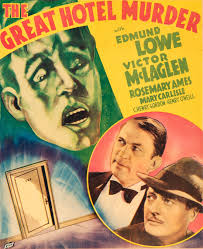
THE GREAT HOTEL MURDER
US, 1935, 70 minutes, Black-and-white.
Edmond Lowe, Victor McLaglen, Rosemary Ames, Mary Carlisle, Henry O'Neill, Jon Quaylen, Herman Bang.
Directed by Eugene Forde.
Not exactly great! In retrospect, just passable, rather slight.
There is a hotel, there is a medical convention, there is a mysterious woman, there are doctors, there are marital problems, there is a poisoning, there is a house detective, played by Victor McLaglen in his gruff way, eager to solve any mysteries. He won his Best Actor Oscar that year for The Informer. But, there is also a resident author, writer of detective stories, more aristocratic in style, played by Edmond Lowe. There is also a worker in the hotel who is susceptible to bribes.
Serious but also comic shenanigans, the detective trying to outwit the writer, getting into all kinds of scrapes and dangers, making the wrong conclusions, following the wrong clues, and, of course, the author winning out.
More for fans of is Lowe and McLaglen who had appeared in 1926, What Price Glory and, much more successfully than this film in 1932, Guilty as Hell.
Mystery Man, The
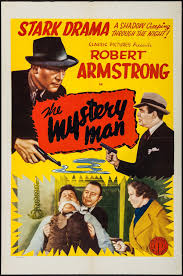
THE MYSTERY MAN
US, 1935, 65 minutes, Black-and-white.
Robert Armstrong, Maxine Doyle, Henry Kolker, James Burke.
Directed by Raymond McCarey.
No particular reason for seeing this short be-budget supporting feature. The focus is on Robert Armstrong who appeared in the number of dramas like King Kong and was a regular at Warner Brothers. Older (45 at the time of production), with a quick line in repartee, he was popular in those decades but probably will not charm or attract a contemporary audience.
He plays a reporter, with his buddies at the office, clashing with the editor, receiving an award, a drinker, something of a conman, but always wanting the big story. Most of the film involves his encountering a young woman who is broke, helping her, saving her by pretending that they were married, conning his way into the honeymoon suite at a hotel. And then disowned by his editor, and his trying to get a story in St Louis.
In fact, the action takes place in the last 15 to 20 minutes of the film, the journalist selling the gun he received as an award, the gun given by the pawnbroker to a famous thief in the city, the reporter setting the thief up, posing as the driver, taking the money, explaining everything to the police, but then charged with the murder of a policeman and the theft.
Lots of to-ing and fro-ing, phone calls, jokes, serious situations, all resolved at the end, of course, and the couple marrying. (James Burke appears as an editor, rather more serious than some of his comic roles, especially as the assistant to the Commissioner in the Ellery Queen thrillers.)
Mystery of Marie Roget, The
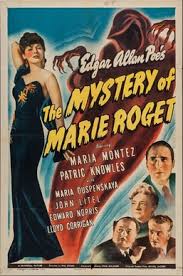
THE MYSTERY OF MARIE ROGET
US, 1942, 61 minutes, Black-and-white.
Patric Knowles, Maria Montez, Maria Ouspenskaya, John Litel, Edward Norris, Lloyd Corrigan, Nell O'Day.
Directed by Phil Rosen.
A better than expected small budget supporting feature from Universal Studios in 1942, directed by Russian-born, Phil Rosen, who has 143 credits of direction from 1915 to 1951.
It is based on an Edgar Allan Poe short story, coming after his famous Murders in the Rue Morgue. (There is a creature here also, a pet leopard, but it serves as something of a red herring in the mystery.) The story was published in 1842 about the time here is 1898, only 42 years before the release of the film, but with its sets and decor and transport, seems a different world.
One of the advantages of the film is the number of sets from previous films, used to advantage to create an impressive atmosphere. The plot moves from Poe’s story, Paris, the theatre background, a diva played by Maria Montez as a femme fatale, and an opportunity for performance of a song.
But, the star of the film is Patric Knowles, a doctor working with the police authorities. The head of the police is a comic figure played by Lloyd Corrigan, something of a Holmes and Watson duo.
The film opens with a mysterious murder, a body in the river, her face disfigured. The doctor quietly pursues clues, examines bodies, removes a brain for study, is hired by a grandmother to protect her granddaughter, target of a murder plot for her inheritance. The grandmother is played by veteran Maria Ouspenskaya who controls every scene she is in, completely dominating the cast and the audience.
The plot is rather complex, takes a number of turns, a villain who confesses but has legal chicanery in mind, wanting to be released with charges dropped but then unable to be tried a second time for murder.
A dramatic confrontation at the end – and quite a good hour is spent with a small budget entertainment.
Carry on Screaming
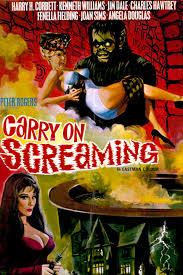
CARRY ON SCREAMING
UK, 1966, 97 minutes, Colour.
Harry H. Corbett, Fenella Fielding, Kenneth Williams, Jim Dale, Charles Hawtrey, Joan Sims, Angela Douglas, Bernard Bresslaw, Peter Butterworth, Jon Pertwee, Tom Clegg, Billy Cornelius, Frank Thornton.
Directed by Gerald Thomas.
With the growing propensity for the Carry on films to parody classic stories, it was inevitable that there would be a horror film. But, no Sid James, no Kenneth Connor.
By this stage, writer, Talbot Rothwell, was in his element. Basically, this story is a Frankenstein variation, Kenneth Williams enjoying himself with his repartee and shtick as a scientist, dead, but like his monsters, electrified into life. And, he has two monsters and a drink which can temporarily change heroes into monsters. And he is aided and abetted by the strong presence of Fenella Fielding as his sister, very much in the Morticia Addams look vein.
The rather unsympathetic hero is played by Harry H. Corbett, of Steptoe and Son. He could have been played by Kenneth Connor. And, there is Joan Sims as his harridqn wife, a parallel to her turn in Carry on Matron. And, just before the end, she has the final wink.
Jim Dale is the put-upon hero. Charles Hawtrey has a small role. But, regular, Peter Butterworth, has a more substantial turn in this film as Corbett’s assistant and having to dress as a woman as bait for the monsters. And Bernard Bresdlaw is the undead butler. Frank Thornton, anticipating Are You Being Served, his shop manager.
All the usual shenanigans – and the film has a high reputation amongst the Carry on series.
Project Hail Mary
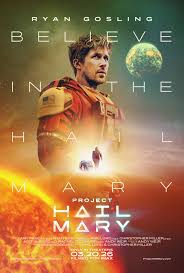
PROJECT HAIL MARY
US, 2026, 157 minutes, Colour.
Ryan Gosling, Sandra Huller, Ken Leung, voices of: James Ortiz, Ray Porter, Meryl Streep.
Directed by Phil Lord, Christopher Miller.
It is a very interesting commentary on 2026 audiences that Project Hail Mary was so immediately successful at the box office, not only in the United States, but worldwide. Which raises the questions about what has drawn the audiences, the themes, science, space exploration and cosmic threats. Or is it issue of heroism, somebody underestimating themselves, challenged, forced, to take on something that they think is beyond them? Probably both.
With its vast theme, Project Hail Mary can be seen in the line of the very serious space films of the last 60 years, beyond the small budget science fiction, beyond the serious action thrillers like the Alien films, going back to 1968 and 2001: A Space Odyssey, and later films like Interstellar, Gravity, Ad Astra.
For those not with the scientific bent, like the present reviewer, this story can be quite bewildering at times, the viewer experiencing that they are not on the wavelength of the details of the mission and its meaning, but realising that it is important to surrender to the atmosphere and what it is suggesting.
And the screenplay demands attention, an opening where the scientist on the space ship awakes from coma, his companions dead, realising that he has to finish this mission by himself. And, as he begins to accomplish the seemingly impossible, there are the flashbacks for his personality, an opinionated scientist, clashing with authorities, teaching in school, summoned by experts, refusing the mission, abducted and sent.
The scientist, with a significant surname, Grace, is played engagingly by Ryan Gosling, by himself for most of the action, but finding a strange companion, rock-shaped (and his being called Rocky), voiced by Jamie Ortiz, becoming a collaborator and friend in the mission. On earth, the chief scientist for the project is played by German actress, Sandra Huller.
Whether one has a scientific bent for not, the response to the technical expertise of the film indicates that there should be many Oscar nominations, for the extraordinary sets the vast spacecraft to space itself, for the stunt work, performed in front of the sets rather than the use of green screens, the expert editing, for the musical score.
The other aspect of the film that is significant is its link with climate change, going beyond this earth, cosmic developments, astrophage fungus that eats into radiation, with threats to Earth and other planets, the need for capturing some of this material and sending it to Earth for scientific studies and future protection.
So, audiences with a scientific bent have really been attracted by the film and recommending it. For others, Project Hail Mary will be something of an overwhelming experience, a challenge to be better prepared for whatever the future is bringing.
- The tradition of space exploration films? The tradition of threats from outer space? The more serious epic films? The thrillers? This film in the epic vein, running time, screenplay tone? The comic touches? The action touches?
- The plausibility of the plot, the threat from the virus, developing in space, near Venus, the line to the sun, the effect on Earth, attack, cooling? The scientific response and investigations? Need to avoid public panic? The plan project, named Hail Mary?
- The significance of the sets, vast, the science, spacecraft, Rocky the alien, the visions of space? The action in front of the sets rather than green screen? The special effects for space, for the beaches and cliffs of the final planet? The comparisons with the scenes on Earth, school, apartments, offices, laboratories? The change in style of the musical score?
- The framework, space, Grace awakening from the coma, his appearance, time passing, regaining his memories, orientation? The mission? His companions dead, floating out into space? Hs recovering, grooming himself, awareness of the mission?
- The insertion of the flashbacks to build up the story, Grace, his reputation, thesis, field of study, clashes with authorities, alone, his teaching in school, the classroom sequences?
- The encounter with Eva, the approach, her personality, convictions, her background, the threat to earth, the scientific discussions, the proposal? The continued flashbacks to his earlier life, the scenes in the classroom, by himself at home, his personal reactions to rejection, meeting with the other scientists, the explanations? The proposal, his refusal, wanting time, running away, the confrontation with the scientists, their expectations of him, Eva and her determination, the time limit, abducting him, sending him into space?
- Grace, his work, skills, adapting, managing the spacecraft? The mission, the samples, to be sent to earth? The film spending the time detailing him on the craft, his work, his personal life, his memories?
- The encounter with the spacecraft, the rock creature, setting up the technology to translate the rocks sounds into speech, their communication? The visuals of Rocky and the reason for his name, Rocky Balboa? The rejected voices, his voice, communication? In the container? The bonding, conversations, friendship? The nature of the mission?
- The shared experiences, the quest, the difficulties, dangers, the attacks, each managing? The shared dangers, unconscious, Grace and the bond with Rocky, fearing it was gone, Rockies gradual revival?
- The communication with Earth, Grace and his work with the samples, the experience of gathering them, the dangers, cataloguing them? Sending them to earth?
- Rocky, his contribution, Grace and his decision to return to earth, the limited fuel, the time? Their saying goodbye, the meaning of goodbye, the gesture of Rocky on the arm?
- Grace, the realisation of the limits, going back to earth, going to Rocky’s planet, the decision, joining together?
- Back on Earth, Eva, the receiving of the samples, Grace’s achievement, the work to save Earth?
- Grace and Rocky, the protection of the cover of the planet, the beaches and cliffs, their colour, the water, the companionship? Grace and his teaching, the class full of Rocky characters?
- The morale of the film, the danger to earth, the need for response, breaking through selfishness or self-centredness, the challenge to become one is better self?
Deb, The

THE DEB
Australia, 2024, 121 minutes, Colour.
Natalie Abbott, Charlotte MacInnes, Tara Morice, Rebel Wilson, Steph Tisdell, Shane Jacobson, Stevie Jean, Coster D’Angelo, Hal Cumpston, Brianna Bishop, Scarlet Crabtree, Susan Prior, Julian McMahon.
Directed by Rebel Wilson.
There is the traditional Debutantes Ball, not so these years but, in this Australian story, important for a country town.
The film began as a stage musical, book and lyrics by Hannah Reilly, music by Meg Washington (who also adapted Paul Kelly’s How to Make Gravy for the screen). On the whole, the music and songs are very cheery, the opening song (and again in the final credits) very frank in its language, to provoke the target audience.
With the opening in an exclusive girls’ school in Sydney, a focus on the teenagers in both city and country town, this is a film with an immediate appeal to teenage girls and young adult women (and their mothers and grandmothers). While there are some men in the cast, younger as well as older, they are very much secondary to the female presence, female assertion, feminism, critique.
Maeve is the school leader, outspoken, demonstrative in behaviour, in trouble with the headmistress who, in fact, is her mother. With some scandals for the school’s reputation, Maeve has to go to the country to her cousins. Maeve is played by Charlotte McInnes, a lively presence once she gets over her being so stuck up.
The cousin in the country, Taylah, a strong performance from Natalie Abbott, lives on the farm, sad at the death of her mother, her father, Rick (the always reliable Shane Jacobson, memories of Kenny) the town’s mayor, with his assistant D (staimitynd-up comedian Steph Tisdell). There is drought, the difficulties of financing, an appeal to the government for aid.
And, still lots of songs and dance, contemporary-style dancing but choreography familiar from the musicals of the past, the youngsters dancing in the streets, bullying – and the condemnation of bullying. Taylah, a large girl, really wants to go to the Deb Ball but is humiliated by the youngsters in the town, except one, Dusty, the charming hero.
So, issues like drought, financial support, and more personal issues of self-consciousness, body image, city snobbery, self-promotion as an influencer, friendships, betrayals, self-assertion.
And Rebel Wilson is also present, an ambitious mother, beauty salon, thwarted, pushing her daughter forward, the daughter being one of the chief bullies. But, Rebel Wilson has also directed the film, happy memories of her being in the Pitch Perfect musical comedies.
With all the songs and dances, preparations for the ball (under the direction of dressmaker, Tara Morice, over 30 years since Strictly Ballroom), social concerns, personal crises, it offers some lively entertainment for those caught in it.
- The title and focus, the country town, the Deb Ball, the debutantes, social event, traditions in Australia?
- An Australian production, the opening, the views of Sydney, the exclusive girls high school, then the move through the countryside, the open spaces, the town, streets, shops, buildings, farms…?
- The film as a musical, initially prepared for the stage, the songs and the lyrics, more forthright perhaps than expected, the music? The insertion into the plot, the situations, the character revelations, conflicts, and the choreography, dancing, the dancers and their style, memories of the old musicals? 21st-century musical?
- The initial focus on Maeve, popular, her followers, the song and dance routine, the defiance and four letter lyrics, the assembly, the clash with the headmistress, feminism, baring of breasts, the reaction of the girls, the revelation that the headmistress was her mother? Clashes, the situation, her having to move away to the country? Her troubles, arrival, sitting waiting for the pickup, her condescending attitudes?
- Taylah, the big girl, self-conscious, mocked by the other girls at school, the bullying? The photo of her mother, dying, missing her mother? Relationship with her father, the farm, the difficulties, the drought, financial needs, at work on the farm?
- Driving, picking up Maeve, the initial reaction, friendly, the cousin, Maeve and her reactions, the farm, the room, her uncle? The meal, the phone? Wanting to be an influencer, the pod cast, her intentions, hearing about the Deb Ball, wanting to exploit it? But, the fickle following, the girls at the school, cancelling her, the Pig title?
- Taylah and Maeve, the conversations, the comparisons? Style? Maeve attacking the bullies? The girls, the boys? The taunting of Taylah, the importance of the ball, her wanting to go, wanting the boy to ask her, his refusal, the humiliation? Her determination?
- The contrast with Dusty, more sympathetic, the attraction for Maeve? His various interventions, his helping against the bullies? Song and dance routines?
- Janette, rebel Wilson to roll, ambitions, her salon, relationship with the daughter, pushing her daughter? The nastiness of the daughter and her friends? At home? Self-promoting and rather fickle in her dealings with others, including Taylah?
- The situation of the town, the drought, Rick and Dimity, the mayor, assistant, Dimity and her wisecracks, support of Taylah? The videos, the appeal to the government, the appeal for finance, on the phone, told 75th in line, sending the videos, the final phone call, no drought relief money, but the support of the Deb Ball?
- Shell, her place in the town, unmarried, with an eye on Rick, his not marrying her in the past? The shop, the dresses, supervising the Ball? Some caricaturist spinster behaviour?
- The preparations for the ball, the dresses, the girls, the partners, song and dance routines, Taylah, the dress?
- The exposure of Maeve, the pod cast, her attempts at apology, clashes with Taylah, sense of betrayal, her deciding to leave?
- The change of heart, return, apology, the financial help, the appeals, online, the change of heart of the girls at school? The preparation for the Ball? Dusty and the relationship?
- Rick and Dimity, the preparations for the ball, his sash, Shell, the humiliation of Taylah, her defiance of Maeve, the cigarette, the fire, the hall burning down, Taylah and her rescuing Shell? But her not wanting to go to the Ball?
- The ball, the speeches, the helicopter, the arrival of the Prime Minister, the show and song and speeches, the rain? Taylah and a change of heart, the dress, Shell helping her, her arrival?
- Musical, the happy ending?
- The target audiences, teenage girls, their mothers and dealing with teenagers, grandmothers and their wisdom? The response of male audiences?
Hidden Strike
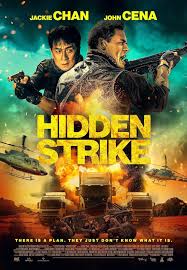
HIDDEN STRIKE
US/China, 2023, 102 minutes, Colour.
Jackie Chan, John Cena, Pilou Asbaek, Chunrui Ma, Wenli Jiang, Amadeus Serafini.
Directed by Scott Waugh.
There are quite a number of strikes in this action film, none of them particularly hidden!
This is a Jackie Chan film and that is what the audiences go to see, not a serious study in world politics…!
And, fans will not be disappointed. The location is Iraq, the desert, oil refineries, the Green Zone, ships and harbours waiting oil transportation. Which means that there is an underlying plot, relevant to the 21st-century, oil supplies, the Middle East. And there are international developments.
Jackie Chan, very agile turning 70, full of enthusiasm, fighting stunts, some gymnastics and athleticism. And he is joined by film star and former wrestler, John Cena, tall, weightier, strong. At first antagonism, then a collaboration.
The film was directed by Scott Waugh, familiar with this type of action film, Expendables 4, Runner.
- Audience expectations, the presence of Jackie Chan, his long career, fights, stunts, choreography? And joined with John Cena?
- Topical issues of the 2020s, oil production, Iraq, Chinese collaboration, exploitation and stealing of oil?
- The locations, the desert, the oil plants, the production lines, the underground tunnels, the ship waiting?
- The situation, the Chinese presence, the threats, international gangs, the stealing of the oil, the evacuation of the workers, Professor, codes for the oil, the buses, leader, the rescue, the attack?
- Jackie Chan, his presence, in command, the expedition, the evacuation, the buses, the attack? In the plane, the orphanage, the confrontation with Chris, suspicions, the orphans, the two banding together, the common enemy?
- Chris, his history, private security, the death of his father, working the orphanage, the friendship with the children, Old McDonald’s Farm, the village, the need for water, mercenaries and the consequences for the village?
- Paddock, his work in Iraq, the oil, his sense of the injustices, leading the attack, merciless, the death of Chris’s brother, the capture of the Chinese, shooting hostages, the pressure on the Professor, the tracker for the bag, the mercenary group attacking the orphanage, the confrontation, the bag, the codes, the ship waiting, the tunnels, the movement of the oil?
- Dragon Luo, his daughter, her presence, alienation, memories, the photos? His work with Chris, the strategies? The huge vehicle, barging through the oil refinery, the daughter following in the car?
- The centrepiece with all the fighting, the choreography, the inventiveness, the fight with everybody covered in foam, the chase with the desert, going over the cliff, calling out for help, Chris climbing up…
- The villain, his going over the cliff? The rescue, the water and the well, the future of the village?
House on Marsh Road, The
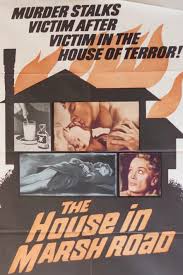
THE HOUSE IN MARSH ROAD
UK, 1960, 70 minutes, Black-and-white.
Tony Wright, Patricia Dainton, Sandra Dorne, Derek Aylward, Sam Kydd, Anita Sharp-Bolster.
Directed by Montgomery Tulley.
A cinematic curiosity item, not essential viewing. However, it was a supporting feature from the changing British industry around 1960, relying on its director, Montgomery Tully, documentarist. then small features.
It has a basic plot that anyone could have written: a marriage, a self-centred alcoholic husband wanting to be an author, his patient wife, his beginnng an affair with a glamorous dicorcee who is his typist. An affair, rendezvous, deception, discovery, confrontation…
The husband, played by Tony Wright, reveals not a single redemptive quality and so alienates audiences, identifying with the much more sympathetic Patricia Dainton.
But, this is also a ghost story!, As explained, a resident poltergeist named Patrick. And there is an Irish housekeeper firmly believing in Patrick and explaining the various interventions.
And, this is what makes this film different, at various times when the couple come to the house in the remote countryside, inherited by the wife from her aunt, Patrick moves furniture, shatters a mirror when the typist visits the house…
But, as expected, when the husband plots the murder of his wife, spikes her drink, carries it upstairs just like Cary Grant in suspicion, then tries to put his push his wife down a liftwell, Patrick intervenes to prevent her from drinking the poison as well as closing the gate on the lift well.
The climax is a storm with thunder and lightning, the wife driving back from London with her friend and legal adviser, the couple still in the house, Patrick setting it alight, the demolition of the house and the couple, and happy ending for the long-suffering wife…
