Displaying items by tag: Victor McLaglen
Great Hotel Murder, The
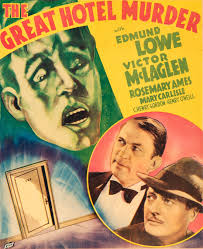
THE GREAT HOTEL MURDER
US, 1935, 70 minutes, Black-and-white.
Edmond Lowe, Victor McLaglen, Rosemary Ames, Mary Carlisle, Henry O'Neill, Jon Quaylen, Herman Bang.
Directed by Eugene Forde.
Not exactly great! In retrospect, just passable, rather slight.
There is a hotel, there is a medical convention, there is a mysterious woman, there are doctors, there are marital problems, there is a poisoning, there is a house detective, played by Victor McLaglen in his gruff way, eager to solve any mysteries. He won his Best Actor Oscar that year for The Informer. But, there is also a resident author, writer of detective stories, more aristocratic in style, played by Edmond Lowe. There is also a worker in the hotel who is susceptible to bribes.
Serious but also comic shenanigans, the detective trying to outwit the writer, getting into all kinds of scrapes and dangers, making the wrong conclusions, following the wrong clues, and, of course, the author winning out.
More for fans of is Lowe and McLaglen who had appeared in 1926, What Price Glory and, much more successfully than this film in 1932, Guilty as Hell.
Guilty as Hell
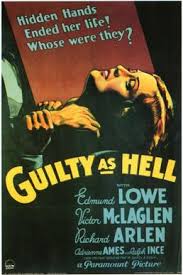
GUILTY AS HELL
UK, 1932, 79 minutes, Black-and-white.
Edmund Lowe, Victor McLaglen, Richard Arlen, Adrienne Ames, Henry Stephenson, Ralph Ince, Elizabeth Patterson.
Directed by Earl C.Kenton.
 The film opens with a murder, the murderer clearly seen, setting up a framing situation, covering all his tracks, including timing, witnesses, and the turning on of the radio. For film buffs, having seen British actor, very dignified, Henry Stephenson in so many films, it is quite a shock to see him as the murderer, a respectable surgeon, vengeance on his wife who is having an affair.
We are also introduced to the main detective, played in his usual bluff, humorous style by Victor McLaglen, three years later to win an Oscar for The Informer. And, he is matched by the cheeky, lackadaisical journalist, played by Edmund Lowe. While there is a serious investigation, even leading up to a potential execution, there is a lot of banter and repartee between these two characters, especially where women are concerned as well as professional jealousies and comparisons.
The accused man is played by popular heartthrob of the time, Richard Arlen. There are other popular supporting actors of the time, especially Elizabeth Patterson as the neighbour.
The accused man discovers the lover’s body, leaves his fingerprints on the door, a piece of evidence from his watch in the woman’s hand. Investigations lead to a nightclub, the witness of the manager of the club and his wife, the involvement of the accused man’s sister who tries to cover for him but, the audience has seen that, by accident, the journalist had given a taxi to her and her brother was not with her.
Trial, sentence, imprisonment, the night of execution, the evidence against the accused, the journalist, for the sake of the sister, trying to find evidence, phone calls to the governor, the disappearance of the owner of the club, his being shot and wounded by the detective, his wife calling in the doctor who then kills the witness saying that his wound was too severe.
Ultimately, the unmasking, the habit of the surgeon to chew gum, his doing so in the detective’s office – but it was poisoned. Suicide. Mystery solved. Execution stopped. The journalist’s discovery that the sister was actually engaged. So, jovial banter again and rivalry between the journalist and the detective. (Lowe and McLaglen had appeared in similar buddy vein in the 1926 What Price Glory!.)
