Displaying items by tag: Julian McMahon
Deb, The
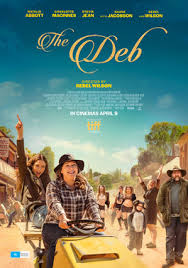
THE DEB
Australia, 2024, 121 minutes, Colour.
Natalie Abbott, Charlotte MacInnes, Tara Morice, Rebel Wilson, Steph Tisdell, Shane Jacobson, Stevie Jean, Coster D’Angelo, Hal Cumpston, Brianna Bishop, Scarlet Crabtree, Susan Prior, Julian McMahon.
Directed by Rebel Wilson.
There is the traditional Debutantes Ball, not so these years but, in this Australian story, important for a country town.
The film began as a stage musical, book and lyrics by Hannah Reilly, music by Meg Washington (who also adapted Paul Kelly’s How to Make Gravy for the screen). On the whole, the music and songs are very cheery, the opening song (and again in the final credits) very frank in its language, to provoke the target audience.
With the opening in an exclusive girls’ school in Sydney, a focus on the teenagers in both city and country town, this is a film with an immediate appeal to teenage girls and young adult women (and their mothers and grandmothers). While there are some men in the cast, younger as well as older, they are very much secondary to the female presence, female assertion, feminism, critique.
Maeve is the school leader, outspoken, demonstrative in behaviour, in trouble with the headmistress who, in fact, is her mother. With some scandals for the school’s reputation, Maeve has to go to the country to her cousins. Maeve is played by Charlotte McInnes, a lively presence once she gets over her being so stuck up.
The cousin in the country, Taylah, a strong performance from Natalie Abbott, lives on the farm, sad at the death of her mother, her father, Rick (the always reliable Shane Jacobson, memories of Kenny) the town’s mayor, with his assistant D (staimitynd-up comedian Steph Tisdell). There is drought, the difficulties of financing, an appeal to the government for aid.
And, still lots of songs and dance, contemporary-style dancing but choreography familiar from the musicals of the past, the youngsters dancing in the streets, bullying – and the condemnation of bullying. Taylah, a large girl, really wants to go to the Deb Ball but is humiliated by the youngsters in the town, except one, Dusty, the charming hero.
So, issues like drought, financial support, and more personal issues of self-consciousness, body image, city snobbery, self-promotion as an influencer, friendships, betrayals, self-assertion.
And Rebel Wilson is also present, an ambitious mother, beauty salon, thwarted, pushing her daughter forward, the daughter being one of the chief bullies. But, Rebel Wilson has also directed the film, happy memories of her being in the Pitch Perfect musical comedies.
With all the songs and dances, preparations for the ball (under the direction of dressmaker, Tara Morice, over 30 years since Strictly Ballroom), social concerns, personal crises, it offers some lively entertainment for those caught in it.
- The title and focus, the country town, the Deb Ball, the debutantes, social event, traditions in Australia?
- An Australian production, the opening, the views of Sydney, the exclusive girls high school, then the move through the countryside, the open spaces, the town, streets, shops, buildings, farms…?
- The film as a musical, initially prepared for the stage, the songs and the lyrics, more forthright perhaps than expected, the music? The insertion into the plot, the situations, the character revelations, conflicts, and the choreography, dancing, the dancers and their style, memories of the old musicals? 21st-century musical?
- The initial focus on Maeve, popular, her followers, the song and dance routine, the defiance and four letter lyrics, the assembly, the clash with the headmistress, feminism, baring of breasts, the reaction of the girls, the revelation that the headmistress was her mother? Clashes, the situation, her having to move away to the country? Her troubles, arrival, sitting waiting for the pickup, her condescending attitudes?
- Taylah, the big girl, self-conscious, mocked by the other girls at school, the bullying? The photo of her mother, dying, missing her mother? Relationship with her father, the farm, the difficulties, the drought, financial needs, at work on the farm?
- Driving, picking up Maeve, the initial reaction, friendly, the cousin, Maeve and her reactions, the farm, the room, her uncle? The meal, the phone? Wanting to be an influencer, the pod cast, her intentions, hearing about the Deb Ball, wanting to exploit it? But, the fickle following, the girls at the school, cancelling her, the Pig title?
- Taylah and Maeve, the conversations, the comparisons? Style? Maeve attacking the bullies? The girls, the boys? The taunting of Taylah, the importance of the ball, her wanting to go, wanting the boy to ask her, his refusal, the humiliation? Her determination?
- The contrast with Dusty, more sympathetic, the attraction for Maeve? His various interventions, his helping against the bullies? Song and dance routines?
- Janette, rebel Wilson to roll, ambitions, her salon, relationship with the daughter, pushing her daughter? The nastiness of the daughter and her friends? At home? Self-promoting and rather fickle in her dealings with others, including Taylah?
- The situation of the town, the drought, Rick and Dimity, the mayor, assistant, Dimity and her wisecracks, support of Taylah? The videos, the appeal to the government, the appeal for finance, on the phone, told 75th in line, sending the videos, the final phone call, no drought relief money, but the support of the Deb Ball?
- Shell, her place in the town, unmarried, with an eye on Rick, his not marrying her in the past? The shop, the dresses, supervising the Ball? Some caricaturist spinster behaviour?
- The preparations for the ball, the dresses, the girls, the partners, song and dance routines, Taylah, the dress?
- The exposure of Maeve, the pod cast, her attempts at apology, clashes with Taylah, sense of betrayal, her deciding to leave?
- The change of heart, return, apology, the financial help, the appeals, online, the change of heart of the girls at school? The preparation for the Ball? Dusty and the relationship?
- Rick and Dimity, the preparations for the ball, his sash, Shell, the humiliation of Taylah, her defiance of Maeve, the cigarette, the fire, the hall burning down, Taylah and her rescuing Shell? But her not wanting to go to the Ball?
- The ball, the speeches, the helicopter, the arrival of the Prime Minister, the show and song and speeches, the rain? Taylah and a change of heart, the dress, Shell helping her, her arrival?
- Musical, the happy ending?
- The target audiences, teenage girls, their mothers and dealing with teenagers, grandmothers and their wisdom? The response of male audiences?
Surfer, The/ 2024
THE SURFER
Australia/Ireland, 2024, 104 minutes, Colour.
Nicolas Cage, Julian McMahon, Finn Little, Miranda Tapsell, Justin Wozniak, Rahel Romahn.
Directed by Lorcan Finnegan.
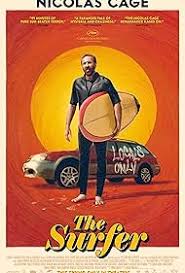
Endurance is key.
Nicolas Cage plays The Surfer”, an Australian, brought up on the West Australian coast, spending time in the US (hence the accent), wanting to recover and buy his father’s home, bringing his teenage son to is one with him to revive his memories and hand on tradition. So far, so good. However, the locals are aggressive, pugnacious, not letting anyone to surf unless they live in the area. And so begins a series of insults, humiliations, vicious attacks, cruel behaviour, with The Server as victim. So, here is the endurance.
But, as we watch, the word endurance also comes to mind, our endurance as we sit watching this cumulative impact of brutality and its effect on The Surfer. Watching it is very tough going.
In realism terms, audiences were probably anticipating that he and his son would leave after the first confrontation. But, no. The Surfer remains, becoming more and more obstinate and obdurate, the physical and psychological onslaught beginning to take its toll but rendering him more stubborn. He should have got in his car and driven away, but…
The portrayal of the clique of surfers certainly raises a key issue of contemporary society, the place of men, critique of patriarchal ways, the response of male assertion, few holds barred. The sequences with the group dramatise some of the aspects of the Andrew Tait and followers promotion of what it is to be for males. In fact, here the group is presented as something of a cult, led by a local, who bullied The Surfer at school, Scally, played as smugly assured by Julian McMahon. He has a philosophy of maleness, the reality and symbol of surfing, but gathering the young men around him even with an immersing ceremony inducting them into his cult.
There is also an older man, somewhat deranged, who hovers, talks with The Surfer, has a grievance of his own with Scally, and also has a gun…
Now and again there is a sympathetic character or two helping The Surfer, notably a photographer played by Miranda Tapsell. But, there are a lot of unpleasant characters, especially the local police officer, the proprietor of a drinks van, who certainly alienate the audience as well.
So, how do we endure this experience? Initially a certain empathy with The Surfer but then our dismay and exasperation, sharing what he suffers and at times this is considerable, but exasperated as he stays on – and, trying to deal with his final confrontation with Scally, the psychological consequences, the confrontation with the mad old man, and the return of his son.
This is an Australian/Irish co-production. The writer, Thomas Martin, and the director, Lorcan Finnegan, both Irish, their interpretation of an Australian coastal community, seemingly relishing some portraits of the Ugly Australian. Some commentators have noted that they are particularly fond of Australian films from the 1970s, especially, small-budget thrillers, often with horror touches, nicknamed Ozploitation. No flattery for Australia or Australian is here!
But, this is a Nicolas Cage film. Over the last decade and more he has made several films each year, often strange and wild characters, all kinds of genres from westerns to horror. But, he has built up a huge number of fans who want to see his films, no matter what, many articles written about him, his place in popular American cinema. Nicolas Cage completists will certainly want to see this film and connect it with his others. But, for many wanting to see an Australian film with Nicolas Cage, this will be something of a bewilderment.
