Displaying items by tag: Peter Malone's Movie Reviews
War Machine/ 2025

WAR MACHINE
Australia/US, 2026, 106 minutes, Colour.
Alan Ritchson, Stephan James, Blake Richardson, Dennis Quaid, Esai Morales, Jai Courtney, Alex King, Keinan Lonsdale, James Beaufort.
Directed by Patrick Hughes.
This adventure works quite well – and has a surprising development in the plot.
The film was written by the director, Australian Patrick Hughes, in collaboration with actor, James Beaufort, who appears in this film as 23. Hughes made an impact with his first film, an action drama, Red Hill. In Hollywood he has been successful with Expendables 3, and the entertaining blend of action and comedy in The Hitman’s Wife and The Hitman’s Wife’s Bodyguard, featuring Ryan Reynolds, added action film, The Man from Toronto with Woody Harrelson.
This is an American/Australian coproduction, filmed in Australia. And the star is Alan Ritchson, who has successfully embodied Lee Child’s hero, Reacher, in the television series. This film offers him more of the same kind of character.
The action opens in Afghanistan, coming to the help of his brother, Jai Courtney, bombing, death, one brother carrying the other to safety and winning a medal, the ambition to become Rangers. At the training camp, headed by Dennis Quaid and Esai Morales, the select group is put through all kinds of training tests, elimination so that only the best remain. And they are all called by numerals, the hero becoming 81. The other sympathetic character is 7, played by Stephan James.
And, then the film changes, science fiction with the appearance of an impregnable is war machine which stalks the squad out on a training mission, 81 as leader. A great deal of combat, disaster for the trip, the pursuit by the war machine through all kinds of rain, the elimination of the trip, 81 and 7 remaining. And 81 discovering a limitation of the war machine and how it might be destroyed – and, on return to camp, the discovery that there has been an invasion from space, the beginning of a war of the worlds.
- Audience expectations, the title, the action films of the director, the presence of action star, Reacher, Alan Ritchson?
- The opening, the reality of war in Afghanistan, American troops, the Taliban, attacks? The transition to the rangers training, the officers, selection of men, the detailed exercises and tests? Transition from reality to science fiction, extraterrestrials, confrontations? The war of the worlds and the future?
- Afghanistan, the two brothers, their bonding, coming to help, the Taliban attack, the brother killed, the other wounded, carrying him on his back? Hospital, medals? His feelings about the alleged heroism when he had collapsed?
- The two brothers, the ambition to be Rangers? The older brother, joining, the interviews with the authorities, acceptance, 81, the others known by numerals? The details of the training, the issue of underwater and his potential drowning, a loner, not relating well with the other men, and the woman candidate?
- The squad, the tests, the limits, eliminations, the reading out of numbers? The remainder? Proving themselves?
- Sheridan and Torres, officers, their expectations, interviews with the men, the eliminations, the confrontations with 81? The discussions, the motivations, his being allowed to stay?
- The setting up of the mission, 81 as leader, the various members of the squad, 7 and his character, interactions with 81? The different qualities of the other members of the troop? Leadership, talents, subordinate roles?
- The test going wrong, the death of the backup troops, the weapons and blanks, dilemmas, leadership questions, particular talents, deaths?
- The war machine, impenetrable, relentless, the attempts to disarmament, the continued efforts on the troop, the pursuits, 81, 7 and his wounds, carrying him, the pursuit down the river?
- 81, his abilities, tough, discerning, the confrontations with the machine, finding the possibilities for destruction, the rocks, the system?
- Eventually returning, with 7, 7 as personable, knowing the story about 81 and his brother?
- The authorities, the world situation, the attack, some confidence with knowing how it was possible to destroy the war machines?
I Saw the Devil
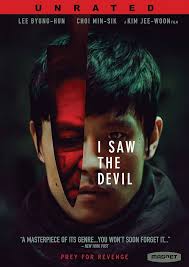
I SAW THE DEVIL
Korea, 2010, 144 minutes, Colour.
Lee Byung hun, Choi Min-sik.
Directed by Kim Jee-woon.
This is a very confronting drama, highly admired in Korea , a challenge to world audiences.
Focus is on a serial killer, an ordinary enough citizen, driving a school bus. However, he has had a violent history and violent friends. He is initially seen attempting to help a stranded woman in her car, brutalising her, ignoring the plea that she was pregnant, bashing her, dissecting her body, a child learning a container with an ear, then a huge squad searching the grounds and finding her head.
And, this is only the beginning of a great number of grim and gruesome confrontations by the killer, with a woman at the bus stop offering her a lift, with a student in the school bus, and various women associated with him and the family of the first deceased woman.
Commentators have been very strong on differentiating this kind of presentation of “obscene” behaviour, highlighting that it is not pornographic, though some may argue that there is a pornography of brutal violence. They say it is different from the American horror films which simply pile on the gruesome sequences for effect rather than an exploration of character.
This film offers some exploration of character, especially the husband of the first deceased woman, her phoning him when she is stranded with a flat tire in the countryside in the snow, his grief at the finding of her body, his attendance at the funeral, his discussions with his father-in-law who had been a police chief. And the police squad is sympathetic towards the bereaved man, giving him leave, one colleague giving him an earpiece will and a device which could be used to track the killer.
The film then become something of a Death Wish, with a vengeance – but more than a vengeance, a ruthless and dramatic pursuit of criminals, the plan not to kill immediately but to torture and torment, pursue. And this is what the bereaved man does. But, at first, he targets two suspected abusers, one watching pornography who is then violently attacked, the other attacked in the street and pursuit.
However, the main part of this very long film is the continual pursuit of the serial killer, catching him, torturing him, fighting, letting go, continually tracking him down, tracking his meeting with a violent friend and torturing him also, the police in pursuit and concerned about the death wish violence and revenge.
Finally, the father-in-law is attacked violently, the police setting up a trap, the killer allegedly saying he would surrender but the bereaved man catching him, a final confrontation, tying him up, a brutal link with his mouth to the door – and final decapitation.
The final sequence is the bereaved man alone, walking down the street, beginning to weep.
The film takes its place in the violence instability in sensibilities of Korean filmmaking in the late 1990s and early 2000’s, a capacity for looking at brutality more than in many other film industries at the time. For discussion, the distinction has to be made when asking the questions “what” is being presented and, so much more importantly, “how” it is being presented.
Star is the popular actor over 25 years, Lee Byung-hun, in Joint Security Area in 2000, a star of the popular television series Squid Game, and the award-winning No Other Choice.
State of Fear/ Salve Geral: Irmandade
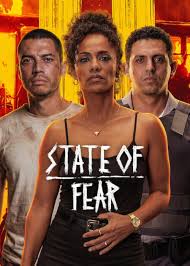
STATE OF FEAR/ Salve Geral: Irmandade
Brazil, 2026, 103 minutes, Colour.
Naruna Costa, David Santos, Seu Jorge, Hermila Guedes, Yetunde Ahmed.
Directed by Pedro Morelli.
In 2019 a Brazilian television series was called The Brotherhood. This feature film is a spin-off from the series, bringing the series to further close with the deaths of some of the key characters. While the emphasis is still on the Brotherhood, it ranges more widely, a narrative commentary on Brazilian society, the city of São Paulo, the role of the police, the numerous prisoners, the crowded prisons, and all the underlying corruption. Audiences may remember Hector Babenco’s Pixote which set a trend in films about Brazilian prisons, and other dramas like City of God…
The screenplay is rather episodic, like chapters of a book. There is an interesting prologue, a police party, husband, pregnant wife, and suddenly explosions and the attack by The Brotherhood, and the attempt to get the wife to the hospital for the birth. (And, touch of spoiler, they do reappear at the end of the film, bringing the themes and characters together, tragically.)
The film highlights the present situation, transferring prisoners to greater security, the networks inside prison, the Brotherhood and the orchestration of the violent uprising which brings the city to a standstill. The key character is the Counsellor, who tries to negotiate with the authorities while having a relationship with the leader of the Brotherhood.
Then, there is Elisa, seen in a rap competition, with a boyfriend, then profiled by the police and help for ransom.
Flashbacks are presented about Elisa, her father who established the Brotherhood, his wife, happy life, but racist criticism and his arrest.
While the film continues with the uprising, the focus then is on the abduction of Elisa, one of her abductors and his taking her to his home, a narrative included about his mother, and then the Counsellor coming to the rescue, the escape, the violent confrontations, especially at a railway station.
Something of a mirror for Brazilian audiences. Something of an alert about prisons, police corruption for audiences outside Brazil.
- The tradition of Brazilian films about prisons, riots, police, corruption, rebellions?
- The city of São Paulo, the views of the city, the streets, police precincts, homes, the prisons and interiors? The action sequences, the riots, car chases…? The musical score?
- The film as a spin-off from a television series? A stand-alone film? Knowledge of the characters, the backgrounds? The structure of the film, a prologue (and the epilogue), focus on the Counsellor, the young woman and her background, the competition, the flashbacks to her fat came her, her parents, happy days, crisis of the beach, the camera, her father’s arrest, his subsequent history? The focus on the Brotherhood and the coordination of the rebellion? The focus on the abduction of the young woman and the Counsellor pursuing? Like chapters in a book, all eventually coming together?
- The tone of the opening, the party gathering, the pregnant woman, her husband, the sudden explosions, the Brotherhood and the uprising? The beginning of the birth, in the car, getting to the hospital, the husband in his strong-minded urging of his wife to focus on the birth? And the sadness of the epilogue, Elisa and her anger, against the police, shooting the car, the dead officer and his dead wife, the crying of the baby, Elisa standing at the end, the camera drawing back, her holding the baby? A judgement of the past? A message for peace and the future?
- The Counsellor, her relationship with Ivan, in the prison, the founder of the Brotherhood, the memories, her brother? The flashbacks to him and his wife, time in prison, his wanting justice, love for his daughter, at the beach, the camera, the racist criticisms, his arrest? News of his death?
- Elisa, the rap competition, the poetry, the crowds, the background, her opponents? The relationship to Cristina, her aunt? Coming to the room, sending her away? On the bike with the young man, held up by the police, profiling him, the bike, the interactions, the recognition, the man going the way, the police keeping her for ransom?
- The uprising, Ivan, the coordination, the radio communication, decisions, the role of the Counsellor, her wanting to intervene, diplomacy? The mayhem in the streets, the shootings, on the bikes, the cars, the police, many dead? Gridlock in the city, the cars, the closing of the railway line?
- Elisa, the death of her capturer, with Borges, capturing her, taking her home? His mother at work, sent home, the crowds, the difficulties, her love for her son, the shower and the meal, the son and his tying up Elisa, the bar, trying to kill her, his mother stopping him? Elisa and her escape, Cristina coming and helping? The son and his mother, in the car, the pursuit, the chase at the railway station, the train, the carriages? The ultimate confrontation, the escape in the car, the son and mother in pursuit, the crash? His wanting her to go to hospital? His death? Cristina being shot, the deaths, Elisa and her anger leading to the rage in shooting the policeman and his wife?
- A commentary on Brazilian society, the police, corruption, gangs, uprisings, violence?
Divorce/ 2024/ Rozwodicy
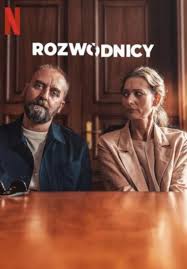
DIVORCE/ ROZWODICY
Poland, 2024, 91 minutes, Colour.
Magdalena Poplawska, Wojciech Mecwaldowski, Tomasz Schuchardt, Michal Pawlik, Szymon Kjsmider.
Directed by Michal Chacinski, Radoslaw Drabik
Poland has had a successful film industry over many decades, especially with some world-class filmmakers during the period of the Soviet Union. It has a strong, traditional Catholic background and tradition but, into the 21st-century, also a strong secular perspective and lifestyle, including divorce and remarriage. Which means then that there is a perspective on the Catholic Church and its regulations in terms of marriage, annulments and divorce.
The film focuses on a couple, 20 years or so after their separation, the wife having now been married again for 17 years and with a daughter, the man living his rather carefree life but now falling in love with a young woman – and her wanting a white wedding in the church, the ambition also of her family. The couple are divorced – so the issue of an annulment of the first marriage, which they don’t quite understand, thinking that a declaration of annulment something is simply the equivalent of the Catholic Church approving a divorce, something that can simply be asked for and received.
Which is not the case.
The screenplay does make it clear throughout the film, not immediately picked up by the couple, and, perhaps, not immediately picked up by the audience. For the annulment of a marriage contract in the church, there have to be good reasons, including establishing the fact that there was not full consent in the first place.
The couple have a plan, go to the church authorities, expecting an immediate formal assent because of their civil divorce and remarriage according to the state law. When required to go through with the first Instance of a hearing before a clerical board, they decide that they would explain that the groom was drunk, could not put the wedding ring on his wife’s finger, getting some testimony from friends and witnesses. However, somebody discovers a video of the wedding which sabotages, somewhat, the argument and alleged evidence. The wife goes along with this – although, impatient with the process, she remembers being in love, but the pregnancy and then the wedding, her husband being young, irresponsible.
At the first Instance, the local diocesan hearing, there are two clergy, one a serious priest who asks all the detailed formal questions, assisted by a young priests, looking inexperienced, the wife asking him his age, 28. He tries to be very friendly. The visits and the interrogations and answers blend the serious and the farcical in the screenplay. The annulment is not granted.
Which moves according to the Church’s Canon Law, to the second Instance, much more formal in the interrogation, the priest serious, meticulous in detail. The young priest is there again as well is a notary. There are witnesses, the wife, becoming impatient, eavesdropping on the witness, caught by the husband, barging in on the formalities, but the same arguments and no annulment. They try an old friend but he has given up drinking and can’t testify. They offer him money and the friend’s wife demands more!
In the third Instance, there is an appeal to the Vatican tribunal, an Italian monsignor on the zoom meeting, a translator present, the calling in of the marriage celebrant, but his advanced age, seeming to remember well but the couple tricking him about the place where he baptised their daughter. His credibility is undermined. But, ironically, the connection was faulty at this stage of the interrogation. The wife, however, feels very strongly about the whole process and speaks her mind.
The value of the process is that the wife, not a believer, does assess the initial marriage, difficulties with her teenage daughter, her relationship with her devoted husband while the man does come to some kind of sense but, after one of the sessions, he actually proposition his former wife…
Finally, there is a wedding, and it is the young priest who is presiding, white wedding, everybody happy, and the final image of a wink from the young priest…
An addendum: the wife is a music teacher at the school with the school band and they have to go to the opening of a railway station (still functioning but refurbished) and a political opportunity for the local member), and the ceremony includes a solemn blessing from a Bishop.
Paper Champions

PAPER CHAMPIONS
Australia, 2020, 85 minutes, Colour.
Luke Saliba, John Tui, Gary Sweet, Tessa de Josselin, Kaarin Fairfax, Genevieve Morris.
Directed by Jo-Anne Brechin.
Divided opinions on this small Australian film. Many finding it slight, silly, boring. However, the majority of bloggers seem to enjoy it, the lightheartedness, a sense of humanity and humour.
The central character Rey (Luke Saliba who co-wrote the screenplay) ponders greatness, his father’s hope for him as a wrestler, the influence of his mother (Kaarin Fairfax) and her attachment to the next door neighbour, Gary Sweet, toughness, posing for the mother’s painting, challenging and encouraging Rey.
However, Rey works in a photocopier shop, mid-20s, timid, awkward, wanting to please, influenced by his boisterous co-worker, Wade, (New Zealander John Tui, featured in many New Zealand and American films and series, Star Wars, Fast and Furious, Shortland Street). Wade is forever quoting Mana, for spirit of masculinity, taking Rey to the company dance, both with pink suits, trying to train him to dance, eventually Rey’s bursting out in quite a routine.
Then there is a nice assistant at the medical centre, Rey trying to please her.
Eventually, after some misadventures and light comedy, Rey moves more out of himself, some training with wrestling, his mother and her relationship, Wade and his support, going to the wrestling bout – and being instantly knocked out.
Filmed in Geelong, a small piece of Australiana.
Voice of Hind Rajab, The/ Sawt Hind Rajab
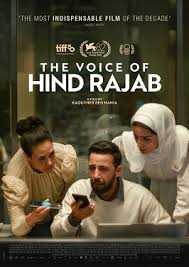
THE VOICE OF HIND RAJAB/ SAWT HIND RAJAB
Tunisia, 2025, 89 minutes, Colour.
Saja Kilani, Motaz Malhees, Amer Hlehel, Clara Khoury.
Directed by Kaouther Ben Hania.
Oscar nominee for Best International Film, Grand Jury Prize at the Venice Film Festival, almost 40 awards nominations, this film was very significant for 2025 – and, as wars in the Middle East continue. The director of the film is Tunisian and the production was an international collaboration including from Occupied Palestine.
But, who is Hind Rajab? She is a six year old little girl from Gaza.
And, where is Hind Roger? She is in a car in Gaza city with her relatives.
And, what is she saying? That her car has been attacked, Israeli Defence Forces, her relatives are dead, and she wants someone to find her and take her home.
And, who is hearing her voice? First of all, her uncle on the phone in Switzerland. And, then, members of the Red Crescent, receiving all kinds of messages, acting as liaison with the Israeli authorities to coordinate some kind of rescue of the little girl, also talking with her distraught mother.
The director chose not to have an actress impersonating the voice but, with the consent of her mother, using the actual voice, the actual conversations with the Red Crescent that were recorded. Which makes the impact, of course, so much more poignant and distressing.
And there is compelling drama within the office of the Red Crescent, a group of workers initially seen jovially together, then phone calls, the harassed officer in charge, the pressures of the attack on Gaza (and this is set in January 2025, only three months after the have Hamas massacre), trying to cope with the Israeli officials, trying to work through clearly defined channels of communication, delays, time passing, rescue time seemingly wasted, and then the increasing intensity of the official liaison officer with the little girl, his emotional involvement, trying to talk with the little girl, his outbursts against his boss, his own need for some kind of counselling within the office.
There are also two women in the office, one whose job is to help with the counselling who also becomes involved with a phone call, and another official who speaks with the little girl, bringing a female reassurance that and the demands on her attention and feelings.
The tension mounts within the office with the frustrating waiting for confirmation of protocol procedures, for the little girl after so long time, continuing to express the hope that she will be rescued, contact with the mother, with the uncle, and, eventually, some protocols established for a local Palestinian vehicle with volunteers to go to the rescue.
It is not a spoiler to indicate that the end of the film is harrowing. Audiences will have been expecting this despite hopes that all will be well.
In many ways a small story, a tragic story, but a microcosm the experience of Palestinians, the city of Gaza, with the bombardments by the Israeli defence Force. And, in 2025-2026, no end in sight.
- The impact on the audience as it watches and listens? The little girl, alone, reflection on the experience after the Hammas’ attack on Israel, October 2023?
- The title, listening to the voice of the six year old girl, then seeing the photos, her mother and brother, her uncle on the phone, her mother’s outbursts on the phone, and home video footage of the end? In view of her anxiety, in the car, the soldiers, the over 300 bullets in the car, uncle and aunt, cousins all dead, her hours in the car, the death?
- The screenplay, based on actual events and characters, and able to use the actual voice footage of the little girl and her communication with the Red Crescent officials?
- The establishing of the situation, the time soon after the Hammas’ attack, the Israeli military and their presence, tanks, guns, shooting? And the civilian population? Issues of targeting?
- The staff at the Red Crescent, genial, the photo, their role in helping the Palestinians? Contact with the Israeli authorities, permissions, strategies, ambulances and rescues, ceasefire moments, safe routes, seen on the computer screens, waiting for the green light from authorities?
- The initial phone call, the visualising of the lines on the screen, hearing the little girl’s voice, identifying herself, the pathos of listening to her, a six year old’s response, having to give adult kind of information about numbers, death, blood, the presence of the tanks, the soldiers, the shooting, her fears, pleading for rescue, moments talking to her mother? The intervention of her uncle from Switzerland?
- The team handling the phone call? The early months in the Israeli invasion? Preparation for this mission, not yet so much experience? Mahdi in charge and responsible, Omar taking the call? Rana and her responsibilities, about to go home, her clothes, tradition? Risleen, the counsellor, supporting the staff?
- Audience response to various techniques used throughout the hours of the phone call, Omar, his age, experience, need for counselling, his identifying with the little girl, the uncle’s call, the later outbursts of the mother, identifying with the girl and her situation, his questions, his feelings, his outbursts, the issue of the ambulance, the volunteers, interactions with Mahdi, Mahdi and authority, his phone? Highly emotional, even tantrums?
- Mahdi, the background of his life and family, responsibilities, the role of the Red Crescent, the communication with Israel, officials, Red Crescent officials, doctors, the ambulance, the volunteers? The pressures on him, responsibility, exasperation, Omar’s outbursts and attacks, explaining himself, reliance on the other members of the staff? Omar and his phone calls, the smoking – and later the both smoking?
- Audiences listening to the little girl, the situation, identifying with Omar, identifying with Mahdi? Audiences emotionally moved and getting desperate? Audiences sensing the need for some kind of control, acknowledging of the reality of the situation and its drawbacks, finding ways?
- Rana, seen at work, her going home, staying, going online, the female presence, her way of talking with the little girl compared with that of Omar, the sympathy, the growing emotions, desperation? Collapsing? Taking turns with Omar talking to the little girl, the intervention of Risleen?
- Risleen, counselling, the initial encounter with Omar, her having to intervene, her also speaking on the phone, her tone with a little girl?
- The audience thinking of how they might talk, or be unable to talk, appreciating the different responses? Then the mother’s outburst on the phone? Contact with the uncle?
- The hours passing, Omar and his outbursts, the phone calls, the volunteers? Sometimes the silence from the little girl? The time passing, her fears, the tanks, the shooting?
- The green light, the relief of all, tracking the vehicle on the screen, the dangers, the bypassing rubble, almost at the petrol station, almost to rescue, then the silence? And the desperate ending of the mission?
- The aftermath, the reaction of the staff, audience sympathy and empathy? The visualising of the two volunteers with their names and the ambulance?
- And the photos of the little girl, the home video, the mother and the little brother, the experience of the Palestinians and the Israeli Army?
Anemone
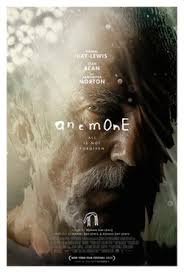
ANEMONE
UK, US, 2025, 125 minutes, Colour.
Daniel Day-Lewis, Sean Bean, Samuel Bottomley, Samantha Morton.
Directed by Ronan Day-Lewis.
A stark, often disturbing and challenging drama.
The film has been directed by Ronan Day-Lewis, son of three-time Oscar-winning actor, Daniel Day-Lewis, considered one of the greatest actors of the times. He retired from filmmaking in 2017 but has cowritten this film with his son and come back to the screen in yet another very powerful performance reminiscent of his sinister knife-throwing in Gangs of New York and his arrogance in There Will Be Blood.
Daniel Day-Lewis plays the central character, Ray, a soldier in the past, the Troubles in Ireland, military action, life and death decisions which still haunt him. He has become a recluse, long since, living in a cabin in the woods, abandoning his wife and son, withdrawing from society and any ordinary life, hunting, surviving.
For the action of the film, Ray’s son, Brian, Samuel Bottomley, has a possible military career, but haunted by the reputation of his father as well as his father’s absence for most of his life, wants to meet his father. His mother, played by Samantha Morton, has married Ray’s brother, Jem, Sean Bean, and they have brought up the young man.
But, Jem goes to visit his brother and a lot of the film is about their interaction, sometimes quiet, sometimes violent, physical struggles, emotional and psychological confrontations, sharing the survival mode in the forest. But this does give the opportunity for Daniel Day-Lewis to speak some extraordinary monologues, his pain and anguish from his military decisions, his sense of isolation and abandonment of family, his intention to continue this way of withdrawal in life.
Suddenly, and strikingly, there is a long and powerful monologue about an abusive priest in the past, Ray’s encounter with him as an adult, the priest not realising that Ray was his victim, again being seductive, but Ray turning on him viciously, and the extraordinarily graphic description of an angry revenge (whether reality or in Ray’s imagination, Ray defecating on the priest, almost parallelling this disgusting act with a sacramental experience. It is one of the most direct and powerful descriptions of vengeance on an abuser.
The scenes between Ray and Jem raise consciousness and conscience, a letter from his wife begging him to come home for their son, the final brutal clash with Jem then a kind of catharsis as Ray makes a decision to come back, arriving at the door, seeing his son, his wife – and leaving it to the audience to speculate, to imagine, what the consequences will be for each of these characters.
The title refers to the flower, anemone:
Anemone flowers, or "windflowers," generally symbolize anticipation, fragility, and protection, with deep roots in romantic passion and tragic love. Deriving their name from the Greek word for wind, they also represent the fleeting nature of life, luck, and emotional attachment, often signifying a fresh start or spring's arrival. (Google AI summary).
- The title, the flower, its symbolism, the story of Ray, Jem, Brian?
- The collaboration between father and son, acting, directing, the collaboration with the screenplay and its issues and themes?
- The British setting, the Troubles in Northern Ireland? Ray, soldier, reputed, service, the uprisings, the wounded man, the decision about killing him? The effect on him personally, conscience, withdrawal, living alone, with his guilt? Leaving his wife and son?
- The locations, the remote heart, the countryside, the fields, river, the grim aspects of nature? The contrast with the town, the streets, ordinary life, home? The musical score – at times pounding?
- The situation, Ray and his withdrawal, the years passing, Nessie and her memories, attitude towards Ray, her son, reliance on Jem, bringing up Brian? Brian, the military, his father’s reputation, criticisms, withdrawal, his future?
- The visit by Jem, the two brothers, the relationship, distance, memories of the past, Jem and his mission to bring Ray home, the letter from Nessie?
- The core of the film, the brothers’ relationship, their talking, sharing memories, silences, hostilities, out in the woods, the clashes, the moods? The portrait of each man, in himself, and in relationship with each other?
- The scenes with Brian, at home, withdrawal, attitude towards his father, wanting to know the truth, his future? relationship with his mother, her work, place in the town, relationship with Jem, her memories? The letter?
- The physical violence between the brothers, the psychological violence, the ups and downs, each pressuring the other? Ray and his determination? The issue of the reading of the letter, eventually?
- Ray, any resolution to the problem, the impact of the letter, his returning, a reconciliation with Jem, coming to the door, Nessie, Brian, and the film stopping – and the audience imagining the future, difficulties, hopes, a new life and relationships?
Carry on Henry
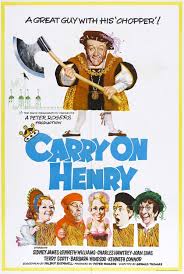
CARRY ON HENRY
UK, 1971, 89 minutes, Colour.
Sid James, Kenneth Williams, Charles Hawtrey, Joan Sims, Terry Scott, Barbara Windsor, Kenneth Connor, Julian Holloway, Peter Gilmore, William Mervyn, Bill Maynard.
Directed by Gerald Thomas.
Of all British Kings, Henry VIII would be the least to need the advice to Carry on! By 1971, Carry on films had a 13 year history, tapping a number of historical situations. Here is an invention that the king had two more wives than his six, chronicled by William Cobler, so a load of old cobblers as the introduction suggests, to the background of Greensleeves (and later Chanson D’Amour and variations on the Trumpet Voluntary).
Sid James continues as a chuckling lecherer as the king, with the same performance as always. Kenneth Williams performance is always the same, but he provides good comedy as Thomas Cromwell. Terry Scott hams it up as Cardinal Woolsey. And Kenneth Connor, shows that he can give quite a different performance in every film. And, many of the supporting cast are present again, especially Barbara Windsor as the possible Queen. But, dominating everything is Joan Sims as the princess from Normandy.
In fact, a lot of the central plot hinges on French love garlic, the Princess putting it into her mouth in the bedroom, the king repelled by garlic, and various Gallic/garlic jokes throughout the film.
A lot of shenanigans, quite some pageantry, Charles Hawtrey as the least likely gallant knight attending to the Queen.
With the subject of Henry VIII, the emphasis on sex is more prominent than usual, crude jokes, clever innuendo, and, of course, as with the king himself, the female members of the cast seen as sexual objects for male gaze and groping. How would they remake this film in the 21st-century!?
Cash/ If We Were Rich
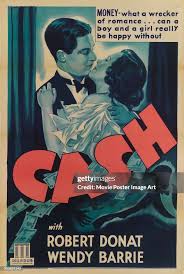
CASH (FOR LOVE OF MONEY/IF WE WERE RICH)
UK, 1933, 62 minutes, Black-and-white.
Robert Donat, Edmond Gwenn, Wendy Barrie.
Directed by Zoltan Korda.
The third film, small budget, for celebrated British actor, Robert Donat. The same year he was to appear in The Private Life of Henry VIII and quickly invited to Hollywood for The Count of Monte Cristo. Donat did not like Hollywood and returned and stayed in England for the next 25 years until his death, making a number of significant films ranging from The Ghost Goes West to The Citadel to The Winslow Boy. He won the Best Actor Oscar in 1939 for Goodbye Mr Chips.
In some ways this film is very quaint, small-budget British filmmaking of the early 1930s. The focus is on money, Edmond Gwenn playing a scheming businessman trying to play off his friends, but rather limited in his cash. The creditors are after him. Wendy Barrie plays his support daughter.
The complication comes when the assistant creditor, Donat, charming in his manner, is attracted to the daughter, finds $100,000 in cash in a bag, place there allegedly by a thief, uses the cash to charm the daughter and the old schemer who then arranges for discussions, on the visual evidence of the cash, for a huge entertainment scheme (and, in the 1930s, reference to one of the attractions as sex appeal).
The greedy colleagues all make a contract. The young man is able to get a is one from the businessman. The butler who has actually paid of the schemer’s bill for home delivery of food, without noticing, actually stokes the fire using all the cash. And, the newspapers then reveal that it was forged cash.
Not particularly startling, more historical interest, and with two Oscar winners, Robert Donst himself and Edmond Gwenn, who is probably best known as Santa Claus, Kris Kringle, Oscar winner for The Miracle on 34th Street.
Carry on Spying
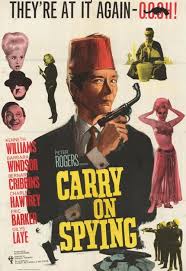
CARRY ON SPYING
UK, 1964, 87 minutes, Black-and-white.
Kenneth Williams, Barbara Windsor, Bernard Cribbins, Charles Hawtrey, Eric Barker, Dilys Laye, Jim Dale, Richard Wattis, Eric Pohlmann, Victor Maddern, Judith Furse, John Bluthal.
Directed by Gerald Thomas.
With James Bond film, Dr No, 1962, followed by From Russia With Love, it was probably inevitable that the Carry on series would move into the world of espionage and British agents. And so it was.
This episode was released at the same time as Carry on Cleo. The series had moved colour but this episode returns to black-and-white. And key members of the team are absent, Sid James, Joan Sims, Hattie Jacques, Kenneth Connnor. But, Bernard Cribbins had been the Kenneth Connor type character in Carry on Jack and does the same here. But, this was the first Carry on film for Barbara Windsor and she certainly makes a big impression, sense of comedy and fun, but also showing that the female characters, while definitely for the male gaze, have character and could contribute to the more serious aspects of the plot.
Not that there are very many more serious aspects. This is very basic Carry on material, really just an espionage farce, with some of the usual jokes and more than innuendo. The screenplay was written by Talbot Rothwell, who was becoming the regular writer, but he collaborates with Sid Colin, writer of many comedies with the Chastity Belt and Up The Front comedies to come.
OF course, it is all a parody of British espionage, four dimwitted agents, Eric Barker as the version of M, Richard Wattis as a kind of Q. And there are various villains, especially led by Eric Pohlman, the in the number of British films at the time.
The impact depends on the presence of Kenneth Williams, not quite his usual role, in fact, giving up his posh accent for a rather flat one. But, a lot of the same shtick in the world of agents. Bernard Cribbins is genial but rather dumb. Charles Hawtrey is as always. And, Jim Dale is very enjoyable in a whole range of disguises as their contact. Dilys Laye sings songs and is ambiguous in her loyalties. Judith Furse is a variation on Blofeld. And, instead of SPECTRE, there is STENCH, Society for the Total Extinction of Non-Conforming Humans.
In and Algiers, an impossible number of extensive changes of costume and disguises. Some laughs, some nods to Bond and, explicitly with the zither music, The Third Man’s scene of Orson Welles emerging from the sewers. But, very basic British comedy.
