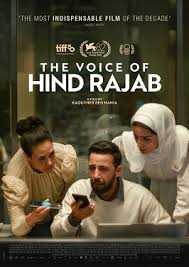
THE VOICE OF HIND RAJAB/ SAWT HIND RAJAB
Tunisia, 2025, 89 minutes, Colour.
Saja Kilani, Motaz Malhees, Amer Hlehel, Clara Khoury.
Directed by Kaouther Ben Hania.
Oscar nominee for Best International Film, Grand Jury Prize at the Venice Film Festival, almost 40 awards nominations, this film was very significant for 2025 – and, as wars in the Middle East continue. The director of the film is Tunisian and the production was an international collaboration including from Occupied Palestine.
But, who is Hind Rajab? She is a six year old little girl from Gaza.
And, where is Hind Roger? She is in a car in Gaza city with her relatives.
And, what is she saying? That her car has been attacked, Israeli Defence Forces, her relatives are dead, and she wants someone to find her and take her home.
And, who is hearing her voice? First of all, her uncle on the phone in Switzerland. And, then, members of the Red Crescent, receiving all kinds of messages, acting as liaison with the Israeli authorities to coordinate some kind of rescue of the little girl, also talking with her distraught mother.
The director chose not to have an actress impersonating the voice but, with the consent of her mother, using the actual voice, the actual conversations with the Red Crescent that were recorded. Which makes the impact, of course, so much more poignant and distressing.
And there is compelling drama within the office of the Red Crescent, a group of workers initially seen jovially together, then phone calls, the harassed officer in charge, the pressures of the attack on Gaza (and this is set in January 2025, only three months after the have Hamas massacre), trying to cope with the Israeli officials, trying to work through clearly defined channels of communication, delays, time passing, rescue time seemingly wasted, and then the increasing intensity of the official liaison officer with the little girl, his emotional involvement, trying to talk with the little girl, his outbursts against his boss, his own need for some kind of counselling within the office.
There are also two women in the office, one whose job is to help with the counselling who also becomes involved with a phone call, and another official who speaks with the little girl, bringing a female reassurance that and the demands on her attention and feelings.
The tension mounts within the office with the frustrating waiting for confirmation of protocol procedures, for the little girl after so long time, continuing to express the hope that she will be rescued, contact with the mother, with the uncle, and, eventually, some protocols established for a local Palestinian vehicle with volunteers to go to the rescue.
It is not a spoiler to indicate that the end of the film is harrowing. Audiences will have been expecting this despite hopes that all will be well.
In many ways a small story, a tragic story, but a microcosm the experience of Palestinians, the city of Gaza, with the bombardments by the Israeli defence Force. And, in 2025-2026, no end in sight.
- The impact on the audience as it watches and listens? The little girl, alone, reflection on the experience after the Hammas’ attack on Israel, October 2023?
- The title, listening to the voice of the six year old girl, then seeing the photos, her mother and brother, her uncle on the phone, her mother’s outbursts on the phone, and home video footage of the end? In view of her anxiety, in the car, the soldiers, the over 300 bullets in the car, uncle and aunt, cousins all dead, her hours in the car, the death?
- The screenplay, based on actual events and characters, and able to use the actual voice footage of the little girl and her communication with the Red Crescent officials?
- The establishing of the situation, the time soon after the Hammas’ attack, the Israeli military and their presence, tanks, guns, shooting? And the civilian population? Issues of targeting?
- The staff at the Red Crescent, genial, the photo, their role in helping the Palestinians? Contact with the Israeli authorities, permissions, strategies, ambulances and rescues, ceasefire moments, safe routes, seen on the computer screens, waiting for the green light from authorities?
- The initial phone call, the visualising of the lines on the screen, hearing the little girl’s voice, identifying herself, the pathos of listening to her, a six year old’s response, having to give adult kind of information about numbers, death, blood, the presence of the tanks, the soldiers, the shooting, her fears, pleading for rescue, moments talking to her mother? The intervention of her uncle from Switzerland?
- The team handling the phone call? The early months in the Israeli invasion? Preparation for this mission, not yet so much experience? Mahdi in charge and responsible, Omar taking the call? Rana and her responsibilities, about to go home, her clothes, tradition? Risleen, the counsellor, supporting the staff?
- Audience response to various techniques used throughout the hours of the phone call, Omar, his age, experience, need for counselling, his identifying with the little girl, the uncle’s call, the later outbursts of the mother, identifying with the girl and her situation, his questions, his feelings, his outbursts, the issue of the ambulance, the volunteers, interactions with Mahdi, Mahdi and authority, his phone? Highly emotional, even tantrums?
- Mahdi, the background of his life and family, responsibilities, the role of the Red Crescent, the communication with Israel, officials, Red Crescent officials, doctors, the ambulance, the volunteers? The pressures on him, responsibility, exasperation, Omar’s outbursts and attacks, explaining himself, reliance on the other members of the staff? Omar and his phone calls, the smoking – and later the both smoking?
- Audiences listening to the little girl, the situation, identifying with Omar, identifying with Mahdi? Audiences emotionally moved and getting desperate? Audiences sensing the need for some kind of control, acknowledging of the reality of the situation and its drawbacks, finding ways?
- Rana, seen at work, her going home, staying, going online, the female presence, her way of talking with the little girl compared with that of Omar, the sympathy, the growing emotions, desperation? Collapsing? Taking turns with Omar talking to the little girl, the intervention of Risleen?
- Risleen, counselling, the initial encounter with Omar, her having to intervene, her also speaking on the phone, her tone with a little girl?
- The audience thinking of how they might talk, or be unable to talk, appreciating the different responses? Then the mother’s outburst on the phone? Contact with the uncle?
- The hours passing, Omar and his outbursts, the phone calls, the volunteers? Sometimes the silence from the little girl? The time passing, her fears, the tanks, the shooting?
- The green light, the relief of all, tracking the vehicle on the screen, the dangers, the bypassing rubble, almost at the petrol station, almost to rescue, then the silence? And the desperate ending of the mission?
- The aftermath, the reaction of the staff, audience sympathy and empathy? The visualising of the two volunteers with their names and the ambulance?
- And the photos of the little girl, the home video, the mother and the little brother, the experience of the Palestinians and the Israeli Army?
