Displaying items by tag: John Tui
Paper Champions
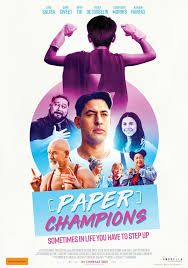
PAPER CHAMPIONS
Australia, 2020, 85 minutes, Colour.
Luke Saliba, John Tui, Gary Sweet, Tessa de Josselin, Kaarin Fairfax, Genevieve Morris.
Directed by Jo-Anne Brechin.
Divided opinions on this small Australian film. Many finding it slight, silly, boring. However, the majority of bloggers seem to enjoy it, the lightheartedness, a sense of humanity and humour.
The central character Rey (Luke Saliba who co-wrote the screenplay) ponders greatness, his father’s hope for him as a wrestler, the influence of his mother (Kaarin Fairfax) and her attachment to the next door neighbour, Gary Sweet, toughness, posing for the mother’s painting, challenging and encouraging Rey.
However, Rey works in a photocopier shop, mid-20s, timid, awkward, wanting to please, influenced by his boisterous co-worker, Wade, (New Zealander John Tui, featured in many New Zealand and American films and series, Star Wars, Fast and Furious, Shortland Street). Wade is forever quoting Mana, for spirit of masculinity, taking Rey to the company dance, both with pink suits, trying to train him to dance, eventually Rey’s bursting out in quite a routine.
Then there is a nice assistant at the medical centre, Rey trying to please her.
Eventually, after some misadventures and light comedy, Rey moves more out of himself, some training with wrestling, his mother and her relationship, Wade and his support, going to the wrestling bout – and being instantly knocked out.
Filmed in Geelong, a small piece of Australiana.
Legend of Baron Toá
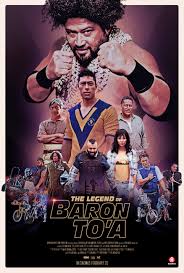
THE LEGEND OF BARON TO’A
New Zealand, 2020, 104 minutes, Colour.
John Tui, Uli Latukefu, Jay Lage'aia, Nathanial Lees, Xavier Horan.
Directed by Kiel McNaughton.
A New Zealand film, set in a suburban city street, a focus on Tom is living in New Zealand, adapting to the style, but with their traditions. The central character is played by Australian actor, Uli Latukefu. This is a film very much for the Tongan community and the wider New Zealand audience. Audiences from outside New Zealand will look on with interest for the human story, the cultural issues, for the background of wrestling and fighting.
The Baron of the title is a wrestling champion from the 1990s. There are scenes of him at home, his bond with his young son, Fritz, and young people in the street. The action then goes 30 years forward, Fritz having spent 10 years in Australia, returning home to sell the house that his father lived in, but a condition from his uncle, who continues to watch the Baron’s fights on television, it up in the fights and politics and control of the street, that house not be sold until the Baron’s victory trophy belt is recovered from some of the locals.
The focus is on Fritz, a big man, trained by his father, but with mixed feelings towards his father and his reputation and the influence of his son, having left home to find himself in Australia. A great deal of interactions with his uncle, explanations, encouragement for him to build himself up and to be able to fight the dominant leaders in the community. Eventually he does so, a collage of training sequences, even including the little girl from the door who plays a role in the ultimate fights.
The local leader runs a club, a haven for the unemployed, the tough older men, the next generation who are taking after them. A lot of fights, a lot of bullying, threats and strutting.
There is a complication with the main white character in the film, the local policeman, having an affair with the next-door neighbour, highly assertive but also cowardly in his behaviour and attitudes. He is aware of the problems, tries at times to solve them, but also likes to sway through his weight around, especially towards Fritz.
At one stage, hearing the crash of his mute friend, riding in a reconstructed wheelchair, his friend on fire, which has a vision of his father, talking, explanations, embrace and reconciliation, encouraging him then to fight for the locals.
Fight fans will certainly relish all the fighting combat sequences, which is often taking a beating, but encouraged to continue to stand up, confront, especially the local chief.
Friendship with the woman next door, the belt restored to the house and to his uncle, the humiliation of the local policeman, the removal of the force a for sale sign that the house, happy ending.
