Displaying items by tag: Ncuti Gatwa
Roses, The
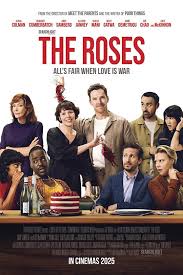
THE ROSES
UK/US, 2025, 105 minutes, Colour.
Olivia Colman, Benedict Cumberbatch, Kate MacKinnon, Andy Samberg, Ncuti Gatwa, Sunita Mani, Zoe Chao, Jamie Demetriou, Halla Finley, Wells Rappaport, Will Smith, Alison Janney.
Directed by Jay Roach.
Once upon a time, well 1989 anyway, the popular stars of such adventures as Romancing the Stone, Jewel of the Nile, Michael Douglas and Kathleen Turner, surprised everyone in the adaptation of Warren Adler is somewhat caustic novel, The War of the Roses. Not the 16th century between York and Lancaster, but a 20th century couple moving from love to enmity. Black comedy with some stinging challenge about marriage and relationships.
And now, 30 something years later, a new version, scripted by Australian Tony McNamara (who began in Australian television but has written screenplays including The Favourite, Poor Things and the series The Great). And it has an American director who has a very interesting career in both comedy and historical drama, ranging from the Austin Powers comedies and the Meeet the Parents comedies to the 2000 US election controversy in Florida, The Recount, and Sarah Palin and the 2008 election, Game Change, biography of black listed screenwriter Trumbo and Fox News scandals, Bombshell.
Added to this, the talent and versatility of stars Olivia Coleman and Benedict Cumberbatch, one-time Doctor Who, Ncuti Gatwa, and popular American comedians ateacKinnon and Andy Samberg.
In fact, while the opening of the film has the meeting between Theo and Ivy in London, he an idealistic architect, she a talent for cooking and a career as a chef, they soon move to California where the rest of the story takes place. In fact, the film was made completely in England, studios and the southern.
10 years pass, happy marriage, twin children, comfortable life – what could go wrong? Answer, practically everything!
Which means that most of the film is black comedy, a great deal of farce, lots and lots of bickering, insults, sometimes no holds barred, even at dinners with guests. A lot will depend on audience sympathies. Theo experiences an absolute architectural disaster which banishes him from his hopeful career, and makes him an at-home father. Ivy experiences great success, critics applause, an expanding empire of restaurants. Which means that underlying all this many themes of male and female roles at home, at work, rivalries, resentments, the effect on children…
And, while the dialogue is often black, bleak, highly ironic, often offensive, our laughter will depend on our sensitivities about these issues and where our sympathies lie.
While there are American comedians in supporting roles, they are something of a distraction, generally unnecessary and not so convincing in their interactions with Theo and Ivy.
But, brilliantly acted, Benedict Cumberbatch always interesting, Olivia Colman indicating that she can take on any role, The Roses is a mixture of amusing, offending, confronting…
- The title and expectations? A reinterpretation of the 1989 The War of the Roses?
- Comedy, satire, farcical situations, sharp dialogue, parody?
- Setting the scene, London, Theo and his architectural ambitions, Ivy and her cooking ambitions, their meeting, marriage?
- 10 years later, in the United States, Theo and his career as an architect, Ivy subduing her cooking talent, the twin children, Ivy at home, spoiling the children? Theo strict?
- The disaster, the storm, the destruction of Theo’s building? The contrast with Ivy’s success, the customers taking refuge, progress, the personalities of her staff, the food critic and his response? The consequences, Theo and his failures, unable to practice? Ivy, progress, increasing number of restaurants?
- The clash between the two, Theo depressed, jealousy of Ivy, Ivy and her success, enjoying it, dominant? The situation with Theo as the stay-at-home parent, his style and strictness with the children? Ivy feeling shut out? And the children, their scholarships, to Miami? Husband and wife at home, clashes? Attempt reconciliation, the visit to New York?
- The friends, Barry and Amy, Barry the lawyer, Amy and her flirtatious manner? The friends, the meals and discussions?
- The marriage counselling and the sardonic response? Ivy, her decision, the finance for the dream home?
- The years, the lavish detail of the home, the success of the home? Entertaining, Barry and Amy, the situation becoming more brittle, the dialogue at the meal table, scoring off each other? The prospects for divorce, Ivy and her sharp divorce lawyer versus Barry?
- The divorce conditions, Theo wanting only the house, Ivy refusing to give it to him? Her restaurants closed for health reasons? The tactics, the spite, the barbs, the farcical interactions? The signing of the papers, the full signature…?
- The exasperation, and finally each admitting that they do love each other, after the fight around the house, the destruction of the Julia Child stove?
- The ending, the reconciliation, the danger, explosive – and the screen turning to white?
- The use of farce and parody for satiric reasons? The film opting for farce and explicit insult and tactics rather than subtlety?
Importance of Being Earnest, The, National Theatre
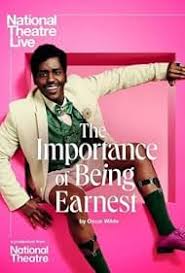
THE IMPORTANCE OF BEING EARNEST
UK, 2025, 179 minutes, Colour.
Ncuti Gatwa, Hugh Skinner, Sharon D.Clarke, Eliza Scanlon, Ronke Adekoluejo, Amanda Lawrence, Richard Cant, Julian Bleach.
Directed by Max Webster.
Once again, Oscar Wilde’s celebrated last play, from 1895.
In 1952, there was the straightforward basic staging as a drawing room comedy film, top English cast led by Michael Redgrave and Dame Edith Evans (and her still remembered classic outraged “handbag”!). It is frequently repeated for screenings on SBS World Movies and so readily available for audiences today.
There have been quite a number of filmed stage versions, even featuring David Suchet as Lady Bracknell.
There was also the 2001 version, very strong cast led by Colin Firth and Judi Dench as Lady Bracknell, but with something of an eye to modern tastes, even imagining Gwendolyn with a tattoo and the idea that Lady Bracknell began her career in the music hall. There were also some notable (inexplicably) omissions from the text.
Now here is the film version of the National Theatre’s 2025 production, complete text to delight those who have appreciated it for a long time. But the word definitely not to be used here is “straightforward”. This is not exactly a straightversion. Commentators on the play have referred to the “queer codes” inserted by Wilde, implicit references.
An unexpected opening sets the tone, Ncuti Gatwa (television’s Dr Who) in a pink gown, playing the piano, a Grieg Symphony, joined by the cast dancing around the piano. Then, stopping suddenly, the curtain opening – and we are back in 1895.
The opening is familiar, Jack visiting Algy, the conversation, Jack’s love for Gwendolyn, the imminent arrival of Lady Bracknell… And the mystery of Jack being Jack in the country and Earnest in the city and Algernon and his creation of his sick friend, Bunbury, whom he has to visit to comfort at a moment’s notice. Themes of deception, relationships. But, while Hugh Skinner as Jack gives an effective performance, he is quite overshadowed so often by Ncuti Gatwa, Jack almost playing straight man (the technical comedy term) to Algernon’s flamboyant domination of the friendship and the play.
It is apt to describe the production as camp in style, manner and mannerisms, but a great deal of posing, lots of postures, running and shuffling around the stage and a great deal of innuendo.
Every audience waits to see what Lady Bracknell is going to be like, a dominating presence, her articulation of opinions, her capacity for being shocked and astounded. Sharon D. Clarke certainly dominates this production – with “handbag” voiced in low, deep dismay. She controls the main two scenes in which she is present, both snobbish and exploitative when tempted by money and class.
Australian Eliza Scanlan is a forthright Sicily. Ronke Adekoluejo is an unexpectedly knowing Gwendolyn, hyperactive (sometimes irritatingly so) and extrovert in the innuendo in a very cheeky tone. Audiences will enjoy the performers playing Miss Prism, Canon Chasuble and the actor playing the two servants.
It is probably correct to say that Oscar Wilde would have enjoyed this particular interpretation of his play, making explicit the issues in his own life and relationships, but we also remember that this was his last play, the court case, his public humiliation, imprisonment and lonely death.
