Displaying items by tag: Timothee Chalamet
Marty Supreme
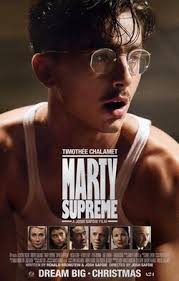
MARTY SUPREME
US, 2025, 159 minutes, Colour.
Timothee Chalamet, Gwyneth Paltrow, Odessa A’zion, Kevin O'Leary, Tyler Okonma, Abel Ferrara, Luke Manley, Geza Rohring, Koto Kawaguchi, Penn Jilette, David Mamet, Fred Hechinger, Levon Hawke, Fran Drescher, Emory Cohen, Sandra Bernhard.
Directed by Josh Safdie.
This is not the most modest of titles! And modesty is not a word associated with the central character, New Yorker, in his 20s, the 1950s, Marty Mauser. The film opens with Marty unwillingly working in a shoe shop owned by his uncle. But then the reveal, that Marty is something of a champion table tennis player. (While there are many sport films, it is something of a surprise to find such a big budget entertainment focusing on table tennis, some wonderfully filmed games, fast, lightning flash, some acrobatics, quite a sport!).
Timothee Chalamet has been nominated for awards for his performance. He has had extraordinary success on screen for almost 20 years, his range most recently including Willy Wonka, Paul Atreides in the Dune films, and Bob Dylan. His Marty Mauser is an entirely different character and Timothee Chalamet offers an exhilarating performance.
As we watch Marty and his manipulations to get himself to London for the British tournament, conning people, taking money, not worried about consequences, we realise that on the surface, he can be quite beguiling but the real Marty? Borrowing from another reviewer who listed some of his characteristics: a young man who is at once charming, a rogue, a hustler, arrogant, likeable, infuriating, flamboyant flair, driven and supremely confident. We spent 2 ½ hours in his company.
And, there is a lot going on, his approach to ageing film star, Gwyneth Paltrow, seductive, offering advice for her stagecraft, but still stealing her necklace. Then there is her husband, a wealthy CEO for a pen company, proposals for a PR table tennis match in Japan, Marty versus the top Japanese player, fake defeat – but then Marty makes some sort of self-assertion.
Meanwhile, Marty’s married girlfriend, Rachel, is pregnant. Marty clashes with his mother, Fran Drescher, goes to a hotel, told not to use the bath, then its crashing through the roof on top of a mobster, played by director, Abel Ferrara, and some complications, ultimately quite violent, in the search for his runaway dog. One never knows what tangle Marty will be caught up in next.
The film was actually based on the real-life Marty Reisman and his 1974 autobiography, The Money Player: The Confessions of America's Greatest Table Tennis Champion and Hustler. The film stays in the 1950s but it is worth Googling Marty Reisman who was still playing table tennis in the 1990s and lived into the 21st-century.
There is a great deal to enjoy while watching Martin Supreme, the star performance, the complications of the character who is able to move chameleon-like from one situation to the next, even capitalising on failures, always with the smart word, unscrupulous in manipulating even his closest friends, with a huge ambition to be the best in his chosen vocation of table tennis. He is a rogue who can get away with anything even when he is losing.
But, the filmmakers chose several endings for the film, some realistic, some surreal, deciding not to take Marty beyond the 1950s – but, to audience relief in some ways, an unexpectedly gentle finale.
The screenplay has been co-written and directed by Josh Safdie who used to make films with his brother Ben, who made the 2025 wrestling sports film, The Smashing Machine.
- Based on a true story, the 1950s, Marty’s subsequent careers?
- The title and tone, Marty and his ego, con man, charm, exploiting people?
- The table tennis film, audience interest, the game, players, competitions, post World War II, Japan?
- The introduction to Marty, his age, moustache, selling shoes, interaction with the customer, the encounter with Rachel, his uncle, his fellow worker, the offer to be manager, his refusal? Lloyd and the money, the gun, taking the money?
- Marty, his family, distance, home, the scenes with his mother?
- The production of the table tennis balls, with Marty Supreme? Dion, his enthusiasm, the uncle, Dion and his support?
- Marty, getting to London, in the competition, his skill, reputation, his goals? The encounter with the competition manager, the accommodation, going to the hotel, his presumptuous demands? The encounter with Kay, the phone call, talk, her husband, the CEO of the company?
- His games with the former champion, his history and a concentration camp, friendship?
- Meeting Kay, her career, her marriage, the sexual encounter?
- With Rockwell, intruding into his office, the talk, the proposal about the exhibition match?
- The encounters with Endo, his skill, ordinary worker, death, Communications? Winning?
- The ups and downs of the proposal, the championship, integrity, promotion? Marty and his associate, there vaudeville performances with the Harlem Globetrotters?
- Back to New York, the police, Rachel and her pregnancy, her angry husband?
- The friendship with Wally, driving the taxi, the table tennis group, the old hotel, told not to use the bath, its collapse?
- Ezra, the mobster, his dog, the bar falling on him, the dog, the promise to take the dog to the vet, in the car, Marty at the bowling alley, hustling, the money, going to the gas station, the attack, the damage to the taxi, the garage fire? The dog running away?
- Kay, the play, the rehearsals, the director, the actor, Marty intruding, offering his advice? Taking the necklace, trying to pawn it? The sexual encounter, Kay telling him it was costume jewellery? The offer to give him another necklace?
- Dion, Marty’s sponging on him, with Rachel, the accommodation? Taking his car, searching for the dog, the house in the countryside, the man with the gun, the shooting, the car crash? Dion angry, throwing away all the ping-pong balls?
- The encounter with Kay, in the park, police, the bad reviews, Kay returning, not able to see Marty?
- Rockwell, Marty trying again for the competition, the humiliating episode of the literal spanking?
- Ezra, kidnapping, Marty and Rachel with the fake dog, going to the farm, the shootout and deaths, Rachel wounded? Discovering the fake reward paper, impact? Rachel, the injuries and her husband, going into labour, the hospital, giving birth?
- At the hospital with Rachel, the split second timing to get on the plane to go to Japan, the issue of the fine, his not being allowed entry into the competition? The clash with the official?
- The exhibition, going according to plan, his loss, the humiliation, the humiliation of kissing the pig, the Japanese crowd? His dignity, willing to play a proper game?
- The rematch, the tension, US military support, Marty winning, on the plane home with them?
- The end, hospital, with his mother, Rachel, the baby, holding it – and his tears? Prospects for Marty’s future?
Hans Zimmer: Diamonds in the Desert
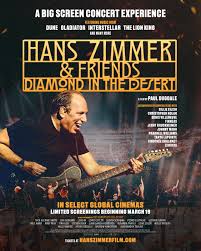
HANS ZIMMER AND FRIENDS: DIAMONDS IN THE DESERT
US, 2025, 158 minutes, Colour.
Hans Zimmer, Jerry Bruckheimer, Timothy Chalamet, Billy Eilish, Christopher Nolan, Denis Villeneuve, Pharrell Williams, Zendaya, Loire Cotler, Laura Lapointe, Holly Madge, Johnny Marr, Juan Garcia-Herreros.
Directed by Paul Dugdale.
A film for audiences who enjoy music. And, especially, music composed for films. The focus here is on long time and prolific composer, Hans Zimmer. In more recent years, he had travelled with orchestra and many musicians, performing around the world. This film captures concerts in the Coca-Cola vast auditorium in Dubai, at other venues in the city and performances out in the desert.
However, it is of interest for film buffs because of the many interviews with actors and directors with whom he worked, as indicated in the credits above. Then also the producers, publicists that he worked with. And, a number of musical artists, singers, performance who are very talented especially a focus on guitarists and drummers, and the number of women in the orchestra talented with violins and cellos. The visuals of the performances and the camera angles and editing, frequently on the move, then impressive close-ups, a treat for those who enjoy music performances.
Zimmer himself is very genial, in his performances, his range of talent with instruments, especially the piano, his enthusiasm during the performances, his encouragement of particular talents, long close-ups, encouragement. And, for the sake of the performances, the number of members of the orchestra and of associated performances is large.
Zimmer also explains his history, European background, years in the United States, work in the United Kingdom, beginnings, developments, the range of films he has scored, much of it played (and, the difficulty for with some of the scores, played alone they can seem quite repetitive, momentarily monotonous, because they have been scored for the visuals on the screen which a live concert does not have – although there are some sequences from some of the film is.)
The discussions with actors and directors like Christopher Nolan (Dark Knight, Interstellar) and Denis Villeneuve (June) are quite informative.
The film is long, as mentioned some of the scores are long and repetitive, but the whole experience is well worthwhile, learning about musicians on composition, collaboration with the filmmakers, the challenges to the composes imagination, living with expectations of success.
One of the films made immediately after this concert film was F1, and audiences who are seen the documentary will appreciate the moods, the chords, the atmosphere of Zimmer’s score for F1.
Complete Unknown, A
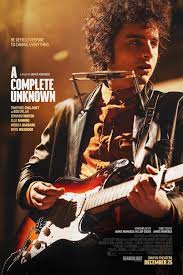
A COMPLETE UNKNOWN
US, 2024, 141 minutes, Colour.
Timothee Chalamet, Edward Norton, Elle Fanning, Monica Barbaro, Eriko Hatsune, Scoot McNairy, Dan Fogler, Boyd Holbrook.
Directed by James Mangold.
For audiences with long memories, singer-songwriter, Bob Dylan, has been a constant presence since he first went to New York City, aged 20, in 1961, made contact with Pete Seeger, admired Woody Guthrie, was given opportunities to sing in clubs, at festivals, and to record. And, he has done so ever since, awarded the Nobel Prize for Literature in 2016 for having created new poetic expressions).still at work in his 80s.
For younger audiences, becoming aware of the Bob Dylan of later years, memories of his songs, his contribution to folk music, his developments and musical talent, may have made a strong impression.
Which means that this two-hour 20 film about Bob Dylan’s earliest years, from a complete unknown in 1961 to a star, acclaimed, also criticised for his transition from folk to electric instruments in developing music styles at the Newport Festival in 1965, will be a significant experience.
And, there is the performance by Timothee Chalamet as Bob Dylan, a physically slight figure, characteristic wavy hair, intent on singing, writing his lyrics, always with a cigarette in his mouth, bringing Dylan to life. (In 12 months to Timothee Chalamet has been Wonka, Paul Atreides in Due 2 and now Bob Dylan, indicating that in his talent, Chalamet is a screen chameleon. It is worth seeing him in interviews as his ordinary self to appreciate his versatility )
Not that Bob Dylan in his early years was always an attractive character to meet. He was self-obsessed, ambitious, intent on writing and composing at all times and all places, fickle, often casual and of-hand, in relationships, especially with singer Joan Baez – but this is a young man in his early 20s. But he knows what he wants for himself and his creativity and career.
However, one of the great values of director, James Mangold’s film is situating the early songs, including some songs from Woody Guthrie and Pete Seeger as well as Blowing in the Wind, The Times are Achanging and quite a catalogue of other songs. And, impressively, Timothee Chalamet sings all the songs himself, plays the guitar and harmonica. In fact, all the supporting cast do their own singing, Monica Barbaro impressive with a beautiful voice as Joan Baez, Ed Norton in a very impressive performance as a sympathetic Pete Seeger, Boyd Holbrook as Johnny Cash. (Incidentally, James Mangold directed the film portrait of Johnny Cash in 2005, Walk the Line.)
There are some moving moments at the beginning of the film and at the end with Pete Seeger present and singing for a chronically ill Woody Guthrie in hospital.
Bob Dylan has been a significant figure in American and world music for more than 60 years. This is a welcome opportunity for us to go back to this introduction to a complete unknown.
- Audience response to Bob Dylan? In the early 60s, from unknown to celebrity, 1965 and his changing of music style, the succeeding decades of success, Nobel Prize for Literature, continuing into his 80s?
- The focus of this film, 1961-1965? Audience knowledge of the period, in the world, the Berlin Wall, the Cuban crisis, the assassination of Kennedy, the March on Washington, the Vietnam war…? The insertion of this information into the narrative?
- The music styles of the 1950s, popular songs, the place of folk, the influence of Woody Guthrie, Pete Seeger, Joan Baez and others? The influence of Bob Dylan, his music, lyrics? The peace movement? (And other movements in this time, The Beatles, Elvis Presley, The Rolling Stones…?)
- The opening and Woody Guthrie’s So Long…, Pete Seeger in court, the judge, the song, the support, This Land is my Land…?
- The atmosphere of New York City in the 1960s, the venues for concerts, the Newport folk Festival, Monterey? Recording studios? Flats and apartments?
- The music, the range of Bob’s Dylan songs throughout, their insertion, the film as a collection of his songs? Woody Guthrie’s songs? Pete Seeger’s? Guitars, harmonicas? The transition to electric, bands and the range of instruments?
- Audience response to the character of Bob Dylan, in these four years, aged 20 to 25, unknown, the way he presented himself, his obsession with music, his ambitions, relationships with Joan Baez, with Sylvie, how committed? The focus on his self-absorption, the consequences, some arrogant behaviour, his devotion to Woody Guthrie, appreciation for Pete Seeger, the clash with him at Newport? Not a character one would like to meet in ordinary life?
- Sympathetic portrait of Woody Guthrie, ill, no speech, Pete Seeger’s visits, Bob’s admiration, the hospital, the song, his final visit to the hospital and complaining orderly?
- His background, enigmatic, Zimmerman, changing to Dylan, the story of the carnival, keeping his life in mystery? The opening, arrival in New York, wanting to see Woody Guthrie, going to the hospital, encountering Pete Seeger, singing the song, the response? Pete Seeger and his wife helping out, his composing, the children? The continued friendship with Seeger and his family?
- The opportunities, his continued singing, the scenes of his composing, the music, the lyrics, writing, typing? His being introduced by Pete Seeger, the response? Joan Baez and her singing, her response, his acclamation? The beginning of the relationship, Joan’s attitude, sharing the songs with him, at Sylvie’s apartment? The later relationship, the clashes, even on stage, his turning up at her apartment, composing, her ousting him? Her later accounts of the relationship? The songs?
- Meeting Sylvie, at the church, talking, together, seeing Now, Voyager, the cigarettes, the comparisons with the story? (And the prevalence of cigarettes throughout the film?) Sylvie, her personality, her art, the attraction to Dylan, the relationship, going to the concerts, her time away and his infidelity, her suspicions, the breakup, his returning, on the bike to Newport? The influence of The Times are Achanging?
- Going success, the records, the producer, latching onto him, staying with him, the other executives and their hopes? The record companies, the takes, the initial song and his missing the microphone, his increasing competence and success? Appearances, a claim? People seeing him in the street pursuing him, escaping the taxi? The claim at the concerts, applause, standing ovations? His later speech and denunciation and people’s puzzle?
- The discussion with the young musician, going to see him play, their working together, the transition to electric guitars, bands?
- The background of the Newport Folk Festival, the personnel, the discussions, the tradition, Pete Seeger and his investment? Successful years? 1965, Dylan and his choices, the public wanting Blowin’ in the Wind and other classics? His refusal, the clash with Joan Baez? Sylvie departing and the final talk with her? His concession to a popular song?
- The clash with Pete Seeger, the interventions of his wife? Dylan, his friends, going to the new phase of his life, wanting to continue and develop the music?
- The final information, his relationship with Pete Seeger and reconciliation, with Joan Baez, the continued success? His career, the Nobel Prize and his not attending? Into his 80s and his approval and consultation for the film?
Dune, Part 2
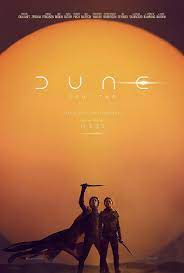
DUNE, PART 2
US, 2024, 166 minutes, Colour.
Timothee Chalamet, Zendaya, Rebecca Ferguson, Javier Bardem, Josh Brolin, Austin Butler, Florence Pugh, Dave Bautista, Christopher Walken, Lea Seydoux, Stellan Skarsgaard, Charlotte Rampling, Roger Yuan.
Directed by Denis Villeneuve.
Denis Villeneuve’s 2021 version of Dune made quite an impact. The Dune novels by Frank Herbert had been popular for decades. David Lynch had made a version in 1984 which was not favourably received (except by this reviewer!). So, in a sense, Villeneuve’s version was a vindication of the power of the novel, its characters, its imagination, its mythical vision of the future.
Now, here is Dune Part 2 – and, in its immediate release, it seems to have pleased almost everyone, quite a number of bloggers relying on the word “masterpiece”. Whether that be the case are not, the film is certainly visually impressive as was the original. And, this review is based on an IMAX screening, which is thoroughly recommended. The landscapes, the endless mounds of dunes, the craggy mountains, the canyons provide a vastly impressive setting. And, the musical score, the brass instruments and their resounding make the cinema seats reverberate.
And, with this kind of tale-telling, kingdoms, battles, futuristic weapons and armaments, vast buildings and interiors, including an enormous gladiator arena filmed in black and white, hundreds of thousands of spectators, there are what we might call state-of-the-art… Effects.
For those familiar with the novels and the films, there is no need to wonder about the House of Atreides, the fate of the ruler, his young son, Paul, his mother, Jessica, the conflict with the Emperor, the hostility towards the Harkonnens. Those not so familiar may have a lot of moments, especially in the battle sequences, as to who is who and why it is all happening at this moment.
As before, Timothee Chalamet is Paul, Rebecca Ferguson his mother, Zendaya is Chani.
In the first part of this this film, we focus on Paul and his mother, the bond with Chani from the previous episode, the hiding from enemies in the desert (who have enormous sky vehicles and have the power of levitation up the sides of mountains), then some combat with hostile locals. However, the local leader, Stilgar, Javier Bardem, welcomes the foreigners, and, with echoes of biblical/Islamic traditions, a reliance on prophecies and fulfilment, a hope for a Messiah. Stilgar puts Paul to the test.
Then we go back to the spice industry, the villain, Beast Rabban, Dave Bautista, his ruthlessness, but also his defeat, his return to his master, Baron Harkonnen, Stellan Skarsgaard, who is grooming his nephew, Austin Butler, whom he describes as psychotic, who combats three remnants of the House of Atreides.
There is further drama concerning Paul’s mother, her later discovery of who her father was and what that means in terms of Atreides versus Harkonnens, and her becoming the new Reverend Mother.
New characters in this film include Christopher Walken as the Emperor and Florence Pugh as his Princess daughter, who has been trained by the sinister Reverend Mother, Charlotte Rampling.
Which means that it all has to come to a head, the power of the Emperor, his plans, Paul as the new saviour, Battle confrontation mano a mano between Paul and the psychotic nephew.
While there is some resolution, the way is now open for a climax in Dune Part 3
- The long popularity of Frank Herbert books? 1984 version? The impact of Part 1?
- The continuation of the story, life on the planet, Arrakis, the house of Atreides and its destruction, the Harkonnens, the Emperor and his family, the setting in the 10,000s?
- The landscapes, the dunes in the desert, the mountains, canyons, the cities, the interiors, the vast buildings, the gladiatorial arena? The colour photography? Black-and-white photography for the Harkonnen world?
- Action sequences, the range of special effects, in the desert, the worms and movement, the winds, the aerial machines, the Army sequences and battles, the hand to hand final combat?
- The musical score, the instruments, the booming and reverberating sounds?
- The situation, the destruction of the House of Atreides, Paul surviving with his mother, the previous bond with Chani, hiding and the attacks in the desert, aerial surveillance, the ability of the soldiers to ascend and climb the mountain sides?
- Paul and his mother and Chani, brought to her people, the issue of the combat, the defeat of their warrior, the response of the crowds, the men, the sceptical women? The funeral?
- Stilgar, his status in the community, the Biblical/Islamic traditions of written words and prophecy, the hope of a saviour? The men and their beliefs, their prayer? The women critical including Chani? Stilgar and his personality, leadership, influence on the others, belief in Paul? Fulfilment of prophecy? The range of tests, the crossing of the dunes, Chani and her advice and help, the big test, going out into the dunes, the soundings, the worms emerging, giant, Paul and his abilities, the hooks, and riding the worms? Acclaim?
- The solemn place of the Reverend Mothers, Jessica, her bond with her son, chosen to be a Reverend Mother, the rituals, the old Mother and succession, the transfer of knowledge, the abstract colour visuals for these sequences? Her tattooed face? Her role with the women, knowledge and advice? Her wanting to go south, to return home, with Paul? His refusal? Seeing her off with the entourage?
- The episode with Beast Rabban, the initial caption about the power and the power with the spice? The spice industry, cause of conflict? The farming of the spice, collecting it, financial issues? The Beast and his autocratic behaviour, slitting the throats of his advisers? Falling foul of the Emperor, the aerial sequences, his defeat, having to kiss the feet of Fayd-Rautha?
- The tradition of the Harkonnens, the Baron, in the bath, his size, bloated? His relationship with the Emperor? Helping the Emperor to defeat the House of Atreides? His plans for his nephew? The description of the nephew as psychotic? Everybody with shaved heads? Preparations for the gladiatorial combat, the black-and-white photography, the visuals of the arena, the special effects for hundreds of thousands of spectators, the three final warriors from the House of Atriedes, the confrontation with Fayd-Rautha, the fights, his arrogance, the blood, the knives, the final foe giving him a fight? Arrogant Victor?
- The return of Gurney, the story in the past, smuggling? The friendship with Paul, their bonding? Chani and her suspicions? Gurney and his participation in the insurrection, present at the end?
- The scenes with the Emperor, his rule, under threat, his assertion? The scenes with his daughter, his hopes for her? The Reverend Mother, her manner, influence in the past, training the daughter, ambitious, controlling, her strategies, her ruthlessness?
- The buildup to the confrontation with the forces of the Emperor, Paul, the Fundamentalists from the south, the attack, the air vehicles and their destruction, on the ground, the firepower, the skills of the fighters and their disguise, rising from the sands? The visuals of the vast confrontations?
- The victory, the confrontation with the Emperor, Paul and his assertions, the killing of the Baron, revenge? The Emperor, defiant? Fayd-Rautha as his champion? Paul and his conditions, speaking of marrying the Emperor’s daughter, peace, Chani and her reaction?
- The Mano a Mano fight, strategies, techniques? Paul being wounded? Turning the tables on his opponent, his death? The Emperor, having to kneel before Paul?
- Stilgar, everybody rejoicing, Paul as the saviour? His mother and her response? The defeat of the Reverend Mother and the Emperor’s entourage?
- The ending, the openness to the reassertion of Paul Atreides and his leadership?
Wonka
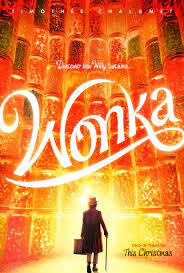
WONKA
US/UK, 2023, 116 minutes, Colour.
Timothee Chalamet, Calaha Lane, Hugh Grant, Olivia Coleman, Keegan-Michael Key, Jim Carter, Patterson Joseph, Matt Lucas, Matthew Baynton, Freya Parker, Rakhee Thakrar, Natasha Rothwell, Rich Fulcher, Colin O'Brien, Sally Hawkins, Rowan Atkinson, Rufus Jones, Tom Davis, Kobna Holdrook-Smith..
Directed by Paul King.
Everyone knows the name, Willy Wonka. He first appeared in Roald Dahl’s story in 1964 and a subsequent story in 1972. Roald Dahl has been one of the most popular storytellers, especially for younger audiences, with such titles as Matilda, The Witches, James and the Giant Peach…
But, Willy Wonka is known far more widely than his readers with the 1971, Willy Wonka and the Chocolate Factory, with the engaging Gene Wilder, and the popular songs, Pure Imagination, and the Oompa Loompa song (both in this present film but not The Candy Man). Tim Burton did a reinvention of Willy Wonka with Johnny Depp in Charlie and the Chocolate Factory.
Now, here is a prequel. Where did Willy Wonka come from, where did he learn how to make chocolate, his relationship with his mother, his ambitions to open a chocolate store, a nicely naive young man setting out on an adventure. The screenplay actually takes a number of issues from the original story, especially the villainous chocolate cartel entrepreneurs and their opposition to Willy Wonka.
So, quite a lot of plot for a prequel. However, this new film is also designed as a musical, rather reminiscent of the film versions of Broadway musicals (and, most probably, Wonka is destined for Broadway and beyond). The new songs are pleasant even if not so memorable as Pure Imagination, sung nicely by the various characters with lyrics that illustrate their characters and the situations – the most memorable, perhaps, involving the repetition and the beat of the word, Scrub.
The film has been co-written and directed by Paul King who became a great favourite with his very pleasing and entertaining Paddington films. He brings the same sensibility to Wonka.
And, to be the new Willy Wonka, here is Timothee Chalamet who has already proven himself as a substantial actor on screen presence in dramas and comedies but, especially as Paul Atreides in Dune – and Dune 2 scheduled for release in 2024. He is quite small, very young-looking, a blend of the innocent and the ambitious, remembering his mother (a cameo by Sally Hawkins), generous, but shocked to discover the greed of a venal world. And the tag, “the greedy always beat the needy” often repeated throughout the film.
There is something rather Dickensian about the early sequences, Wonka encountering an ultra-Dickensian landlady played by Olivia Coleman. And Wonka is sentenced to a long imprisonment below the boarding house, a workhouse laundry, with a different assortment of penalised characters, especially a young girl, Noodle, who tries to save Wonka. Amongst those down below is the former accountant of the cartel, played by Jim Carter, liberated from Downton Abbey.
Willy Wonka has a chest full of ingredients for chocolate, a magician’s capacity for multiplying chocolates with the most exquisite tastes and physical and psychological effects, leading to a lot of comedy turns. He concocts a plan to escape from the laundry with Noodles’ help, then with the help of the others, to find the cooked books of the cartel and expose them. However, they have their allies, the chief of police, the chocoholic Keegan-Michael Key (and his fat suit, fatter suit, fattest suit after his choc indulgence), and the chocoholic priest, Rowan Atkinson this time with no weddings but one funeral.
The cartel is sinister, led by the aggressive Patterson Joseph, aided by Matt Lucas with an orange wig which falls off, and Matthew Baynton who chokes whenever he tries to say the word “poor” and gags when others see it. They are due for a comeuppance.
And, the Oomps Loompas? Well worth awaiting the arrival of a miniature Hugh Grant as Lofty, resentful that Wonka has stolen his special beans and demanding repayment. Hugh Grant has been sending himself up in recent films and obviously is enjoying this escapade, a heroic rescue for Wonka and Noodles – and a kind of MC entertainment during the final credits!
Roald Dahl is often quite dark in his stories. Even though Wonka is very light, there are the three villains, there is the corrupt chief of police and priest, and a dire attempt on the life of Willy Wonka and Noodle.
This is quite a lavishly produced entertainment, incorporating happy memories of Willy Wonka from the past, drawing us into his extraordinary chocolate world yet again.
- The popularity of Willy Wonka, Roald Dahl’s stories, 1971 film, 2007 film? Now a musical? Prequel?
- The production values, fantasy and effects, costumes and decor, locations, the city blend of London/Paris/Berlin?
- The new songs, the characters singing them, the lyrics illustrating the characters and situations, Scrub, the dance routines, the lavish stagings and sets, choreography – and Broadway musicals?
- The incorporation of the original song, Pure Imagination, theme for the film? The Oompa Loompa song?
- Willy Wonka and his origins, with his mother, her care and love for him, the chocolate bar, the message? The dream of opening the chocolate store, the memories of the store in the city? His ambitions? Setting out, his suitcase and its contents, his magic powers? Farewell to his mother? Her reappear at the end and the opening of the store? Being with him?
- Arrival in the city, his personality, young, enthusiastic, naive, the 10 sovereigns, the demands made on him, a fine for daydreaming… No money, sitting on the bench, Bleacher talking with him, taking him to Mrs Scrubbit? Nice, nasty, demanding the money, his staying the night, with the money, her demanding interest, is relegation to the basement, not reading the fine print, the warning from Noodles?
- Downstairs, the laundry, hardship, the song, Scrub, Noodles at her place, the other members, the comedian, Abacus and his being an accountant? The plan, Wonka getting out with the laundry, then everybody getting out, working together, the search for the books of the entrepreneurs (and the flashback to Abacus searching and his arrest)?
- The cartel, the three personalities, the aggressive leader, Matt Lucas and his bad wig and naive utterances, the chocolatier who could not say the word “poor” and choked when he heard it? Their shop, encountering Willy, tasting the chocolate, turning against him? Using the chief of police, his being paid in chocolate to eliminate opposition? The deals, a touch of conscience, taking the chocolate, becoming fatter and fatter? The priest, the Cathedral, the confessional, payment by chocolate, the lift downstairs, the preparation for the funeral, the giraffe, getting the giraffe out, the group getting inside, the chocoholic monks, the funeral?
- Noodles, the nice orphan, age, mystery of her background, drop-down the shoot, the ring, Willy recognising the link with the chocolatier? Helping, the dangers, the final revelation, the story of her birth, inheritance, disappearance?
- The scheme for Mrs Scrubbit and Bleacher, pretense that he was Austrian nobility, his dressing up, the flirting, the final expose?
- The nature of the chocolates, the people in the square, the response? The police? The ingredients of the chocolates, going to the zoo, the episode with the giraffe? In the Cathedral?
- The arrival of Lofty, the background of the Oompa Loompas, Lofty and his size, dress, Hugh Grant’s manner, vocal style, song, walk, accusations about the stealing of the beans, the flashbacks? His keeping guard? His reclining, Willie and his puzzles? His coming to the rescue when the couple were drowning in chocolate? The origins of the Oompa Loompas and their work in the factory, Lofty being shorter and the truth, becoming the taster?
- The threat to Willie and Noodles, the cartel and the confrontation, releasing the chocolate, their almost drowning, the rescue? And the transformation of the chocolate into the town square fountain? The chocolates the entrepreneur, their flying, the arrest, the good policeman and the exposure of the overlarge Chief of Police?
- Noodles, the happy ending, reunited with her mother?
- The happy ending, and the future for Willy Wonka and his chocolate factory?
- And Hugh Grant And puzzled but, the MC during the final credits?
