Displaying items by tag: Virginie Efira
Vie Privee/ Private Life
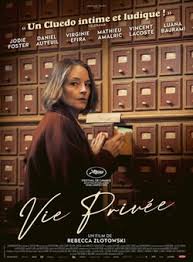
VIE PRIVEE/ A PRIVATE LIFE
France, 2025, 109 minutes, Colour.
Jodie Foster, Daniel Auteuil, Virginie Efira, Mathieu Amalric, Vincent Lacoste, Luana Bajrami, Noam Morgensztern, Sophie Guillemin, Frederick Wiseman, Aurore Clement, Irene Jacob, Park Ji-min.
Directed by Rebecca Zlowtoski.
Jodie Foster, very American in her award-winning career for over 50 years, nevertheless had quite an education in French and has appeared previously in French films. Here is a star vehicle for her, working along some of the most prominent of contemporary French actors.
She is Lillian, divorced from a Frenchman, and eye-doctor, Gabriel (Daniel Auteuil) with a son she does not communicate well with who is married with a baby son (Vincent Lacoste). She is a psychiatrist, quite a clientele, working with some of her patients for many years – and glimpses of her at work, with an angry client who wanted to give up smoking and failed after so many years and has gone to see a hypnotist with an instant cure and he wants his money back! So, serious themes with touches of humour.
But, she is visit by the daughter of one her long-term clients with the news that her mother has died. Lillian goes to the memorial but is angrily rejected by the dead woman’s husband (Mathieu Amalric), her being blamed for the death which turns out to be a suicide.
Which means then that the film turns into something of a detective story, Lillian worried about the suicide, coming to the conclusion that it was really murder, suspicions on the husband, and then the erratic behaviour of the daughter. And she enlists her genial ex-husband to help her find evidence. Thedead woman, Paula (Virginie Efira) appears in flashbacks.
At one stage, Lillian also visits the hypnotist because she has started to weep cannot prevent the tears. The therapy includes quite a startling episode, imagining a former life, 1942, Lillian with the dead woman, musicians in Orchestra, the husband the conductor drawing a gun, and the police arriving, led by her son. Which seems to indicate that Lillian herself is in serious need of some kind of therapy.
While Jodie Foster is a strong screen presence, her character here is rather superior in the American way, sometimes alienating the other characters and, sometimes, the audience.
With all the investigations, the complexity of relationships, and, it should be mentioned, strong Jewish background, there are many threads to be followed. With its complexity, the temptation is to say that it is all very much psychologised or, more accurately, psychiatrised.
- The title? For Lillian and, for Paula, the other characters?
- The French setting, atmosphere, psychiatrists, opticians, the range of clients, sessions? Background, apartments, restaurants, the home invasion, the countryside? The musical score?
- The film’s perspective on psychiatrists, their patients, years in sessions, effective, not effective, listening, hypnosis, special techniques? Psychiatrists and their personal life interfering with their practice?
- Lillian, American, American superiority, her skills as a psychiatrist, interactions with her patients, the patient and smoking, hypnosis, wanting his money back? The sketches of other clients and their talking, on the couch? Lillian and her life, marriage to Gabriel, her professional work, the separation, her relationship with her son, the grandchild, offhand? Superior?
- Valerie, the visit, Paula’s death, Lillian going to the wake, Jewish ceremony, Simon and his hostility, ousting Lillian? Valerie explaining the suicide? Lillian and the long years of therapy, the relationship with Paula? Not listening to her final tape? Suspicions, the psychiatrist mind, questioning, suspecting Valerie and her motivations, suspecting Simon, the visit to the funeral, his hostility, the decision to go with Gabriel to find the stolen tape? His coming to her office, making her lie down, his speech explaining the situation, all, Paula, choosing him as the father of her child, the death of the hunt?
- Paula, seen in flashbacks, character, relationship to Simon, relationship to Valerie, the long years of therapy, her aunt and the death, the issue of the medication, ending her suffering, the repercussions, her suicide? Or murdered by her daughter, Simon using the medication to kill her?
- Gabriel, working with eyes, love for Lillian, the marriage, the separation, her going to him for advice, her weeping, the meetings, the meals, the friendship and response, going to Simon’s house, pretending to be out of petrol, the aftermath?
- The ransacking of the office, the stealing of the tapes, and a confession of the patient with the smoking problem, apology?
- Lillian going to see her son, the technical issues, her using old-fashioned tapes, her set? Difficulties with her son, the glimpse and her grandchild? The later visit, the apologies? Her daughter-in-law?
- Going to see the hypnotist, the session, going to the imagination, a past life, the war, the orchestra, relationship with Paula, Simon is the conductor, her son as the military presence? Her escaping? The hypnotist, not wanting to see her again, Lillian listening to the tape, the imagination?
- The resolution of the issues, Lillian and her problems, needing some kind of therapy, the contribution of all of the characters? And peaceful ending with the family?
Continuer/ Keep Going
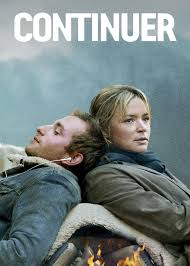
CONTINUER/ KEEP GOING
Belgium, 2018, 84 minutes, Colour.
Virginie Efira, Kacey Mottet Klein.
Directed by Joachim Lafosse.
This is a brief Belgian film, focusing on a relationship between a mother and son.
The context is their travels in Kazikistan, an attempt by the mother to reach out to her older teenage son, having abandoned him earlier and his living with his father. He has had trouble sometimes, and has been accused of attacking a teacher.
The journey takes place in quite exotic settings for the audience to gaze at. And there are various communities in the desert, small villages, friendly tribes, raiders…
And the travel is on horseback.
The son is rather wilful in his treatment of his mother. She is frequently exasperated. While there are some moments when they do bond, there is continual uncertainty, even a dramatic climax and his pulling a gun on his mother.
There is no certain ending, leaving the film for the audience to gauge their response to each of the characters and how the conflict could be resolved.
- The title, a journey, external travel, interior journey?
- A built-in production, the cast, locations in Morocco, standing in for Kajikistan? The musical score? Songs, dancing?
- The journey, the introduction, the desert locations, the horses, mother and son? The development of the relationship? The past, the young mother, abandoning the family, the role of the father, the son growing up, early adulthood, with his father, travel with his mother, choices?
- The audience enjoying the travel, the range of locations, the various encounters, friendly families and hospitality, local raiders, the blacksmith and the ritual traditions with the horses, the village gathering in celebration?
- The portrait of the mother, her age, her intentions, riding the horses, the relationship with her son, love, exasperation, the conversations, the silences, her concern, the target of his bitterness? At the various locations, the son with the people, the mother mediating? The moments of breakthrough, then the resentments? The finale in the village with the injured horse, working with the horse, the meal, the singing and dancing, the son, his anger, returning with the revolver? The confrontation? The continuing of the journey, some kind of reconciliation and understanding? A future?
- The son, age, experience with his father, the father’s condemnation of his mother and her drinking, her absence, his behaviour, uncontrolled, attack on the teacher, going on the travels, listening to the music, ignoring his mother, angry with his mother, the comments, the reminiscences? His bad manners with people, on the travels? The horse, the village and its care for it, the celebration, his drinking, exasperation, returning with the revolver, the threats? Continuing the journey, some possible understanding and reconciliation?
- Audiences identifying with the mother, with the son, understanding, empathy or not, hopes for reconciliation?
Madeleine Collins
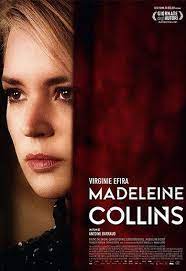
MADELEINE COLLINS
France, 2021, 104 minutes, Colour.
Virginie Efira, Quinn Gutierrez, Bruno Salamone, Jacqueline Bissett, François Rostain, Loise Benguerel.
Directed by Antoine Barraud.
Madeleine Collins doesn’t really appear in this film. That is part of a point made at the end of the film.
This is a film about identity, a film about someone who is present to two families. In films, this is usually a man with two families. This time it is a woman. And she is played by Virginie Efira, emerging in the last decade as one of France’s most significant and versatile actresses.
There is an opening sequence with the Virginie Efira in a dress shop, with money from her mother, trying on dresses, and collapsing with low blood pressure, then leaving the shop and the sound of a crash.
However, the main action takes place in the two households, one in Switzerland where Judith is in partnership with Abdel and his little daughter to whom she is devoted. She is a translator and has to go to various meetings. But, most often she goes to Paris to her other family, longtime husband who is an orchestra conductor, eager to advance his career, and with two teenage sons. On the one hand she has a happy domestic household. On the other, there is the glamour of the theatre, performances, socials, wealth, the buying a house.
Each of the men knows the name of the other but does not really know what is happening.
Which means that this is something of a psychological study of how Judith, also known as Margot, dependent on an admiring forger who is able to give her any identity she wants or he wants to give her (Madeleine Collins), the way she relates to each of the men in the families. It is also a story of deceit, cover, lies, becoming more and more complex and the possibilities of her being exposed. There are parents (and a welcome cameo by Jacqueline Bissett as her mother), there are clients who turn up unexpectedly…
This is a film for admirers of Virginie Efira and those intrigued by stories of coping with double households.
- The title? Area of mystery? Identity?
- The Swiss settings, homes? The Paris settings, concert and orchestra, socials? The musical score?
- The prologue, the visit to the store, looking at the dresses, trying them on, the collapse, low blood pressure, the aftermath and the accident? With reference to the rest of the film? To Judith that her character?
- A film about a double life, a middle-aged woman, her background, the visit of her parents and her relationship to them? Her marriage to Melvin, many years, his career, the two sons, the household, her travels, his travels, the scene of buying the house? The socials, the concerts, her leaving with her low blood pressure? Her friendship with the singer?
- The relationship with a Dell, Her relationship, the little girl, not married, their life together, a love for the little girl and devotion, a contrast with her other family?
- Judith and her work, translations, the jobs, seeing her in action, but her creating situations, her lies, travels? Going from one family to the other? The effect on her?
- Annabelle, the death of his wife, the birth of his daughter, the relationship with Judith, setting up a household, her devotion, love, his feeling our absences, bringing another woman home, Judith’s reactions? The visit of her parents? The other woman in the house? Their observations, the little girl calling out to Judith as her mother?
- Melville, his career, promotions, concerts, the growing separation? Doris and his observations, listening, his own secrets and orientation? His reaction to Judith?
- Juggling the two lives, the times, the travels, the passport, the forger and his devotion to her, saying she would have as many names as she wished, giving her a final card and name?
- The police, her upset, wanting documentation, her refusal? Picked up by her father?
- The chance encounter, the Canadian, her name is Marco, at the social, her awkwardness, Abdul and his reactions?
- Judith, her identity, the two families, separations, alienations, wanting her own life, identity?
Other People's Children/ Les Enfants des Autres
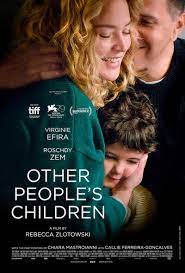
OTHER PEOPLE's CHILDREN/ LES ENFANTS DES AUTRES
France, 2022, 103 minutes, Colour.
Virignie Efira, Roschdy Zem, Chiara Mastroianni, Callie Ferreira-Goncalves, Yamee Couture, Sebastien Pouderoux, Frederick Wiseman.
Directed by Rebecca Zlotowski.
This is a very personal film by writer-director, Rebeccaatowski, reflecting on her own experiences, family (and casting her father as the father of the leading character, Rachel), on not having children, the emotional consequences for a woman, and exploring the maternal instinct. This is very much a film by a woman, for women, and an alert to the male audience, something of a plea for understanding.
The setting is Paris, ordinary life, homes and apartments, school. Rachel is played by Virginie Efira, prominent in French films in recent years. She is a strong screen presence, at times what might be described as “luminous”. While we observe her initially, we begin to identify with her, share her experiences – and the issue of working with other people’s children. Rachel is in her 30s, moving towards 40, time running out for her to have a child (and, later, a revelation that she had an abortion earlier. Interestingly, Rachel is from a Jewish family, goes to the synagogue with her father and sister, and has a discussion about Jewish tradition on abortion, whether the fetus can be considered a person, the father is suggesting that the tradition says that it is not – but that Jewish tradition is against child killing.) We see her as a dedicated teacher in her school, concerned about the students, especially a young boy, teenager, Dylan, difficult family background, not doing well at school, the staff meeting urging that he not return to school, Rachel organising a placement for him, pleading that he is the kind of student that the school should be working to support. It is clear that in her professional life, Rachel is dedicated to other people’s children.
Rachel becomes involved with an engineer, Ali (Roschdy Zem), separated from his wife, sharing the custody but much responsibility for his five-year-old daughter, Leila (quite a striking performance from the young Callie Ferreira-Goncalez). There is an intensity about Rachel’s commitment to Ali and, especially, to Leila, other people’s children. Leila is quite a wilful little girl, critical of Rachel and her presence, wanting her mother, but gradually getting used to Rachel’s presence, even doing a drawing which he presents to Rachel showing Rachel closer to her than her mother. Will her teaching and her relationship with Ali and Leila be Rachel’s fulfilment?
There is a further emotional complication when Rachel’s sister becomes pregnant and gives birth, Rachel a devoted aunt.
But, can this last? There is pain and pathos for Rachel, Ali making a decision for his wife, Rachel and the pathos of the farewell to Leila. The suggestion of a possible pregnancy – but only possible.
And that is how the film itself ends – but, there is an unexpected epilogue, very nicely judged, Rachel older and accepting her life, continuing her teaching, but being affirmed by her student, and her knowing her life is for other people’s children.
1. The title, tone, significance? Is focused on the character of Rachel, her experiences, motherhood, not having children, caring for other people’s children?
2. The Paris settings, homes, schools, the streets, outings, hospitals, doctors rooms? Realistic feel? The musical score? The Vivaldi, Doris Day singing Again? The final credits joy and song?
3. The writer-director, female, writing and directing at 40, her experience, family, the casting of her father as Rachel’s father, her sensibility, her sensitivities? Understanding female characters? Understanding male characters? Audience identifications?
4. Rachel story, Virginie Efira’s screen presence, luminous, sympathetic, strong, tender, assertive, vulnerable? Her age, the revelation about her past, relationships, pregnancy, abortion? Jewish background? At the synagogue, the prayer, her father and sister? The discussion about the Hebrew tradition and abortion, the life of the fetus, not alive, the crime of killing children? Rachel and her work at school, concerned for the students, Dylan and his placement, with Ali, its not working out, the staff discussion about him, her plea, they’re accepting him (and the epilogue)?
5. Her relationship with Ali, his marriage, failing, Leila, at five, in love with Ali, time with him, the outings with Leila, her criticism of Rachel’s always being there, Rachel and the hurt, the gradual change, Leila taking Rachel for granted, wanting her presence, at the judo lessons, driving the car and her being sick, the impact of the crash, the drawing and Rachel’s place in it? Her meeting Alice, Alice and her friendship, Alice and her friendship with Jean, the illness, her death? The prospect of a future with Ali and with Leila?
6. Ali, the meetings with Alice, going to Alice’s parents for Leila’s birthday, his return, breaking with Rachel, his love for her, his love for Leila?
7. The impact on Rachel, her wanting a child with Ali, her being hurt? The meetings with Alice? The farewell to Leila? The encounter with Paul, from school, consolation, sexual encounter? The possibility of her being pregnant, going to the doctor, his sympathy?
8. Rachel sister, the bond between them, her pregnancy news, Rachel and her happiness, the time of the pregnancy, the birth? Later with the child, Rachel looking after her, the photographer?
9. Rachel, age, too late for children?
10. The film ending – the surprise of the epilogue, Dylan and his story, Rachel listening, her joy in his success, her walking away – and her being satisfied with her teaching, her care, her commitment to other people’s children?
