Displaying items by tag: Peter Malone's Movie Reviews
Vingt Dieux/ Holy Cow
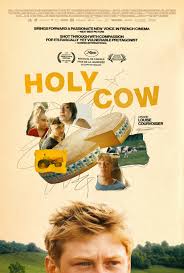
VINGT DIEUX/ HOLY COW
France, 2024, 94 minutes, Colour.
Clement Faveau, Maiwene Bartlelemy, Luna Garret, Mathis Bernard.
Directed by Louise Courvoisier.
For a French film by a Swiss director, her first feature film, Holy Cow seems a particularly English-language title. And, it is. The title in French actually means “20 Gods”. And, the experts suggest that an English translation of this local idiom is, in fact, Holy Cow but in translation more politely, Good Heavens! (But Holy Cow is exclaimed many times in the subtitles.)
And, the audience does seek cows at the beginning of the film, as it opens at a local fair. This is very much a drama of life in a comparatively small town, village life, farming, and a local cheese industry.
However, this is the story of Totine, a 17-year-old, caring for his seven-year-old sister, Claire, their father friendly but a drinker and soon to die in an accident, leaving the two to try to manage a life without him or any support. The difficulty is that Totine is literally one of the boys, a gang of friends, boisterous, drinking, sex with the local girls, hangovers, no inclination to work, irresponsible and with prospects accordingly.
It is not easy to like Totine who needs a good talking to or…
But, this is a film about real life, about decisions that have to be made, even by 17-year-olds. Totine does look after his sister. And he tries to get work, going for an interview at the cheese factory, falling foul of members of rival gangs, but persevering. While he does take some initiatives, especially fascinated by the making of cheese, good straightforward and honest procedures are not yet in his make up. He steals milk with his friends, works with his sister using processes that he learns from a session held by a local cheese producer.
In the meantime, there are clashes with his friends, one of them preparing an old car for a stockcar rally – one of those old-time rallies with the old cars speeding around, turning somersaults, standing on end, dangerous but exciting the thrillseeking drivers and the thrillseeking crowds in support.
There is no final happy ending. Totine has still to face up fully to a lot of the realities and responsibilities of life but he is on the way. There is rejoicing with his friend winning the stockcar race. There is a sense of satisfaction in having made some cheese which has quality. Totine has to move on from his liaison with the young woman who manages cheesemaking and he has learned some truths about what is required for a genuine relationship.
Holy cow! This is a story about a young man having to learn to be his better self.
- The meaning of the title: 20 gods, local expression, English equivalents, Holy Cow, Good Heavens!?
- The location, France, mountains, the village, homes, the dairies, factories? The musical score?
- A slice of village life, the countryside, the older people, work, steady jobs, manufacturing cheese? The younger generation, irresponsible, drinking, sexual encounters, avoiding work? The background of stockcar racing?
- The theme, the young and irresponsible, real-life catching up with the death of the father, taking care of the young sister, finance, work? Change, still roguish, but facing reality more and more?
- Totne, age, carefree life, at the fair, the challenge, stripping naked, his friends and the bonding, drinking, hangovers, sexual encounters? At home, his father, drinking, his young sister, taking her to school? Ordinary life? Prospects?
- The death of his father, at home, caring for his sister, her age, personality, dependence? His having to get a job, going to the company, the interview, the work, cleaning the vats? The background of the gangs, the fights, Totine being bashed? His return to work?
- Cheesemaking, importance for the area, the cows, the factory, the making of the cheese, the blocks? Business? Competitions?
- Totine and his interest, going to the class, the woman explaining, the audience? Totine and his friends, deciding to make cheese? His meeting with Marie-Lise, her age, the attraction, the sexual encounters? And behind the scenes, the stealing of the milk?
- The attempts to make the cheese, his sister helping, the process, the achievement?
- Totine taking the cheese to the competition, the desk, the requirements, unable to fulfil them?
- Marie-Lise, discovering the truth, the clash, the fair, getting together again?
- The stock car driver, friendship, the clashes with Totine, sequence of the race, the cars, the turns, standing on end, accidents? The victory? Friends, Totine his sister celebrating?
- The prospects for Totine, life in the village, growing up, having to take responsibility, cheesemaking? Yet the continued drawbacks? His future?
Age of Heroes
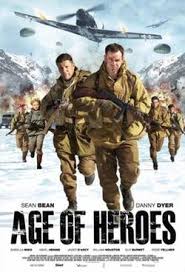
AGE OF HEROES
UK, 2011, 93 minutes, Colour.
Sean Bean, Danny Dyer, Aksel Hennie, Izabella Miko, James D'Arcy, William Houston, John Dalgleish.
Directed by Adrian Vitoria.
During World War II there were many stories of military action, spying, propaganda. And, they formed a staple, especially in England, of movie entertainment in the 1950s. Age of Heroes is very much in this vein 70 years later.
The screenplay follows the general pattern of those old films so we know, more or less, what to expect, except that these are in colour, have saltier language then the films of the past, and have some exciting location photography.
The film has for centres of action, the first with a group of soldiers in occupied France, May 1940, under attack, the small group surviving with their corporal, Rains (Danny Dyer) making decisions and falling foul of a superior officer. The next setting is prison, for those accused of cowardice, drilling, treated harshly by those in charge.
An officer arrives to take away one of the inmates, is confronted by Rains who wants to be a commando. And, eventually, he does. The officer, played by Sean Bean, is in charge of an operation, in collaboration with the Navy authorities, especially Fleming, played by James D’Arcy. The group chosen, including Rains who is at first targeted and challenged, does the expected hard training in Scotland.
And the main action is in Norway, the commandos landing, the plane on fire and crashing. The target is a German radio installation, to get the information and documents, destroy the installation, get out of the country. The snowy Norwegian landscapes always look impressive. The Germans are very familiar in their attitudes and behaviour from those old films. And there are Norwegian loyalists, and a very grim sequence where their leader pleads for their lives, and German soldier filming everything, their being lined up and all shot.
A mixture of the commando troop, some clashes with a local Norwegian soldier, but, ultimately, the kind of action we expect, and a reminder of as the title suggests, war heroism.
It is interesting to note that the film is based on an episode led by the future writer of the James Bond novels, Ian Fleming.
- Ambitious title? World War II, special commando squads, the background of Ian Fleming? Dramatisation of a true story?
- The French settings, may 1940? UK, military prison? The Scots training sequences? The action in Norway, the snowclad landscapes? The musical score?
- The basic formula for World War II action films, in the past, in the 21st century? The appeal of war action films, patriotism, heroics?
- The setting, the French sequence, the isolated group, the Germans, deaths, the encounter with the main group, Rains and his leadership, confrontation with the officer, arrested, prison?
- The prison sequences, the rough treatment, the offices, physical abuse?
- The authorities, Jones, his visit to the camp, taking the injured man away, the confrontation with Rains? His visit to Fleming, the Navy, the collaboration, the plan?
- The choice of the men, Rains included, his friend, going to Scotland, the rigour of the training, targeting Rains, but his being included in the group?
- The meeting with the authorities, the explanation of the mission, Norway, the tower and the information, the Germans, the Norwegian Patriots? The flight, the fire, crash landing?
- The details of the mission, travelling the terrain, the snow on the mountains, morale amongst the men, the encounter with a local group, the female soldier, aggression towards her? Working together, over the mountains?
- The Germans, their presence, the Norwegians, helping, the Germans rounding them up, for information, the plea not to kill the family, their all being lined up, shot, everything filmed?
- The final confrontation, the strategies, the battle, shooting, the pursuit, the capture, the final fights, survival and escape?
- The information to London, Fleming and his decisions, the rescue?
- The finale, the sense of achievement, and the title of the film?
Happy Gilmore 2
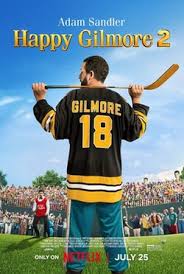
HAPPY GILMORE 2
US, 2025, 114 minutes, Colour.
Adam Sandler, Julie Bowen, Christopher McDonald, Benny Safdie, Ben Stiller, Bad Bunny, John Daley, Dennis Dugan, Haley Joel Osment, Jackie Sandler, Sadie Sandler, Steve Buscemi, Margarette Qualley, Verne Lindquist, Post-Malone, Nick Faldo, Sergio Garcia, Charles Howell III, Scotty Scheffler, Lee Trevino, Bubba Watson, Seth Waugh, Will Sasso, Travis Kelce. Tim Herlihy, Richard Kiel, Scott Mescudi, Judith Sandler, Nick Swordson, Eminem, John Lovitz, Rob Schneider.
Directed by Kyle Newacheck.
29 years later! Happy Gilmore was one of Adam Sandler’s earliest comedies – very successful and he named his production company after him. In the meantime, Sandler has become a household name, critics not always favourable to his comedies but praising him in his serious roles, Anger Management, Punch-Drunk Love. In more recent years his films have gone straight to Netflix.
Sandler takes up his old character, often likeable, often unlikeable, having made a great success 30 years earlier with his golf skills, and his clashes with his arch rival, played by Christopher McDonald. As this film begins, there is an emotional and dramatic shock, Happy Gilmore has hit a stroke which has hit his wife, Virginia (Julie Bowen) and has killed her! This causes him a great deal of grief, drinking, collapse – but the opportunity for her to reappear in many ghostly supportive sequences. In the meantime, they have four rough and ready boys who are ready to mix it amongst themselves and with anybody else at an instant’s notice. But, there is also a daughter who is a successful dancer and has the prospect of going to study in Paris if the fees can be raised.
This gives a certain framework to a plot, Happy Gilmore dependent on drink, full of self-pity, memories of his wife. When he is persuaded to try again at golf, there are all kinds of comic misfires. But, we know that he will actually improve but, many hurdles and sandpits along the way.
In the meantime, his foe from the past, Christopher McDonald, has spent his years in an institution but is allowed out under the influence of millionaire, Frank who is setting up a rival golf organisation which could eliminate traditional golf (memories of the Saudi Arabian competition). Frank is played by director Ben Safdie. But, McDonald will not accept the terms and actually becomes one of the main good guys for the rest of the film.
There are a number of flashbacks to the past, including a scene with the late Carl Weathers as the coach and a tribute to him.
And, quite a number of characters from the past, substantial like Ben Stiller as the would-be councillor for AA meetings, comic glimpses of Richard Kiel and his diminutive mother, Judith Sandler. In fact, there are various members of the Sandler family appearing throughout the film. There are momentary glimpses of Rob Schneider, a comic sequence with John oevitz, Steve Buscemi as the bad neighbour. And, a modern touch, Margaret Qualley as a young golfer.
And, there are over 20 champion golf players making cameos here from Jack Nicholas to Rory Mc Elory. Which probably makes the film something of a must for golf aficionados.
The screenplay was written by Tim Herlihy with Adam Sandler, Herlihy having written 12 of Sandler’s films. His popular rector, Dennis Dougan, has a cameo role here. The present film has been directed by Kyle Newacheck, who directed Sandler in Murder Mystery.
Which means that any conversation about the film will focus on Sandler and his comedies and his reputation, memories of the first film, and sharing appreciation of all the guest comics who make an appearance and, more especially, all the golf celebrities.
And, on first release on Netflix, it broke the records!
Lyceen, Le/ Winter Boy
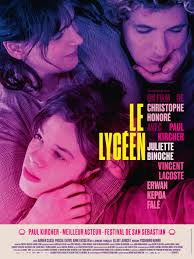
LE LYCEEN/ WINTER BOY
France, 2022, 122 minutes, Colour.
Paul Kircher, Vincent Lacoste, Juliette Binoche, Erwan Kepoa Fale.
Directed by Christophe Honore.
Christophe Honore has written and directed a number of films which are emotional dramas, films about identity, relationships, sexual orientation. This is one of his later films but dramatising the same themes.
The English title does not translate accurately the French title which simply means High School Student. And the central character, Lucas, aged 17, is at high school, a boarding school. Lucas is played by Paul Kircher who won a number of awards for this performance.
Lucas bonds strongly with his devoted mother, another fine performance from Juliette Binoche. His somewhat distant from his father, played by Christophe Honore himself, a man who does reach out to his son but is soon killed in an accident on an open road, raising the question of whether it was an accident or deliberate on the part of the father.
These are some of the grief questions that haunt the film. There is also an older brother, Quentin, Vincent Lacoste, an artist who lives and works in Paris.
One night at boarding school, a teacher wakes Lucas with the news of his father’s accident and is taken to the hospital where the extended family has gathered. From here, the drama highlights how the mother and her two sons respond to the situation, the details of their grief, and the effect of the grief on each other.
And a key issue for Lucas is that he is gay. He says he has known this since he was eight or nine and that his father knew this and was disappointed in him, grating a feeling that his father did not like him and that Lucas wanted him to – and Quentin continually tries to reassure him. Honore dramatises Lucas as in no way confused about his orientation, certainly uninhibited in his behaviour – and there are some explicit sexual encounter scenes.
Quentin decides that Lucas should come to stay in Paris with him, opening Lucas’s eyes to the city, but also some encounters, with Quentin’s art associate friend, Lillio, which leads to some unexpected aspects of the gay issue. But, Lucas also goes to a church, meets a sympathetic priest, looks at some of the baroque paintings of Jesus and the passion, Lucas is honest with the priest asking what resurrection means and the priest giving a credible brief explanation about risen life, new life and hope. This makes an impact on Lucas even though this is an isolated religious sequence.
Honore uses the device of Lucas talking and reviewing his life and emotions straight to camera, a kind of explanation of himself to his father and to the audience. And, at the end, his mother, also addressing his father, talks about the effect of all this experience on herself which enables her to come to terms with her grief and resume her life teaching at a school.
The film is well acted and draws the audience into the lives of these characters, sometimes sympathetically, sometimes provocatively, sometimes with edge. But, this is what life is like. The director acknowledges sadness but also indicates hope.
- The literal title, High School Student? The emphasis on age, the boy at school, his coping with the crises in his life?
- The setting, the countryside, the town, homes, travel along the roads? The boarding school, corridors and rooms? The contrast with Paris, the apartment, streets and buildings, the atmosphere of Paris? The musical score, the songs and their significance, performance, lyrics, by Lollio, by Lucas?
- Time shifts, the focus in the present, the flashbacks to sequences with the father and husband, the interspersing of the action with Lucas speaking to camera, or to his father, explaining himself? Isabelle and her talking to camera, confiding in her husband and his continuing presence?
- The bond between Lucas and his mother, driving, his moods, nonchalant, withdrawn? Life at school, his relationship with Oscar, horseplay at the school, the later sequence of the sexual relationship?
- Lucas as a gay character, his accepting it, taking it for granted from the age of eight, his father recognising it, his reaction to his father’s disapproval? Wanting his father’s approval? The relationship with Oscar but non-commitment? His brother aware of his situation? His mother not making any reference? In Paris, the initial encounter with Lillio and the attraction, interest, discovering Lillio and the paid sexual encounter? Lucas and his contact with the young man in Paris and the sexual encounter and discussion?
- The visit to the church, questioning of the priest about the resurrection, the police explanation, new life and hope? The insertion of this religious dimension into the narrative?
- Lucas, his age, attitude towards school, no plans for his future? At night, the teacher coming with the news of his father in hospital, going to the hospital, the extended family gathering, discovery of the truth, his mother upset because she wanted to tell him? The film’s focus on the aftermath of the death and its impact, on Isabelle, on Quentin and his grief and sometimes weeping, on Lucas, disoriented, wanting his father, wanting his father’s approval? Disturbed?
- The decision to go to Paris, the apartment, Quentin and his art, his girlfriend, the curator’s visit, getting upset with Lucas, getting him up, the bed, breakfast, sending him out, giving him the money? Quentin and his friendship with, Lillio, the meeting with the artist, her implying that Lillio was anti-Semitic, the aftermath? Quentin and his reaction to Lucas being with the paying man? Wanting him to go back home?
- With Lillio, the attraction, the discussions, the visit with his mother, her strong-minded opinions, Lillio and the song, the aftermath?
- Lucas, depression, sitting, watching, slitting his wrists, in the institution, his mother and the care, not speaking, therapy, the Christmas visit, the meal, Quentin and the desert, the happy atmosphere? Lillio’s visit, their going on the run, Lucas leaving him at the station? His mother, her joy, his speaking?
- Isabelle, going back to school, talking to camera and her husband, the basketball, going back to some kind of normal and ability to cope with grief? The good news to Quentin about Lucas speaking?
- Lucas, running, greater self acceptance, possibilities for his future?
Ghost of St Michael's, The
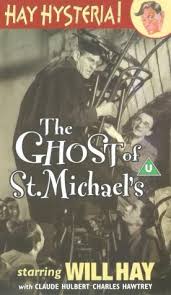
THE GHOST OF ST MICHAELS
UK, 1941, 82 minutes, Black-and-white.
Will Hay, Charles Hawtrey, Claude Hulbert, Felix Aylmer, Raymond Huntley, John Laurie, Hay Petrie, Brefni O'Rourke.
Directed by Marcel Varnel.
An example of popular comedy produced in the UK in the late 1930s and early 1940s. Will A, the scientist and astronomer in training and hobby, was popular as a comedian in a series of small-budget films at the time. He was revered and audiences now watching his films will be interested in his status and impact at that time. But, it seems quite dated.
This is a wartime story, an indication of spies operating in England and Scotland. It is a story of a transfer of school students to an old Castle in Scotland, travelling by ferry to an island, and the old Castle reputed to have ghosts. (Those interested in screenwriting might note that one of the contributors here, John Dighton, made the school comedy, The Happiest Days of Your Life almost 10 years later.)
The comedy is very broad, farcical, the suggestion of ghosts and eerie music, especially agitated by the Scots staff member, John Laurie. And, in fact, there are two deaths, not by ghost but by a spy. In the two deaths are of the serious characters in the film, two headmasters, Felix Aylmer and Raymond Huntley, playing straight rather than comic roles.
However, in retrospect, the surprise of the film is the presence of Charles Hawtrey at the age of 26, already a strong career in film and radio, really the commanding presence of the film even over Will Pay. He portrays a very precocious student, shrewd, mischievous, a touch self-righteous, the contributing strongly to the solution of the mysteries. It would be another 15 or 16 years before he made his first Carry on film, starring in 23 of the series. And, his style in 1941 certainly prefigured his comic abilities in his Carry on career.
One for the historical record and for film history buffs.
Fantastic Four, The: First Steps
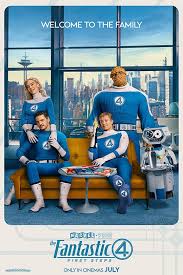
THE FANTASTIC FOUR: FIRST STEPS
US, 2025, 115 minutes, Colour.
Pedro Pascal, Vanessa Kirby, Egon Moss-Bachrach, Joseph Quinn, Julia Garner, Natasha Lyonne, Paul Walter Hauser, Sarah Niles, Mark Gattis. Voices of Ralph Ineson, Matthew Wood.
Directed by Matt Shakman.
2025 as been a superpower blockbuster movie year, Thunderbolts*, then DC with Superman and Marvel with The Fantastic Four. The latter two performed beyond expectations at the box office in the US and around the world. Still popular!
The Fantastic Four are not as familiar to moviegoers as Superman or Batman. There were two films in 2005-7 and an attempt to revive the franchise in 2017. This film is another attempt – and with the promise that the Fantastic Four will appear in forthcoming Avenger films.
One of the features of the Fantastic Four is that they are a very friendly group, especially likeable for the audience. For anyone not familiar with them, and for those who are, there is a prologue to this film, a TV program, a kind of This is Your Life summarising with clips the personal lives and origins and all the exploits of the Four, their venture into space, their DNA being altered, then becoming superheroes, and very popular with the citizens of New York City and the world.
Reed Richards, played sympathetically by Pedro Pascal, is the scientist, mathematician, intelligent, cerebral in his approach to crises. By contrast, Vanessa Kirby is his wife Sue Storm, her discovering she is pregnant, and she and the family, and the audience, happy anticipating the forthcoming birth. Then there is her younger brother, Johnny Storm, played enthusiastically by Joseph Quinn sometimes brash, literally full of fire, eager to be an uncle. The fourth member is Ben, played by Egon Moss-Bachrach, seen as his ordinary self in the prologue but then DNA drastically altered to some thing of a monster look, but genial behind all that orange granite that forms his exterior.
Casting is interesting because two of the Four are British, Vanessa Kirby and Joseph Quinn. Pedro Pascal is from Chile.
When Earth is threatened by a strange alien, the Silver Surfer (Julia Garner), and threatened by the archetypal cosmic villain, Galacticus (voiced by British Ralph Ineson), the Four go into space to confront him.
Part of the drama is their initial failure (though with some spectacular sequences in space, and, emotionally and dramatically, the birth of the baby), the brief press conference where they tell their adoring public that there is no hope, then the determination to find a way of confronting Galacticus who has set his ambitions on taking over the new born child and its powers.
Which means that the second part of the film is the confrontation of Galacticus, the intervention of the Silver Surfer, the giant Galactic is heavily treading through New York City demolishing huge areas (as Lex Luthor did in Superman) intense demonstration of the superpowers by the Four.
And, there is nothing like a baby to elicit audience sympathy – and there is a pleasing preview during the final credits of the baby at four, with his mother, just having spent a day reading Charles Darwin’s Origin of Species.
- The status of the Fantastic Four in the marvel comics, created by Stan Lee? The previous film versions, modest, this version as a new beginning?
- The basis of the plot, the Marvel universe, the four characters, Reed and Sue, their backgrounds, marriage? Johnny as Sue’s brother? The work with Ben?
- The opening, a kind of resume of the characters and their superpowers, their activities, their reputation in New York City?
- The relationship between Reed and Sue? Background of their space mission, the experience, overwhelmed, the changes in their DNA, superpowers? The marriage, Sue, discovering she was pregnant, Reed, the scientist and mathematician, his more cerebral approach, his joy? Johnny and his enthusiasm?
- Ben, in the television program, his normal self, the space experience, the DNA, the granite and its colour, his size? And his voice, human and humane, his interventions? The encounter with Rachel, the students and his comic behaviour with them, his later going to find Rachel?
- The situation with Galactus, origins, age, giant, sinister, eager for power, targeting the baby? The Silver Surfer, her appearance, the surfboard, through space, arriving on earth, the warning?
- The status of the Four, Ed Gilbert and his show, the program, the exploits, the public and acclaim?
- The decision to go into space, travel, the space ship, the equipment, technical skills, Reed and intelligence? The confrontation with the Silver Surfer, with Galactus, their being caught, the escape, travelling back to earth, the pursuit by the Silver Surfer, her skills, evading capture, each of the Four coping, Ben and his piloting, reading the calculations, Johnny and his attempts with his fire? Their eventually arriving home?
- Sue, pregnant during the return, her experience, everybody involved in the delivery of the baby, the happy birth? Franklin?
- The television show, Mary and her friendship, the press conference on return, no hope, the reaction of the public, gradually turning against them?
- Reed and his experiments with transportation, the plan to move the planet Earth to the outer reaches away from Galactus? Its failing?
- The determination to resolve the situation, the public learning about Galactus wanting the baby, accusations of selfishness with the family not giving up the baby? The calculations, seemingly impossible? The discovery of the lever, the calculations, the appeal to the public, the television response, the collecting all the materials, the building of the bridges, the issue of electricity, the world collaborating in blacking out to give full power?
- The plan, times square, the central landing, the ring to trap Galactus?
- The encounter with The Silver Surfer, her coming for the baby, the dialogue with Johnny, her back story, her experience with Galactus, giving up family for the sake of the planet? Her hostility, her embarrassment and shame, her finally turning against Galactus and sacrificing herself?
- The help of Harvey Elder, his role in the past, sinister, ruling in the subterranean area, the clashes with the Four, their appeal to him, selfish, but agreeing, taking all the refugees from New York City?
- The arrival of Galactus, gigantic, walking through New York, crushing the buildings, the tremors for those in the underground? Capacities, voice, penetrating sight to see the baby, his being blinded, the substitute group, but his seeing where it was hidden, the continued pursuit, Ben and his interventions, Johnny willing to sacrifice himself, read in the calculations, Sue and her willpower, forcing Galactus back, almost to the Circle, the machine, the 37 seconds, his destruction?
- The Four, acclaimed, the public, Ed Gilbert and the program, Mary and the studio, the sudden call and their going out on mission?
- The preview for the Avengers films, four years later, the baby and reading Charles Darwin, Sue finding the baby with the sinister hooded figure?
Hand of Night, The/ Beast of Morocco
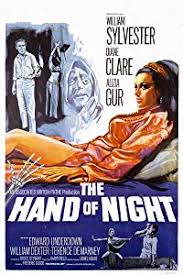
THE HAND OF NIGHT/BEAST OF MOROCCO
UK, 1968, 90 minutes, Colour.
William Sylvester, Diane Claire, Alizia Gur, Edward Underdown, Terence De Marney.
Directed by Frederic Goode.
The Hand of Night is a small budget blend of horror and adventure in Morocco. It was filmed on location in Morocco, directed by Frederic Goode who also made The Syndicate in Kenya the same year – and using the same star, William Sylvester (who, also in that year, starred in Stanley Kubrick’s 2001: a Space Odyssey).
The film opens with sinister nightmarish behaviour – which turns out to be a nightmare for the central character on a flight. The fellow traveller in the next seat, played by Edward Underdown, also appeared in the dream, carrying a cough and in a sinister cave.
The central character was driving when his wife and daughter were killed in an accident and this haunts him, escaping to Morocco, becoming involved with archaeologists, a sinister presence called Omar, and the tomb of the vampire Princess. He becomes involved with the vampire and finds it hard to tell whether this is reality or fantasy.
On the one hand, this is 1968 in Morocco, a modern city, a lot of sequences are driving around the city and through the countryside. On the other hand, with the excavations, the story of the vampire Princess, her threats, and the involvement of the niece of the archaeologist, the film builds up touches of romance, the abduction of the niece, her final rescue – and the decision to finally impale the vampire.
Of historical interest for those who wonder about small budget filmmaking in England in the late 1960s.
Meaning of Hitler, The
THE MEANING OF HITLER
US, 2020, 90 MINUTES, Colour.
Directed by Petra Epperlein, Michael Tucker.
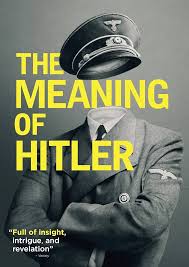 This film is based on a book by German historian, Sebastien Hafner, published in 1978, in English in 1979. His original title was Notes on Hitler.
This documentary is something like a workshop, something like a Zoom conference with the audience observing how hide range of speakers, starting with novelist Martin Amis and ranging through a great number of academics, historians, social commentators, psychologists…
And, there is a lot of location photography, the visit to Berlin, to Vienna, to Hitler’s birthplace (and a reference to the Bethlehem of the Third Reich). This is quite an amount of material to observe and absorb in 90 minutes.
The film follows the chapters in Hafner’s book, acknowledging that it is very difficult to comprehend the complexity of Hitler himself, his origins, his attempted art, the chaos in postwar Germany, his entering into that chaos, finding that he was an orator, building on his successful propaganda, in many ways a retiring man, having no friends, strange relationship with Eva Brown, and speculation on his suicide, and a critique of documentary and feature films giving him a dignity and choosing his own death and timing unlike the many that he sentenced to the camps…
The film is interspersed with some sequences from Hitler movies and actors who played him including Anthony Hopkins, Alec Guinness, and sequences from The Producers, Inglourious Basterds, Downfall. But, there is a focus in many clips from Benny Riefenstahl’s idealisation of Hitler and the Reich, Triumph of the Will.
Psychologists speculate on his psychology with suggestions of bipolar, schizophrenia… There are quite a number of Jewish contributors, discussions about the status of the Jews, persecutions, the visit to the Treblinka camp.
The main impact of the film is not to do a considered study because there are so many contributions. Rather, it is an opportunity to look and listen, to note key ideas, of the points of view and store for further reflection.
The film came out in 2020 and there are some sequences from Donald Trump’s first presidency offering some parallels in his ideological policies and personal propaganda rising with Hitler. (Seeing the film during the second Trump presidency could well reinforce this impression.)
Nice Indian Boy, A
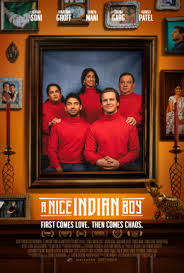
A NICE INDIAN BOY
US, 2024, 96 minutes, Colour.
Karan Soni, Jonathan Groff, Sunita Mani, Zarna Garg, Harish Patel, Peter S.Kim, Sas Goldberg, Sean Amsing.
Directed by Roshan Sethi.
A film with a great deal of heart. It is often very funny, witty, but a very serious theme for a romantic comedy. The two central characters are gay.
There have been many films about Indian communities in Britain, religious background, arranged marriages, lavish wedding celebrations. This time we are in the US. But, initially the same themes, opening with a huge wedding celebration. But, quietly observing everything, not participating much, is the brother of the bride. And, of course, everybody cheerfully commenting to him: “you’re next!” Which is the last thing he wants to hear.
He is Naveen, played with great charm, a way with words, but always with diffidence, by Karan Soni. We are always on his side even when he is too reticent, too self-conscious, too much moving aside. Six years after the wedding, he is a successful doctor, his good friend, outgoing and camp, played by Peter S.Kim.
The film has a lot to say about Indian culture, highlighting religious prayer and devotion, the reality of arranged marriages and spouses adjusting. The two parents in the film are very strong, a dominant and forthright mother who wants to be empathetic, a reticent father, traditional, quiet and often disappointed. But the daughter who married at the opening, is separating from her husband, very 21st-century forceful.
In prayer at a shrine of Ganesh, Naveen encounters a photographer, Jay, Jonathan Groff, who takes portraits of the hospital staff, a mutual attraction, played out with an emphasis on the humanity of each of the partners, appreciating each other, affection, love, challenges. And, not the least, is the white American, adopted by an Indian couple, dealing with Naveen’s family. There are quite a number of awkward meetings, calamitous family meals.
However, the audience knows that this is going in a reconciliation direction, some fine encounters with the parents, the bitter sister having to face family realities, the acceptance of J into the family. And, comparison with the opening of the film, another lavish Indian wedding.
There had been a number of romantic comedies with gay themes but this is a film which most audiences could well appreciate, whatever their approach to gay marriage, thoughtful, dealing with day-to-day realities of gay orientation and commitment.
- A pleasing romantic comedy, comic, witty, serious?
- The American setting, Indian culture in America, family, arranged marriages, religious perspectives, and weddings?
- The film in chapters, the headings, bright Indian colours and designs? The lavish backgrounds, costumes and decor, especially for the weddings?
- The musical score, Indian traditions, American songs? Dance?
- The opening, the wedding, lavish, the bride and groom, ceremonies, dancing? The family and friends?
- Naveen, quiet in the background, sitting, the narrative, his being gay, not out, everybody telling him that he was next? The touch of depression?
- Six years later, Naveen as a doctor, his friend, extroverted gay, comments? The work in the hospital, Naveen serious, with the patients, the taking of the photo, Jay as the photographer? Naveen going to the temple, Ganesh, his prayer, Jay coming in, his prayer and reverence? The recognition during the photo session?
- Jake, his story, orphan, adopted by the Indian couple, being gay, his photography, his exhibition, the gay subjects, the photo with his parents, the impact on Naveen? The going out together, the gay bar, conversation, friendship?
- The film as Naveen’s overcoming his lack of self-confidence, his withdrawing, giving himself to his work, the visits to his family, the meals, his sister, critical, and her husband encountering Naveen and Jay? Her wanting a divorce? The meal, the discussions, the parents, the reactions? Later inviting Jay to dinner, the sister and her sabotaging the relationship, Jay leaving, the effect on Naveen?
- The portrait of the parents, the family background, the arranged marriage, the mother saying she had adjusted, the life together, her strong opinions, forthright, watching the gay television channel for her son, but interfering, especially with her daughter? The father, his life, quiet, traditional, relationship with his children, the issue of homosexuality?
- Naveen, the discussions with his family, some understanding, his greater confidence? The relationship with Jay, the sexual encounter, moving in, their life together, going out, sharing, Jay drawing Naveen out of himself? Jay and the satisfaction of the relationship?
- The break, the possibilities of coming together, the sisters intervention, the role of the parents, the father going to see Jay’s photo exhibition? The encounter in the kitchen, Jay and the suggestions for cooking? Greater reconciliation?
- The proposal, the planning for the wedding, Indian style, the range of friends, Jay and the couple who always stood by him, Naveen’s co-worker and his mother?
- The Joy of the wedding, the celebration, Indian style, American style, happy ending?
- Again romantic comedy for all audiences focusing on humanity, relationships, love?
Brink, The
THE BRINK
US, 2019, 91 minutes, Colour.
Directed by Alison Klayman.
The Brink is a close-up portrait of political activist, Steve Bannon, in 2017-2018, especially 2018 and his activities in the months approaching the midterm elections of that year.
The film was significant in its release in 2019, director, Alison Klayman, producing and directing, no crew (which gave her rather unobtrusive close-up action at many private meetings), photographer, editor, her personal portrait of Bannon. In some ways, it is surprising that Bannon allowed her such access but, as with Donald Trump, bad publicity is better than no publicity!. The film has something of his background in politics, finance, but very little about his personal life except reference to his wives and his nephew, Sean Bannon, working for him.
The film gives some background to Breitbart News, his work in this alt-right organisation, writing, radio, television, his links with various personalities in the organisation especially in the UK.
He is credited with some masterminding in Donald Trump’s 2016 election campaign but, in 2017, began to be critical of Republicans, his being fired by Trump, and then his very personal mission of promoting Populism, the film highlighting many travels to Europe, press conferences, political meetings and discussions, especially strong with Nigel Farrage, Victor Orban, Giorgia Meloni, Marine Le Pen…
Which means that there is a lot of discussion about right-wing policies, leadership and control, issues of immigration, collaboration between the right-wing movements, especially in Europe.
The film also shows his involvement in promoting candidates and interviewing them for the midterm elections, and the end of 2018 with his candidates not succeeding in being elected.
While the film ends here, another film could certainly be made about Bannon’s life and career in the succeeding years, fraud charges, cases, a pardon from Trump, international links with financial partners, more fraud charges, imprisonment, 2025 and his criticisms of Trump, especially as regards the relationship with Jeffrey Epstein.
Which means then that anyone viewing The Brink after 2020 is looking at it with a value of 2020s hindsight.
