Displaying items by tag: Peter Malone's Movie Reviews
Utopia
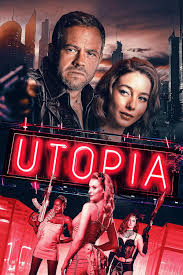
UTOPIA
US, 2024, 91 minutes, Colour.
Moe Dunford, Charlotte Vega, Michael D. Xavier, Alex Milleret, Wanda Banda, Lucy Ackhurst, Sean James Sutton.
Directed by James Bamford.
Utopia is an ultra-luxurious hotel resort complex built in a remote fictitious former Soviet Union country. The film opens with a sexual encounter, a leering man, a seductive woman, her getting a sword and decapitating him.
In many ways, for a popular entertainment, the film is quite a disturbing experience. Although, this is not the comment from most of the bloggers on the IMDb.
Women watching this film would generally be appalled at the intensity of the lustful male gaze, the exploitation of the women as sex slaves, the behaviour of the women and the discovery that they were being manipulated as replicants of their real selves, the replicants complicit in the dominance of the males, their whole existence to make the males happy, the presumptuousness of the male characters and the implicit misogyny of the exploitation of the women.
Men watching the film may be disgusted at the situation and the presentation of male exploitation of women – though, on the other hand, many men in the audience may well identify with the male characters and their attitudes towards women, exploitation, sex slaves…
The framework of the film, written, directed and produced by men, has a central hero played by Irish actor, Moe Dunford. He is in a relationship with Alexis, played by Charlotte Vega. They clash because of his work, his connection with MI5 investigations and his linkup with fellow officer, played by Jason Fleming. Then the audience sees that she is abducted and we see her then as one of the women in Utopia.
There is a large cast of women in the resort and Utopia contains a great deal of leering, ogling, sexual attitudes of the men and the complicity of the replicant women. The range of male characters include the entrepreneur who has created Utopia, his staff of technicians, various thugs in his employ, and a leering businessman who wants to invest in the future development and who takes a liking to Alexis. There is even a bespectacled nerd, ridiculed by others but just as leering and, eventually, wanting to invest in the future developments.
Moe Dunford infiltrates, discovers Alexis, participates in many of the fantasies, especially the recreation of Paris in 1943, the Nazi occupation, the burlesque, and he as an American in Paris.
But, he is in contact with Jason Fleming, gaining sympathy with some of the women who have lost their memories, tries to activate them, various pursuits and fights, the discovery of the actual women sedated and the creation of their replicants.
Final climaxes, fights, stances of the replicants, the revival of the women, the confrontation with the entrepreneur, some split-second timing…
Here is a futuristic film which speculates about AI, the recreation of the clones, the creation of live replicants – but it is presented in the context of male exploitation and misogyny, images of female submission. The original intention might have been expose and challenge but on the way there is a great deal of exploitative titillation.
One Battle After Another
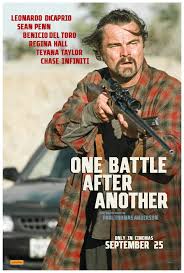
ONE BATTLE AFTER ANOTHER
US, 2025, 161 minutes, Colour.
Leonardo DiCaprio, Sean Penn, Benicia del Toro, Teyana Taylor, Regina Hall, Chase Infiniti, Tony Goldwyn, James Downey, John Hoogenakkerr, Kevin Tighe, D.W.Moffat.
Directed by Paul Thomas Anderson.
An American movie with quite some frightening impact – even though there are many, many comic moments throughout. It has been written and directed by Paul Thomas Anderson who has had a significant 30 year career, many feature films and great number of music videos. For this reviewer, Magnolia and The Master stand out as well as the menacing There Will be Blood.
Anderson has said that he was interested in Thomas Pynchon’s 1984 novel for many years, seeing it as something of a futuristic vision of a disturbed United States, revolutionaries, status quo, clashes and violence… He has taken the novel as a starting point for a 21st-century futuristic look at this kind of United States. Filming was completed by 2024 but by its release in mid 2025, it does not seem futuristic so much as a satiric imagination of Donald Trump’s America, no longer futuristic, the present. (And it will be interesting to look back on this film when the second Trump presidency ends.)
The opening is quite disturbing, intense revolutionaries, of the left, protests and sabotage down at the Mexican border, the freeing of imprisoned migrants and refugees. More than topical. And then there is the military, the revolutionaries battling the soldiers. The key revolutionary is Perfidia, played by an intense Teyana Taylor. And her comrade is explosives manager, Pat, Leonardo DiCaprio. There is an intense power and sexual struggle between Perfidia and the symbolically named soldier Lockjaw, one of Sean Penn’s best performances. The revolutionaries are shown in a collage of all kinds of explosive protests but, no spoilers, they are dramatically taken down – with unforeseen circumstances and consequences.
However, the action suddenly moves on 16 years, Pat is living with perfidious daughter, Willa, Chase Infiniti, popular at school, Pat changing his name to Bob, tough with his daughter but the consequences of drink and drugs hovering. Long story short, his daughter is taken by the military for interrogation, and Bob has to go on the run, making contact (in an exaggeratedly funny sequence where the bureaucratic revolutionary on the other end of the phone won’t accept that Bob over the years has forgotten aspects of the recognition code), making contact with Willa’s martial arts teacher, Benicia del Toro, and all kinds of action adventures on the way to the hippy convent where she has taken refuge.
Colonel Lockjaw has come up through the ranks and is being offered the opportunity to join one of those secret societies of ageing white men, the Christmas Adventurers!. A lot of satire as we sit in on meetings of the committee. But, they have the power, influence the politicians, pride themselves on racial purity… And Col lockjaw suddenly presents a problem because of his past association with Perfidia.
So, definitely one battle after another, and abuild up to quite an exciting climax with cars speeding along the highway, Willa, Bob, pursued by the elite club hitman, an extraordinary photography of highways through the desert which continuously undulate almost like a rollercoaster ride mounting to a literally smashing finale.
Somebody has noted that Steven Spielberg has seen the film several times – which does indicate that for those who found it impressive on first viewing, it would probably be even more impact the second or the third time round.
- This film in the career of Paul Thomas Anderson? Critical acclaim? Popular response?
- The inspiration from the novel, Vineyard, by Thomas Pynchon? The novel from 1984, Anderson developing ideas with the novel as a starting point, for the 21st-century?
- The scope of the film, revolutionary groups in the United States, race issues, the Mexican border, sheltering of refugees and migrants? The authorities, the role of the military and the police, increasing authoritarianism? Background of wealthy white older men and secrecy and conspiracies, elitism? Characters within this society?
- The locations, the range of locations in California, from the forests and woods of the North, to the coastlines of the desert scenery of the South, urban El Paso?
- The range of music, different moods, the range of songs included, lyrics? And the climactic music of road chase and the undulating terrain and tarmac, rollercoaster-like?
- The strong cast and performances?
- The impact of the first part of the film, France 75 and the revolutionary code and behaviour, the introduction to Perfidia, walking along the road, arrogant, in charge, Pat and his explosives, the other members of the group, the American-Mexican border, the infiltration, overcoming the troops, the confrontation with Lockjaw, her taunting him, sexually, overcoming him? The migrants and refugees, the achievement of the mission? Explosions and mayhem?
- The members of the group, Deandra being more sympathetic, the other women? The collage of the various raids and the spectacular success, explosions, robbing banks…?
- Perfidia, planting the bomb, Lockjaw and his intelligence, tracking her down, the confrontation, the sexual encounter, his letting her go? His threats, imprisonment, his persuading her to give names and locations, tracking down the various members, action, flights, arrests? Her escape from Lockjaw, but considered a rat by the revolutionaries?
- Perfidia, pregnant, still acting independently, shooting ranges, going out, giving birth, the relationship with Pat, becoming the father, tending the child, the disappearance?
- 16 years later, the child, Charlene, now called Willa, cared for by Pat, his name now Bob? At home, the style of the house, his background of drugs, the codes, the machines, his being apprehensive? Her character, independent, going to school, the martial arts classes, Sergio, the dance, the friends coming to the house, the transitional student, pronouns, they? Bob and his reaction, his treatment of Bluto and the others, her defiance? Going to the dance, the visuals of the dance?
- Leonardo DiCaprio as Bob, addict, protective, the crisis, his friend arrested, his having to flee, trying to contact Willar, getting the help of Sergio, his shop, his contacts, the refugees, the safe house, getting them out of the house, Bob trying to make contact, not remembering the date with the code, the exasperation with the official at the end of the phone, talking to his friend, persuading him to reprimand the contact and his apology? Bob, escaping, leaping over the roofs, falling, tasered, arrested, interrogated, the contacts with the revolutionaries, his escape?
- Lockjaw, Sean Penn’s intense impersonation of the rigid military man, Perfidia seeing him, overcome by Perfidia, the sexual taunting, his humiliation, his finding her, the sexual encounter, the birth of the child, his tracking her down, arresting her, the interrogation, her giving him the names, the disappearance to Mexico, his rising through the ranks?
- 16 years later, his quest for his daughter, the invitation to join the Christmas Adventurers’ club, various members of the club, white, older, middle-aged, power, their meetings, discussions, the invitation to Lockjaw, the sudden discovery of the documents, summoning Tim as their action man, to eliminate Lockjaw?
- Lockjaw, getting the help of the bounty hunter, getting the military, information about the revolutionaries, raiding the dance, taking Willa, the issue of her having a phone or not, the machines to detect her presence? The interrogations, the treatment, her reactions?
- Deandra, her character, revolutionary, rescuing Willa, taking her to the convent, the eccentricity of the nuns, revolutionaries, marijuana? Lockjaw and his troops arriving, the interrogation of Willa’s friends and their treatment? And his DNA test?
- Bob, in the car with Sergio, the pursuit, Sergio pushing him from the car for his escape? Bob wiring another car, going to the convent, trying to shoot Lockjaw?
- The final showdown, the undulating roads, the hills, the rollercoaster effect, the music? And the bounty hunter, his change of heart, taking her to the hardened group, the shootout, her escape, driving? Smith and his mission to get rid of Lockjaw and Willa? His shooting Lockjaw, the crash of the car? The three cars, Willa, Smith, Bob, up and down the undulating roads? Willa and her plan, Smith crashing into her, the testing him with the codes, her shooting him? Bob, finding her, her agitation, the codes, reunited with Bob?
- Lockjaw, surviving, scarred, coming to the club, being welcomed, his own office, seated in the office, locked in, the gas, his death, carried out?
- Willa and Bob, mellowing a little, her going to a protest in Oakland?
- The inspiration from Thomas Pynchon in the past, filmed during the Joe Biden presidency, released during the first year of the second Trump administration, the crises of 2020 file, refugees, power, the Trump cabinet, money and corruption…? And the future of the US?
Smashing Machine, The/ 2025
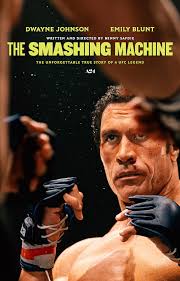
THE SMASHING MACHINE
US, 2025, 123 minutes, Colour.
Dwayne Johnson, Emily Blunt, Ryan Bader, Bas Rutten.
Directed by Benny Safdie.
The Smashing Machine was the professional name for fighter, Mark Kerr. (There had been a 2002 documentary with the same title focusing on this period of Mark Kerr’s life and career, sport, achievement, his relationship with Dawn Staples.)
The film focuses on the development of fights, boxing, wrestling, martial arts, their combinations, and the development of the UFC, Ultimate Fighting Championship. For those in the know, there will be great interest in this re-creation of the period, the staging of fights (which may be more than a touch alarming and/or offputting for those not familiar). And there will be the interest in this portrait of Mark Kerr, as a fighter, as a personality, his public image, his private life, his relationship with Dawn Staples.
The film opens with fights and interviews, enabling the audience to enter into this world.
The main expectation from audiences for The Smashing Machine was to see Dwayne Johnson in the role, bringing his long experience in wrestling to the part, and also showing his ability in acting and performance. Make up and hair transform him into the appearance of the actual Mark Kerr rather than a variation on Dwayne Johnson (except when he does shave his head towards the end of the film). The Mark Kerr of this drama comes across much more sympathetically than the actual Mark Kerr of the documentary. However, at the end of this film, there are some 2025 scenes of Mark Kerr himself, many years after retiring from fighting in 2009, at a supermarket in Arizona, smiling, genial and friendly – and some photos during the credits with Dwayne Johnson preparing for the film.
Mark Kerr comes across well to fans and the media, this film focusing on the fights in Japan, the media and interviews there, rules and regulations, the crowds at the bouts, the physicality of the fighting and its consequences, physically, psychologically, emotionally. Key to Mark Kerr’s experience is his beginning to take painkillers, drugs and injections, their increasing, having an effect on his moods, ultimately his going into rehab after a physical collapse but emerging once again.
Emily Blunt (who had starred with Dwayne Johnson in the Disney action adventure, Jungle Cruise), offers an intense interpretation of Dawn Staples, the glamorous look, easily emotionally upset, supportive of Mark, but often careless in the details he demands. She is loving but she is also clingy, some peaceful sequences at home, then some highly emotionally-charged conflicts. In the final crisis sequence, highly intense, both stars are able to create an alarming atmosphere.
While Mark Kerr achieved some fame, his life and career were not as fulfilling as he hoped for, especially in comparison with Mark Coleman, his friend (portrayed here very effectively by actual fighter, Ryan Bader).
The film was directed by Benny Safdie, who with his brother directed such films as Good Times and Uncut Gems.
- Martial arts, wrestling, mixed martial arts, UFC, Ultimate Fighting Championship?
- Based on actual characters and events? The appearance of Mark Kerr during the final credits, the photos, and with Dwayne Johnson?
- The 1990s and early 2000’s, lifestyle in the US, Arizona, homes, gyms, training, fights? The sequences in Japan, the atmosphere for Pride tournament, dressing rooms, auditoriums, the fights? The musical score? The use of My Way?
- The introduction to Mark Kerr, his background, fighting, competitions, winning? His friendship with Mark Coleman? His relationship with Dawn? Their life together? The 1990s, Mark Kerr and his career, the nickname, The Smashing Machine? The interviews and his explanations? Mark Coleman and the interviews and his giving the information about their careers?
- Dwayne Johnson as Mark Kerr, the make up, the physique, his personality, sympathetic, alienating, manner of speaking, vocabulary, interactions with trainers, match authorities, the discussions about money and payment? His fights, techniques, success? Success in Japan, the crowds, the interviews, the presentations?
- The pressure on Mark Kerr, relief, painkillers, persuading suppliers to give him drugs, the amount taken, the injections, the effect on him? In conversation with Dawn, high, differing consciousness? The effect on his career? Dawn and her pills? Mark Kerr going into rehab, the effect of the rehab, coming out? His moods?
- The visualising of the fights, audiences and understanding or not, the mixing of boxing, wrestling, jujitsu, martial arts? The visual impact of these fights? The consequences for the fighters, physically, psychologically, emotionally?
- Success in Japan, unable to go because of the rehab? Going into training again, the encounters with Bas? Bas and his advice, techniques?
- The friendship with Mark Coleman, over the years, Coleman and his career, his family, wife and children, supporting Mark Kerr, Dawn’s phone call, his coming to the hospital, support? His re-entry into competition, successes? The buildup to competing with Mark Kerr?
- The background to going back to Japan, the clash with Dawn? Dawn, her personality, psychologically, the relationship with Mark Kerr, at home, the reaction about the cat on the sofa, making the shakes and the ingredients, her style, glamour, her friends, the parties? Socialising? In Japan, the moods, surprise arrival, supporting Mark, his defeat? At home, the tensions, Mark and his nitpicking, her response, the angry exchanges, his accusing her of being self-centred, her wanting to be liked and loved, his ousting her, going packing, the gun, the struggle, her breaking the gold laced bowl that he bought her? (And her later fixing it and reconciliation)?
- Japan, the buildup, the various bouts, the rivals, the matches, the authorities, the press conferences? The interviews?
- Mark, his fight, the device of having the flashbacks of his life and relationships, unable to move, his defeat? The aftermath, his having shaved his hair, his beard, the stitches, his bearing in defeat?
- Mark Coleman, his success, achievement?
- The information afterwards, the defeat, the return, marrying Dawn, six years of marriage, their child? His retiring in 2009?
- The scenes in 2025, the actual Mark Kerr, in the supermarket, check-in, to the vehicle, smiles, genial?
- The overall impact of the film, for fighting fans? For those interested in biography? Dwayne Johnson’s performance as well is that of Emily Blunt?
She'll Have to Go
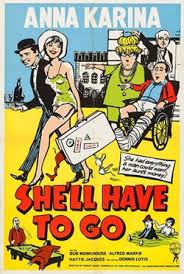
SHE'LL HAVE TO GO
UK, 1962, 89 minutes, Black-and-white.
Bob Monkhouse, Alfred Marks, Hattie Jacques, Anna Karina, Dennis Lotis, Graham Stark, Clive Dunn, Hugh Lloyd, Peter Butterworth.
Directed by Robert Asher.
A very broad British farcical comedy, based on a play, typical of popular comedies in Britain in the early 1960s – and, with some of the humour that characterises the Carry On comedies.
Bob Monkhouse was a popular film and television personality, Alfred Marks more serious. The Carry On the connection can be seen with the presence of Hattie Jacques, much more dominating and posh as an intrusive journalist. A number of popular British comedians of the time have comedy cameos, Graham Stark, before the Pink Panther films, as the journalist’s cameraman, Clive Dunn as a bumbling chemist, Hugh Lloyd as a pompous lawyer, Peter Butterworth as a shortsighted doctor getting himself into tangles.
However, the surprise for many cineastes who come across this comedy is the presence of Anna Karina, the Danish born actress who appeared in films for many decades, a variety of films in the UK, US, European countries – but is still best known as the wife of Jean-Luc Godard in the 1960s and starred in a number of his memorable films of the 1960s. Most would not associate her with this kind of British comedy.
Two brothers, novelists, live in a mansion, little income, manservant played by Dennis Lotis, getting news that a remote cousin was going to inherit the house and probably oust them. The title indicates the tone of the film, the option of marrying her and retaining the money or of murdering her. Which means there are some romantic scenes and several attempts on her life. She arrives, charms the journalist, charms the man servant, escapes all the attempts on her life, then turns the tables on them.
A great number of farcical situations, puns and quips, exaggerations all round. Nowadays mainly for film historians.
Copenhagen Does not Exist/ København findes ikke
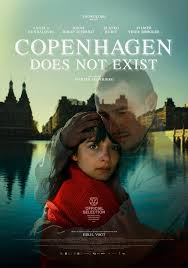
COPENHAGEN DOES NOT EXIST/ København findes ikke
Denmark, 2023, 99 minutes, Colour.
Angela Byndalovic, Jonas Holst Schmidt, Zlatko Buric, Vilmer Trier Brogger.
Directed by Martin Skovbjerg.
An enigmatic drama, principally for those who are interested in Danish cinema, for cineastes who might enjoy exploring the dramatic and emotional enigmas.
The setting is Copenhagen, homes, streets, countryside… All presented rather sombrely.
The central character is Sander, a morose personality, being interrogated by his father-in-law concerning the disappearance of Sander’s wife. It is also being covered by video, photographed by the brother of Ida, Sander’s wife.
The film moves to reconstruct the initial encounter between the two, the partnership, life together, Ida and her moods, her lack of contact with her father, resentment against him. And, some of these sequences also appear in flashbacks during the interrogation.
The father is demanding and bombastic, successful in life, wanting to know the truth about his daughter and her alienation. The brother is often curt and resentful.
And while Sander continues to remain enigmatic, changing his moods, changing details of the story, Ida comes to the centre, the audience understanding her alienation from her father, but her move away from him, no contact, the liaison with Sander and her treatment of him, his response to her – and final disappearance and the audience pondering Sander’s motivations.
Good on Paper

GOOD ON PAPER
US, 2021, 92 minutes, Colour.
Iliza Shlesinger, Ryan Hansen, Rebecca Rittenhouse, Margaret Cho.
Directed by Kimmy Gatewood.
Iliza Shlesinger is a stand-up comedian, writer and actor. She draws on this experience for this film, with an ironic title, if something is good and works on paper, how does it stand-up in reality?
The film is enjoyable for Iliza Shlesinger’s performance, a strong screen presence, able to deliver the lines, frequently comic as well as sometimes full of pathos.
Her character is after the ideal man and, with the constant presence of Denis, Ryan Hansen, always on hand, a plausible story, full of charm, she feels she has met him.
And this narrative is carried on throughout the framework of her performance in stand-up comedy.
And she has a good friend played by Margaret Cho, urging her on, sometimes sceptical.
And, of course, the charming man, potential romantic hero, proves not only to be a fake but also a deceiver, unmasked at the end – and, continuing the disillusion of Iliza Shlesinger.
Whether all the jokes work on screen in comparison with the impact of performance in the club can be debated. However, there is the strong feminist attitude pervading the film which, in circumstances like these, is significant.
- Iliza Shlesinger, stand-up comedian, writer, actor, her film and perspective? Feminist perspective?
- The Los Angeles setting, apartments, studios, television offices, banks, bars? The contrast of different areas, Beverly Hills? The musical score?
- The framework of the stand-up comedy, Andrea, personality, age, references to 35, her career, stand-up comedy and success, diffidence, onstage strength, working the room? Her monologue, looking back over her life, her relationship with Denis? The monologue interspersed with the action? And the flashbacks?
- The airport episode, the criticism of people dropping things, Denis and her boarding pass, sitting next to her in the plane, the conversation, his story about hedge funds, his personality, pleasant, accommodating? Andrea and the attraction, despite herself?
- Andrea, her friendship with Margot, Margot is tough-minded, the bar, observing Denis, backup, criticisms, support?
- The rivalry with Serena, the past friendship, Serena as the star, her billboard, Andrea’s reaction to the prominent billboard, the clashes? Serena’s career, Andrea and the audition, her criticism of the script, the reaction of the producers, dismissing her, taking her points? Her later offered the part, her elation, going to the reading, Serena present? The role of Serena later, their friendship, helping each other, some bonding?
- Denis, always charming, always appearing, his story, the background from Yale, Andrea’s cousin, the golf game, Denis and his injury, avoiding the issue, his stories about Yale? nice and believable?
- Andrea and Margot, going to Dennis’s address, finding the roommates, their characters, eccentricities, art? Truth about Denis, the friends and their later collaboration with Andrea and the unmasking?
- The effect of the relationship on Andrea, the sexual relationship, friendship, support? Unwilling to doubt? The evidence, Margot’s pressure? Serena’s collaboration?
- The buildup to the finale, serious, Denis and his unmasking, the true unpleasantness in his character, the physical capture, his comeuppance? The blend of the sad, slapstick, humour, truth?
- In the final effect for Andrea, able to do the monologue, her future?
Angry Angel

ANGRY ANGEL
US, 2017, 83 minutes, Colour.
Brenda Song, Andy Favreau, Ricky Mabe, Andrew Bachelor, Anastasia Phillips, Julia Pastorius, Elizabeth Bowen, Jason Biggs.
Directed by Jamie Travis.
Audiences who enjoy Christmas films, here is one with quite a difference!
Brenda Song, a very bright screen personality who has been acting since the age of seven, plays Alison Pyke, working in a diner, dissatisfied with life – and, revealed to be an Angel trying to earn points to get her to heaven.
There is a back story, she was previously Megan, growing up in love with Patrick, marrying him, then dying, and assigned a new appearance and a new life, having to earn a number of points in helping people in order to get to heaven. She has a good friend, Leonard, a bright Andrew Bachelor, who is in a similar situation and they have chats and help each other.
An amusing idea is to have Jason Biggs as himself, a former life, reincarnated as Jason Biggs who is a kind of supervisor in New York City checking the various angels and their progress, correcting, urging…
Brenda Song brings to life this kind of life, confiding in the audience, getting points, losing them, and then encountering Patrick visiting from Nebraska with his girlfriend, Jill. The rules are no contact with past life but, eventually, Pyke makes contact, trying to explain herself to Patrick, kissing him, alienating Jill. So, she has an opportunity to get a bus ticket to heaven and loses all her points.
It is Christmas, she is criticised for being self-centred, finds Jill to apologise to her, finds Patrick to explain and to letting go, meets up with Leonard and, on the bus, to heaven.
Nothing very religious here, despite all the Christmas songs and carols. Heaven is a kind of middle-class happy resort for every whim and wish. Pyke, however, is still concerned about a friend on earth and drives out of heaven to help him. She is accountable to the tribunal and Jason Biggs again and has to start all over again!
Lots of sentiment and goodwill in a different kind of Christmas story.
- A Christmas story with a very different plot – but with many of the same messages?
- Audiences accepting the basic premise, life after death, a new life, a new form and situation, getting points in order to go to heaven, the supervisors and staff checking progress, the eventual picture of heaven, extremely secular, heaven as an easy-going resort?
- The basic story, Patrick and Megan, friendship, growing up, shared interests, in love, marrying? Megan’s death?
- The fantasy story, Megan becoming Alison Pyke, a new form, Asian-American, living in New York, working as a waitress, not particularly effective, all the mistakes and faux pas? Friendship with Connie, Connie’s tolerance at work? The friendship with James Barker, cook, the relationship, the sexual encounter, the consequences? His response to her, her preoccupation with getting to heaven, the clash between them?
- The enjoyment of having Jason Biggs as himself, referring to his career, supervising, checking on points earned? Discussions with Pyke, urging him on, criticising her, the various encounters, Christmas, offering her the possibility of getting to heaven?
- The rules, the points for various good deeds, Pyke and her exasperation? Doing good, saving people, the various episodes? The rule of not being into contact with the past? Her memories of Patrick, love for him, the encounter with him and Jill, her intruding, the question breaking the rules, talking with Patrick, explaining herself, memories the past, his being taken aback, her kissing, Jill and her upset? Jason Biggs and the rules? Offering her the opportunity to do something big to regain the points?
- The atmosphere, the Christmas messages, doing good for people, being selfless?
- The character of Leonard, friendly, his good deeds, images of heaven, talks with Pyke, turning up, helping her, sharing missions?
- Christmas, Pyke being urged to do something selfless, the would-be suicide at the subway, letting Leonard help him, the embrace to life? Her doing something kind?
- Finding Jill, the explanation and apology, finding Patrick, urging him to love Jill, the separation?
- The bus, with Leonard, going to heaven?
- Her commentary about heaven, the luxury resort, every wish and a whim? Her being dissatisfied? The story of Barker? Her escaping, saving Barker’s life, his meeting the French girl?
- Going back to the tribunal, Jason Biggs, her losing all the points – and having to go out and start again, on the plane as she was in the opening sequence, the people panicking, her surviving – and saying she could do it again?
Addiction, The
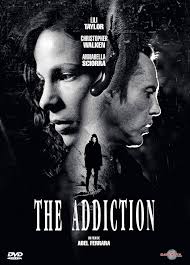
THE ADDICTION
US, 1995, 82 minutes, Black-and-white.
Lili Taylor, Christopher Walken, Annabella Sciorra, Edie Falco, Paul Calderon, Katherine Erbe, Michael Imperioli, Robert W. Castle.
Directed by Abel Ferrara.
The Addiction is a significant film in the career of Abel Ferrara. In independent filmmaker, eccentric, Catholic background and frequent Catholic themes, an addict himself.
After small budget violent films, he was recognised in the 1980s as a significant film maker. And, especially during the 90s, with such well-received films, Bad Lt, The Funeral as well as The Addiction, he was able to make some studio films as well is to continue on his own way.
He also drew on several actors in many films including Christopher Walken and Harvey Keitel.
This short feature, filmed in black and white, goes to the New York streets, to the University, to hospitals. It focuses on a young woman played by Lili Taylor, studying philosophy, an encounter with a vampire, played by Anna biller surer, and transformed into a dark vampire, then praying and transforming others, erratic behaviour, sexual, stealing, preying on people in the streets.
She encounters reforming vampire, played by Christopher Walken, who takes her in, tries to help her, getting her to read William Burroughs’ The Naked Lunch, helping her to get her PhD.
However, in the celebratory party, with many guests, she lets loose, transforming the party into a kind of vampire blood orgy. But then, she wanders the streets, goes to a hospital, a visit by a priest for the last sacraments and The attic.
Finally, she visits her own grave, and the question whether she has been redeemed or continue to be part of the living dead.
- The title, expectations? Abel Ferrara and his own addictions? His life, memories, possibilities for change and redemption?
- The effect of black-and-white photography, New York City, the University, the streets, the dark world, academia, the party, the hospital? The musical score?
- Vampire films, the traditions? Transferred to the United States? The LOI ready, blood, the living dead, biting and killing? Possibilities for overcoming the condition? The range of characters that arise here?
- The religious themes, Ferrara and his Catholic background, evil, sin, repentance, redemption? And the priest visiting Kathleen in hospital?
- Kathleen, her age, studies, her thesis, the encounter with Casanova, her being transformed? In the dark, needing blind, HIV fears in the 1990s, the hospital, her anaemia?
- Her changing character, the sexual approach to her Prof, stealing his wallet, Jean noticing, her attack on Jean, the attack on the young woman and her weeping, Kathleen asserting her indifference? The encounter with Black, the blood? Gene talking to her about guilt?
- The encounter with Pena, his history as a vampire, trying to overcome his condition? Taking care of Kathleen, her reading William Burroughs The Naked Lunch?
- Defending her thesis, the award, the party afterwards, the guests, the transformations into vampires, and all G of blood?
- Kathleen, regrets, walking the streets, in hospital, life and death, the priest visiting her with Communion?
- Her visiting her grave, the meaning of her life – and the quotation: self-revelation is annihilation of self?
Next
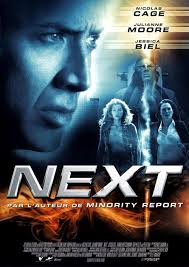
NEXT
US, 2007, 96 minutes, Colour.
Nicolas Cage, Julianne Moore, Jessica Biehl, Thomas Kretschmann, Tory Kittles, Jose Zuniga.
Directed by Lee Tamahori.
Philip K. Dick has become more and more popular over the last quarter of a century, especially since the release of Blade Runner which was based on one of his stories. In recent years, we have had quite a few film versions, especially Steven Spielberg’s Minority Report. Most of the versions seem to be aiming less at being a classic than offering conventional entertainment with a dash of science-fiction and futuristic reflection. There was Imposter, with Gary Sinise and John Woo’s Paycheck with Ben Affleck.
Next is in this category rather than a chapter in the science-fiction movie books. It is directed by New Zealand director, Lee Tamahori, whose excellent Once Were Warriors gave him an entrée to Hollywood where he went into slambang and smasheroo mode with The Edge, the James Bond film Die, Another Day, Along Came a Spider and xXx: The Next Level. This is what he does well and this is how he presents Next.
Nicolas Cage is a small-time Las Vegas magician and mentalist but we soon learn that he is a Philip Dick character because he is able to see two minutes ahead (no more) of what is going to happen to him. This
works well on stage – and in the casinos. It also helps him avoid punches and bullets. However, with a nuclear bomb about to explode somewhere in America, his ability comes to the attention of the FBI. They want to recruit him to prevent the detonation. All would be well but he is involved with the woman of his dreams (or of his, by exception of the two minute rule, long term vision), Jessica Biel. The foreign agents are after him so they will use her to stop him working with the FBI. This description sounds a bit slow in comparison with what is up there on the screen. Editing is fast paced.
There are explosions and chases, confrontations and shootouts and plenty of effects and stunt-work. What is inventive is the sudden insertion of deadly situations followed by what really happens two minutes later.
When the magician has to quickly search a warehouse at the end, he splits into many versions of himself (like the villainous Mr Smith of The Matrix).
Julianne Moore is the tough and almost relentless agent. This 2007 film seems to relish role reversal and feminist achievement. In the past, the Cage character might well have been a woman with visions and the Moore character a tough and macho male, so it is interesting to see the vice versa.
The written story is set in the future. The producers (rightly) saw that it might play more effectively on screen in the present.
- Title? The works of Philip K. Dick, the film versions? Science-fiction, fantasy? Futuristic?
- Screen presence of Nicolas Cage over the decades, action hero?
- The title, Chris Johnson and his gift, foreseeing two minutes? The advantages, the drawbacks? In his life, the magician, Las Vegas, gambling? Going to the diner each day, the vision of Liz Cooper?
- Kelly Ferris, the FBI, agents, the French terrorists, the nuclear bomb, Kelly and her character, leadership, action? Pursuing Chris? His eluding her?
- The terrorists, going to the casino, interrogating the manager, killing him? Learning about Chris? The continued pursuit?
- Liz, in the visions, Chris foreseeing her future, more than two minutes? The consequences? The encounter, her boyfriend? Aggressive? The possibilities, Chris’s choices, Kelly and her pursuit?
- The FBI, the authorities, the nuclear weapons, to Los Angeles? The terrorists and their team work, pursuit?
- Kelly, the encounter with Liz, persuading her, Chris and the truth?
- Chris, evading the terrace, their following him? Acting and not acting? The dilemmas of the two minutes? Saving Kelly? Taking lives?
- The FBI, taking Chris, tying him up, watching the television set, hoping for visions of the future? His seeing Liz, the bomb, escaping to rescue Liz?
- Chris, the confrontation is the terrace, shooting, evading, the action fights, the bombs explosion in the sea?
- Reverting to the past, the various scenarios, changing the future? Saving the day?
Vita Accanto, La/ The Life/ Apart

LA VITA ACCANTO/ THE LIFE APART
Italy, 2024, 100 minutes, Colour.
Valentina Belle, Sonia Bergamasco, Paolo Pierobon, Sara Ciocca, Beatrice Barison.
Directed by Marco Tullio Giordano.
A rather sombre Italian drama that focuses on depression but does hold out some hope.
The setting is the city of Vincenza in Italy’s north, attractively photographed throughout the film. But, much of the action takes place in a mansion, the home of a doctor, celebrated in the city, and his wife who suffers from depression. Also in the house is the doctor’s twin sister, an accomplished concert pianist.
While the film does focus on the mother, most of the action concerns her daughter, a very difficult birth, and a large birthmark on one cheek which singles her out, her mother blaming herself, furthering the depression, unable to care for her daughter properly even though she loves her. There is a nanny in the house to take care of the daughter. However, it is the aunt, the pianist, who takes a great interest in the young girl.
We see the girl, Rebecca, at crucial stages of her life. She is sheltered at home but wants to go to school, her hair sometimes covering her birthmark, but actually relishing school, and making friend with another young girl who comes from an entirely different background, poor, absent father, struggling mother. Rebecca realises that she can have a life outside the mansion.
Then Rebecca discovers that she has a talent for the piano, fostered by her aunt who, along with the nurse, act as surrogate mothers for the young girl.
Rebecca is able to cope as she grows older, interactions with the students at school, the staff, her skills at the piano, the constant care of her aunt, overcoming the pathos of her mother’s suffering and death, sometimes imagining her.
Ultimately, Rebecca is on the road to success, encountering her friend from school days again, liberating, and, an unexpected transformation.
A film for a serious-minded audience.
- The significance of the title for Maria, for Rebecca?
- The setting, the 1980s and 1990s, the city of Vincenza, historical, beauty, modern?
- The importance of the score, music, Erminia and her concerts, performances, Rebecca, discovering her skills, performance? Maria and music and its effect on her?
- Italian drama, operatic?
- The focus on Maria, her age, relationship with her husband, her background, the Palazzo, pregnancy, the difficult birth, Rebecca and the severe birthmark? Maria’s reaction, unable to be mother to the daughter, love, yet alienation, erratic behaviour, with her husband, with Erminia, years passing, increasing depression, contemplating suicide, eventually killing herself? Her sometimes reappearing in Rebecca’s imagination?
- Osvaldo, older than Maria, doctor, work in the city, reputation, society? Erminia as his twin sister, unmarried, musical talent, practice, performance, travels? Her bond with Rebecca, surrogate mother, encouraging her music?
- Rebecca, seen at various stages of her life, the difficult birth, the significant birthmark, her mother keeping her apart, her being looked after by Laura as nanny, her response to Erminia, to her father? A little girl at home, the prospect of going to school, the various opinions, her mother’s not wanting it, Rebecca wanting it?
- The experiences school, the birthmark, covering it, the reaction of the students, the staff, Rebecca coping? The friendship with Lucilla, Lucilla and a family background, the absent father, the desperate mother? And the bond continuing? Lucilla coming to Rebecca’s home, welcomed?
- Rebecca growing older, the continued friendship with Lucilla, then her disappearance?
- Rebecca as adult, the actress portraying her as an accomplished pianist? The impact of the music? Relationship with her father? The continued influence of her aunt? Social, the acceptance of her birthmark? The encounter with Lucilla, the bonding again with her, Lucilla and her music, contemporary, breaking out of the boundaries of the gilded life in the Palazzo?
- The magic realism sequence with the disappearance of the birthmark? The intention behind this sequence, the reason for the transformation, the consequences?
