Displaying items by tag: Sara Ciocco
Vita Accanto, La/ The Life/ Apart
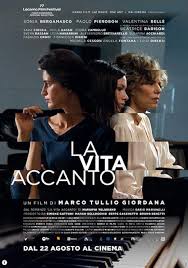
LA VITA ACCANTO/ THE LIFE APART
Italy, 2024, 100 minutes, Colour.
Valentina Belle, Sonia Bergamasco, Paolo Pierobon, Sara Ciocca, Beatrice Barison.
Directed by Marco Tullio Giordano.
A rather sombre Italian drama that focuses on depression but does hold out some hope.
The setting is the city of Vincenza in Italy’s north, attractively photographed throughout the film. But, much of the action takes place in a mansion, the home of a doctor, celebrated in the city, and his wife who suffers from depression. Also in the house is the doctor’s twin sister, an accomplished concert pianist.
While the film does focus on the mother, most of the action concerns her daughter, a very difficult birth, and a large birthmark on one cheek which singles her out, her mother blaming herself, furthering the depression, unable to care for her daughter properly even though she loves her. There is a nanny in the house to take care of the daughter. However, it is the aunt, the pianist, who takes a great interest in the young girl.
We see the girl, Rebecca, at crucial stages of her life. She is sheltered at home but wants to go to school, her hair sometimes covering her birthmark, but actually relishing school, and making friend with another young girl who comes from an entirely different background, poor, absent father, struggling mother. Rebecca realises that she can have a life outside the mansion.
Then Rebecca discovers that she has a talent for the piano, fostered by her aunt who, along with the nurse, act as surrogate mothers for the young girl.
Rebecca is able to cope as she grows older, interactions with the students at school, the staff, her skills at the piano, the constant care of her aunt, overcoming the pathos of her mother’s suffering and death, sometimes imagining her.
Ultimately, Rebecca is on the road to success, encountering her friend from school days again, liberating, and, an unexpected transformation.
A film for a serious-minded audience.
- The significance of the title for Maria, for Rebecca?
- The setting, the 1980s and 1990s, the city of Vincenza, historical, beauty, modern?
- The importance of the score, music, Erminia and her concerts, performances, Rebecca, discovering her skills, performance? Maria and music and its effect on her?
- Italian drama, operatic?
- The focus on Maria, her age, relationship with her husband, her background, the Palazzo, pregnancy, the difficult birth, Rebecca and the severe birthmark? Maria’s reaction, unable to be mother to the daughter, love, yet alienation, erratic behaviour, with her husband, with Erminia, years passing, increasing depression, contemplating suicide, eventually killing herself? Her sometimes reappearing in Rebecca’s imagination?
- Osvaldo, older than Maria, doctor, work in the city, reputation, society? Erminia as his twin sister, unmarried, musical talent, practice, performance, travels? Her bond with Rebecca, surrogate mother, encouraging her music?
- Rebecca, seen at various stages of her life, the difficult birth, the significant birthmark, her mother keeping her apart, her being looked after by Laura as nanny, her response to Erminia, to her father? A little girl at home, the prospect of going to school, the various opinions, her mother’s not wanting it, Rebecca wanting it?
- The experiences school, the birthmark, covering it, the reaction of the students, the staff, Rebecca coping? The friendship with Lucilla, Lucilla and a family background, the absent father, the desperate mother? And the bond continuing? Lucilla coming to Rebecca’s home, welcomed?
- Rebecca growing older, the continued friendship with Lucilla, then her disappearance?
- Rebecca as adult, the actress portraying her as an accomplished pianist? The impact of the music? Relationship with her father? The continued influence of her aunt? Social, the acceptance of her birthmark? The encounter with Lucilla, the bonding again with her, Lucilla and her music, contemporary, breaking out of the boundaries of the gilded life in the Palazzo?
- The magic realism sequence with the disappearance of the birthmark? The intention behind this sequence, the reason for the transformation, the consequences?
Ragazzo dai pantaloni rosa, Il/ The Boy with Pink Pants
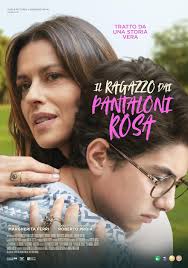
IL RAGAZZO DAI PANTALONI ROSA/ THE BOY WITH PINK PANTS
Italy, 2024, 114 minutes, Colour.
Samuele Carrino, Sara Ciocca. Andrea Arru, Claudia Pandolfi.
Directed by Margherita Ferri.
It is something of a surprise to hear that this film was the most successful Italian film at the Italian box office of 2024. But, it is a significant film, well worth seeing and reflecting on.
This is the story of a young boy, Andrea Spazzacatena, his family, his loving mother, continually absent father, younger brother. He is successful at school, rather quiet in his way, musical talent, intelligent, love of sports, all kinds of possibilities before him. And, he is played by the young Samuele Carrino, completely convincing in this complex role.
In fact, this is a film about bullying, school bullying, physical and psychological and emotional confrontations at school, joking and humiliations, betrayals of trust, and the pressures of social media. The film is based on a book written by Andrea’s mother, Teresa, who has spent the years since her son’s suicide in 2012 campaigning against this bullying.
The film is intended for a wide audience, even young ones and so a decision was made that the actual suicide would not be visualised, with the effect that younger audiences can watch the film, experience the impact and be able to deal with the theme and issues.
The technique for the film is the voiceover by Andrea, stating that as the film was being made he would be turning 27 – and then the reality that he had died in 2012. Andrea takes us back over his difficult birth, his happiness in his family life and the strong bond with his mother, dealing with his absent father, his abilities at school and a priest suggesting that he should audition for a choir which would sing at the Vatican and entertain the Pope. He is successful and enjoys the experience.
But there is a complication with his friend at school, Christian, a year older, repeating the year, admired by Andrea, even with some moments of infatuation. But Christian is the self-confident type, able to make jokes about Andrea, and yet asking him for help with his studies. The counterbalance in Andrea’s life is his friend Sara, someone on the outer, but perceptive about what is happening to Andrea, warning him about Christian, but sharing a great friendship, confidante, going to the cinema, able to put some steadiness in Andrea’s life with the complications coming from his initial faith in Christian and Christian’s turning on him, encouraging the others at school to mock Andrea.
And the title? His mother had bought Andrea a new pair of trousers, put them in the wash, dye running, their turning out pink. He is happy but, of course, this leads to some taunting, even the boys at school writing his name as Queercatena.
The screenplay invites the audience to observe Andrea, and to appreciate him, to share in his emotional confusion, to feel the cumulative effect of his experiences at that age, to share with him the solemn evening before he dies, with his mother, his final message, and the ultimate sadness of his unnecessary death.
A film to be recommended for parents, teachers, students, who are involved with school and family bullying.
- Expectations from the title? A young boy, puberty, issues, bullying?
- The film based on the book by the boys mother, her campaign about school bullying?
- Italy, the 2000, Rome, the atmosphere of the city, homes, schools, cinemas, the beach, the funfair? And the visit to the Vatican? The musical score, piano, singing?
- The device of the voice-over, of the dead Andrea? At age 27, his looking back from his death?
- Andrea’s life, the difficulty of his birth, his mother and strong connection with her, his father’s comment, the absent father, the separation? Andrea remembering his childhood, family life, his younger brother, watching the DVDs? At school, his talent, music, the priest suggesting he go to train in the Vatican choir, the audition, his getting a place, the issue with Christian, his not getting a place, their discussions? The performance, the Pope and the bishops, his parents present?
- Andrea and his friendship with Sarah, her age, at school, her being on the outer, the ups and downs of the relationship, her wise advice, listening to him, going to the films, the choosing of the films, the discussions? A warning him about Christian?
- Christian, older, repeating the class, popular student, looking down on Andrea, jokes against him, yet asking him to help him with his studies, Andrea drawn in by Christian, helping him, yet the double standards of the friendship? And seras warnings?
- Andrea and his age, the transition to high school, the challenges, Christian going to another school, the separation, yet his turning up? Mr and the others in the class? Mocking Andrea? The effect on Andrea, trying to assess it, cope? Is mother support? Sarah?
- The title of the film, the pants, his delight, washing them, the colour running, pink pants? The comments on the pants, colour, putting queer in his name, insinuations?
- The cumulative effect of Andrea and his age, dealing with Christian, with the mockery, at school, online, the preparation for his death, with his mother, with Sarah, quietly, his room?
- The decision of the filmmakers not to show the death, making the film more available to the younger audience?
- The significance of the film in highlighting school bullying and its dire consequences in suicides?
