Displaying items by tag: Sean Penn
Daddio
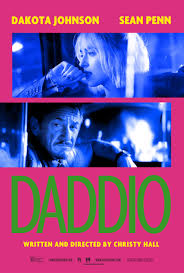
DADDIO
US, 2024, 100 minutes, Colour.
Dakota Johnson, Sean Penn.
Directed by Christy Hall.
There are many styles of presenting a two hander drama. And there are many films set within vehicles, especially cars, like the British Locke and several of the films by Iranian director, Abbas Kierostami. And the screenplays provide material which could easily be adapted for theatrical presentation.
Writer Christy Hall (also writer of the screenplay for It Ends With Us), directs her first film. And her two players are Dakota Johnson and Sean Penn.
The film is persuasively photographed by veteran cinematographer, Phaedon Papamichael, and the editing is skilful, moving from face-to-face, the use of the rear vision mirror, the driver turning his head, the to-ing and fro-ing of conversations, the camera resting during pauses for reflection.
Dakota Johnson is (strangely/provocatively) referred to as Girlie. In her 20s, arriving at Kennedy airport, and eventually getting a taxi to go home, she encounters Sean Penn as a driver with decades of experience. He notes she doesn’t immediately go for her phone for the trip, begins a conversation with her, she responding. He has been driving taxis so long that he has become something of character spotter, noting clues, interested, capacity for sympathy, and empathy.
The conversation takes place during the drive to Manhattan, halted by an accident, giving plenty of time for the conversation to develop. Girlie is polite, interest aroused, responding to conversation questions. Clark, the driver’s name though he would prefer Vinnie and at the end would opt for Mikey, is very direct, frank in dialogue and vocabulary, not so many filters.
What happens is gradual revelations, Girlie and her background in Oklahoma, present relationship, family issues, memories. Clark is also able to talk about himself, his marriages, his behaviour, his opinions on male status and treatment of women, women and their responses. Each of them begins to vie with telling episodes – but, just when we think they have done some self-revelation which has been worthwhile, Girlie tells a much more telling personal experience.
The cab acts as something of a therapy room, a confessional, and the audience realising that everybody needs to surface their issues, be able to articulate, appreciate an empathetic listener, enabling some kind of salvation/redemption through confession and an experience of some kind of healing.
- The impact of the drama set within a taxi, two characters, conversations, sympathy, clashes, empathy?
- The airport, the taxi line, the roads from the airport, traffic accident and block, the visuals of New York at night? The musical score underlying the conversation?
- The performances, the writing, the ordinary beginning, initial interactions, gradual revelation of character, truths, lies, stories, becoming deeper, and the final story and its impact?
- Calling the female character, Girlie? Dakota Johnson’s performance, delivery of lines, quiet times, the effect of the conversation on her? Her story, Oklahoma, harsh background, half sister, the impact of her father, and the separation, memories of his shaking her hand, leaving? The work and study, programming? The relationship, the phone communication, his being married, the comment on his wife, the three children, the texting and the children going to bed, the issue of whether he loved her not?
- Her response to clerk, the cab driver, years of experience, pleasant, listening, pleased that his passenger did not initially isolate herself with her phone, the gradual involvement, the rival stories and revelations, expressing her bucket list, the herbs, diving from the Greek cliff… ? Her final story to Clsrk? The sudden depth of experience, her expressing it, profound, the pregnancy, decisions, concealing, the blood, the miscarriage, the fetus leaving her, her not leaving the fetus? Her final text to the lover, her uncertainty?
- Clark, 20 years, Sean Penn’s performance, appearance, worldly -wise, chatting with passengers, reading people, commenting, few filters on his conversation? His eliciting responses from Girlie? His listening, silences, questions, challenges? Gradual revelation of his own story, frank, meeting his first wife, blonde, beautiful, not intelligent, but optimistic, his enjoying moments with her, her getting older, putting on weight, h is is further affairs, second wife, his attitudes towards women? His attitude towards men, summing up the lover, the use of the word love or not, reading his character, his analysis of men, their attitudes towards women, vying with each other in terms of position, masculine status?
- The impact of the final story on him, her arriving home, his telling her of his preference for the name, Vinnie, instead of Clark, but finally preferring Mikey?
- The cab as the equivalent of a therapy room, confessional, highlighting the need for people to communicate, to reflect in-depth, to surface responses, to express them, the possibilities for healing?
One Battle After Another
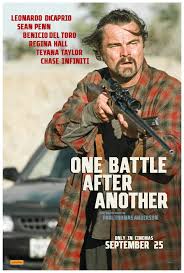
ONE BATTLE AFTER ANOTHER
US, 2025, 161 minutes, Colour.
Leonardo DiCaprio, Sean Penn, Benicia del Toro, Teyana Taylor, Regina Hall, Chase Infiniti, Tony Goldwyn, James Downey, John Hoogenakkerr, Kevin Tighe, D.W.Moffat.
Directed by Paul Thomas Anderson.
An American movie with quite some frightening impact – even though there are many, many comic moments throughout. It has been written and directed by Paul Thomas Anderson who has had a significant 30 year career, many feature films and great number of music videos. For this reviewer, Magnolia and The Master stand out as well as the menacing There Will be Blood.
Anderson has said that he was interested in Thomas Pynchon’s 1984 novel for many years, seeing it as something of a futuristic vision of a disturbed United States, revolutionaries, status quo, clashes and violence… He has taken the novel as a starting point for a 21st-century futuristic look at this kind of United States. Filming was completed by 2024 but by its release in mid 2025, it does not seem futuristic so much as a satiric imagination of Donald Trump’s America, no longer futuristic, the present. (And it will be interesting to look back on this film when the second Trump presidency ends.)
The opening is quite disturbing, intense revolutionaries, of the left, protests and sabotage down at the Mexican border, the freeing of imprisoned migrants and refugees. More than topical. And then there is the military, the revolutionaries battling the soldiers. The key revolutionary is Perfidia, played by an intense Teyana Taylor. And her comrade is explosives manager, Pat, Leonardo DiCaprio. There is an intense power and sexual struggle between Perfidia and the symbolically named soldier Lockjaw, one of Sean Penn’s best performances. The revolutionaries are shown in a collage of all kinds of explosive protests but, no spoilers, they are dramatically taken down – with unforeseen circumstances and consequences.
However, the action suddenly moves on 16 years, Pat is living with perfidious daughter, Willa, Chase Infiniti, popular at school, Pat changing his name to Bob, tough with his daughter but the consequences of drink and drugs hovering. Long story short, his daughter is taken by the military for interrogation, and Bob has to go on the run, making contact (in an exaggeratedly funny sequence where the bureaucratic revolutionary on the other end of the phone won’t accept that Bob over the years has forgotten aspects of the recognition code), making contact with Willa’s martial arts teacher, Benicia del Toro, and all kinds of action adventures on the way to the hippy convent where she has taken refuge.
Colonel Lockjaw has come up through the ranks and is being offered the opportunity to join one of those secret societies of ageing white men, the Christmas Adventurers!. A lot of satire as we sit in on meetings of the committee. But, they have the power, influence the politicians, pride themselves on racial purity… And Col lockjaw suddenly presents a problem because of his past association with Perfidia.
So, definitely one battle after another, and abuild up to quite an exciting climax with cars speeding along the highway, Willa, Bob, pursued by the elite club hitman, an extraordinary photography of highways through the desert which continuously undulate almost like a rollercoaster ride mounting to a literally smashing finale.
Somebody has noted that Steven Spielberg has seen the film several times – which does indicate that for those who found it impressive on first viewing, it would probably be even more impact the second or the third time round.
- This film in the career of Paul Thomas Anderson? Critical acclaim? Popular response?
- The inspiration from the novel, Vineyard, by Thomas Pynchon? The novel from 1984, Anderson developing ideas with the novel as a starting point, for the 21st-century?
- The scope of the film, revolutionary groups in the United States, race issues, the Mexican border, sheltering of refugees and migrants? The authorities, the role of the military and the police, increasing authoritarianism? Background of wealthy white older men and secrecy and conspiracies, elitism? Characters within this society?
- The locations, the range of locations in California, from the forests and woods of the North, to the coastlines of the desert scenery of the South, urban El Paso?
- The range of music, different moods, the range of songs included, lyrics? And the climactic music of road chase and the undulating terrain and tarmac, rollercoaster-like?
- The strong cast and performances?
- The impact of the first part of the film, France 75 and the revolutionary code and behaviour, the introduction to Perfidia, walking along the road, arrogant, in charge, Pat and his explosives, the other members of the group, the American-Mexican border, the infiltration, overcoming the troops, the confrontation with Lockjaw, her taunting him, sexually, overcoming him? The migrants and refugees, the achievement of the mission? Explosions and mayhem?
- The members of the group, Deandra being more sympathetic, the other women? The collage of the various raids and the spectacular success, explosions, robbing banks…?
- Perfidia, planting the bomb, Lockjaw and his intelligence, tracking her down, the confrontation, the sexual encounter, his letting her go? His threats, imprisonment, his persuading her to give names and locations, tracking down the various members, action, flights, arrests? Her escape from Lockjaw, but considered a rat by the revolutionaries?
- Perfidia, pregnant, still acting independently, shooting ranges, going out, giving birth, the relationship with Pat, becoming the father, tending the child, the disappearance?
- 16 years later, the child, Charlene, now called Willa, cared for by Pat, his name now Bob? At home, the style of the house, his background of drugs, the codes, the machines, his being apprehensive? Her character, independent, going to school, the martial arts classes, Sergio, the dance, the friends coming to the house, the transitional student, pronouns, they? Bob and his reaction, his treatment of Bluto and the others, her defiance? Going to the dance, the visuals of the dance?
- Leonardo DiCaprio as Bob, addict, protective, the crisis, his friend arrested, his having to flee, trying to contact Willar, getting the help of Sergio, his shop, his contacts, the refugees, the safe house, getting them out of the house, Bob trying to make contact, not remembering the date with the code, the exasperation with the official at the end of the phone, talking to his friend, persuading him to reprimand the contact and his apology? Bob, escaping, leaping over the roofs, falling, tasered, arrested, interrogated, the contacts with the revolutionaries, his escape?
- Lockjaw, Sean Penn’s intense impersonation of the rigid military man, Perfidia seeing him, overcome by Perfidia, the sexual taunting, his humiliation, his finding her, the sexual encounter, the birth of the child, his tracking her down, arresting her, the interrogation, her giving him the names, the disappearance to Mexico, his rising through the ranks?
- 16 years later, his quest for his daughter, the invitation to join the Christmas Adventurers’ club, various members of the club, white, older, middle-aged, power, their meetings, discussions, the invitation to Lockjaw, the sudden discovery of the documents, summoning Tim as their action man, to eliminate Lockjaw?
- Lockjaw, getting the help of the bounty hunter, getting the military, information about the revolutionaries, raiding the dance, taking Willa, the issue of her having a phone or not, the machines to detect her presence? The interrogations, the treatment, her reactions?
- Deandra, her character, revolutionary, rescuing Willa, taking her to the convent, the eccentricity of the nuns, revolutionaries, marijuana? Lockjaw and his troops arriving, the interrogation of Willa’s friends and their treatment? And his DNA test?
- Bob, in the car with Sergio, the pursuit, Sergio pushing him from the car for his escape? Bob wiring another car, going to the convent, trying to shoot Lockjaw?
- The final showdown, the undulating roads, the hills, the rollercoaster effect, the music? And the bounty hunter, his change of heart, taking her to the hardened group, the shootout, her escape, driving? Smith and his mission to get rid of Lockjaw and Willa? His shooting Lockjaw, the crash of the car? The three cars, Willa, Smith, Bob, up and down the undulating roads? Willa and her plan, Smith crashing into her, the testing him with the codes, her shooting him? Bob, finding her, her agitation, the codes, reunited with Bob?
- Lockjaw, surviving, scarred, coming to the club, being welcomed, his own office, seated in the office, locked in, the gas, his death, carried out?
- Willa and Bob, mellowing a little, her going to a protest in Oakland?
- The inspiration from Thomas Pynchon in the past, filmed during the Joe Biden presidency, released during the first year of the second Trump administration, the crises of 2020 file, refugees, power, the Trump cabinet, money and corruption…? And the future of the US?
Flag Day
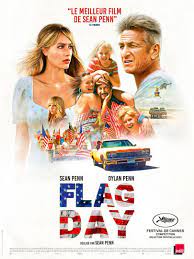
FLAG DAY
US, 2021, 109 minutes, Colour.
Dylan Penn, Sean Penn, Hopper Jack Penn, Kathryn Winnick, Josh Brolin, Regina King, Beckham Crawford, Jadyn Riley, Bailey Noble, Norbert Leo Butz.
Directed by Sean Penn.
Flag Day was not widely seen on its release in 2021. However, it is worth seeing as a piece of Americana. It is a true story, based on a memoir by journalist, Jennifer Vogel.
Another reason for seeing the film is that it has been directed by Sean Penn who, over 30 years, directed a number of interesting films including Indian Runner, The Crossing, but not so successful with The Last Face. He had not appeared in any of the films he had directed but he does appear here. And, significantly, his adult children are played by his actual two children, Dylan Penn, Hopper Jack Penn. And, many note, how strongly, especially facial features, Dylan Penn resembles her mother, Robin Wright.
Flag Day is symbolic for Americans, patriotism, sense of identity – and this motif continues throughout the film, especially visuals of celebrations and parades. It is significant for John Vogel, a sense of entitlement, despite the strange arc of his life.
The film is told in flashback from the perspective of Jennifer Vogel, sequences in 1975, happiness with her father and mother, but a beginning realisation that her father is unreliable, piles of debts, disappears, and, as her mother frequently insists, he is a liar. But, abandoned, the mother takes to drink and the children decide to walk out on her, returning to their father. But, after a happy summer, he cannot manage them and returns them to their mother. Mixed happy and unhappy childhood, different images of mother, father.
The narrative moves on six years, Jennifer in rebellion, black hair, drugs, failing at school, unreliable company, hostile to her mother, abandoning her brother, walking out, seeking her father. She does attempt something of his rehabilitation, believing that he could change, but… Even to his robbing a bank and sentenced to prison.
Jennifer in herself has ambitions to be a journalist, despite fabricating references, her sample essays when her a place at the University, leading to successful journalism, a glimpse of this (and with a small cameo from Britain Eddie Marsasn) in an attempt to expose the poisoning of the water system of Minnesota.
However, her father has come back to see her after release from prison, but she still finds him a liar – and suddenly, on television, sees the post police in pursuit of him, the crash, choose one all shooting himself and, a return to the scene at the beginning where in 1992, Jennifer is told that her father had been an expert in counterfeit money producing.
Audiences interested in complex and dysfunctional American families may find this film of interest – but an affirmation in some ways of family with Sean Penn working with his children.
- The title, American identity, the holiday, the parades, the inclusion of glimpses of Flag Day throughout the film, in connection with John and his beliefs?
- American settings, Arizona, Minnesota, the seasons? Poor neighbourhoods, homes, interiors? The contrast with the lake and their holiday atmosphere? The countryside, moving around? Newspaper offices? University of Minnesota? The musical score?
- Sean Penn acting and directing, his children in the central roles?
- The introduction, the story about John, his death, printing the money, its quality, Jennifer, the close-ups on her face, wanting to touch the money, her grief? The framework for the flashbacks and her memories of her father?
- The voice-over, Jennifer telling the story, love for her father, disappointment in him, disillusionment, the final grief?
- The family, the children, the holiday, the enjoyment, John and his care for his children? Jennifer’s comments, the happy sequences but his moving out, Jennifer looking out the window? His disappearances? The consequences for their mother, her drinking, the debts John piled up, the hard years? The children walking out, wanting to be with their father? Finding him, his relationship with Debbie, cheerful times?
- John, Sean Penn’s presence, performance, age, background, marriage, the children, seeing himself as an entrepreneur, the various jobs, money? Continual revelation of his lying? With the children, not being able to manage the children? The bus, returning them to their mother?
- Six years passing, Jennifer failing at school, company, drugs, her black hair, clashes with her mother? Her brother, his age, subservient in the house? The confrontation with her mother, walking out?
- Seeking out her father, his reaction, her hair, his situations, his explanations, her moving in?
- Jennifer, her wandering times, the effect on her, wanting to change? Wanting to change her father, sprucing him up, his hair, clothes, briefcase, his applications for jobs? Seeing him go to work, seeming success? Jennifer suspecting the truth, his empty briefcase?
- Jennifer, her own ambitions, journalism, the approach to the University, writing the sample articles, the discussion with the Dean, fabricating her references, his having the photo of her father in prison, asking her what she wanted to do, to make an impact? Allowing her to the University, the years passing, her graduation, her mother and brother present? The reconciliation with her mother?
- John, money, the decision to rob the bank, the wig and the disguise, seemingly successful, the chase, the arrest,, the mark on his forehead from the wing her disillusionment with him? The money in the letterbox, her leaving it?
- His years in prison, her not getting in contact? Her success, the years passing, her investigative journalism, the pollution of the water, the interview with the executive, seeing the chase on the television, the crash, her father shooting himself?
- And back to the beginning, the money, touching it, memories of her father? Her own later success in writing the memoir?
