Displaying items by tag: Michael Imperioli
Song Sung Blue/ 2025
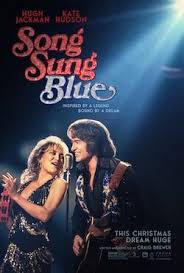
SONG SUNG BLUE
US, 2025, 132 minutes, Colour.
Hugh Jackman, Kate Hudson, Ella Anderson, Hudson Hensley, King Princess, Michael Imperioli, Fisher Stevens, Jim Belushi, Mustafa Shakir, John Beckwith.
Directed by Craig Brewer.
Song, Sung, Blue - everybody knows one.
Who does not enjoy and relish the songs and singing of Neil Diamond? Well, some bikies back in Milwaukee in the early 1990s for a start! But, certainly, not too many others.
This film is a treat for Neil Diamond fans, incorporating substantial renditions of many of his songs - and everyone wanting to hear and join in Sweet Caroline!
But, the songs here are not sung by Neil Diamond himself. Rather, this is the story of Mike and Claire Sardina, a husband and wife entertaining team called Lightning and Thunder, Mike is Lightning, Claire Thunder, from Milwaukee. Mike, a Vietnam veteran with subsequent alcohol problems, but sober for 20 years, sings Neil Diamond songs in clubs, encounters Claire, a Patsy Cline impersonator. They click, marry, bond with the children of their previous marriages, form something of a family, performing locally over many years, celebrities with a devoted following.
And the point is made that Mike is not just an impersonator of Neil Diamond but, with his looking something like the singer himself, he presents himself as an ‘interpreter’ of the songs. And, with Hugh Jackman in the role, talented singer, convincing actor, Mike Sardina comes alive. And, again talented singer, very persuasive actor, Kate Hudson is a most effective Claire.
This is a showbiz story of localized oomph, Mike’s dentist as his agent (even doing a filling with a lightning bolt on the tooth), a Milwaukee entrepreneur organising the venues (Fisher Stevens and Jim Belushi in these roles).
But it is also a suburban story, a busy house that audiences would recognise, financial struggles, dealing with the children, especially Claire’s daughter and a pregnancy, not just a bright lights story.
And, the story becomes very serious when Claire is the victim of a runaway car crashing into her and the house, losing a leg, therapy, new leg, depression, withdrawal, and Mike doing his best to keep the family afloat, jobs at karaoke bar… And some very joyful singing sequences at a Milwaukee Thai restaurant, the manager and his daughters gleefully joining in.
But, as they did in real life, they make a comeback, and another very happy moments when Pearl Jam’s Eddie Vedder joins them in a song. And, their filling a hall when Neil Diamond himself comes to town and his concert is sold out.
This dramatisation is based on a documentary from 2008, with the same title, incorporating quite a number of small details of Mike and Claire’s life.
There is a great deal of feeling, sadness and joy, in Song Sung Blue.
[For audiences who would like more, the original documentary 2008 is readily available Youtube when Googled. https://www.youtube.com/watch?v=YDukMQIz1Sc
And, further, there is a very lengthy interview with the director of the documentary, Greg Kohs, about how he made the film: https://www.reelasdirt.com/song-sung-blue]
- Based on a true story, the documentary of the same name? The characters, their lives, performances? And the interpretation of Neil Diamond?
- The 1990s, Wisconsin, the city, the streets, the town, homes, performance venues, bars, clubs, theatres? The Thai restaurant? Hospitals, AA groups, support groups?
- The musical score? The selection of Neil Diamond’s songs, performance, interpretation? Audience response? The lesser-known songs? The popular songs, especially Sweet Caroline and audience participation?
- The introduction to Mike, the extreme close-up, his speech, the AA meeting, 20 years without drinking, the support group? His life, singing? Previous marriage, daughter? The visits? His creativity, the issue of interpretation rather than impersonation? Hugh Jackman, singing, serious acting? His friends, Mark, the introduction to Tom, his enthusiasm, possible bookings? Mike and his wanting control? His pulling out of the performance and the repercussions for his friends?
- The encounter with Claire, Patsy Cline songs, the conversation, the attraction, his watching her? The meetings, discussions, his name, Lightning, her becoming Thunder? The range of their performances together, the bonding, the audiences, the selection of songs?
- Mike’s daughter, her coming to visit, the contrast with Claire’s daughter, her hostility, forced to be hospitable? The younger brother? Mike, the relationship with the family, the two girls and their friendship, discussions together? The romance, the kissing, the hesitations, good behaviour, the proposal, the ring, the wedding? The family together, the friends and playing, the cantankerous mother? The growing bond is within the family, my becoming a father figure to Rachel and Dana?
- The idea for the Neil Diamond interpretation, the various performances, the bad booking and the bikie’s reaction, the fight? Other successes, Dave Watson, the dentist, his managing Mike, the discussions with Tom, the promotion? Tom and his enthusiasm? The issue of the tooth – with the lightning symbol on it?
- The bond between Lightning and thunder, the exhilaration of the performances? Hopes for the future? Claire, in the garden, the car crashing into her, hospital, the amputation, her depression, at home, hostile, suspicious, depressed, Rachel trying to help her, the appointments for therapy and her neglecting them? Her outbursts against Mike? His sadness? Support for the children?
- The issues of insurance, the money, Rachel and her working, the revelation about her pregnancy, Mike’s response?
- Claire going to hospital, rehabilitation, the discussions with the therapist, the dream of her being successful again and her waking up on the lawn, her previous despising of AA talk, the effect of the therapy, her return? Building up, walking, suggesting that they play again together?
- The continued support of their friends, Sex Machine, little Richard, Tom and the bookings, Mark and his age, retiring, support? The other members of the band?
- The Thai restaurant, the manager and his love Neil Diamond, the karaoke, the songs, the manager singing? The later development, everybody singing, the manager’s daughters, the customers…?
- The Pearl Jam issue, the girls excited, Mike ignorant, the performance, Eddie and his singing the song with them, the response of the audience?
- Mike, his health, the various heart turns, Rachel knowing it, his concealing the attacks, continuing on? The second car out of control?
- The buildup to the finale, Neil Diamond in Milwaukee, the sellout, the theatre manager, inviting them to do the supplementary concert, its being sold out? The excitement for everyone? And the possibility to meet Neil Diamond afterwards?
- The concert, Mike and his heart attack, falling, hitting his head, persevering, the welcome to Claire, his coming up on the lift, and the singing the song, fulfilling his dream, the audience response? Afterwards, going to see Neil Diamond, in the car, his death?
- The funeral, Claire and her tribute, the singing? The grief of the family?
Local celebrities, the fulfilment of their ambitions, the friendships, the tragedies, overcoming them?
Addiction, The
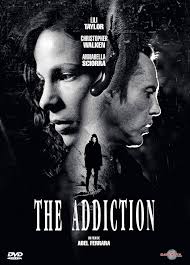
THE ADDICTION
US, 1995, 82 minutes, Black-and-white.
Lili Taylor, Christopher Walken, Annabella Sciorra, Edie Falco, Paul Calderon, Katherine Erbe, Michael Imperioli, Robert W. Castle.
Directed by Abel Ferrara.
The Addiction is a significant film in the career of Abel Ferrara. In independent filmmaker, eccentric, Catholic background and frequent Catholic themes, an addict himself.
After small budget violent films, he was recognised in the 1980s as a significant film maker. And, especially during the 90s, with such well-received films, Bad Lt, The Funeral as well as The Addiction, he was able to make some studio films as well is to continue on his own way.
He also drew on several actors in many films including Christopher Walken and Harvey Keitel.
This short feature, filmed in black and white, goes to the New York streets, to the University, to hospitals. It focuses on a young woman played by Lili Taylor, studying philosophy, an encounter with a vampire, played by Anna biller surer, and transformed into a dark vampire, then praying and transforming others, erratic behaviour, sexual, stealing, preying on people in the streets.
She encounters reforming vampire, played by Christopher Walken, who takes her in, tries to help her, getting her to read William Burroughs’ The Naked Lunch, helping her to get her PhD.
However, in the celebratory party, with many guests, she lets loose, transforming the party into a kind of vampire blood orgy. But then, she wanders the streets, goes to a hospital, a visit by a priest for the last sacraments and The attic.
Finally, she visits her own grave, and the question whether she has been redeemed or continue to be part of the living dead.
- The title, expectations? Abel Ferrara and his own addictions? His life, memories, possibilities for change and redemption?
- The effect of black-and-white photography, New York City, the University, the streets, the dark world, academia, the party, the hospital? The musical score?
- Vampire films, the traditions? Transferred to the United States? The LOI ready, blood, the living dead, biting and killing? Possibilities for overcoming the condition? The range of characters that arise here?
- The religious themes, Ferrara and his Catholic background, evil, sin, repentance, redemption? And the priest visiting Kathleen in hospital?
- Kathleen, her age, studies, her thesis, the encounter with Casanova, her being transformed? In the dark, needing blind, HIV fears in the 1990s, the hospital, her anaemia?
- Her changing character, the sexual approach to her Prof, stealing his wallet, Jean noticing, her attack on Jean, the attack on the young woman and her weeping, Kathleen asserting her indifference? The encounter with Black, the blood? Gene talking to her about guilt?
- The encounter with Pena, his history as a vampire, trying to overcome his condition? Taking care of Kathleen, her reading William Burroughs The Naked Lunch?
- Defending her thesis, the award, the party afterwards, the guests, the transformations into vampires, and all G of blood?
- Kathleen, regrets, walking the streets, in hospital, life and death, the priest visiting her with Communion?
- Her visiting her grave, the meaning of her life – and the quotation: self-revelation is annihilation of self?
Oh, Canada
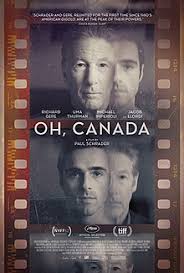
OH CANADA
US, 2024, 91 minutes, Colour.
Richard Gere, Jacob Elordi, Uma Thurman, Victoria Hill, Michael Imperioli, Caroline Dhavarnas, Penelope Mitchell.
Directed by Paul Schrader.
A Paul Schrader film, written and directed by him, based on the novel, Forgone, by American novelist, Russell Banks, with whom Schrader had collaborated in the film version of Banks’ novel, Affliction, 1998. Schrader notes that he had three bouts of Covid and hospitalisation, saying that he became more conscious of mortality, was interested in Forgone and collaborated with Banks who preferred the title Oh Canada – and then Banks himself dying while the film was in production. Prior to Oh Canada, Schrader was focusing on older men reviewing their lives, First Reform, Card Counter, Master Gardener.
Watching Oh Canada is both an interesting and intriguing experience.
The film opens with an ominous comment that a son has not seen his father for 30 years. Then the setting up of cameras by a documentary filmmaking trio in the house of a famous documentary filmmaker, Leonard Fyfe, now in his 80s, dying of cancer, an opportunity for him to tell his story for the television audience. The crew have been Leo’s former students, as has been his wife, Emma, living with him for 30 years and concerned for his health and the strain of doing the interview. The other character during the filming is Leo’s full-time nurse.
It is usually pointed out that Paul Schrader came from a strict Calvinist background and has been concerned with religious themes in many of his films. This is not just a documentary about the life and career of Leo, but his opportunity to face the truth and lies of his life, seduction and exploitation, but also skills as a filmmaker and lecturer.
And Leo is played impressively by Richard Gere in his mid-70s, old, almost bald, stubbled chin, experiencing the pain of cancer, determined to go through with the interview, despite the effort and strain, by to tell the truth, uncovering lies, and all the time dedicating this to his wife who, he says, has never known him fully.
The intriguing part of the experience is the range of flashbacks, not always in chronological order, moments of memories by Leo, puzzle pieces for the audience to put together. And, some of them are in bright colour, others in black and white, often stark. So the memories are invested with moods, colourful and severe. Most of them go back to 1968, Leo aged 26, his hometown and family, the calling in the priest for a family discussion about his future, his marriage, a son, pregnant wife, prospects, the Vietnam war, the draft, and his decision to avoid the draft – Oh Canada.
The young Leo is played by Jacob Elordi, making an effective contrast with Richard Gere, though Schrader also using the device of having the older, but healthier, Gere take Elordi’s place in many of the sequences of the past. His wife, Emma, is played by Uma Thurman (and, indicating confusion of memories, she also plays the wife of his artist friend in 1968.)
There is discussion about photography and filmmaking in black and white flashbacks to the 1990s and his academic career and his eager students.
With the filmmaking, Leo has the opportunity for some kind of assessment of his life, acknowledging the good and the bad, the hurt to others, deceit and lies, an opportunity for truth in the deathbed confession.
- The title, the national anthem of Canada, the perspective of Canada in 1968, draftees avoiding Vietnam? Life in Canada?
- The settings, Montréal and the house, interiors, the filming? Massachusetts towns, in the 60s? Richmond Virginia? Vermont? The Canadian border? The atmospheric score?
- The work of Paul Schrader, his later interest in older men and coping with life? The adaptation of Russell Banks novel? as writ Schrader er and director?
- The situation, Leonard Fyfe, the opening comment by his son not meeting his father for 30 years? The documentary filmmakers, setting up, Leo and his health, cancer, weak, agreeing to the film? His having taught Emma, Malcolm, Victoria 30 years earlier? His agreeing to do the interview, his impatience? A deathbed confession?
- The structure of the film, the interview in 2023, the many flashbacks to 1968, the flashbacks to the classes in the 90s? The range of flashback memories? The style of the film, muted colour for the interview, bright colour for some of the flashbacks, the many black and white flashbacks?
- Richard Gere, his career, in his mid-70s, portraying a dying man, but also the flashbacks the 1990s and teaching, and the insertion of the older Leo instead of the younger Leo in flashbacks? Jacob Elordi as the younger Leo?
- Leo reviewing his life, facts, lies, confessions, confusions? The effect on him, wanting to keep going, wanting Emma to be present, for her to know the man she married, his tiredness, the nurse, going to the toilet? Coming back, his insistence? Finally stopping, his attitude towards the filmmakers? In his room, with Emma and the nurse, Sloane putting the camera in the room, the filmmakers watching his dying scene?
- Leo, his family, his home town? His wandering, the relationship with Amy, her pregnancy, loving her not, the encounter with Amanda, sexual relationship? Meeting Alicia, the marriage, her son, her pregnancy, Leo and his writing, the prospect for teaching, going to Vermont, the pressure from his father-in-law and his brother, to work for the firm? The break, his going away, not seeing his son for 30 years, the loss of contact with Alicia?
- The various pieces of his story, 1968, the draft, his lining up, costume, questions about being gay, his answers, awaiting his documents? Going to Vermont, hiring the car, the scene in the shop, the clothes, stealing the money and the clothes? Visiting Stanley, the conversations, Stanley and draft dodgers, his art, relationships, Gloria (and being played by Uma Thurman), the sexual encounter, his leaving?
- The visit to his hometown, the diner, memories of his family? the family discussion, all in the priest, his declaration going to Cuba – is not getting there, the story of his crossing America like Jack Kerouac, the calling of the priest for advice?
- Going to the border, the signpost, his choice, standing in the field, the sign, his crossing the border to his future?
- The documentary makers, past students, the scenes of their eagerly listening to him, his invention of the camera and looking at the interviewer on camera, his comments on Susan Sontag and photography, the meetings, the tutorials? His relationship with Emma and Victoria?
- Marrying Emma, the 30 years, her devotion to him, her concern in his illness, during the interview?
- Leo and his career, the film about testing weapons, the glimpses of his further films, about exploitation of the Arctic, about the sex offending Bishop? His reputation? His being introduced, bringing Emma on stage?
- The encounter with his son, the son driving to the screening, talking to his father, Leo turning his back and disowning him? The son and his conversation with Emma? The news about what happened to Alicia?
- The final death scene, Emma and the nurse, breathing his last, having made his confession?
