Displaying items by tag: Peter Malone's Movie Reviews
They Knew What They Wanted
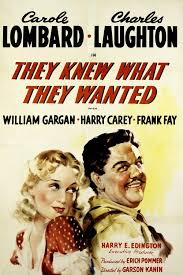
THEY KNEW WHAT THEY WANTED
US, 1940, 89 minutes, Black-and-white.
Charles Laughton, Carol Lombard, William Gargan, Frank Fahey, Harry Carey.
Directed by Garson Kanin.
They Knew What They Wanted was a Pulitzer-prize-winning drama, 1925, written by Sidney Howard (Oscar for Gone with the Wind). It was filmed in 1928, The Secret Hour, with Pola Negri and Jean Hersholt. It was made again, this time with the title A Lady to Love, 1930, with Edward G. Robinson and Vilma Banky, directed by distinguished Swedish actor and directors, the conditional strong.
The further remake, with the original title, was released in 1940, directed by writer and director, Garson Kanin, a star vehicle for Charles Laughton and Carole Lombard. By 1940, Laughton had already won an Oscar playing Henry VIII had appeared as Bligh, Javert, the Hunchback of Notre Dame. This is an exuberant Laughton, an Italian migrant growing grapes in Napa Valley, full of verve, movement, emotion. Sadly, within a few years, Carol Lombarde had died in a plane accident.
This is a film about the Italian community in California, Italian traditions, the presence of the parish priest and the religious traditions, an unlikely marriage between the farmer and a waitress San Francisco, corresponding, the wrong photo sent, that of the farmer’s associate (played by William Gargan), misunderstandings…
From 1940 and the motion picture code, the film is fairly straightforward and frank in terms of Gargan as a womanising character, the encounter with the waitress, the final revelation about her pregnancy, recriminations, confrontations, and the very Christian perspective at the end, not an immediate happy ending, but the farmer and his forgiveness and hopes indicating happiness in the future.
- Prize-winning play, film adaptations, production values, the cast?
- The Napa Valley, the Vineyards, farmers, the Italian community, homes, work, the local community and festivities, doctor, priest, a self-contained world? The musical score?
- Toniys story, Charles Laughton’s performance, exuberant, migrant, accepted in the US, the vineyards, money saved, Joe as his manager, getting dressed up, suit and tie, shoes, the trip to San Francisco, the meal, the comedy with the shoe, Amy as the waitress, stern and matter-of-fact, Tony’s attraction, hopes?
- His return, confiding in Joe, Joe and the writing of the letters, reluctant, style, and his receiving them, response, her friend typing the letters, formal? the request for a photo?
- The discussions for a better future, her decision, travelling, the issue of the wrong photo after the comedy of taking of the photo, Joe the station, not able to tell the truth, taking her to the house, meeting with Tony, and bewilderment, his showing her about the house?
- The celebrations in the evening, her participation, the puzzle with Joe, the truth, Tony and his dancing, the pyramid of men over him, taunted, going on the roof, falling, injuries, the doctor?
- Tony, the time as the recovery, Amy staying, Joe, his womanising background, deciding to leave, promises to Tony, the encounters with Amy, the kissing – and the later news of the pregnancy?
- Tony’s recovery, the priest, his friendship with Tony, advice, going to Sacramento for the Bishop to officiate the marriage, the tension the night before going?
- Joe, packing and leaving, and the deciding to leave after Amy fainting, the doctor knowing the truth?
- The final meeting, the priest, Amy and her shame, wanting to leave, Tony by contrast, happy, the vision of the son, no matter the father, raising, the son inheriting…?
- Amy leaving, grateful to Tony, his waiting – and the hopes for her eventual return?
North, The
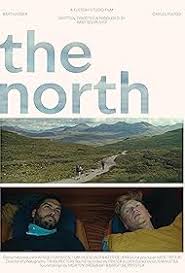
THE NORTH
Netherlands, 2025, 130 minutes, Colour.
Bart Harder, Carles Pulido.
Directed by Bart Schrijver.
Definitely a film for walkers, long-term hikers, those who like to spend time contemplating in nature. Already in 2024, there is a film version of Raynor Winn’s novel, The Salt Path, with Gillian Anderson and Jason Isaacs, set along the Southern English Coast.
This is a Dutch production, writer-director, Bart Schrivers, creating a scenario with two friends, glimpses of them in the past, then 10 years later meeting up and deciding to go on a walk through Scotland, the West Highland Way, then the Cape Wrath Trail, 600 Miles, 28 days according to the plan.
There are many very enthusiastic reviews and blogs. Audiences have wanted to share the wonderful range of scenery of Scotland, the open fields, the mountains and crags, the country lanes, tracks through the forests, rivers and lochs, bays and beaches, small towns along the way, refuge hurts in the mountains. These are all here with fine cinematography.
Some have described it as a contemplatives experience through film.
And the two characters, Chris, from Holland, Lluis with a Spanish background. We gradually learn of their stories, Chris, business, wife, expecting, family hopes. Lluis, coming across as something of a loner, sometimes in phone contact with his father. We do not find out much detail about how they became friends 10 years earlier. And, sometimes they are quite puzzling, one or other going off by himself, not really the greatest of talkers, not the greatest of confidantes, not always communicating well or clearly.
We, the audience, walking with them, might have all kinds of questions to then, to get to know them better, to help us understand what they really want to achieve in the walk, not just the physical exercise, but the psychological impact of this kind of physically demanding experience, what they intended to achieve. But, most of this is left to our imaginations, closely observing each of the friends, hearing what they say, wondering what they don’t say, looking at their body language, some shared experiences, some moments of alienation, somewhat away from each other, but, ultimately, despite the audience wondering, a personal achievement for each of them.
(It should be said that not everybody has been as exhilarated with this film experience as the walkers and the contemplatives. Those who are not great observers of the details around them, who do not notice a lot of the reality, this 130 minutes can be exhaustingly demanding, not much happening, not a development of the characters, not enough to excite the imagination with possibilities – these observations drawing on some of the ideas of Carl Jung and his perceptions on different personality types, sensing people and their living in the present, intuitives and wandering away from reality details.)
Ready or Not, Here I Come
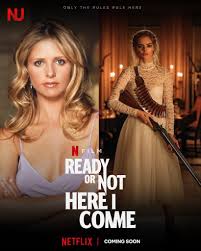
READY OR NOT: HERE I COME
US, 2026,114 minutes, Colour.
Samara Weaving, Kathryn Newton, Elijah Wood, Sarah Michelle Gellar, Sean Hatosy, David Cronenberg, Olivia Chang, Antony Hall, Nestor Carbonell, Kevin Durand.
Directed by Mark Bettinelli-Olpin, Tyler Gillette.
It is six years since the original film made such an impact, popularity, positive critical reviews. It had a complex plot and characters, dangerous situations, deadly games and hunting, guess, conflict between the wealthy and the poorer, the suggestions of Satanism. At the centre is Samara Weaving as Grace, the young bride in the first film, the target of the deadly game of High and Seek, satanic ritual whereby she becomes the hunted by the rest of the family, a sacrifice in the perverse satanic world.
The sequel, with the addition of Here I Come, a strong affirmation by Grace, Samara Weaving appearing again (and, as suggested previously, passing for Margot Robbie’s sister).
The sequel takes up from the past, lots of references to the characters and action of the past and sinister plots and menacing games. But, while there is a repetition of the plot, a repetition of the dangerous hunt with even more complex situations, there are some additions to the plot, especially the introduction of the estranged sister of Grace, played by vigorous Kathryn Newton. This time, they will share in being hunted together, reconciling, clashing, falling out, but a final coming together and victory over the satanic machinations and rituals.
Also added this time is the character of the family lawyer, smooth and smart, sinister, explaining the regulations and the families commitment to a mysterious and sinister character who controls the family and its destiny, creating its satanic laws. He is played by Elijah Wood, presiding over the satanic sacrifice but, somehow unexpectedly, surviving.
Also added is the development that there are various families involved in having the ring from the original founder of the group, is gaining power over everyone and control of the fortune. And, this time, there are Hispanic rivals, Indians, Chinese, all arriving for the ritual and hunt. Sarah Michelle Gellar and, a somewhat demented Shawn Hatosy are ruthless villains.
There is also an intriguing cameo at the opening from master-director, David Cronenberg, who is a larger-than-life portrait intimidates throughout the film.
The mansion is large, the grounds also large, patrons celebrating weddings and playing the casinos hurried out so that the rich can commence their deadly ritual game. So, all kinds of hunting, hiking, traps and ambushes, betrayals, greater use of developed technology from the last film, as well as betrayals, cowardice, really unpleasant characters – and, for those breaking the rules, as previously, the characters exploding.
The review of the first film complained about the tiresome language. The same here, though more so, all the characters have an extremely limited four lettered vocabulary more than frequently invoked, no creativity in invective and exasperation expressions.
The final ritual where the disciples have all gathered leads to violent and chaotic mayhem of destruction during the satanic ritual – with Elijah Wood looking on while the two sisters, at last, reconciled, lacerations and wounds galore, facing their future (and another sequel?) together.
Jennifer
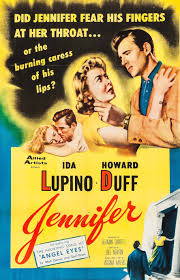
JENNIFER
US, 1953, 73 minutes, Black-and-white.
Ida Lupino, Howard Duff, Robert Nichols.
Directed by Joel Newton.
Jennifer was a film noir of the 1950s, focusing on female paranoia. It had mixed responses, some considering it excellent of its kind, others noting that the plot was rather slight.
It is a star vehicle for Ida Lupino, playing with her husband of 30 years to come, Howard Duff. Ida Lupino had been a star of the 1940s and moved into direction in the 1950s with films like The Hitchhiker and The Bigamist (both with more impact than Jennifer).
Ida Lupino plays a woman, Agnes, needing a job, anxious, looking after mansion where the previous owner has disappeared, Jennifer. She has to pack Jennifer’s things, finds a diary with notes, becomes obsessed with these notes and what has happened to Jennifer, people in the area suggesting she was a blackmailer, suicide.
Howard Duff plays a local owner of a business, is attracted to Agnes, trying to break her out of her anxiety, taking her dancing which mellows her. However, a local helper to Howard Duff keeps referring to the disappearance, suspicions about his boss, continuing to influence Agnes and her thinking she has found Jennifer’s body in the pool in the furnace room.
Eventually, Howard Duff is able to reassure her, she has seen her own reflection, that Jennifer was insane and had been removed to a sanatorium where she has died.
A curiosity item in the tradition of American film noir, and significant in the talented career of Ida Lupino as actress and as a director.
Collection, The
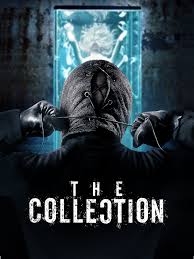
THE COLLECTION
US, 2012, 82 minutes, Colour.
Josh Stewart, Emma Fitzpatrick, Christopher McDonald, Lee Tergesen, Tim Griffin, Andrei Royo, Randall Archer.
Directed by Marcus Dunstan.
In 2009, Marcus Dunstan directed The Collector, a horror film with Josh Stewart as the central character, criminal, persecuted, but an open ending to the film.
Three years later, this sequel. The central character, Arkin, played by Josh Stewart is released from prison. There is a focus on a young woman, Elena, previously involved in a car accident, her devoted father, played by Christopher McDonald.
Elena is persuaded by a friend to go to a party, a sinister location, an abandoned area of the city. The party is very lively, crowds, Elena dancing, her friend and the young man with them. However, what occurs is a frighteningly vicious and gruesome sequence, a harvester ploughing through the dance floor, killing all the dancers
In the 2000s, many commentators referred to films with “torture porn”. And this was in the eerie era of the Saw franchise, a concealed sadistic killer, a range of victims trapped in an eerie building, all kinds of devices for torture and killing.
This is the theme of The Collection, Elena surviving but imprisoned by the masked giant killer. Arkin there, but not saving her, is injured but decides then to go back in and rescue her. In the meantime, her father has engaged a group of mercenaries, very tough and determined, to find her.
The main part of the plot, of course, is the pursuit through the vast building, its many floors, the range of torture implements throughout the building, various prisoners who have been trapped, overcome. And there seems to be a laboratory with all kinds of victims in the water cases.
As might be expected, the team is picked off one by one. The leader does his best to find Elena. Arkinis involved, under suspicion, but continuing to help. A young girl is seen, misleading the group, but viciously killed in a machine.
Ultimately, Arkin does save the day, allowing his arm to be broken again to open the catch of the cage in which they are trapped. He confronts the killer, eventually the killer toppling down into a shaft with many dead bodies.
The SWAT team arrives, Elena reunited with her father, Arkin getting physical help – but, seeing the mask of the killer lying on the ground, he realises that the killer is still alive – and the buildup to a final confrontation and a sequel.
The sequel was planned for many years, promised by the filmmakers, but not made it yet…
We Don't Need a Map
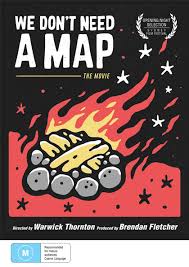
WE DON'T NEED A MAP
Australia, 2017, 85 minutes, Colour.
Directed by Warwick Thornton.
Two compelling reasons to watch this documentary from 2017. First is the subject. Secondly, the writer-director.
The reason for the title is that Warwick Thornton is making a film about the Southern Cross and its role in aboriginal lore, the vastness of the stars, the recognition of the stars in the Southern Cross, its role in guiding people in their travels, its symbolism with various myths.
There is a focus on the Eureka flag, with the Southern Cross, and the suggestion that it could be interpreted as a swastika, something that upset people in 2017. Warwick Thornton has invited quite a range of talking heads, many aboriginal leaders, writer and commentator, Bruce Pascoe, singer, Adam Briggs, and many more.
The narrative of the film encompasses indigenous history, pre-1788, and the relationships between the first peoples of the land and those who came from elsewhere. Thornton uses the device of small creative scrap-iron puppets to dramatise the events.
For those who are familiar with the history from 1788, conflicts, the authorities, the squatters, the hostilities, massacres, this film presents a dramatic visual and thematic overview. For those not familiar, for younger audiences, indigenous audiences to appreciate history, it is interesting and provocative.
The second reason for watching this film is to appreciate the career of Warwick Thornton, his background, photography, filmmaking, early documentaries, his formal training, his work as a cinematographer, his breakthrough feature film, 2009, Samson and Delilah. He often works with his famous cinematographer son, Dylan River. This includes a six part documentary about Thornton and his life, The Beach.
At the time of this documentary, Thornton was making his second feature film, Sweet Country, racist prejudices and wars at the time of World War I and its aftermath, a winner of many awards. Thornton was to make The New Boy, drawing on his time in Catholic education at New Norcia, the continuation of the themes of Sweet Country in Wolfram, the exploitation of indigenous child labour in the search for tungsten. (Thornton also directed some episodes of televisions, Mystery Road.)
A significant contribution to Australian history, race history.
Roommates/2026
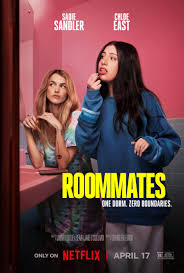
ROOMMATES
US, 2026, 107 minutes, Colour.
Sadie Sandler, Chloe East, Aidan Langford, Natasha Lyonne, Nick Kroll, Carol Kane, Megan Thee Stallion, Billy Bryk, Sarah Sherman, Steve Buscemi, Janeane Garofalo, Martin Herlihy.
Directed by Chandler Levack.
A long tradition of films about roommates, some sinister, some dramatic, some comic.
This film is produced by Adam Sandler’s company and features his daughter, Sadie, in the central role while other members of the family have various credits. And, it is very much on Adam Sandler -like comedy.
There is a framework to the main narrative, two college students bickering, screaming insults at each other, into the supervisor’s office where she tells a story. During the film we see its impact on the two angrily students – and, ultimately, some understanding and reconciliation.
The supervisor’s story has a focus on Devon, 18-year-old, high school, very supportive mother and father, Natasha Leonne and Nick Kroll, very good friends with her brother who is about to come out. In fact, he is her best friend. She is accepted at school but only just. She finds an outlet in sport activities.
She is about to go to college hoping to find a friend and roommate. Surprisingly she does and is all enthusiastic. She is going to study architecture and meets a senior student and feels she has a bond with him. The friend is played by Chloe East, Celeste.
Best friends, moving in together, out to socials, Celeste making sure that Devon comes out of herself. But, it does not last. Devon is irritated by Celeste’s sometime irresponsibility. Yet, her parents invite Celeste to visit and she makes friends with the young brother.
However, it becomes too much for Devon, having to pay for spring break plane trips, seeing Celeste kissing the architecture student…
Celeste plans with her brother a revenge scheme, building a model house for roommates, Devon presenting it on stage as part of her student competition, reenacting the difficulties with Celeste, naming her, Celeste incognito in the audience. Then Celeste humiliates the younger brother by putting up a huge poster about his going to the prom with a boyfriend.
The buildup to a confrontation between the two young women, Celeste putting the case that she comes from a wealthy dysfunctional family, mother with Alzheimer’s, and feels that Devon has been imposing her ideal family on her. Devon lights a fire, it spreads, the house burning down, Celeste’s father coming, her trying out at a number of schools, while Devon, because of the fire, is sentenced to 2 months in jail where she meets a dominating roommate whom she tells off – but, the fellow prisoner is only joking. End of film, they form a friendly partnership with architecture and design, best friends.
A film mainly of interest for the female audience, high school and college students, parents and grandparents (with a bizarre comic cameo by Carol Kane as Gigi, the grandmother). The male audience – perhaps a learning experience!
Space/ Time
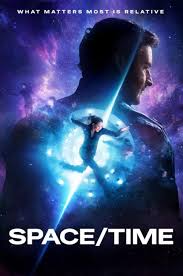
SPACE/TIME
Australia, 2025, 89 minutes, Colour.
Ashlee Lollback, Hugh Parker, Pacharo Mzembe.
Directed by Michael O'Halloran.
Space/ Time is set in the near future in Australia. The film opens with a critique of human behaviour and the destroying of the world and its consequences, an apocalyptic tone.
This a small budget film made in Melbourne in 2016 but not released until 2025. Filmed in a factory, it does have elaborate sets, especially for the experiments with time machines and travel. The look of the film at times is quite striking.
The plot consists of a response to the crisis, a group of scientists experimenting with a machine for time travel. However, the experiment fails and three years pass. One of the scientists is intense, determined to continue the experiments though there are prohibitions by law for experiments and the finance and the getting of equipment. He challenges a talented designer to continue her work. This means that there is a moral dilemma for her, her ambitions, hopes, and her relationship with her partner who is supportive but also serves as something of a conscience.
The group of scientists decides to continue their experiments, get financial support from dubious resources, the film building up to the testing of the experiment and further failure.
The film is mainly interested in the apocalyptic science fiction aspects rather than the development of characters and personal dramas. To that extent it is for science fiction and science-oriented film buffs.
- Futuristic science-fiction, the 2020s and 30s?
- Apocalyptic atmosphere, the opening, the effect on earth, the condemnation of humans for spoiling the earth? Prospects for the future?
- The team, their work, the vast sets, time and space travel, scientists? The work, the tension, the experiment, failure?
- Scientists, Holt, his personality, experience, the visual experiment, the glow on his back? Liv, her abilities, participation, interactions with the other members of the crew? Harris, relationship with Liv, background, supporting, at home, serving as something of a conscience?
- Three years passing, the apocalyptic crisis, the motivation of the scientists, the discussions, the resources, the financial backing, the online critic, the secrecy of his death?
- The proposal, illegal, Liv and her conscience, her motivations, Holt and his domination? The experiments, success and failure?
- The prospects, the aftermath of the experiment, the effect on Holt, Liv and Harris?
- Small budget science fiction, for science fiction and science fans, the special effects making it a good-looking example of science-fiction?
I am not an Easy Man
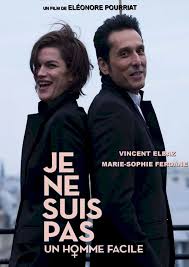
I AM NOT AN EASY MAN
France, 2018, 98 minutes, Colour.
Vincent Elbaz, Marie-Sophie Ferdane, Pierre Benezit, Blanche Gardin, Celine Menville, Remi Gerard, Olivier Pajot..
Directed by Eleonore Pourriat.
A French comedy from 2018, the time of the emergence of the #Me Too movement, especially in the US.
This is a comedy variation on the vice versa genre films, children becoming parents and vice versa, characters returning to a younger age or moving to an older age. This time it is a man entering into an alternate universe.
The message is basic, a feminist critique of chauvinist male behaviour. The central character, Damian, is very cavalier, thinking himself a ladies man, dismissive of the women and business meetings. Turning and ogling, he walks into a lamppost and collapses, waking to see a sign indicating Mere Lachaise Cemetery and discovering a reverse world while he remains the same, the chauvinist male puzzled by what he is seeing.
The film is comparatively small scale, a few characters, the city of Paris. Damian then sees the women dressing in a more masculine way, discovering they are in charge of business, and doing traditional male work. And then he discovers that the men are in a way that males often attributed to women, their interest in clothes, their emotions, their subservient roles, being dismissed… And some of the subtitles play on this with words referring to lumberjanes, and a variation on a common coarse swear word…
The other central character is Alexandra, who worked in a bookshop but now is in charge, a celebrated writer, behaving in the male chauvinist way as are some of the other female characters.
Damian is sometimes bewildered, but always judging from the chauvinist perspective, entering a relationship with Alexandra, she taking him on as a case study problem, recording their encounters, she treating him in the sexual relationship as audiences are used to seening many men treating women.
The message is clear, the comparisons often amusing but highlighting male bad attitudes and behaviour and how women are seen and treated. Perhaps it is the French, but so much of the comparisons between men and women focuses on bodies, bodily behaviour, sexuality, sexual relationships, dominance and submission (and a visit to a club where there is a cross-dressing singer with the ballad rendition of a song from Grease, not mentioned specifically, but example of a Drag King! Finally, Alexandra, involved in a divorce situation, misjudged by Damian, encounters a feminist protest march through the city, and discovers Damian now marching in sympathy with the women.
The basic plot was reworked for Ladies First. However, the plot is highly amplified, especially with its cast, Sasha Baron Cohen and his reputation as Borat and other chauvinist characters, with Rosamund Pike noted for strong female commanding roles. And, there is a significant British supporting cast, a world of bigger business than the original, the same humour with the reversal of male and female behaviour, more chauvinist treatment by the women from the office, then Damien and his being knocked out again and learning his lesson.
Power Ballad
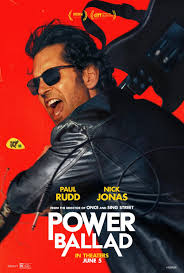
POWER BALLAD
Ireland/US, 2026, 98 minutes, Colour.
Paul Rudd, Nick Jonas, Peter McDonald, Marcella Plunkett, Beth Fallon, Jack Reynor, Havana Rose Liu.
Directed by John Carney.
Drama about music, songs and lyrics, creativity, performance, the wonderful satisfaction that a composer has in creating something beautiful. But, this is a story with some edge. But it is humane, sometimes funny, sometimes with regrets, but a satisfying ending.
The film is the work of writer-director, John Carney, himself a singer and bass player, composer (from the some of the music in this film). His films have had music very centrally in their dramas, popular successes with such films as Once and Sing Street.
The action takes place mainly in Carney’s Ireland, in Dublin, are some sequences in the United States, especially a concert performance in Los Angeles. However, the central character is American, a very fine performance by Paul Rudd, always adept comedy, but also having the opportunity to play music and sing. His character, Rick Power (which as many of the title) has settled in Dublin, married with a daughter, part of the band who said at weddings. (Paul Rudd’s biography mentions that he sang and played at bar/that Mrs in his young days.)
In the meantime, a young American singer, Nick Jonas, who in real life has had this kind of career with his brothers and then as a soloist, is invited to sing with a group at a wedding. He is genial, Rick is happy to join him in singing, a happy success. In the aftermath means that the two of them spend a night, at the piano, wrecking, Rick sharing some of his compositions, a great learning experience for Danny who gifts Rick with a classic guitar.
Where to from here? Home, Danny’s scrums, please and sings a melody that Rick had shared with him. Encouraged by his girlfriend, manipulated by his manager, Danny records the song – instant hit, millions of followers, rapturous audiences and concerts, everybody singing it.
At a shopping mall, Rick it – and the rest of the film is the drama, the impact on Week, no proof that he ever wrote the song, calls to the manager, legal issues, his family expecting a financial windfall. And quite an effect on Rick and his feeling exploited.
In fact, the aftermath has very serious overtones for Rick, his family, his band, but it is also played with great good humour, a Russian visit to LA, an encounter (understatement) with Danny and pleasing ending journey at a concert, for Rick back home – and a final short sequence with a pleasing moral for the whole story, especially for Rick.
All in all, a pleasing experience and a nice song.
- The title, songs, sock soft rock ballads, the central character of Rick Power?
- The work of the director, musician, singer, composer, his films are musical themes?
- Composition of the song? Rick, his story, American, his band, the initial sequences, the credits, Rick and his playing to the fans, then reality, not successful, the Irish tool, meeting his life, marriage, the birth of his daughter, staying in Ireland, his group, singing at weddings? Satisfied with his life? The encounter with Danny, spending the evening, the piano, songs, the lyrics? The friendship?
- The Irish setting, Dublin, homes and streets, the weddings, celebrations? The contrast with US, Los Angeles, concerts, the venues, backstage? The LA mansions?
- The musical score, the background score, the range of songs, the key song and its repetition? The chorus? The range of cities, the fans? The full song at the end?
- Rick, his friendship with Sandy, manager, covered and, very Irish? The band, the performances, the crowds? Long time with the group, the van, the instruments, performances, the response of the newly married’s, those attending?
- At the Castle, the accommodation, the double bunks in the small room, the performance, the couple asking for Danny Wilson to singing, his popularity, his presence, the singing, ripped joining in, bonding? The evening, Danny his vast room, the piano, the songs, the lyrics, the happy ending? The gift of the classical guitar?
- Rick, the mall, hearing the song, his reaction? The popularity, online, the millions of hits? The effect on him? Disbelief, the phone calls to his manager, no response? The group asking for the song, his refusal, the fight? The clash with Sandy? At home, claiming the authorship, the response of his wife and daughter, not supporting him? Becoming paranoid, leaving home, asking Sandy for help?
- Danny, America, lack of success, the reputation of the boy band, his manager, pressurising him, his girlfriend? Hearing the song, her response? The manager, the discussions about the authorship, the pressure, the performance, the record, the success, the fans?
- Rick, decision to go to LA, with Sandy, the dream on the plane that he reconciled, Sandy and his behaviour, laughing at the comedy is on the plane?a, the ruse for getting behind the scenes with the pretended phone call, meeting the couple from Dublin, the address the party, getting in, Sandy, playing the guitar, ripped finding Danny following up to the sauna, Danny and his lifestyle?
- The confrontation, the issue of money, ripped not wanting money, wanting the truth, the fight, admitting the truth, falling over the balcony, Rick jumping, the manager and the pursuit?
- Back home, the issue of money, wife and daughter wanting it, ripped talking about it but wanting only the truth? His daughter playing the videos, the discovery of playing it for her when she is a little, the story that he had told to Danny, support of his wife and daughter?
- The reconciliation with the band, Sandy and his role? The performances at the wedding? The request of the song, singing it? His explanation?
- The moral of the story, truth, reputation, creativity, the episode with the young stealing from the busker in the street and Rick’s reaction, the final moment, giving the busker the role of money, a happy moral ending?
