Displaying items by tag: Ken Watanabe
Kokuho

KOKUHO
Japan, 2025, 175 minutes, Colour.
Ryo Yoshizawa, Ryusei Yokohama, Soya Kurokawa, Keitatsu Koshiyama,Ken Watanabe, Nana Mori, Mitsuki Takahata, Shinobu Terajima, Min Tanaka.
Directed by Sang-il Lee.
Kokuho has been very popular at the box office in Japan. It is a film about kabuki. Which leads to the question by most non-Japanese audiences, what is kabuki?
Kabuki is a classical form of Japanese theatre, mixing dramatic performance with traditional dance. Kabuki theatre is known for its heavily stylised performances, its glamorous, highly decorated costumes, and for the elaborate make-up worn by some of its performers. (In 2005, kabuki theatre was proclaimed by UNESCO as an intangible heritage possessing outstanding universal value. In 2008, it was inscribed in the UNESCO Representative List of the Intangible Cultural Heritage of Humanity.
And this film, which runs almost 3 hours but keeps the attention, does offer a brief history, the developments in the 17th century, the forbidding of women to perform, the art form then becoming a theatrical vehicle for male performance.
And the title of the film? It actually means “National Treasure”. The title bestowed on performers who excel in kabuki.
While there is a narrative development through the film, the focus is on a talented teenager, his being the son of a yakuza head in the 1960s, the killing of the chief, family revenge, but the boy’s surprising performance observed by the head of a family with a kabuki heritage. The boy is chosen for intense training joining with the son of the kabuki master, the developing expertise over the years, some of envious attitudes of the son who is not as committed as he might be, and also the suspicions his mother has towards the newcomer.
The training sequences and the discussions about performance provide important background for the film’s audience: details of movement, stylised representation, the importance of costumes, make up, scenery, which all serves as something of a tutorial for the audience to learn what kabuki entails. And, there is a huge emphasis on the male performers learning how to move as female characters, timing, the suppleness of their bodies and movement, angles, holding positions as well as voices, and vocal range.
Throughout the whole film there are many performances of kabuki dramas, titles given, indications of plot, and the audience is invited to sit back and absorb the kabuki experiences.
But, as the years move on, the master kabuki performer decides that he will pass on his title, choosing the young man over his son to his wife’s dismay. The son disappears, the young man’s girlfriend disappearing with him, a strong sequence when this newly crowned head of the family leads a large parade through the town, a little girl, his daughter with a geisha, runs after the procession and he spurns her.
Important is the performer’s visit to a shrine, suggestions of prayer, the supernatural – and a kind of Faustian pact for success.
Pride, fall, humiliation – but in this story, possibilities for redemption, the return of the son, his wanting to return to kabuki performance, complications with an injury to his leg, gangrene, amputation, and reconciliation.
For audiences outside Japan, this film is something of a challenging experience, this immersion into Japanese history, Japanese culture.
- The title? Meaning “National Treasure”?
- The popularity of the film, box office in Japan, awards and nominations?
- The introduction to Kabuki, the art form of the 17th century, historical glimpse, the issue of women not performing, the men taking the female roles, onnagata?
- The style of Kabuki, the stage, scenic backgrounds, musicians, singers, the performers, the characters, costumes and elaborate, make up, stylised movement, stylised singing, voices? The range of stories, male and female characters, birds, herons, wisterias, love, relationships, suicide?
- 1964, Japanese society, the popularity of Kabuki, the young boy and his performance, age, appearance, make up, physical movements and extremes, the response? Hanjari sitting, impressed, wanting to train the boy?
- The yakuza connection, the attack on the party, the killing of the father, the effect on the boy, time passing, his girlfriend, the planning of the revenge, the attempt, the confrontation, failure?
- Hanjari, continuing to support the boy, inviting him to his family, his wife’s reaction, suspicions of the yakuza, concerned about her son, the importance of bloodline for Kabuki families, the son, the two boys together, the training in detail, the performances, climb, friendships, rivalries and comparisons? The years passing?
- The elderly national treasure, his observing, influence, later performances?
- The two young men, their names, the theatres in Osaka, the range of theatres, layouts, the audiences, large, response, acclaim? Japanese response to these performances? Non-Japanese responses? To the stylised nature of Kabuki?
- Two young men, Kikuo and his complete dedication, the training, the young son, more laid-back, drinking, late, the repercussions? The concern of his mother?
- Hanjari, the car accident, in hospital, the issue of who was to take his place, expectations for his son, his choice of Kikuo? The reactions, the performance and the young man’s nervousness, success, the son walking out, in the foyer, leaving and disappearing? His mother’s reaction?
- The personal life, Kikuo, the relationship, his daughter? The son disappearing, the geisha following him, their child?
- The issue of succession, the announcement, the buildup, the dignitaries, the National Treasure present, the ritual, the announcement, Hanjari and the blood, withdrawing? Kikuo and his inheriting the title? Celebrations, the procession, his daughter running out, his ignoring her?
- The consequent years, Kikuo and his abilities, his reputation, the yakuza connections, his relationship and illegitimate daughter? The consequences?
- His failure in theatre, his performances in smaller venues, the drunk man accosting him thinking he was a woman and the aftermath? His visit to the shrine – and a Faustian pact and its consequences?
- The return of the son, his return to the theatre, the reconciliation, Kikuo training the son, baseball rather than Kabuki?
- The son, the gangrene, his wanting to perform, the amputation? The buildup to the final performance, Kikuo assuming the male role, memories for the audience of having seen the play previously and the style, the action? The son, the female role, the performance, the difficulties, the other foot with gangrene, the collapsing, but Kikuo enabling them to complete the performance?
- The move to the future, Kikuo decades later and as national Treasure, the acclaim, the public, his long career, the journalist interviewing him, about the scenery that he favoured, the realisation that this was his daughter, the response to his performances?
- The ending, Kikuo and his life, looking at the scenery, successes, failures? Achievement?
Shanghai
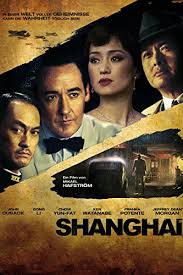
SHANGHAI
China/US/Thailand, 2010, 105 minutes, Colour.
John Cusack, Gong Li, Chow Yun-Fat, David Morse, Ken Watanabe, Franka Potente, Jeffrey Dean Morgan, Hugh Bonneville, Benedict Wong, Christopher Buchholz.
Directed by Mikael Halfstrom.
Shanghai was not so well reviewed on its release – however, it does have something of a more favourable following now (as instanced by comments on the IMDb).
Production was prepared for filming in Shanghai but permission withdrawn after complaints about presentation of sexual matters in Ang Lee’s Lust: Caution. The production was moved to Thailand – and the sets to recreate Shanghai in 1941 are quite elaborate, blocks of city streets of the time, buildings, facades, lights, as well as elaborate interiors, especially in a casino with the gambling, the stage entertainment, the crowds. And, the film is filled with extras, quite a number of strong crowd sequences, Japanese troops killing people in the streets and subsequent panic, panic at a railway station, and crowds at the end trying to get away on ships leaving Shanghai.
And the audience needs to pay attention to the complexities of the plot. The focus is on the journalist coming from Nazi Berlin, some considering him favourable to the Nazis, but is now collaborating with the Americans present and finding himself in complex situations with the Chinese resistance to the Japanese. He is played, rather sternly, by John Cusack.
The film has a strong supporting cast, led by celebrated Chinese actress (especially in the 1990s in ang Yimou films), Gong Li. She is married to Anthony, a power in the crime community of Shanghai, and played also by veteran Chinese actor, Chow Yun-Fat (famous at the time for his appearance in John Woo films). There is also the military chief played by Ken Watanabe.
The plot involves John Cusack searching for the killer of his journalist friend, played by Jeffrey Dean Morgan, leading him to the crime chief as well as the military chief. But the important thing is the role of the wife and her involvement with the resistance, and especially at the end, trying to get a young woman who has been mistress both to the military chief and the American journalist who has been killed out of Shanghai.
The film has been directed by Swedish director, Mikael Halfstrom.
- The title and focused, 1941, Shanghai’s place in China at the time, International Centre, the war with Japan, the year of Pearl Harbor?
- The production values, the elaborate sets for Shanghai, streets and buildings, interiors, casinos, offices, apartments? The large cast, the many crowd scenes, war, action, railway stations, wharfs? The musical score, songs and performance? International atmosphere?
- International intrigue, the background of Germany during the 30s, the outbreak of the war? The situation of Japan and its attack on China, the 30s? Japan preparing for the world war? The effect on Chinese citizens? The resistance? International presence, the dividing of the city into zones, the British, American, French, the Germans?
- The focus on Paul Soames, the American, undercover, agent, journalist, his work in Berlin, reputation, coming to Shanghai, his friendship with Connor? Meeting him, Sumi, his work, information, his death? wanting to find out the truth?
- The opening with Tanaka, the arrest, the interrogation, the threats? Going back two months?
- Paul, his friendship with Richard Astor, commissions, the American presence, international intrigue?
- Paul and his work as a journalist, the British editor, hostility, suspicions of his political stances?
- His getting the background information, travelling through Shanghai, observing, the people, the politics, the Japanese presence, the resistance, the shootings in the street…?
- The encounter with Anna, the attraction, questions, her relationship with her husband, his criminal background, power, at the casino? The revelations about Anna, the resistance, at the casino, passing on messages, but her relationship with her husband? The secrecy? The continued encounters with Paul, his following her and her knowing it? The issue of his friend and his death, the girl who is his mistress, the revelation of her relationship with Tanaka, her role as an agent? Her drug addiction, her being shielded and hidden? The plan to get her out of Shanghai?
- Social life in Shanghai, the German Embassy, the Consul, his wife, relationship with Paul, from the past?
- Tanaka, his presence, suspicions, authority, the relationship with Anthony, with Anna? The arrest of Paul, the brutality, the interrogation? Watching the execution of the Chinese agent?
- The complexities of getting the mistress out of Shanghai, the intrigue, all watching, Anna and her friends with the girl, the railway station, Japanese suspicions, the creating of the diversion, the shooting, the crowd and confusion? Tanaka, with the young girl, his love for her, the final injection?
- The final complications, Anthony and his giving infomration to Tanaka, the confrontation at the house, the bodyguard, the driver, the shootings, Anthony taking a stance, his death, can occur wounded, Paul and Anna escaping? Going to the wharf, the passport, Paul saying and it was his wife, there seem Tanaka, or having spent his life, their being allowed on the ship? Indications of returning later?
- Espionage, journalism, war atmosphere, in an exotic location?
Bel Canto
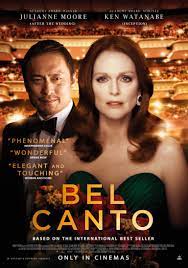
BEL CANTO
US, 2018, 100 minutes, Colour.
Julianne Moore, Ken Watanabe, Sebastien Koch, Ryo Kase, Christopher Lambert.
Directed by Paul Weitz.
This is quite an unusual film, written and directed by Paul Weitz whose range of films includes American Pie and About a Boy.
The title indicates opera themes and, this is to the fore, an American diva, played by Julianne Moore, comes to a Latin American country to sing at a social for the elite. One of her greatest fan is a Japanese businessman played by Ken Watanabe. He arranges that he come to the concert on the pretext of offering an industrial plant to the President of the country though he has no intention of fulfilling the promise.
During the performance, rebels invade the mansion, wanting to take the President prisoner but he has not attended (staying home, in fact, to watch his favourite telenovella). The rebels make speeches about corruption in their city, are demanding the release of fellow prisoners, taking the guests at the party hostage.
Sebastien Koch appears as a Swiss mediator. And Christopher Lambert has a significant role as one of the hostages, provocative, but able to play the piano and accompany the singer when performance is demanded of her.
Women are released. The men have to stay. Time passes, the negotiator does his best, no co-operation from the government, soldiers outside the besieged building.
There is a planned that the Opera singer perform on a balcony, the people, for the media, a gesture for negotiations. In the meantime, the Japanese businessman becomes more involved with the singer. He has a translator who is attracted by a female rebel, teaching her to read and write, becoming emotionally involved.
There are suggestions of the Stockholm syndrome, the bonding in some ways between rebels and hostages, and a final football match.
There are some tension during the siege, the audience wondering what will happen, what could happen. Eventually, there is an attack on the mansion, the deaths of the rebels, the death of the businessman shielding the female rebel, the Opera singer returning to the US that to her career, with memories of this experience.
- The title? Music? Opera? Song, divas? In the context of a Latin American uprising, siege, hostages?
- The locations, the opening in Japan, business offices? Homes? The transition to Latin America, filming in Mexico, the city and the streets, the palatial house and interiors, the enclosed grounds, the background of the mountains?
- The musical score, the Opera excerpts, Julianne Moore and the Opera singer’s voice?
- The opening, the Japanese businessman listening to Roxanne singing, his love for the music, the travelling to Latin America, alleged opening a business, but not his intention, his deciding to go to listen to the singer? Welcomed, the reception, the guests, affluence, celebration, but the refusal of the president to go?
- The businessman, the translator, the translator and his skills, moving comfortably with everyone? The interview with Roxanne? Her singing?
- The invasion, the rebels, uniforms, masks, weapons? Taking control? Wanting the president? Motivations, the release of political prisoners, accusations of corruption?
- The mayhem, the wounding of the host, the young rebel sewing his wound? Everybody on the floor, time passing, the businessman offering his coat to Roxanne as a pillow?
- The extended siege, the personalities of the rebels, their backgrounds as teachers, their causes, commitment? Weapons?
- The negotiator, from Switzerland, personality, skills, calm? Searched? Discussions? Negotiating the release of the women and the elderly? The musician, his need for tablets, his collapse, the decision to retain Roxanne, his being upset, going back, opening the door, the young rebel shooting him?
- Outside, ambulances, the media? The reports on television? Local police, guards?
- Roxanne being detained, seen as more valuable? The time passing, the various personalities, Simon, the farewell to his wife, the incident with the shaving and the loss of water, his ability to play the piano, accompanying? His excitement with the football?
- The lack of water, attempted negotiations, the decision for Roxanne to sing, going up onto the balcony, Simon playing the piano, the effect? The water being turned back on? The delivery of the food? Roxanne being given a comfortable room, Carmen looking after her, the conversations?
- Carmen, not able to read, talking to the interpreter, asking him to teach, the various meetings, the attraction, the night together?
- The businessman, the attraction towards Roxanne, the mutual attraction, taking blame for being in Latin America, ultimately together, the interpreter arranging things, Carmen and her intervention?
- Time passing, the Stockholm Syndrome, the bonding between captors and hostages? Especially playing football together? Symbolism of the soccer match? Their being allowed outside? The cause, to give up or not?
- The rebel singing, his embarrassment at going off key, climbing the tree, people urging him down, Roxanne teaching him how to sing?
- The invasion by the troops, the singer shot in front of Roxanne, the young man working in the garden, offered jobs by the hostages when they left, his death, the leaders? The businessman shielding Carmen and being killed?
- The rescue, people led out, the effect of the experience?
- A year later, Roxanne singing, the presence of the interpreter, her vision of the businessman?
