Displaying items by tag: Toby Jones
Othello/ 2026
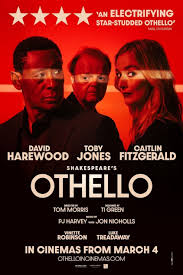
OTHELLO
UK, 2026, 165 minutes, Colour.
David Harewood, Toby Jones, Caitlin FitzGerald, Vinette Robinson, Luke Treadway, Tom Byrne, Peter Guinness, Rose Riley.
Directed by Tom Morris, Tim Van Someran.
In theatre history, Othello stands with Shakespeare’s King Lear, Hamlet, Macbeth, as the four great tragedies. There have been many film versions including Orson Welles, Laurence Olivier, Anthony Hopkins, Laurence Fishburne, David Oyewolo… and very interesting portrayals of Iago, Michael McLemore, Bob Hoskins, Frank Finlay, and, especially, Kenneth Branagh.
For centuries, this play has been acclaimed as Othello’s downfall, the downfall of a great man, victim of a character flaw, in Othello’s case, susceptibility, especially to jealousy.
Looking at this filmed theatre piece, emphasis on dialogue and performance rather than setting and staging, it looks and sounds now far more like the Tragedy of Desdemona, the woman, victim of domestic violence, victim of Othello’s jealousy and rage, wounded pride, Desdemona is misunderstood, undervalued. But this is also the tragedy of Emilia, again a forthright character, being deceived and used by her malicious husband, Iago.
This version emphasises the unsubtle character Othello. David Harewood has a strong presence, deep baritone, poise as a general but this gradually disintegrating as he is deceived by Iago. He is the straightforward, successful soldier taking Iago for granted, then his exuberantly joyful acceptance of love from Desdemona.
This Iago of Toby Jones (unlike the interiorly devious Kenneth Branagh in the 1995 version) is military, ambitious, thwarted, racist, going step by step on his destructive path, not really interiorising his ploys, but taking advantage of a situation as it comes, not so much a well-thought-out plan, but capably exploiting each opportunity as it arises.
Desdemona is a strong-minded woman, her own woman, forthright, loving, in no way suspicious, equal to Othello, taken aback by his jealousy, loving but defiant to the end. This is a very strong performance by Caitlin FitzGerald (though her sometimes noticeable American accent is a distraction). Desdemona is an ideal contemporary woman but still one who is a victim of-taken-for-granted masculine superiority which becomes, in tragic fact, misogynistic murder.
And, in the latter part of the play, Emilia, a fine strong performance from Vinette Robinson, becomes a vigorously fearless facer of facts, who speaks out in Desdemona’s defence, shaming Othello, defying Iago. But she is also a victim of fatally masculine violence. Toby Jones’ interpretation of Iago is inherently misogynistic towards both Desdemona and Emilia, as well as denigrating Bianca (who is also used by the otherwise charming Cassio).
Using some perspectives from the psychology of Carl Jung, this interpretation of Othello and Iago is that they are military men in war and in the alleged peace times, direct, living in the present, using their own logic and seriously deficient in awareness of possibilities in life and relationships – or becoming trapped in the deadly conspiracies – jealousy for Othello, ambition, position and status for Iago.
In the 21st century, the title can be Desdemona.
Mr Burton
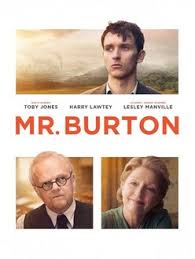
MR BURTON
UK, 2025, 124 minutes, Colour.
Toby Jones, Harry Lawtey, Lesley Manville, Mali O'Donnell, Amy Ffio Edwards, Aneurin Barnard, Steffan Rhodri.
Directed by Marc Evans.
Richard Burton was one of the most admired stage and screen actors of the 20th century. But the title of this biography has two meanings which his fans will know. The actor was, in fact, Richard Jenkins, a from mining family near Port Talbot in Wales. It did not seem likely when he was young that he would become so famous, so admired, and marrying Elizabeth Taylor twice.
The principal Mr Burton of this film is his teacher, Philip Burton, who recognised the young man’s talents, fostered them, encouraged his ambitions, legally adopted him. And, here he is played by the versatile actor Toby Jones who has portrayed a number of historical characters including Alfred Hitchcock and Truman Capote.
And this is something of a breakthrough performance by young actor, Harry Lawtey. He has to portray young Richard Jenkins as a late teenager at school, a mixture of a character who was a bit of a lad (and more than a bit of a lad as he grew older) but also a man with a resonant voice, someone who was able to take advice and transform his vocal tones, language and pacing (while incorporating still something of a Welsh lilt), overcome a difficult family background (his father finally agreeing with Philip Burton about the adoption and getting £50 compensation even though he had little time or attention for his son), valuing the support of his sister, helped with jobs by his brother-in-law who did not understand him.
So the film creates the atmosphere of Wales in the early years of World War II, opening when Jenkins was 17, a mixture of one of the boys yet special in terms of studies, responding to the affirmation of Philip Burton, a dedicated teacher, something of a loner, who saw the potential, took great trouble to train him with his breathing and enunciation, hours and hours spent out in the hills with dedicated practice. Philip Burton so believed in his protégé that he risked comments from the locals, insinuations as well as declarations of suspicions about his gay interest in Jenkins.
There are some very good set pieces throughout this film, very vivid with Jenkins’ drinking father, meetings with his son, the pub, showing himself that he could be a boisterous entertainer for his drinking friends, and the minimum reluctance in selling off his son for adoption. And, by contrast, there are the scenes of his sister and brother-in-law, hard times with the mines, with the economy, with the war. And, many scenes at school.
One of the entertainment benefits of the film is the presence of Lesley Manville as Philip Burton’s housekeeper, friend and confidante.
By the end of the film, with all his gratitude to Philip Burton, we begin to see more vividly what was to come, the intensity of Burton’s personality, ambitions, recklessness, which was manifest in his later tempestuous relationships, especially with Elizabeth Taylor.
But, we see that Burton was accepted to Oxford, something a lot of his fellow Welshman, including his father, could not understand. We see him accepted at Stratford-upon-Avon, hopes, fears, drinking, moody, preparing for his debut as Henry V.
Which is where the film ends but, there have been so many films in his career, reports of his wonderful stage performances, the details of his sometimes scandalous life, so that we know where this portrait of the beginning of his life and career will lead to.
- Audience knowledge of Richard Burton, his background, his career, Elizabeth Taylor, marriages, their work together, drinking, his death?
- The film about his origins, Richard Jenkins of Port Talbot, his father and mining, his family? Hard life and background? His education, the encounter with Philip Burton, working with Philip Burton and the opening up of his acting career?
- The setting of 1942, World War II, Wales, the re-creation of the town, the mines, the streets, shops, school, pubs, church…? The musical score and the atmosphere of Wales?
- Richard Jenkins at 17, his life so far, his talents and abilities, the difficulties with his father, living with his sister and brother-in-law in the family? His visits to his father, the pub, boisterous, his father’s attitude towards his son and acting? The later sequence in the visit with Philip, the discussions about the adoption, the revelation about the father and his attitudes, £50?
- Philip Burton as the main Mr Burton, his background, personal life, loner, suggestions of homosexual orientation? Quiet life at home, his friendship with his housekeeper, the routines of life, meals, conversations?
- Philip Burton as a teacher, his pupils, his own love of theatre, poetry, and the Welsh atmosphere of poetry? The classes, his interest in Richard, in class, poetry and drama, Richard’s voice, the sequences of training, pronunciation, out in the hills, declaiming, the transformation in Richard’s voice?
- The innuendo around the town, the range of people, the gossip, the pubs? The decision about adoption, Richard’s attitude, Philip’s visit to Mr Jenkins? Allaying some kind of suspicions? Richard’s own attitude towards the situation, at the time, afterwards?
- The possibilities for Richard and a career, the issue of Oxford, the seeming impossibility of someone from the town going to Oxford, his father’s comments about Oxford?
- Richard, branching out, going to Oxford, wilful, some alienation from Phillip, going to Stratford-upon-Avon, the rehearsals for Henry V, his nervousness, drinking, unreliable, timing? Philip’s visit, the encouragement, tutoring?
- The performance, the nerves, success, responses, and the beginning of his career? Indications of future success, stage and film performance, voice? Yet scandals, drinking, untimely death?
Instigators, The
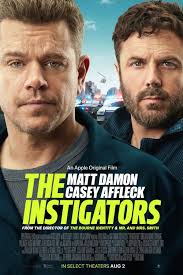
THE INSTIGATORS
US, 2024, 101 minutes, Colour.
Matt Damon, Casey Affleck, Hong Chau, Jack Harlow, Michael Stuhlbarg, Alfred Molina, Ron Perlman, Toby Jones, Ronnie Cho, Ving Rhames, Paul Walter Hauser.
Directed by Doug Liman.
This is a robbery story with a very strong cast, intended as an enjoyable pastime. Audiences might like to ponder who the actual instigators are in this story and what they were instigating in reality!
The setup is a buddy film, but two unlikely characters forced to work together, involved in a high-stakes robbery. We are introduced to the two, Matt Damon, always a solid presence, in therapy with his psychiatrist, Hong Chau, wanting an exact amount of money to be able to reunite with his son. By contrast, there is the alcoholic ex-conman played by Casey Affleck.
The situation is an election in Boston, Ron Perlman as the Mayor, corrupt, aiming for re-election against his ethnic rival, played by Ronnie Cho. The mayor is surrounded by his yes-men, especially his lawyer, played by Toby Jones.
In the meantime, there is a range of criminals played by Michael Stuhlbarg and Alfred Molina. They have the plan for the buddies, with the young nephew, to rob the vans carrying the money before it is delivered to the mayor.
They might be instigators but, of course, everything goes wrong. The money has already been transferred, they go into the Mayor’s office, still his keepsake with the number of his safe, a shootout, and escape in the van, chases through the city…
Ving Rhames appears as a corrupt police investigator.
When they are taken, there is a siege situation and the therapist is invited into mediate – enabling her to get out with some of the money to pay off Damon’s debt in view of a happy ending, and Casey Affleck escaping to Canada. The reason that they do escape and there is a happy ending is that the new Mayor, coming into possession of the money, anonymous money from the previous corrupt Mayor, is not declared and they can keep it as long as the two are not arrested and brought to court. So, off to Canada and happy ending.
The director is Doug Lyman (Bourne Identity, Jumper, Edge of Tomorrow), skilled at some action shows – but this is more relaxed for streaming audience.
- Title? Robberies? Who were the instigators?
- The Boston setting, the neighbourhoods, public spaces, the streets, car chases and pursuits, the mayor’s office, meeting places planning the robberies? The election – the rooms, corridors, social areas, the strong room with the safe? The musical score?
- The situation, introduction to Rory, therapy with the doctor, her questions, his responses, his crisis? The situation with his son? The need for money?
- The setting up of the robbery, the mind behind the robbery, his moods, dealing with his men, with Scalvo, young and inexperienced, the connections with Richie at the bakery? The plan, the testing of Rory and Cobby, details of the plan? The corrupt Mayor, as target, corruption and money?
- Rory and Cobby, personalities, interactions, slow, the as matter-of-fact, the precise amount needed, the bargain with the boss?
- The setup, the vans, the election night, the television news, the alternate candidate, Rory praising him, the presumption the corrupt Mayor would win? The scenes of the Mayor, his staff, tough tactics, reliance on his attorney, Alan Flynn?
- The comedy of the robbery gone wrong, the timing, the amount of money, the earlier van taking the money, guns and shooting, confrontations, the little money in the safe, Rory and the bag, the shooting, the deaths, Scalvo dead? Cobby wounded?
- Going to the doctor, the pressure on her, the discussion about her being a hostage, going with them, treating the wound, the consequences? Her later being chosen as the mediator for the hostages, her bargain with Rory and getting the money out under her uniform, helping Rory with his debt – but continually asking how he was feeling, especially during the negotiations? And copy finally returning to her?
- The mayor, his cronies, the defeat, Cobby with the money, the various positions, having the code number to the mayor’s safe, his not being able to remember, the various combinations?
- The boss, fleeing, contact with Richie, Richie and the interviews, sending the henchmen, tracking down Rory and Cobby, their escaping him? Frank, in the pay of the mayor, the dealings with Richie, his continued pursuit of Rory and Cobby? The finale and their doing the deal with him? And the final credits seen of the boss dead in the snow?
- The vans, the pursuits, the desperation of the chase, guns, Cobby wounded again, his complaints?
- The confrontation with the mayor, his desperation, the arrest, in jail?
- The return to the scene of the crime, Alan Flynn present, to do a bargain deal, opening the safe, all the money? The dilemma, the doctor as mediator? The device for escape, throwing the safes out the window, the scattering of money everywhere, the crowd racing for the money?
- Rory, finally, deciding to give himself up? The new mayor – and the information about the contracts, the new potential corruption? The two men let out, Rory going to see his son, reconciliation?
Mercy Road

MERCY ROAD
Australia, 2023, 86 minutes, Colour.
Luke Bracey, voice of: Toby Jones.
Directed by John Curran.
On Mercy Road there is no mercy.
This is a very intense film, focusing on a man driving a car through the night, his momentarily getting out of the car, but the camera inside the car, focusing on the man, on the dashboard, on his face, on the continued phone calls and his responses. He is played, even more intensely, by Australian actor with international career, Luke Bracey.
The audience has to pay attention, listening to the man and his sometimes confused outbursts, the range of phone calls he gets, commanding sum to be listened to, cancelling others. We gather that he has committed a crime, that a man, business connection, husband of his ex-wife, has been killed. But, his more frantic about the disappearance of his young daughter.
In the pounding score reinforces this frantic atmosphere, often desperate.
By contrast with the anxieties of the driver, there is the caller whose voice is very calm, controlling, giving advice, driving directions, information about his daughter, about the dead man, about the ex-wife, seemingly detached, called in to handle situations. And the voices that are British actor, Toby Jones.
Filming inside a car has been a test of many directors, an expert was a bus tourist Army from Iran. But, there was also the British drama, Locke, with Tom Hardy behind the wheel, and a desperate situation.
The phone calls heighten the tension. Apart from the calmly sinister voice of the mediator, there are phone calls from community services concerning the daughter, some contact with his ex-wife, and, somewhat out of the blue, business partners expecting him to turn up for work. They have a cumulative effect.
Some audiences may find this a drive to claustrophobic and intense. On the other hand, it is a bold experiment by American director, John Curran, Chappaquidik,, The Painted Veil, who spent some time in Australia and directed films like Praise and Tracks.
- The title, the location, the tone?
- Australian production, the Australian star, voices? Of the menacing voice of Toby Jones? The musical score? Tone, intensity?
- The situation, the father, searching for his daughter, relationship with his ex-wife, with her husband, the business deals, his contracts and commitments? The confrontation with the husband? The threat to his daughter?
- The film within the car, his momentary stepping outside the car, the camera within, the focus on the driver, his face, the spaces of the car? The phone? The intensity of the pace, the editing?
- The character of the driver, his background, favours, drinking, the broken marriage, his daughter, business partner? The crime, the murder, driving, getting away, the night?
- The voice, sinister, controlling, knowing everything about the driver, his daughter, statements of detachment? Being present in crises? Control? The psychological pressure, the conversations? Threats and menace yet calm? The directions, the turns, the destinations? The information about his wife, her husband, the death? The taking of the daughter?
- The intensity of pressure, the phone calls, his business associate expecting him to turn up, putting them off? The voice control, excepting calls, refusing calls? The social welfare calls, the information, the appeals? His wife? Her following his directions? Her fate?
- The buildup to saving his daughter, communication with his daughter, his crime, sense of guilt, defiance? Desperation?
