Displaying items by tag: Tim Blake Nelson
Testament of Ann Lee, The
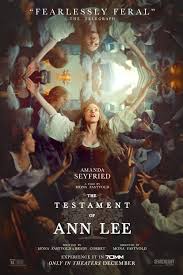
THE TESTAMENT OF ANN LEE
US, 2025, 137 minutes, Colour.
Amanda Seyfried, Lewis Pullman, Thomasin McKenzie, Matthew Beard, Christopher Abbott, Viola Prettejohn, David Cale, Stacy Martin, Scott Handy, Jeremy Wheeler, Tim Blake Nelson.
Directed by Mona Fastvold.
Who was Ann Lee – and a woman significant another to leave a testament? The answer to this question here is challenging, unsettling.
Norwegian writer-director Mona Fastvold, who writes and directs with her partner, Brady Corbett, especially the Oscar-winning The Brutalist, discovered that Ann Lee was significant in the 18th century establishment of the Shaker movement in New England, moving from the English city of Manchester. As the film shows in an initial startling Quaker episode where participants begin to shake, dangling arms loose, and young man and an old woman screaming incessantly, the Shakers were a development from the very quiet religious prayerful movement of the Quakers.
One of the striking features of this film is the recreation of the city of Manchester in the middle of the 18th century, the attention to detail, costumes and decor, the religious meeting places, homes, workplaces, the streets and markets, the intervention of the authorities. This film looks very impressive.
And, it sounds very impressive. The music direction has gone back to Shaker Spirituals of the period, disturbingly movement rhythms, forcefully sung, chanted, heavy pounding beats of the instruments, and all accompanied by an extraordinary choreography, men and women, period costume, rhythmic and erratic movement, shaking, stirring, stomping, the participants lost in some kind of spiritual ecstasy.
One might say this is a rather brutalist screen experience.
There is a voice-over narration of the story of Ann Lee, a devout little girl, always accompanied by her brother William, no playing with toys, rather a sense of prayer and the presence of God, continuing as she grew up, her Quaker involvement, her rebellion against formal Anglicanism and enthusiasm for popular movements like the Methodists. Personally, she experienced some lingering shock when witnessing her parents’ lovemaking, but marrying blacksmith, Abraham, having four children but their all dying young, and her spiritual sense and development moving her against all kinds of sexual experience. And requiring this her followers.
Ann Lee is played in an award-nominated performance by Amanda Seyfried, a powerful and intense performance, ensuring that Ann Lee comes across as intensely sincere, ecstatically prayerful, high standards for herself, her being acclaimed as Mother in the Shaker movement, and her belief that, while God came to earth as male in Jesus, God was to return to Earth for the second coming as female, in her.
There are also some arresting supporting performances led by Lewis Pullman as her brother William and continue disciple, and Christopher Abbott as her tormented husband, Abraham.
Ultimately, Mother has an inspiration that she should take her followers to America, just as the American Revolution was underway, an extraordinary storm scene which would make anyone wonder why men and women took the sea in those centuries, her trust and faith to find a land base, and the establishment of the various communities in this new world, becoming more numerous, significant prayer gatherings, a men’s door and a separate women’s door into the meeting room, then chant, stomping, gesticulating, until the time comes when Ann realises that she must leave this world.
Many audiences have found they are not on the wavelength of this particular religious history, its themes, its manifestations of faith, the peculiarities of this spirit manifested in bodily shaking. But, for those interested in what William James called the varieties of religious experience, this film is informative, interesting in its way, confronting and always challenging.
During the final credits there are continued statistical pieces of information, the maximum number in various communities at their peak in America, and the dwindling numbers to the present (remembering Ann Lee’s injunctions against spiritual sexual experience and her reliance on converts.)
- The history of the Quakers, the Shakers, the transition to the United States and establishing communities? The heritage?
- Audience knowledge of the Shakers, Ann Lee, of 18th century Manchester and the religious movements, the mission to America? The final statistics as to the number of continuing Shakers, the peak community numbers?
- The film is described as a musical drama, the emphasis on the drama of Ann Lee’s religious experience, the churches in Manchester, her marriage, children and their deaths, her emerging leadership? Described as Mother?
- The musical contribution: the traditional Shaker Spirituals, the movement, the lyrics, the dance, gestures, the pounding instruments? The titles on screen, the scriptural references to the woman? Choirs, the group and dancers, costumes, choreography? Their insertion into the narrative?
- 18th century England, the status of the Anglican church, the emergence of other movements, the indication of the Methodists? The Quaker meetings? The key visuals of the meeting, the man and his cries, gestures and contortions, the old woman and her very long crying out? Presence of God, presence of the Spirit, entering the psyche, entering the body, the mentality, the contortions, the shaking, a different kind of religious experience?
- The narrative, explaining Ann, her family, her situation, her brother William, her reaction to her parents copulating, Abraham, the marriage, the sexual encounters, the pregnancies, the four births, the difficulties, the babyirs dying? The effect on Ann, her rejection of physical sexuality, the bride of Christ in union with him? (And making converts but no marriages, and the lessening of the population of the Shakers?)
- Ann and William as children, his dependence, walking the city, the churches, their workplace, the relationship with the parents? Ann and her description of her life, prayer, conscious of God, not playing with toys, religion all through her life? And her growing up?
- Ann and her female qualities, the qualities of leadership, in Manchester, the role of William, her marriage to Abraham, his work, her praise of him, his sexuality needs, her refusals, the children and their deaths? Some alienation?
- Her going to the local communities, James Mawdsley and his wife, their leadership, welcoming and, the sessions, the religious fervour, prayer, dancing, shaking, gestures? The God language?
- The development of the group over the years, and growing older, William and his continued presence, separation from Abraham? The role of the Wardsleys? The response of the people of Manchester? Some converts? The role of Mary, her eyes, her friendship?
- The attitude of the churches, condemnation and rejection, the Shakers and their defiance, the local authorities?
- The sense of mission, the decision to go to America, the discussions, the appeal for finance to the member, his recommendation for a sponsor, the Wardsleys staying in England, Ann, William, Abraham and his going with them, the other members of the group?
- At sea, the vividness of the storm, the waves, the effect on the ship, on the passengers, and her defiance, providence, the calm, the criticisms of the crew of the denunciations, and confronting them?
- The small group, landing in America, the political situation, the background of the war of independence, through the city, finding the landlady, Ann and her visions and convictions, their being welcomed, the meals, the discussions? The young man and the girl, the sexuality issues, their leaving the dinner, together, found by their father, their having to leave?
- The small group, sailing north, the eccentric captain, going through the woods, the old man and his visions, shaking, pointing, the travelling, finding the land, settling in?
- The overview of the settlement developing, Ann and her leadership, the maps and her pouring over them, the buildings, the trees, logging, sawing, the houses and halls?
- The increasing congregation, people gathering? The assembly, the separate doors for men and women, the women’s dress, the prayer, the shaking, the dancing?
- The issue of the second coming, Jesus as male, the second coming for Jesus as female, God as male and female? Ann seen as Jesus in his second coming, Mother, The leader?
- The character of William, dependence on his sister, constantly with her, his role at the meetings, the prayer, always with the group, his ventures in America, his death?
- Mary, with Ann, Ann speaking of William coming, Mary explaining to her his death, Ann saying that he was coming to welcome her to happen, to her babies?
- And the continued impact of the Shaker songs, movement and choreography throughout the film?
- The overall experience, depending on the audience’s religious attitudes, scepticism, belief, different modes of prayer and spirituality, the impact of shaking, songs and dancing, gesticulating? Historically interesting? Relevance to the 21st-century?
Captain America: Brave New World
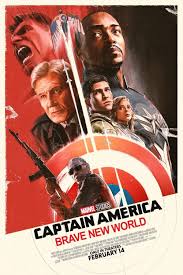
CAPTAIN AMERICA: BRAVE NEW WORLD
US, 2025, 118 minutes, Colour.
Anthony Mackie, Harrison Ford, Danny Ramirez, Shira Haas, Carl Lumbley, Tim Blake Nelson, Giancarlo Esposito, Xosha Roquemore.
Directed by Julius Onah.
Chris Evans was the original Captain America, Steve Rogers, appearing in Captain America, The First Avenger in 2011, giving his back story. He then appeared in America, Winter Soldier and Civil War and a number of Avengers and Spiderman films. Anthony Mackie appeared as his associate, The Falcon, and now has the mantle of Captain America. (And Mackie appeared in the series, The Falcon and the Winter Soldier.)
The world has been experiencing some disasters but, suddenly, an island has appeared in the Indian Ocean, a source of a new element which will help rebuild the world. Needless to say, desired by political leaders, desired by criminal powerbrokers. And an initial episode to get us into the frame of mind with Sam Wilson, now Captain America, with his apprentice, The Falcon, a brash young enthusiast played by Danny Ramirez, fly to Mexico to confront a villain, Sideliner, Giancarlo Esposito, and a buyer for the new element. When are in the picture, Capt America and The Falcon in their distinctive costume, their wings and flying, and the importance of the or defending, all attacking, shield.
Enter from the wings, newly elected American Pres, Theodore Ross, played by Harrison Ford now in his 80s and entering into the spirit of the Marvel Universe with some enthusiasm. He has had a bad reputation in the past, alienated from his daughter, but now insists that he is change. He is negotiating an international treaty, especially with the Japanese Prime Minister, the safe use of the new element.
Then some mayhem, an attempt on his life at the White House, shooters, including a close friend of Sam Wilson now released from jail are taken back. And the revelation of the villainous mastermind, Samuel Sterns, appearing as something of a mutant, played with sinister relish by Tim Blake Nelson. In fact, in prison, he has been experimenting with all kinds of drugs, feeding them to the President, working on mind control for assassins, ambitious to be in power of the element.
In a way, so far more a less expected – and this has disappointed some of the Marvel fans. However, there is a huge set piece towards the end, the Pres himself victim of his medication, transforming into a large Redcap Hulk, wrecking all kinds of destruction including demolishing of half the White House. (And, since the film was released after the re-election of Donald Trump, there is the temptation to look at all the mayhem scenes are some kind of allegory, the Pres morphing into a red raging monster-figure, attacking everyone, demolishing everything, even the destruction of the White House!).
The quiet finale, peace and some prosperity restored, millions in prison. However, marvel fans should not race for the exit during the credits because there is a substantial sequence right at the end. The future?
- The Marvel Universe, Steve Rogers as Captain America, Anthony Mackie as the Falcon, participation in The Avengers movies? The television series featuring The Falcon? Sam Wilson as Captain America?
- The interconnections in the Marvel Universe, the connection with The Hulk?
- The role of Captain America, as initiated by Steve Rogers? The distinctive uniform, the wings and flying, the significance of the shield? The Falcon as apprentice, costume and shield, wings, learning?
- The global situation for the film, post-apocalyptic situations, the United States, hostilities, the emergence of the island in the Indian Ocean, new element, powers wanting possession of it? The working for a treaty for participation in its use?
- The establishing of Anthony Mackie as Captain America, presence, personality, African-American hero? Seeing him in action, flight, the operation in Mexico? Hostility towards President Ross? Being summoned, the discussions with the president, his change of situation, working towards the agreement and a treaty? His previous antagonism towards the president?
- The operation in Mexico, Sidewinder and his presence, the buyer, absence, the conflict? The character of Sidewinder and his presence, deals? The return from Mexico?
- The character of the president, the election, in the wings, the discussions, his address to the people, the acclaim, Together? The first hundred days, the discussions with the Japanese Prime Minister? The discussions with Sam Wilson, his assistant and her presence, Ruth and her security? Sam Wilson investigating her? Joaqui Torres and his computer skills and investigations?
- The character of Isaiah Bradley, his past, imprisonment, skills, meeting The Falcon, the brashness of the young man, Bradley and his strength? His antagonism towards the president? Sam Wilson and rehabilitating him, the invitation to the White House, dressing up, the security, the ceremony, the president, the shooters, Bradley and his role, overcome, imprisoned?
- The consequences, Sam Wilson and investigations, the prison, the laboratory, the information, the profiles, the medication, the character of Samuel Sterns?
- Sterns, his appearance, mutations, imprisonment, his experiments, the president and his dependence on him for medication, his control of the president, his power, wanting the element? His experiments, mind control?
- The president, the visit to Japan, the Japanese Prime Minister wary? The failure of the mission?
- The return to Washington, the press conference, everybody gathered, the replaying of the tape, the president and his deal with Sterns? Sterns and his control, the transformation of the president into The Red Hulk? The mayhem into action? The confrontations?
- The return of the president to himself, imprisonment, his accepting responsibility, the visit of Sam? His alienation from his daughter, her visit?
- Sidewinder and his defeat? Captain America and his future, The Falcon?
- The significance of the post-credits sequence, Sterns in prison, the challenge to Captain America, the future?
Greedy People
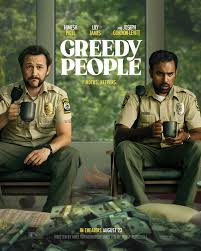
GREEDY PEOPLE
US, 2024, 112 minutes, Colour.
Himesh Patel, Joseph Gordon-Levitt, Lily James, Uzo Aduba, Tim Blake Nelson, Simon Rex, Jim Gaffigan, Joey Lauren Adams.
Directed by Potsy Ponciroli.
The title is absolutely correct. And, there is only one of the principal characters who is not greedy.
This reviewer had read only the cast list before seeing the film but, about 15 minutes in, the title Fargo came to mind, thoughts about the Coen Brothers and their style of filmmaking. (And, then reading the comments and reviews, practically everybody thought of Fargo and the Coen Brothers!).
Once you’re on the wavelength of Greedy People, there is no turning back. Screenplay, by Mike Vukadinovich, is cleverly funny, situations highly contrived but that is part of the enjoyment. And, gradual revelation of links between the various characters and their behaviour, the consequences of greed (and husband organising the murder of his wife also reminiscent of Fargo) becoming more humorously deadly as the film goes on. This is entertaining black humour.
At the opening, we are introduced to a sympathetic young policeman on his first day in a small town in Providence, Will he ia played by British actor, Himesh Patel. His wife, played by British Lily James, is pregnant. And then he meets his partner, one of the brashest to the brash, Terry, played by a very nonchalant Joseph Gordon Levitt, a walking satire of verified self-importance.
Answering a police call, and misinterpreting it, Will becomes involved in a scenario that he could never have imagined. He calls Terry – and thus begins a series of choices that will lead to disaster, greed, violence and general mayhem which makes greedy People both interesting and funny.
There is a good supporting cast, especially Tim Blake Nelson as the fish Baron of the town (and Tim Blake Nelson had played the title character in the director, Potsy Poncirili’s western, Old Henry). Among the supporting characters is an awkward masseur, Simon Rex, under the domination of his religion mother. There is hit man in the town, philosophical but deadly, played by Jim Gaffigan, The Irishman. And there is his Colombian counterpart who, apparently, has jurisdiction in the town for hits. There is the fish Baron’s ambitious secretary. There is also Uza Aduba who is the good one, the police chief.
So, with memories of the Coen Brother films, tantalising situations, ironic and satiric dialogue, audiences can sit back and enjoy the mayhem until the final macabre, laugh-out-loud image and a nice postscript, perhaps another tribute to the Coens, with Raising Arizona.
- The title? Tone? Expectations?
- The satire, the irony is, linking to the Coen brothers, Fargo?
- The variety of chapters, the focus on each character?
- The introduction to Will, bloodshot eye, his relationship with Paige, her pregnancy, his first day? The revelation about his father and the stealing of money? Murphy as the boss, solid and reliable? The introduction to Terry? Terry and his style, forthright, the talk, the copies and meals, going to see the Chinese lady, the rendezvous, the loud music, Will responding to the call, thinking it a burglary, going to the house, the woman and her cutting the carrots, his entry, her fear, the shooting, the fight, her fall, the wound to her head, her death? Calling Terry, is arriving, discovering the bag of money, the plan, roughing up the house, inheriting the money in the locker, noting the missing bike? Getting an alibi, holding up the driver, the fierce argument, the time?
- The character, Terry, life, bullied at school, becoming a policeman, 16 years, his personal style, bravado, unselfconscious, the relationship with the Chinese woman, her husband? The situation, the money, the locker, owed? His coming to dinner, the encounter with Paige, the threats, killing the dog?
- The husband, Chetlow his grief, his being interrogated, the revelation of the truth, hiring the Colombian hitman, the payments, at work, the secretary, the affair, the plan? The Colombian, the truth about his not doing the murder? 48 hours for payment? The suspicions of the Mass are?
- The masseur, suspicious, the meeting, his explanation himself, his work, the dancing, the sex, his mother intervening, having seen the money, escaping on his bike?
- Paige, pregnant, painting the house, doing the shopping, the information about the Irishman? Will telling her the story but blaming Terry? The invitation to dinner, Terry at the talk, the threats, the death of the dog? The decision, going to the Irishman, the talk, his philosophising and rationale about killing, the local areas for hitmen? Her getting the money, $50,000 to pay him?
- Will, disturbed in the night, the masseur, observing hetlow, the secretary, mother, the shootings, the secretary shooting? Everybody dead? His phoning Terry? The phone calls to page? The confrontation between Will and Terry, Terry shooting him?
- The phone calls, Murphy, pursuit, and the shooting, Will dead?
- Terry, confronting the Irishman, the fight, the Chinese woman defending him, shooting the Irishman?
- Murphy, the tracking, her arrival, confrontation with Terry? His menacing Paige, her shooting him?
- The hospital, the birth, page wanting to abscond with the money? The Colombian arriving, taking the money, killing Paige the elevator? The secretary, going to the lift? Murphy waiting, the noise, the lift opening, the two dead, the money scattered?
- The nice ending, Murphy and her caring then for the baby, the back story of the death of her child?
Bricklayer, The
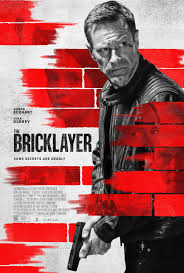
THE BRICKLAYER
US, 2023, 110 minutes, Colour.
Aaron Eckhart, Nina Dobrev, Clifton Collins Jr, Tim Blake Nelson, Oliver Trevino, Ilfenesh Hadera.
Directed by Renny Harlin.
This action thriller is based on the novel by former Marine and FBI agent for 20 years, Paul Lindsay, writing under the name of Noah Boyd. The screenplay has changed the agency from the FBI to the CIA.
Renny Harlin has made action thrillers for several decades, especially Die Hard 2. There is quite a mixed quality to his work. The action sequences are very strong – even though Aaron Eckhart is the hero, bricklayer, agent, is able to defeat all kinds of tough opponents, though in one sequence succumbing to just one of them! However, Eckhart is strong and tough in the role.
The villain is seen at the opening, Clifton Collins Jr, a disaffected agent, turning Road, wanting to expose the CIA and its many tentacles in Western cultures, secret assassinations…
The central character is a very prim, first, agent played by Nina Dobrev who accompanies the bricklayer to Greece where the action takes place. Quite a number of complications, assassination of journals, a political assassination attempt, a final confrontation between hero and villain despite a bonding in the past.
Tim Blake Nelson is the CIA boss.
More or less as expected.
- The title? The cover for the CIA agent? His explanation of his liking the work, precision, well fitting?
- The CIA, action throughout the world? Attitudes Western countries? Covert operations? Assassinations and targeting? Reactions?
- The realism of the screenplay? Or far-fetched?
- The opening, the journalist, Victor Radek, his purpose, her reporting, the photos and or sitter? Shooting her? The next journalist on the list? The group politician on the list? His making a case, disrepute of the CIA?
- The introduction to Steve Vail, Philadelphia, working on the building, the bricks, precision? Contact O’Malley? The meeting with Kate? The explanation of the situation? His decision to go to Greece, with Kate?
- The subtext of Miles Davis, music, records, the gift from Victor Radek, Tye with the collection of records, indication of her guilt?
- Kate, her CIA work, the office, re-examining the photos, discovering Radek?
- The flight, the interactions between the two, her self-importance, professional, his attitudes, Frieda? The arrival, posing as husband and wife, the hotel, the range of surveilance? Going to meet Patricio, his skills, the vehicle, IT and tech?
- She’s three, to the social, meeting with Tye, the past relationship, the discussions, her being bureau chief? The later encounters with her, at the apartment, the music?
- The attack on the journalist and the square, the protesters, Constantine and his speeches, Radek and his communication with Vail, motivations, memories, the death of his family? The decoy and Vail following, the shooting? The escape, the pursuit, talking with Radek?
- Vail and his visiting the club, the thug and his respectability, the fights? The credibility of Vail and his ability to conquer so many attackers? Yet in the office, his being overcome? The dangers for Kate, her involvement, with the vehicles? And the use of tracking devices?
- Vail, the memories and flashbacks with Radek, his family, his job is with the CIA, the promised to transfer his family, the Russians, the killing his family? Vail, the deal with Radek that he could disappear?
- The car chase, Radek’s escape, with the camera on the building, male or knocking it, the assassination attempt failing? Konstantin and his change of attitude, rescued by the CIA?
- Final confrontations, Radek’s death, the suspicions about O’Malley, the vast transfer of the bid calling? Vail and his suspicions, going to Tye, the confrontation, her death?
- The end, the interview with Kate and O’Malley, his being upset about suspicions, offer of promotion to Kate, her refusal? And Vail going back to his bricklaying?
Old Henry

OLD HENRY
US, 2021, 99 minutes, Colour.
Tim Blake Nelson, Scott Haze, Gavin Lewis, Trace Adkins, Stephen Dorff, Richard Speight Jr, Max Arciniega.
Directed by Potsy Poncirolli.
There is an interesting and entertaining reveal at the end of this film for those who do not recognise Henry McCarty. For those who do, the film is an interesting piece of creative history.
This is the changing west. It is 1906. Three men with sheriffs’ badges torture and hang a man for information and then pursue another. And then we are introduced to Henry McCarty, a wonderful performance by long-time character actor, Tim Blake Nelson. His voice-over explains his background (though a lot more to be revealed by the end of the film). He is widowed. He has a teenage son who is angry with him, wanting some independence from his rather stern and commanding, hard-working father.
They discover the pursued man, wounded, a gun, a sack full of money. They tend to him. But, as expected, the posse turn up, confrontations, the abduction of Henry’s brother-in-law, the posse hiring guns from the local town.
The odds seem impossible. The pursued man joins in the defence. So does the son. However, quite spectacularly in its way, Henry is able to dispose of the whole posse. And, then the reveal.
A small Western, not so well-known, emerging and the Covid era, but well worth seeing, a continuation of Western themes.
- The title, Henry McCarty, the final revelation of his identity?
- The mood of the opening, the posse, sheriffs, the torture and hanging of the fleeing man? The continued pursuit?
- The contrast with the introduction to Henry, his wife’s grave, with his son, Wyatt, the continued work, the son’s rebellion, the impositions of his father? The detail of the farm work? The boy wanting his independence?
- The wandering and bloodstained horse, Henry and his search, finding Curry, the money, decisions? Bringing him back, tending his wound, hiding the stolen money, Wyatt spying on his father? Henry going to the doctor, Wyatt taking the gun and shooting practice? The posse and Henry’s return?
- The membership of the posse, Ketchum as leader, brutal, the Spanish scout and his skills, the confrontation with Henry? Backing off?
- Tending Curry, consciousness, explanation who we was, the law? The others as bank robbers? His telling the story of his background, Henry believing him, feeding him, freeing him?
- Dugan, impatient, scouting the house, the shooting, Henry outwitting him, feeding him to the pigs?
- Preparation for the siege, Ketchum returning with the posse, the confrontation, the talk, the plot? The shooting? Curry wounded, Wyatt wounded? Henry going out, single-handed, destroying each member of the group, the scout and his surrender, death, Henry running, Ketchum in pursuit, confrontation?
- The phone with Curry, revealing his true self, the memories of Billy the Kid, stories, he shooting Henry?
- A saga of the west? And the tie in with the stories of Billy the Kid?
