Displaying items by tag: Julia Garner
Weapons
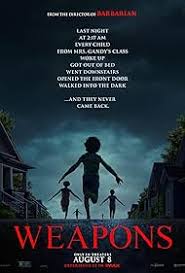
WEAPONS
US, 2025, 128 minutes, Colour.
Julia Garner, Josh Brolin, Amy Madigan, Cary Christopher, Benedict Wong, Austin Abrams, Alden Ehrenreich, Clayton Farris, Justin Long, Sarah Paxton,
Directed by Zach Cregger.
Weapons is quite a general title and audiences may be expecting to see a lot of firearms. However, the weapons this time are young children, 17 in a school class who suddenly disappear, running from their homes, in the early hours one morning. Only one does not disappear, Alex (Cary Christopher), who lives a lonely kind of existence. Where can this be going?
The film was written and directed by Zach Cregger whose previous film, Barbarian, employedthe same pattern as here, establishing characters and situations, building up to the explicit horror. He certainly is able to create an atmosphere of mystery, often quite unsettling, the audience puzzled, looking for clues and indications and then, finally, a frighteningly overwhelming climax.
While we see the disappearance of the children, wondering where they could be, the structure of the film is in chapters, each with the name of a significant member of the cast, from Justine (Julia Garner), the initially hapless teacher of the disappeared children, blamed by the parents, branded as a witch, and not quite a steady personality. Then there is her relationship with Paul (Alden Ehrenreich), a rather callow policeman with the angry, neglected wife and pursuing a vagrant, James (Austin Abrams), addict, homeless, always ready to exploit situations. The other main characters are Marcus, the school principal (Benedict Wong), and Archer (Josh Brolin), a concerned parent whose son has been the principal bully to Alex.
And, the screenplay moves around in time, revealing characters, going back to situations, developing interconnections, which means that the audience has to be quite attentive.
And, at Alex’s house, more sinister revelations, the fate of Alex’s parents and the mysterious Aunt Gladys insinuating herself into the household, eliciting pity, but frightening people and the gradual revelation of who she is, her powers of control, the discovery of the children and a ferocious climax. Amy Madigan offers a powerfully alarming performance.
This may not appeal to audiences, of course, but it is a horror film worth considering, an involving plot, a range of flawed characters, the problems of a small town, school and teachers and parents, and eerie suggestions of horror which may or may not be possible in real life.
- The arresting title? Audience puzzle? The later explanations, the possessed characters, their arms like wings, their attacks, violent destruction?
- The Middle American town, atmosphere, homes, school, streets, police precincts, the countryside? The musical score?
- The narration throughout, the voice of the schoolgirl, touch of the eerie?
- The episode, the 17 children, visualised, running with their arms like wings, disappearing? All from the one class? Only Alex coming to school the next day? Justin’s class, her coming, the discussions with the principal, the reaction of the parents, her being blamed, the meetings and denunciations, the painting of “witch” on her car? The setting up of the atmosphere?
- The writer-director and his previous film, the same pattern, establishing characters and situations, building up to the explicit horror?
- The device of having chapters, the names of the principal characters? Focus on them, introducing other characters, flashbacks, the building up of the time and momentum, going back for the audience to see episodes from a different angle? And then the final sequences, in chronology, with explanations, visuals, and the introduction of the horror and gore aspects? The cumulative effect?
- Justine, teacher, devoted to the children, yet past DUI, her drinking, at the bar, living alone, and nightmares, the relationship with Paul, deceiving his wife, drinking, going home with Justine, the sexual encounters, the aftermath? Justine recommended to be quiet, yet her following Alex, going to the house, looking in the windows, the people still, boarded-up? The vigil in the car, the mother cutting a look at her hair? Further encounters with Paul?
- Paul, age, police, tense, drinking, his marriage, relations with his wife, deceiving her, her outbursts? His time with Justine? Tension, with the police chief, the discussions with him? The pursuit of James, vagrant, anger, his finger pierced, health worries, the discussions with his superior, keeping it quiet?
- James, vagrant, asking for money from Justine, stealing, going to the pawnbroker, being chased by Paul, Paul pierced, his running away? Wandering, seeing Gladys in the field? His tent, the drugs? The rain, going to the house, getting inside, the mystery of the people, his apologies, steal the cutlery, going to the pawnbroker?
- Archer, parent, his wife, his son seen in bullying Alex, his work on the building site, erratic, the confrontations with Justine, the injuries and the accident, their beginning to share concerns, his own investigating, his dreams, teaming up with her eventually, going to the house, getting inside?
- Marcus, principal, ethics, strictures on Justine and her following Alex? With the parents? Time passing? At home, his relationship with Terry?
- Alex, his age, at home, his relationship with his parents, happy relationship, driving with his father, dropping him at school, his mother at home, the prospect of aunt Gladys coming, preparing the house? His being bullied, especially by Matthew? Aunt Gladys and her arrival, his reaction, her behaviour in the house?
- Aunt Gladys, appearing in the dreams, glimpsed by James? Her arrival, appearance, the make up, a witch, old and wizened, taking control of the family, her branches, has sticks, her rituals, pricking, the blood, on the branch, breaking it, the personal links with the victims, hair…? Her control in the house, paralysing Alex’s parents, his reaction to this, keeping them alive, feeding them the soup? Her dying, but being sustained by energies from the victims? Her encounter with Marcus, at school, bringing Alex’s father to the school, her coming to Marcus’s house, hypnotising him, controlling him, his live-in partner, and bashing him to death? Then his running through the town, like a weapon, to track down Justine?
- James, taken by Paul, in the car, all in the house, his being controlled, bringing James into the house? The arrival of archer and Justine, all hypnotised? The confrontations within the house, archer hypnotised, Justine almost killed, her getting the gun, killing Paul, rescuing Alex?
- The children, Archer’s search in the basement for his son, Gladys asking Alex to get personal emblems, the gymnasium, Justine, his taking them and chopping them to pieces? Their coming alive, pursuing her, the mayhem in the chase throughout all homes, smashing, the glass? And the descending on Gladys and destroying her?
- The little girl in the narration, talking about the aftermath, Alex moving away, some gradual recovery for the children…?
Wolf Man
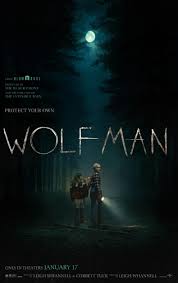
WOLF MAN
US, 2025, 103 minutes, Colour.
Christopher Abbott, Julia Garner, Sam Jaeger, Matilda Firth, Benedict Hardie, Zac Chandler.
Directed by Leigh Whannell.
A few years ago, Australian writer-director, Leigh Whannell, who has had a successful career with horror films, the Saw franchise, of the Insidious franchise, directed the remake of The Invisible Man, which was very successful with both critics and box office. He has now followed up with Wolf Man. But, it is not so much in the tradition of the previous Wolf Man horror films but rather a new development, a 21st-century perspective with reference to Native American traditions.
There is quite a contrast between the impact of The Invisible Man and Wolf Man, the visibility and invisibility. A filmmaker can work more subtle variations on horror and terror when the terrorising character is invisible, able to appear or disappear, those terrified not knowing where the invisible man is, present or absent, suddenly menacing. With the Wolf Man, everything is visible. This is very much the case here.
The setting is Oregon, forested mountains and valleys, a recluse taking his young son out hunting, trying to prepare him for the sense of menace and the tradition of a strange creature, somehow or other infected, wolflike manifestations, and, according to the Native American traditions named here, “the face of the Wolf”.
The action, in fact, takes place 30 years later. The young boy, Blake (Christopher Abbott) is npw a writer in New York, married with a young daughter, Ginger (McK enna Roberts) full-time parent, his nervy wife Charlotte (Julia Garner) a journalist. When news comes about the will of his dead father, he suggests they all go to Oregon which will bond them as a family.
As we guess, big mistake!
Most of the film takes place overnight, the family arriving with a huge van for removals lost in the forest, encountering a friend from the past, but suddenly confronted by the mysterious presence. The truck crashes, Blake is scratched and bleeding, Charlotte and Ginger terrified.
So, we see the gradual transformation of Blake into a monstrous version of himself, his daughter terrified, Charlotte able to assert some kind of authority to help.
This is a film of horror with the transformation, gradual and ugly, into the Wolf Man. It is also a film of terror for Charlotte and Ginger. And for audiences who appreciate and respond to this kind of horror and who have an enjoyment of menace and terror, this is what Wolf Man sets out to offer.
- The popularity of Wolf Man stories? Classic films? 21st-century interpretation?
- The beauty of the Oracle mountains and forests, the father and son, their home, the equipment and communication, hunting, the rifles? The stern father, the boy and his attention, fears, going to ship the deer, his father’s reaction, and up on the lookout, his father’s explanations? At home, the effect of the father on the boy? The personality of the Father, war, communications? Then the story of his disappearance?
- 30 years later, New York City, Blake, writer, looking out his daughter, Charlotte, at work, her moods, difficulties at home, phone calls? Blake and his daughter, protecting her, her reading his mind, the meals?
- The news of his father’s will, the suggestion to go to Oregon, the fan, travelling through the forest, the desd end gate, Derek on the lookout, the fears, his friendliness, back story, guiding them to the house? The apparition of the road, swerving, the crash, Derek falling out, being taken away by the creature? The creature, the struggle, Blake being scratched, mother and daughter on the roof of the van, walking through the woods, finding the house, getting the lights going, the threats, locking the door?
- Blake and his transformation, the arm, the blood, Charlotte ending the wound, his later tearing it off, chewing on his arm, the impact on Charlotte, the impact on Ginger? Her age, dependence on her father, not so close to her mother, her mother having to protect her, her being bewildered by the transformation of her father?
- Blake and the further degeneration, his face, the touch of the Wolf, facial hair, the blood, his trying to protect them, Charlotte and her getting the engine going, trying to escape in the car, Blake leading of the creature?
- The revelation that the creature was Blake’s father, the confrontation between the two, the fight, the destruction of the creature? Blake and his death?
- A grim ending, the action taking place overnight, the pessimism of this variation of the Wolf Man story?
Apartment 7A
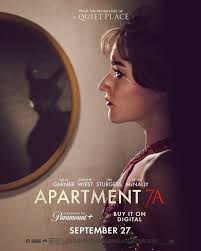
APARTMENT 7A
Julia Garner, Dianne Wiest, Kevin McNally, Jim Sturgess.
Directed by Natalie Erica James.
Many audiences who decide to watch Apartment 7A and who have a love for films and memory for those of the past, will soon begin to realise that this is a reworking of Rosemary’s Baby. This is especially the case when Minnie and Ramon Castavet appear on the scene, and the moon might seem familiar, and the realisation that Dianne Wiest is doing impersonation of Ruth Gordon’s character in Rosemary’s Baby, as is Kevin McNally for Ralph Bellamy’s. Which means then that interest gathers pace as to how this film will resemble the original.
In the final credits, after the credit for screenplay and a credit for story, there is acknowledgement of the novel by Ira Levin.
And, then we realise that this is a prequel. For many audiences, they say that this is not necessary. Rosemary’s Baby stands on its own. However, there was a television sequel, Look at what Happened to Rosemary’s Baby (1976).
The central character, Terry, is played by Julia Garner who has built up quite a reputation in a number of films as well as television series, Fargo. She plays a young dancer from Nebraska, full of ambition, experiencing a fall and injuring her ankle. Feeling sick on the sidewalk, she is befriended by the elderly couple who become her patrons, offering the apartment and all kinds of support.
The film spends a lot of time on the choreography and dance routines, performance and rehearsals, and incorporates a number of popular songs including If my friends could see me now and, especially at the end, seeming rather incongruous and ironic at the final meeting of the coven, Be my baby.
Gradually, the Satanist issues become part of the narrative, substituting the kindness of the elderly couple, even though it does seem somewhat sinister, as well as the apartment block in which they live and its sinister corridors, and the basement the centre for the coming gatherings. Hallucinations, dreams, injuries, and a pregnancy.
There is a 21st-century film and so the issue of an abortion is quickly raised. But there are also Catholic themes and images, Terry going to a church, an encounter with an elderly nun who reveals the truth.
And, while the heroine seems rather ingenuous, she is also fiercely ambitious, making a Faustian pact with the director to be the star of the show, and her name in lights.
After sinister episodes, and the ambiguous behaviour of the elderly couple as well as the director and the taunting co-star who also injures her ankle, twisting her foot, and Terry then becoming the star of the show, there is a finale where Terry takes the initiative to thwartthe ambitions of the coven.
There is a final moment, at the scene of the accident in the street, where Minnie and Roman set their eyes on a potential mother for their ambitions, Rosemary…
- A prequel to Rosemary’s Baby, the basic original story, the variation on the theme, the failure to produce the baby and the need to find another woman?
- The New York setting, Broadway and Theatre, the world of dance? The apartment block, the rooms, the corridors? Rehearsal spaces? The musical score?
- Terry, her story, filling in the background, Nebraska, raising pigs, the slaughter, the effect on her mother, the death of her father? Moving to New York, the opening sequences, looking in the mirror, make up, the dance routine, her joy, the fall and its consequences?
- The aftermath, her going to the auditions, the continued interrogation, having to repeat her movement, the interrogation by Alan, his wanting her to imitate the pigs? Her refusal, his praise?
- Her apartment, her roommate, their friendship, her support?
- Her decision to follow Alan, the apartment block, at the desk, in the street, being sick, Minnie and Roman finding her, helping her, bringing her to the apartment, the next morning? In themselves, sinister, smiling, childless? (And the performances paralleling Ruth Gordon and Ralph Bellamy in the original?) The offer, the friendship, the apartment, Terry settling in? Night date, the couple missing, Alan, the night, drugged, her fantasies in the musical, diabolical presence? The aftermath, discovering her pregnancy, the shock? Discussions with her roommate, going to the abortionist, the dire effect on the abortionist, paralleling Vera and her injuring her foot on stage?
- The finding of the shoe of the previous tenant, asking the concierge about her, her clothes and possessions, the Bible, the indication of Satan, her mysterious death?
- The pregnancy, the discussions with the doctor, the help from the retired judge with the medication? The later appearance in the room, the fright, the knife? The cumulative effect on Terry?
- The rehearsals, the criticisms, Vera and her taunts? Support from Alan? , Vera’s injury, Terry declaring she wanted the role?
- The buildup of terror, after the visit to the abortionist, the injuries? The discussions with Minnie and Roman, the realisation of Roman in the mask? Going to the basement, the discovery of the room, the Satanists? Her going to the church, the Catholic symbols, her meeting the nun, the nun and her terror, revealing the truth, the presence of the Bible?
- Terry, her decision, the gathering in the apartment, the song and the dance routine, the choice of “Be My Baby” for the song? The reaction of the audience, her charming them, her going to the window, her fall? The shock for the group?
- Her falling on the car, the police interrogating the young couple, Minnie and Roman watching – and the move towards the story of Rosemary’s baby?
Royal Hotel, The
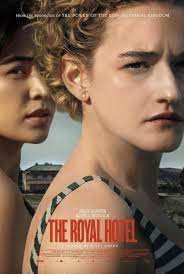
THE ROYAL HOTEL
Australia, 2023, 91 minutes, Colour.
Julia Garner, Jessica Fenwick, Hugo Weaving, Ursula Yovich, Toby Wallace, Daniel Henschel, James Frecheville.
Directed by Kitty Green.
Writer-director, Kitty Green, notes that she grew up in a hotel. Which means that she knows what she is talking and writing about here. But, some years ago, she was impressed by a documentary, Hotel Coolggardie, which recorded the experience of two young women, from Europe, working for a time in the pub in the mining area of Western Australia. It focused on how the young women dealt with the situation, with the customers, with the response of the men who frequented the pub.
Kitty Green, along with writer, Oscar Redding, have produced a fictionalised version of Hotel Coolgardie.
This is a drama although it is advertised as a thriller (with a lot of discontented audiences who expected more thriller conventions). But, as a drama, set in an outback pub, many audiences will immediately remember the film version of Ken Cook’s novel, also made as a television miniseries, Wake in Fright. That was the story of an Englishman in Broken Hill, caught up with the drunken match oh culture, succumbing to it, waking in fright.
One of the phrases to describe this is “toxic masculinity”. And, this is the theme of this film – though not quite as aggressive, though definitely aggressive, as Wake in Fright.
Two young Canadians are holidaying in Sydney, played by Julia Garner (who worked with Kitty Green in The Assistant) and Jessica Fenwick. They run out of money, go to an employment agency, the only immediate job available way out in the outback, train, bus, car pickup and they arrive at the Royal Hotel.
A lot of what happens at the hotel is what we would be expecting. Live is more the goodtime girl and joins in the spirit of nights at the pub. Hannah, on the other hand, is strong-minded, doesn’t smile, but is wary of the men. The pub is owned by Billy, inheriting it from his family (played by Hugo Weaving), but Billy is unwell, alcoholic, chauvinist torts the young women. His partner, also work’s chauffeur at the hotel, is veteran first Nations actress Ursula Yovich, an anchor for the hotel, the Billy and for the girls.
The men come in each night from the mines, most of the miners, some of them with science and engineering background, especially Matt, a meteorologist played by Toby Wallace, who offers some friendship to the girls. There is also the minor, Teeth, James Frecheville, seemingly more subdued than the others, and more sympathetic. In fact, everybody survives well enough day by day, not as bad as Wake in Fright, though that is not particularly reassuring for Hannah.
And, while most of the men fail to respond well to the challenges, the most sinister character is Dolly, played with a mixture of smiling insinuation and violent outbursts by Daniel Henschel (many audiences still remembering his sinister serial killer in snow town).
On the one hand, the picture of life at the hotel, each night, is presented as realistic. However, the ending, looking realistic, is far more to be seen as symbolic, an apocalyptic ending to this kind of life at the Royal Hotel.
- The title, sounding pretentious, the hotel in the outback, the family owning it for generations, the mining town, the surroundings?
- The Australian literary and film tradition of Wake in Fright? The pub, the locals, the male ethos, presence of females, harassment and misogyny? The owners and coping? The aboriginal presence? Alcohol? The women coming in to serve at the bar? The documentary, Hotel Coolgardie, and this screenplay as a fictionalised version of documentary revelation?
- The situation of overseas visitors in Australia, holiday, travel, enjoyment, issues of money, jobs? Hannah and Liv, Canadian backgrounds, getting away, furthest away, in Sydney, the touristic look, the clubs, music, drinking, dancing, flirting, the Norwegian and Hannah? Liv going to the bar, the card refused, the girls needing to get a job, the agency, as in the bush?
- The visuals of the South Australian landscapes, the highways, the desert, the distances, Martin backgrounds, off the beaten track, by train, bypass, deposited, Carol and the car picking up the girls, the dust? Arriving at the hotel, the locked door, the rooms, the English girls upstairs spaced out?
- Life at the hotel, the miners, Gladys and her drinking, the absence of women? Billy, managing the hotel, from his father, his moods, age, issues of money, owing the aboriginal delivery man $4300, not paying the girls, explaining how everything worked, his rules, exclusions for behaviour, but letting people in? The rituals?
- The importance of Carol, aboriginal background, picking the girls up, working the kitchen, managing the hotel, her relationship with Billy, control of him, urging him to pay, forbidding him to drink, his collapsing, behaviour in the hotel, the final collapse, taken to hospital? Carol taking him, leaving everything behind?
- Anna and Liv and their personalities, live more as the easy-going, not having the money, taking the job? The contrast with Hannah, more controlled, edgy? The trip, the arrival, the accommodation, the British girls and their stories, learning the ropes from Billy? Carol and the cooking? The girls gradually getting used to things, going to the swimming pool and its being empty, sunbaking? The friendship with Matty, his taking them for the drive, the distance, the service station, the key to the toilet on a box, finding the pool and falls? The good effect? And seeing the kangaroo?
- The range of men, their behaviour, the drinking, the sexist remarks, the crude four letter comments, what is called “toxic masculinity”?
- Matty, meteorologist, friendly, taking the girls out, with Hannah, drinking, the sexual approach, her refusal, his reaction, sleeping the car, his apology? His later making advances, a mixture, with Dolly, the effect of drink and flirting, Hannah rejecting him?
- The contrast with Teeth, quiet, the miner, more polite, friendship with Liv, making progress, but the drink, the reactions, crashing the car, Billy banning him, his return, disgruntled at the end?
- Dolly, sinister, smile, driving the British girl, returning, sitting at the bar, drinking, the seeming charm, but the advances, at the door and Hannah barricading the door, the later confrontations, live excusing him, and the suspicious, her wanting to leave? In the bar with the loner and the Jubilee couple having champagne, Dolly and his behaviour, Hannah and her stances, the violent reaction? Dolly coming upstairs, the confrontation with Hannah, pushing her, her injury? Dolly getting the support of Matty?
- The ultimate effect on the girls, the experience of wake in fright, the misogyny, the need for self-preservation, the snake in the bottle, smashing it, the lighter for the candle on Liv’s birthday cake, the Canadian flag? And with the lighter, setting the hotel alight, their walking away?
- Marketing emphasising the film is a thriller, the bloggers reacting badly? The film, however, as an Australian drama, the outback, men and women, realistic and symbolic, and the final five and walking away as more symbolic than realistic?
