Displaying items by tag: Stephen King
Life of Chuck, The
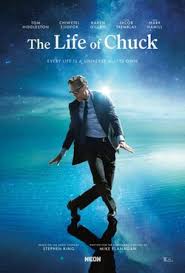
THE LIFE OF CHUCK
US, 2024, 111 minutes, Colour.
Tom Hiddleston, Jacob Tremblay, Benjamin Pajak, Chiwitel Ejiofor, Karen Gillan, Mia Sara, Carl Lumbley, Mark Hamill, David Dastmalchian, Q’Orianker Kilcher, Matthew Lillard, Taylor Franck.
Directed by Mike Flanagan.
Chuck is a very popular name, especially in the US, amiable, ordinary, your next door neighbour… So, we can expect that the life of Chuck would be nice, amiable. And, in many ways it is. But, in the eyes of America’s most prolific writer, Stephen King, always considered a master of horror stories, it could be anybody, or Anybody. Which means that Chuck is being set up as an Everyman Figure. Chuck, or a variation on him could be any of us, men or women.
Stephen King published this short story in 2020 – the initial year of the pandemic.
Writer-director, Mike Flanagan (who directed film versions of King’s Gerald’s Game, Doctor Sleep, and the fascinating Catholic-themed miniseries, Midnight Mass) has adapted the story in ways audiences who have not read the story, would be surprised. (For any audiences who intend to see Life of Chuck and knows nothing about it, best to stop here and read reviews after your own experience.)
In fact, the film tells its story in reverse, three acts. Act three starts ordinarily enough, at school, a sympathetic teacher played by Chiwitel Ejiofor. But, very soon we move into a kind of apocalyptic, end of the world scenario, news of disasters like California North lapsing into the sea, but highlighted in a suburban kind of way by the loss of Wi-Fi, interruptions to television programs, the electricity going out, sinkholes in the streets, cars abandoned, forlorn people walking home alone. All this is really alarming, but quietly communicated, especially by conversations of hapless people facing a diminishing future.
However, suddenly lit up in all the windows of houses and buildings, images of Chuck, messages of thanks for his 39 years. So, where is Stephen King going from here?
Act two steps back in time, and we meet Chuck, quiet-mannered, well dressed in his suit, an accountant at a conference, and played by Tom Hiddleston (whom many remember as Loki). In fact, this is a brief sequence in the narrative that makes an extraordinary impact: dancing in the street. A young drummer sets up her instruments in the town square, Chuck walks along, stops, looks, listens to the beat and one of the most joyous intense sequences on film follows. And Chuck is joined by a disappointed young woman whose boyfriend has suddenly cut her off. A growing crowd shares this increasing joy.
Many directors have used the theme of the Dance of Life – and this is a wonderful example.
The theme of the end of the world is put on the back burner as we go back to Chuck’s childhood, accidental death of his parents and unborn sister, cared for by his grandparents, a charmingly dancing Mia Sara, a wonderful portrait of a crabby old man, a monologue which will be valued by anybody devoted to mathematics, and played by Luke Skywalker, Mark Hamill, almost 50 years since Star Wars.
The young Chuck, a wonderful experience with the lively performance by Benjamin Pajak, grieves, listens to his grandfather, shares some mysterious ghostly experiences, but, it is revealed, at school is where he learned to dance – and a kind of prom night dance sequence which again is exhilarating.
So, who is Chuck? Could be any of us. And while he is a white American male, there is a wide range of multi--ethnic characters for multicultural experiences including the African-American drummer. And, what is Chuck’s life telling us – a quotation from Walt Whitman’s Song Of Myself he heard at school, “I contain multitudes”. So, for Every Man and Every Woman, there can be an extraordinary vitality of life. And, a realisation that life comes to an end, as the world will come to an end (in a realism aspect of this tale telling or in Chuck’s inner consciousness?).
Generally audiences have appreciated The Life of Chuck, a number of critics dismissing its sentiment and what they see as superficial observations. But, most will find the opening sequence arresting, arousing curiosity, and, as the film goes on, especially with the exuberance and dances of life, the possibilities for deeper life reflections.
- The title, expectations, Chuck as an ordinary name? Anybody? Leading to an Everyman character?
- The perspectives of Stephen King, his career, human nature, end of the world? The quote from Walt Whitman, I contain multitudes?
- The structure of the film, in reverse? The impact of the end of the world, humans facing the end of the world, the signs of thanks for Chuck? His death?
- The atmosphere of Act three, the introduction to Marty, his work at the school, students, the news of disasters, California, around the world, his talking with the parents, urging the children to school? Loss of Wi-Fi? Reading and writing? Marty at home, watching the television, communication with Felicia, their marriage, her work at the hospital, the doctor and the suicides, people deciding to go home to be with family? The long conversation with Gus and his aspirations? The conversation with Sam, reminiscing, his being revealed as working with Chuck and Albie? The many people walking home, alone, dropping their bags? The sinkhole, Marty in the car, cars parked? The contact with Felicia, wanting to be together, their love, the end of the world?
- The signs in the window, images of Chuck, messages of thanks, 39 years? The glimpse of him, his wife and son, his death?
- Act two, the explanation of Chuck, accountant, well-dressed, at the accountants’ meeting, walking along the street, Taylor, with her manager, the drums and her busking, looking at Chuck, his looking at her, the beat, the beginning of the dance, the extensive and varied choreography, the exhilaration for Chuck, the story of Janice, walking along the road, bitter, her boyfriend cutting off, invited to dance, her exuberant response, Taylor and her excitement, the crowds gathering, sharing the joy and rhythms, the money, it is one giving the gift to Janice and to Chuck, then not continuing, the dance of life?
- Act one, Chuck and his story, the accident on the ice, death of his parents, the unborn sister? Living with his grandparents? The grief? His grandmother, coming alive, the dancing, urging Chuck to dance? Albie, grief, the accountant, drinking, the locked room upstairs and his attack on Chuck? Apology? The long discourse about mathematics and its explaining everything, rationally and accurately? Urging Chuck ac to be an accountant?
- Chuck at school, short, some bullies, the encounter with Cal, the poetry teacher, the students not interested, the quotation from Walt Whitman, his song, I contain multitudes? Its meaning? The teacher’s response? The dance teacher, the lineup, her urging, the music, the range of songs and dances, illustrated (and the clip from Gene Kelly and Rita Hayworth in Cover Girl)? Chuck and his dancing skills, with Cal? Dressing up for the school evening, the teachers present, Marty and Felicia, Chuck and his reluctance, his sore leg, the teacher challenging him, going outside, his return, and the exhilaration of the dancing, the jealous boy? And the story of the scar on his hand, blaming the boy, actually jaggling it on the wire?
- Albie, going to the cupola, the ghosts and deaths, his heart attack? The funeral? The Jewish background?
- The older Chuck, discussions with Sam, his prospects, and going to the cupola, unlocking it, the contemplation? The end?
- Audience popularity, critics attacking the film, sentiment, superficial philosophising? Audiences caught up in the story, the personalities, reflections?
Monkey, The
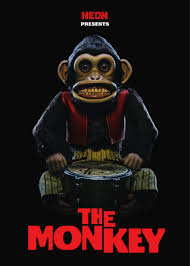
THE MONKEY
US, 2025, 98 minutes, Colour.
Theo James, Tatiana Muslany, Christian Convery, Colin O'Brien, Elijah Wood, Rohan Campbell, Sarah Levy, Osgood Perkins, Adam Scott.
Directed by Osgood Perkins.
From a short story by Stephen King. Strong credential in itself. And the film has been written and directed by Osgood Perkins who achieved strong response to his 2024 horror-thriller, Longlegs.
The name of Stephen King, of course, is for many a recommendation in itself. He has been writing novels and short stories for just over 50 years, with more than 50 adaptations of novels and short stories for the big screen and for television – the film starting in 1976 with the shocks in Carrie. He is a household name. So, especially for Stephen King completists, The Monkey goes on the list of films to be seen.
While the Stephen King’s stories have an underlying base of realism, especially in his treatment of family relationships, there is also the move to an atmosphere beyond realism, in the world of the physical, in the world of the psychic, in the realms of: what if…?
This is definitely the case with The Monkey. On one hand, it is the story of twin brothers, one dominating the other, an absent father, a mother trying to raise her children, the decision to search through the absent father’s possessions and the finding of a toy, a monkey with huge eyes which stare, in extreme close-up and threatening, from the screen at the audience, the touch of mesmerising, then the turning of the key and the monkey beginning to twirl the drumsticks and then beat on the drum – with dire, in fact, a lot beyond dire, murderous consequences.
It means then that this is very much Stephen King material, ordinary audiences can appreciate the story of the two brothers and their eventual antagonism and confrontation. But, this is also Stephen King horror territory, and there are quite a number of deaths, targets of the murderous monkey. And, visually and thematically, they are grisly and gory, some audiences might find them too much.
It should be noted that the writer-director, Osgood Perkins (son of Anthony Perkins and memories of Psycho), has noted that the deaths are macabre, black-humour, and the reminder that nobody in reality could die in the style of the deaths portrayed here, that nobody could complain that in watching the film it reminded them in any way of their relatives’ or friends’ death. (And, there is an extraordinary last 10 seconds of the film, surprise and some shocking deaths.)
British actor, Theo James, takes on the role of the adult twins and quite effectively makes them very different. In fact, a lot of the drama and confrontation depends on this effectiveness. And for those who note names in casts, Adam Scott appears only in the prologue to the film, which sets the tone as he tries to sell the monkey to a dealer with shock results. And, Elijah Wood, has only a few, quite telling minutes, as a self-important family and marriage guru.
It seems that Stephen King has approved of this version of his story and so it will take his place in all the analyses of his films. In the meantime, his fans will want to see it.
- The title? Stephen King story? The reputation Osgood Perkins and horror films?
- The plausibility of the plot? Realism? Imagination? Beyond the natural? Psychology drama, family relationships? Terror/horror/gore?
- The opening, Petey at the shop, the toy monkey, the shopkeeper, the discussions, the death of the shopkeeper? Setting the tone?
- The story of the twins, Bill and Hal, the difficulties of birth, Bill dominant, growing up together, Bill strong, teasing, bullying, Hal, glasses, taking it? The absent father? Their mother, coping? Domestic scenes, school, meals? The boys in their rooms? Rivalries? The effectiveness of Theo James in differentiating the twins in adult of life?
- Searching their father’s goods, finding the monkey? The visuals of the monkey, small, but large on-screen, the penetrating eyes, the arms, the drums, the movement, the drumsticks? The key?
- The sinister aspects of the monkey, depending on who has the power, the key? The babysitter, agreeable, going to the meal, the decapitation? Funeral service, the inept priest? Mother dancing with the children? Hal, his reaction against Bill? With the monkey, the mockery at school, Hal covered in slime, wanting the key, the death of his mother? The funeral? The aftermath, going to their aunt and uncle? The behaviour, the monkey, its presence, the deaths?
- Bill, on his own, bad behaviour, his appearance, his set up, the Thrasher, searching for the monkey, finding it, in Bill’s possession? The Thrasher, his character, searching for the monkey, finding it, wanting it? The phone call to Hal?
- Hal, the years passing, the marriage, the unexpected birth of Petey, the meeting with Ted, his books, his lording it over Hal, the prospect of the divorce? His wanting time with Petey?
- The plan, the news of the deaths, the garden sale of the monkey? Petey questioning Hal about the family tree, Hal’s lies? The contact with Bill, the contact with the Thrasher, their going to the house?
- Bill, his intentions, the monkey, vengeance against Hal for killing their mother?
- The madness of the monkey, the range of deaths, deaths in the neighbourhoods? The wide range of people dying, heads on fire, diving into a flaming pool, running with the pram…?
- Hal, Thrasher and Petey in the car, the beehive, the shot, Thrasher consuming the bees?
- Petey in the house, the confrontation with Bill, the challenge to turn the key, his turning it, Hal coming into the house, confrontation between the two? Bill’s death?
- The final seconds of the film, the previous glimpse of the cheering group, the bus passing, the truck, the deaths, the final impact of the film?
- Hal, Petey, the monkey, travelling together – into the future and the indications the future from the prologue?
