Displaying items by tag: Karen Gillen
Life of Chuck, The
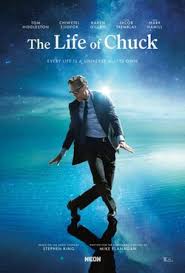
THE LIFE OF CHUCK
US, 2024, 111 minutes, Colour.
Tom Hiddleston, Jacob Tremblay, Benjamin Pajak, Chiwitel Ejiofor, Karen Gillan, Mia Sara, Carl Lumbley, Mark Hamill, David Dastmalchian, Q’Orianker Kilcher, Matthew Lillard, Taylor Franck.
Directed by Mike Flanagan.
Chuck is a very popular name, especially in the US, amiable, ordinary, your next door neighbour… So, we can expect that the life of Chuck would be nice, amiable. And, in many ways it is. But, in the eyes of America’s most prolific writer, Stephen King, always considered a master of horror stories, it could be anybody, or Anybody. Which means that Chuck is being set up as an Everyman Figure. Chuck, or a variation on him could be any of us, men or women.
Stephen King published this short story in 2020 – the initial year of the pandemic.
Writer-director, Mike Flanagan (who directed film versions of King’s Gerald’s Game, Doctor Sleep, and the fascinating Catholic-themed miniseries, Midnight Mass) has adapted the story in ways audiences who have not read the story, would be surprised. (For any audiences who intend to see Life of Chuck and knows nothing about it, best to stop here and read reviews after your own experience.)
In fact, the film tells its story in reverse, three acts. Act three starts ordinarily enough, at school, a sympathetic teacher played by Chiwitel Ejiofor. But, very soon we move into a kind of apocalyptic, end of the world scenario, news of disasters like California North lapsing into the sea, but highlighted in a suburban kind of way by the loss of Wi-Fi, interruptions to television programs, the electricity going out, sinkholes in the streets, cars abandoned, forlorn people walking home alone. All this is really alarming, but quietly communicated, especially by conversations of hapless people facing a diminishing future.
However, suddenly lit up in all the windows of houses and buildings, images of Chuck, messages of thanks for his 39 years. So, where is Stephen King going from here?
Act two steps back in time, and we meet Chuck, quiet-mannered, well dressed in his suit, an accountant at a conference, and played by Tom Hiddleston (whom many remember as Loki). In fact, this is a brief sequence in the narrative that makes an extraordinary impact: dancing in the street. A young drummer sets up her instruments in the town square, Chuck walks along, stops, looks, listens to the beat and one of the most joyous intense sequences on film follows. And Chuck is joined by a disappointed young woman whose boyfriend has suddenly cut her off. A growing crowd shares this increasing joy.
Many directors have used the theme of the Dance of Life – and this is a wonderful example.
The theme of the end of the world is put on the back burner as we go back to Chuck’s childhood, accidental death of his parents and unborn sister, cared for by his grandparents, a charmingly dancing Mia Sara, a wonderful portrait of a crabby old man, a monologue which will be valued by anybody devoted to mathematics, and played by Luke Skywalker, Mark Hamill, almost 50 years since Star Wars.
The young Chuck, a wonderful experience with the lively performance by Benjamin Pajak, grieves, listens to his grandfather, shares some mysterious ghostly experiences, but, it is revealed, at school is where he learned to dance – and a kind of prom night dance sequence which again is exhilarating.
So, who is Chuck? Could be any of us. And while he is a white American male, there is a wide range of multi--ethnic characters for multicultural experiences including the African-American drummer. And, what is Chuck’s life telling us – a quotation from Walt Whitman’s Song Of Myself he heard at school, “I contain multitudes”. So, for Every Man and Every Woman, there can be an extraordinary vitality of life. And, a realisation that life comes to an end, as the world will come to an end (in a realism aspect of this tale telling or in Chuck’s inner consciousness?).
Generally audiences have appreciated The Life of Chuck, a number of critics dismissing its sentiment and what they see as superficial observations. But, most will find the opening sequence arresting, arousing curiosity, and, as the film goes on, especially with the exuberance and dances of life, the possibilities for deeper life reflections.
- The title, expectations, Chuck as an ordinary name? Anybody? Leading to an Everyman character?
- The perspectives of Stephen King, his career, human nature, end of the world? The quote from Walt Whitman, I contain multitudes?
- The structure of the film, in reverse? The impact of the end of the world, humans facing the end of the world, the signs of thanks for Chuck? His death?
- The atmosphere of Act three, the introduction to Marty, his work at the school, students, the news of disasters, California, around the world, his talking with the parents, urging the children to school? Loss of Wi-Fi? Reading and writing? Marty at home, watching the television, communication with Felicia, their marriage, her work at the hospital, the doctor and the suicides, people deciding to go home to be with family? The long conversation with Gus and his aspirations? The conversation with Sam, reminiscing, his being revealed as working with Chuck and Albie? The many people walking home, alone, dropping their bags? The sinkhole, Marty in the car, cars parked? The contact with Felicia, wanting to be together, their love, the end of the world?
- The signs in the window, images of Chuck, messages of thanks, 39 years? The glimpse of him, his wife and son, his death?
- Act two, the explanation of Chuck, accountant, well-dressed, at the accountants’ meeting, walking along the street, Taylor, with her manager, the drums and her busking, looking at Chuck, his looking at her, the beat, the beginning of the dance, the extensive and varied choreography, the exhilaration for Chuck, the story of Janice, walking along the road, bitter, her boyfriend cutting off, invited to dance, her exuberant response, Taylor and her excitement, the crowds gathering, sharing the joy and rhythms, the money, it is one giving the gift to Janice and to Chuck, then not continuing, the dance of life?
- Act one, Chuck and his story, the accident on the ice, death of his parents, the unborn sister? Living with his grandparents? The grief? His grandmother, coming alive, the dancing, urging Chuck to dance? Albie, grief, the accountant, drinking, the locked room upstairs and his attack on Chuck? Apology? The long discourse about mathematics and its explaining everything, rationally and accurately? Urging Chuck ac to be an accountant?
- Chuck at school, short, some bullies, the encounter with Cal, the poetry teacher, the students not interested, the quotation from Walt Whitman, his song, I contain multitudes? Its meaning? The teacher’s response? The dance teacher, the lineup, her urging, the music, the range of songs and dances, illustrated (and the clip from Gene Kelly and Rita Hayworth in Cover Girl)? Chuck and his dancing skills, with Cal? Dressing up for the school evening, the teachers present, Marty and Felicia, Chuck and his reluctance, his sore leg, the teacher challenging him, going outside, his return, and the exhilaration of the dancing, the jealous boy? And the story of the scar on his hand, blaming the boy, actually jaggling it on the wire?
- Albie, going to the cupola, the ghosts and deaths, his heart attack? The funeral? The Jewish background?
- The older Chuck, discussions with Sam, his prospects, and going to the cupola, unlocking it, the contemplation? The end?
- Audience popularity, critics attacking the film, sentiment, superficial philosophising? Audiences caught up in the story, the personalities, reflections?
Sleeping Dogs/ 2024
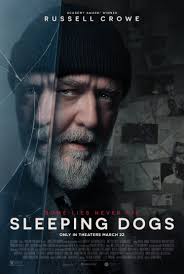
SLEEPING DOGS
Australia/US, 2024, 110 minutes, Colour.
Russell Crowe, Karen Gillan, Marton Csokas, Tommy Flanagan, Thomas M.Wright, Harry Greenwood, Pacharo Mzembe, Lynn Gilmartin.
Directed by Adam Cooper.
The metaphor of the title indicates that sometimes it may be better to leave past events as they are because we do not know what revelations will appear if the past is stirred. And that happens here -in an interesting and evocative way.
This is a very American story, the police, death row and executions, investigating cold cases, psychology and experimentation, drugs to suppress PTSD memories, experiments to reactivate memory. However, Sleeping Dogs was, in fact, made in Australia, with a mainly Australian cast with New Zealand’s Marton Csokas, Karen Gillan and Tommy Flanagan from Scotland – no American in the cast. (Of interest, Harry Greenwood is the son of Hugo Weaving; Thomas M. Wright was a writer-director of the award-winning drama, The Stranger, 2022).
But it stars Russell Crowe in a very interesting performance as a former police officer of 20 years, Roy Freeman, involved in a drink-driving accident, damage to his skull and brain, now undergoing a particular therapy to try to reactivate his memory, to redirect the neural paths of his brain. We see him at home, notes everywhere around his apartment indicating how he is to act, his name, preparing a meal… We see him undergoing his treatment and moments when memory begins to return.
However, the key to the drama is a prisoner coming to appeal to Roy to reopen his case because he is about to be executed and professes his innocence, Roy thinking that this was an expected ploy. However, something alerts him and he begins to investigate.
Which, clearly, is the point where a reviewer has to go no further with the narrative. Rather, there can be a whetting of the audience appetite to indicate who the central characters are. Marton Csokas’s appears as Dr Wieder, a very talented psychologist who is working on the program for suppressing PTSD memories. Karen Gillan is his equally talented associate in the research. There is the enigmatic writer, played by Harry Greenwood. At his home, there is an Iraq war veteran, played by Thomas M. Wright, doing repair jobs.
Tommy Flanagan plays Roy’s former partner approached by Roy to help him pursue the case. And the case is the murder of Dr Wieder in his home – and, all of the above characters, involved each in their own way.
So, a different kind of police investigation, unearthing different clues, some plot twists, and, depending on how many films one has seen, an expected or unexpected ending!
- The metaphor of the title, leaving past events lie unless, when roused, there is greater trouble?
- An American setting, the police and investigations, psychology and medicine, prison, death penalty?
- But the film made in Australia, locations for the US, the cast, Australian, New Zealand, Scotland? No American cast?
- The atmosphere of the American city, homes and apartments, the streets, police precincts, universities, lecture rooms, laboratories? The musical score?
- The situation, Roy Freeman, a Russell Crowe performance, his situation, the drunk driving accident, his injuries, skull and to the brain, his undergoing experimental therapy, to retrain the neural paths, to regain memory? Seeing him in his apartment, all the notes around the room to indicate who he was, meals, refrigerator, domestic details?
- The visit of the condemned criminal, Roy not remembering him, the man about to die on death row, his plea for Roy to help him, proclaiming his innocence, that there was someone in the house when he went to confront Dr Wieder who had testified against him? Roy not believing him, thinking it was a usual plea to prevent his execution?
- The structure of the film, the action in the present, Roy and his investigations, his continued treatment, beginning to remember some details, his pursuit of the case, looking at the records, getting the documents on the case? The signature of Jimmy Remis?
- His going to see Jimmy again, Jimmy off the force, in decline, the death of his wife, the memories of the case, his reluctant agreement to help Roy?
- The filling of the background of Dr Wieder, his experiments to help people six our past memories (and the contrast with Roy’s treatment to recover memories)? His work with the Laura, her academic collaboration, the relationship? Dr Wieder and his personality? His helping Wayne Devereaux, his background in Iraq, PTSD, working for Dr Wieder?
- The film following through on the characters connected with Dr Wieder, Laura and her disappearance, Roy finding her again, memories of having met her in the past, the new identity, her book, the reviews, the issue of the credit for the work with Dr Wieder, the flashback to her visiting the authorities after his death and claiming authorship, and Roy later visiting the authority and interviewing her and getting her perspective?
- Wayne Devereaux and his disappearance, finding him again, his explanations, the phone call, in the truck, trying to knock down Roy, Roy and his gun, shooting, the identification of Devereaux, the mystery of his attempt to kill Roy, Roy and the police interviews?
- Laura as Elizabeth, her meeting with Roy, taunting him, the gradual revelations about her, her seeming to be a suspect, the plausibility, yet her alibi, her being the house, leaving?
- Mystery of Richard Finn, his connection with Dr Wieder, the encounter with Laura, her advance, the relationship, tensions, her disappearance, we are going to see Richard’s widow, the impact of his death? The connections? Roy at the funeral, his brother, the manuscript, the dramatising of the manuscript, his story, especially about Laura and Dr Wieder, Roy giving it to Laura, her denying its truth? Richard and his ambitions as a storyteller, creating the story and memories of a life? (Contrasting with Dr Wieder of liberating, Roy’s therapist resurrecting?)
- The visualising of the murder suspect, drugged, hiding, being present at the death?
- The complications with Jimmy, his being the only signature on the documents whereas Roy always co-signed, gradual revelations about Jimmy, the contact with Laura, the money issues, her confronting Dr Wieder?
- The gradual revelation of why Roy did not sign the documents, Jimmy’s role and support, but Roy in his seeking out, turning against Jimmy? Jim’s death? Laura?
- The memory coming back, this discovery of himself, the issue of his wife at the diner, her death, the photo with his wife and the smashed glass over her face, his removing it, the final truth and the brutal visualisation of the murder? And the meaning of the title?
In a Valley of Violence
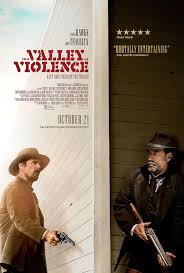
IN A VALLEY OF VIOLENCE
US, 2016, 97 minutes, Colour.
Ethan Hawke, John Travolta, Taissa Farmiga, James Ransone, Karen Gillan, Toby Huss, Burn Gorman.
Directed by Ti West.
Writer-director, Ti West, began his career with ventures into horror films, gaining great deal of attention with the Innkeepers in 2011. What he continued his career with films, his main work was in television until the 2020s when he made a series of films, well received, starring Mia Goth, sometimes a blend of sex and horror, X, Pearl, Maxxxine. However, this is a Western revenge.
Ethan Hawke plays the central character, Paul, ex-army, having left his wife and daughter, wandering, initially encountering a bogus preacher, Burn Gorman, taking his horse, riding into an abandoned mining town.
While minding his own business in the saloon, he is confronted by an exceedingly brash self-centred Healy, James Ransone, who challenges him to a fight. Paul simply knocks him out. However, Gilly is the son of the local Marshall, an interesting role for 60 year old John Travolta. There are two young women running the local hotel,, Karen Gillan, and the young Maryann, Taissa Farmiga, who is attracted to the stranger.
While the Marshall arranges a kind of peace, Paul rides out of town with his dog (whom everybody admires and asks whether he can do tricks, Paul relying that he bites, though we do see a few tricks, especially his wrapping himself in a blanket!), Gilly and his associates kill the dog, threatening Paul, throwing him from a cliff. He survives.
Which means then that he will return, wreak vengeance on each of the members of the group – which he does. And there will be a confrontation with the Marshall.
Audience emotion is on Paul’s side while they are of the conscience issues of the wreaking vengeance (and his strong motivation of revenge because of the killing of the dog).
Quite an effective vengeance Western achieving what it set out to do.
- The title, expectations? The Western context?
- The location photography, town, the streets, bar, Marshall’s office, jail, hotel rooms, the countryside, the mountains? The musical score?
- Paul and his story, background of enlistment, his war experience, the effect on him, leaving his wife and daughter, his companionship with his dog, talking to the dog? The encounter with the priest, hostile, violent, taking his horse? Arriving in the town, searching for Dollar Bill, in the saloon?
- Gilly, boasting, the salesman and his field, ousted, Gilly confronting Paul, silent, the challenge to the fight, the five dollar bet, the barman and his caution? Crowd gathering, Paul punching Gilly, his collapse?
- The Marshall, meeting Paul, the discussions, Gilly his son, Deputy, a father’s care? Willing Paul off? And his encounter with Mary Anne, the bath, flirting, Mary Anne and her relationship with Ellen, Gilly’s fiance, urging him on?
- Paul leaving, camping, with the dog, the ambush by Gilly and his men, the shooting of the dog, threatening Paul, on the is one, pushing him over? His recovery, returning to the town, spirit of vengeance?
- Paul and his return, the welcomed by Mary Anne? Roy, his manner, the bath, with Mary Anne, Paul coming in, the confrontation, killing him, the blood? Ellen and her response?
- The Marshall, confronting Gilly, beating him? Yet protecting him? The plan, Harris going onto the roof, Paul confronting him, the final conversation, Paul merciless, shooting him? Tubby, his fear, urged by the Marshall, his self-assertion, against Tubby, his name Lawrence, standing in the window, shot?
- Gilly, searching for Paul? Paul and the confrontation with the Marshall, out in the street, the Marshall laying down his arms, Gilly confronting, the challenge, the shooting, the death of the Marshall?
- The barn, Gilly searching, the news, the fight? Going to the hotel? The women, Gilly and his protecting them, and her pregnancy, Gilly and his surly response?
- Paul, telling Mary Anne his story, her supporting him? The future?
