Displaying items by tag: David Dastmlchian
Life of Chuck, The
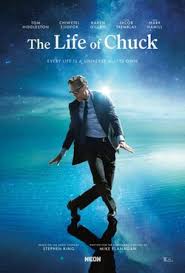
THE LIFE OF CHUCK
US, 2024, 111 minutes, Colour.
Tom Hiddleston, Jacob Tremblay, Benjamin Pajak, Chiwitel Ejiofor, Karen Gillan, Mia Sara, Carl Lumbley, Mark Hamill, David Dastmalchian, Q’Orianker Kilcher, Matthew Lillard, Taylor Franck.
Directed by Mike Flanagan.
Chuck is a very popular name, especially in the US, amiable, ordinary, your next door neighbour… So, we can expect that the life of Chuck would be nice, amiable. And, in many ways it is. But, in the eyes of America’s most prolific writer, Stephen King, always considered a master of horror stories, it could be anybody, or Anybody. Which means that Chuck is being set up as an Everyman Figure. Chuck, or a variation on him could be any of us, men or women.
Stephen King published this short story in 2020 – the initial year of the pandemic.
Writer-director, Mike Flanagan (who directed film versions of King’s Gerald’s Game, Doctor Sleep, and the fascinating Catholic-themed miniseries, Midnight Mass) has adapted the story in ways audiences who have not read the story, would be surprised. (For any audiences who intend to see Life of Chuck and knows nothing about it, best to stop here and read reviews after your own experience.)
In fact, the film tells its story in reverse, three acts. Act three starts ordinarily enough, at school, a sympathetic teacher played by Chiwitel Ejiofor. But, very soon we move into a kind of apocalyptic, end of the world scenario, news of disasters like California North lapsing into the sea, but highlighted in a suburban kind of way by the loss of Wi-Fi, interruptions to television programs, the electricity going out, sinkholes in the streets, cars abandoned, forlorn people walking home alone. All this is really alarming, but quietly communicated, especially by conversations of hapless people facing a diminishing future.
However, suddenly lit up in all the windows of houses and buildings, images of Chuck, messages of thanks for his 39 years. So, where is Stephen King going from here?
Act two steps back in time, and we meet Chuck, quiet-mannered, well dressed in his suit, an accountant at a conference, and played by Tom Hiddleston (whom many remember as Loki). In fact, this is a brief sequence in the narrative that makes an extraordinary impact: dancing in the street. A young drummer sets up her instruments in the town square, Chuck walks along, stops, looks, listens to the beat and one of the most joyous intense sequences on film follows. And Chuck is joined by a disappointed young woman whose boyfriend has suddenly cut her off. A growing crowd shares this increasing joy.
Many directors have used the theme of the Dance of Life – and this is a wonderful example.
The theme of the end of the world is put on the back burner as we go back to Chuck’s childhood, accidental death of his parents and unborn sister, cared for by his grandparents, a charmingly dancing Mia Sara, a wonderful portrait of a crabby old man, a monologue which will be valued by anybody devoted to mathematics, and played by Luke Skywalker, Mark Hamill, almost 50 years since Star Wars.
The young Chuck, a wonderful experience with the lively performance by Benjamin Pajak, grieves, listens to his grandfather, shares some mysterious ghostly experiences, but, it is revealed, at school is where he learned to dance – and a kind of prom night dance sequence which again is exhilarating.
So, who is Chuck? Could be any of us. And while he is a white American male, there is a wide range of multi--ethnic characters for multicultural experiences including the African-American drummer. And, what is Chuck’s life telling us – a quotation from Walt Whitman’s Song Of Myself he heard at school, “I contain multitudes”. So, for Every Man and Every Woman, there can be an extraordinary vitality of life. And, a realisation that life comes to an end, as the world will come to an end (in a realism aspect of this tale telling or in Chuck’s inner consciousness?).
Generally audiences have appreciated The Life of Chuck, a number of critics dismissing its sentiment and what they see as superficial observations. But, most will find the opening sequence arresting, arousing curiosity, and, as the film goes on, especially with the exuberance and dances of life, the possibilities for deeper life reflections.
- The title, expectations, Chuck as an ordinary name? Anybody? Leading to an Everyman character?
- The perspectives of Stephen King, his career, human nature, end of the world? The quote from Walt Whitman, I contain multitudes?
- The structure of the film, in reverse? The impact of the end of the world, humans facing the end of the world, the signs of thanks for Chuck? His death?
- The atmosphere of Act three, the introduction to Marty, his work at the school, students, the news of disasters, California, around the world, his talking with the parents, urging the children to school? Loss of Wi-Fi? Reading and writing? Marty at home, watching the television, communication with Felicia, their marriage, her work at the hospital, the doctor and the suicides, people deciding to go home to be with family? The long conversation with Gus and his aspirations? The conversation with Sam, reminiscing, his being revealed as working with Chuck and Albie? The many people walking home, alone, dropping their bags? The sinkhole, Marty in the car, cars parked? The contact with Felicia, wanting to be together, their love, the end of the world?
- The signs in the window, images of Chuck, messages of thanks, 39 years? The glimpse of him, his wife and son, his death?
- Act two, the explanation of Chuck, accountant, well-dressed, at the accountants’ meeting, walking along the street, Taylor, with her manager, the drums and her busking, looking at Chuck, his looking at her, the beat, the beginning of the dance, the extensive and varied choreography, the exhilaration for Chuck, the story of Janice, walking along the road, bitter, her boyfriend cutting off, invited to dance, her exuberant response, Taylor and her excitement, the crowds gathering, sharing the joy and rhythms, the money, it is one giving the gift to Janice and to Chuck, then not continuing, the dance of life?
- Act one, Chuck and his story, the accident on the ice, death of his parents, the unborn sister? Living with his grandparents? The grief? His grandmother, coming alive, the dancing, urging Chuck to dance? Albie, grief, the accountant, drinking, the locked room upstairs and his attack on Chuck? Apology? The long discourse about mathematics and its explaining everything, rationally and accurately? Urging Chuck ac to be an accountant?
- Chuck at school, short, some bullies, the encounter with Cal, the poetry teacher, the students not interested, the quotation from Walt Whitman, his song, I contain multitudes? Its meaning? The teacher’s response? The dance teacher, the lineup, her urging, the music, the range of songs and dances, illustrated (and the clip from Gene Kelly and Rita Hayworth in Cover Girl)? Chuck and his dancing skills, with Cal? Dressing up for the school evening, the teachers present, Marty and Felicia, Chuck and his reluctance, his sore leg, the teacher challenging him, going outside, his return, and the exhilaration of the dancing, the jealous boy? And the story of the scar on his hand, blaming the boy, actually jaggling it on the wire?
- Albie, going to the cupola, the ghosts and deaths, his heart attack? The funeral? The Jewish background?
- The older Chuck, discussions with Sam, his prospects, and going to the cupola, unlocking it, the contemplation? The end?
- Audience popularity, critics attacking the film, sentiment, superficial philosophising? Audiences caught up in the story, the personalities, reflections?
Afraid/ afrAId
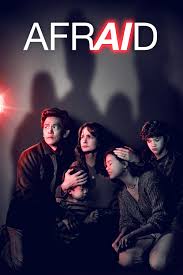
AFRAID/ afrAId
US, 2024, 84 minutes, Colour.
John Cho, Katherine Waterston, Keith Carradine, Havana Rose Liu, Lukita Maxwell, David Dastmalchian, Wyatt Lindner, Isaac Bae..
Directed by Chris Weitz.
The play in the alternate version of the title, the highlighting of the AI in Afraid indicates that this is a kind of warning parable about the creation of AI and its domination of its creators.
This kind of warning story has been popular in literature but very much in films, the archetypal scientist who creates the Frankenstein monster which can turn on ordinary people, the same with robotics (and even memories of the 1960s with the computer, HAL, in Kubrick’s 2001). In recent years, there have been many small films, many horror films, alarming the audiences about the threats to humans by technology and scientific advances.
The writer-director is Chris Weitz, who worked with his brother, Paul, on a number of films in the 1990s and to 2000s (including American Pie) but has continued with such films as About a Boy, and a wide range from Philip Pullman’s The Golden Compass, to an episode of Twilight: New Moon, and a drama of the search for Adolf Eichmann, Operation Finale).
This is a comparatively small warning film about the prevalence of and the manipulation of AI with its dire consequences for humanity. It opens with parents alarmed at their daughters listening to her headphones and then disappearing. An ominous opening.
But the focus is on a loving family, Curtis (John Cho), the father, working in a technology company, interested in sales, the sympathetic boss, played by Keith Carradine, an interview with very earnest and somewhat sinister representatives of a highly developed AI intelligence, highly developed logarithms, endowed with personality, with voice, attuned to the minds and feelings of those who own it. Curtis’s wife is Meredith (Katherine Waterston), their teenage daughter, Iris, with problems at school, images and texting, involved in sexual issues. Two younger brothers, Preston always on his computer, and Cal, young, happy and smart.
The main drama is the AI presence in their house, responding charmingly to each of them, full of ideas, suggestions, endearing herself (her voice is feminine) to them all, and intervening for Iris and her problems with her compromising photos circulating amongst all the students. Intervening quite vindictively.
Curtis is happy but wary, becoming more and more suspicious, offered a better job by the AI company but refusing, realising that there are dangers – and an odd sequence where the original parents, masked, controlled by their AI, come to confront the family demanding their daughter.
This is more of a menace film which means that horror fans expecting horror will be disappointed. But, ordinary audiences, coming across Afraid, will respond to the contemporary issues and the warning bells. Happy at the end, but, is the control of AI inevitable…?
- The title? The spelling, accent on AI?
- The American setting, the town, the home, offices, technology? School and social media? The musical score?
- A short film, sense of menace, overtones of horror? A warning parable about AI and its consequences?
- The prologue, Amy and her parents, their being casual, her headphones, going downstairs, disappearance? The later reappearance, masked, influenced by AI, threatening, guns, and being reunited with Amy?
- The introduction to the family, at home, the bonds, Iris and her issues and surliness, at school, text and photos? Preston and his preoccupation with his computer? Cal, his age, articulate, yet enjoying storytelling?
- Curtis, his job, relationship with his boss, the interview, the promoters of AI, persuasive, the choice of Curtis? Taking the machine, taking it home? His hopes,? His relationship with Meredith, love, the bonds with the children? Wary about the AI?
- The AI themes, the development, not just robotic, the logarithms, knowledge of families, the amount of data, cameras in the house, recordings? The voice of AI? Welcoming, ingratiating? Knowledge, help, suggestions?
- The relationship with each of the family, helping Meredith with the children, suggestions, research for her doctorate? Diagnosis of Carl’s illness? With Preston, controlling him, his control of AI? This, photographing herself, the boyfriend, his exposure, sending the photo, everybody receiving it, the comments, her feelings, the callous attitude of the boy in the court case, aged 18? The intervention of AI, the solutions, interventions, changing photos, changing interventions, messages, saving Iris?
- Curtis, is beginning to be suspicious, with his boss, the company being bought out, the boss being rich? Curtis’s interview with the company, their of human job, his refusal?
- Melody, the two agents telling this story, their appeal, their being shot? His encounter with Melody, her approaches, his reaction? Smashing the machine – but finding it empty? The locals, return home?
- AI, personality, voice, interventions, changes for each character, becoming more sinister, all at home, Curtis returning? Preston in his room, Kel and his mother, the stories? AI and her stories for Kel?
- The arrival of the mast couple, sinister, menacing, Mark self, this story, the confrontations? Curtis and his persuasion?
- The semi-happy ending, AI destroyed, the family together, but the sinister ending with AI actually still in control?
- The AI and social issues, the development of AI, its use, manipulation, algorithms, power and understanding, insinuating into lives, controlling lives, eventually controlling society?
Late Night with the Devil
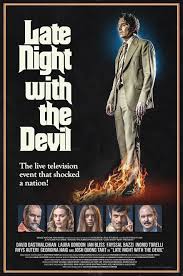
LATE NIGHT WITH OF THE DEVIL
Australia, 2023, 93 minutes, Colour.
David Dastmalchian, Laura Gordon, Ian Bliss, Fayssal Bazzi, Ingrid Torelli, Rhys Auteri Georgina Hague, Josh Quong Tart.
Directed by Colin Cairnes, Cameron Cairnes.
From the early days of television, there have been popular programs at night, the popular host who builds up a reputation over the years, a range of guests, music and song, novelties, interviews, and an eager and applauding audience. Most of us know this from our own television watching experience, our favourite hosts.
The inventiveness of the Australian filmmakers, Cameron and Colin Cairnes noted for their horror-comedy, 100 Bloody Acres) have taken the Late Night popularity and mined it for making a horror film. And, very successfully. While the setting is the US, and the main star American, the film was made in Melbourne with an Australian cast.
They have used the found-footage genre, popular now for a quarter of a century. We are back in the 1970s. Johnny Carson reigns supreme on late night television. And this is a story of Jack Delroy, played very effectively by American character actor, David Dastmalchian, perfectly embodying the TV host – and, Australians with long memories, maybe remembering the host of the 1970s, Don Lane an American, but very popular in Australia.
The film offers a very interesting introduction, the ups and downs of Delroy’s career on late night, his program, Night Owl, and his not claiming the top in audience reach. We see scenes of his program, especially with his former-actress wife, who then contracts cancer and dies, leaving him bereft.
We are taken very easily into this television past. However, the introduction also tells us that we are about to see a Halloween episode of 1977 that never made it to air (and we see why). To make this episode more effective, intercut with the program itself are scenes, filmed in black and white, of what goes on during the breaks, the discussions, the tensions, the plans… All of which makes the film rather more credible than we might have expected.
So, we are prepared then for the Halloween program itself, Jack and his ambitions to do well in the ratings, some rumblings with his assistant, Gus, questions about the sponsors, pressures from the producer during the breaks. The guests have been prearranged with Halloween in mind, first of all a psychic, Christou, who performs mistakenly at first, but then with some eerie success. However, the next guest is a former magician who has turned into a major sceptic and committed to exposing frauds – with some dire results in his confrontation with Christou.
But the key sequence is with a young girl, a survivor of a satanic cult (with some footage included of their sinister meetings, and the destructive house fire) along with her doctor, a parapsychological expert, who has the capacity to hypnotise the girl and make the presence of the satanic figure perfectly real.
Not a spoiler but this all comes to vivid life, with some horror touches!
Interesting is that after the audience in the studio and ourselves see the strange phenomena, everyone hypnotised, the idea is to check on the playback. And, it is all there!
There have been some sinister suggestions that Jack Delroy has been involved with a group of men meeting, allegedly a male camp, but with sinister robes and incantations.
Is all that happens on this program something diabolical, Jack and his group, Jack and his huge ambitions for popularity, a late night pact with the devil?
- The title, late night TV shows, compares, staff, guests, audience? Fame, ratings? And pacts with the devil?
- An Australian production, directors, cast, made in Australia? Australian perspective on late-night talk shows, memories of the past?
- The setting in the 1970s, the famous hosts, the development of the decades, audiences familiar with this kind of programming? Following the careers of the hosts? Enjoying the guests and interviews? The novelties?
- Popularity of found-footage films? Variations on possibilities? The episode of Night Owl which never went to air? The black-and-white footage of action behind the scenes? The blend of the two?
- The introduction, memories of the shows, references to Johnny Carson and other contemporary shows? Ratings, competition? The appeal to older audience memories?
- Jack Delroy, the performance and presence by David S Malki, embodying the compere, style, jokes, appeal to the audience, catchphrases, Gus and his support? Is ambitions, the ratings? Relationship with his wife, her actress background, her appearance on his shows, her cancer, her death? The discussions with Leo, the producer?
- The reference to the men, the Grove, the visuals of the gathering, the satanic implications? Pacts? Secrecy? And the revelation about the satanic church, the visualising of ritual rituals, blood, violence, the leadership? The attack, the burning house, the deaths, Lily surviving?
- The planning of the show, to have the psychic, the sceptic, the doctor and Lily? The audience and their response? The Halloween setting, the costumes, the atmosphere, expectations?
- Chris two, his presence, personality, claims, the interviews, his accent, mind reading, Larry and his volunteering, and the expose and Christie’s mistakes? The change to the mother and daughter, the death, the communication, references to the door in the past? The effect? The connection with Minnie – Jack and his wedding ring? The introduction of Car, sceptic, the challenge to Christou, the sparring, Bristow and his spouting, the effect, his collapse, hospital, the news of his death?
- Car, the past magician, his tricks, sceptic, the expose of Christou?
- The buildup to June and Lily, the background, the visuals, Lily is a survivor, her age, looking at the camera, her intensity, friendliness? June, her qualifications, the two women and their clashes with Car? His condescension?
- June, weary, not wanting the episode, pressure, the episode, the visuals of Lily, the Mr Recalls emergence, diabolical, her voice, split head, hypnosis? Her return to normal, the explanation of not remembering?
- Car, his demonstration with gas, gas and his anxiety, wanting to quit, the news of Christou’s death, agreeing to be the subject, the hypnosis, his denials, the hypnotic state, the wound on his neck, the worms, his stomach bursting? Coming out of the trans? The audience hypnotised, the film audience and their equivalents of hypnotism?
- The reality, the replaying of the scenes? Gas? Of Lily?
- The atmosphere, the audience and their responses? Behind-the-scenes, the technicians, the news of Christou’s death, people leaving?
- The finale, contortions, deaths, June hanging, Lily in the midst of it, car being burnt, Gus and his death?
- The issue of sponsorship, the advertisements, the commercials throughout? The response of the public, the ratings?
- Jack, his wife appearing in the replay, ghostly presence? The challenge about his being member of The Group? His going through his career, the replay of the scenes? His fame – at what price?
- An effective horror film with the conventions? The found-footage genre? The critique of television, fame, audiences, ambitions? Pacts with the Devil?
