Displaying items by tag: Peter Malone's Movie Reviews
Benal & Adama
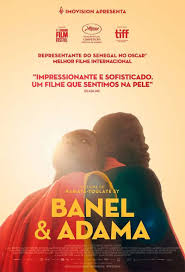
BENAL & ADAMA
France/Senegal, 2023, 87 minutes, Colour.
Khady Maned, Mamadou Diallo, Bint Racine Sy.
Directed by Ramata-Toulaye Sy.
Writer-director of this film is from Paris with origins in Senegal. This is her first feature film after writing several films and directing a short film.
The setting is a remote village in Senegal, beautifully photographed, the details of the village, of the surrounding lakes landscapes, cattle grazing, then relentless drought and the deaths of the cattle.
The focus is on a young woman, Benal, who doesn’t want to live in the village, unable to relate well to others, except Adama whom she marries after the death of her husband, his older brother. She is looked at with suspicion by Adama’s mother, by a young girl who had been intended for Adama, by the rest of the people in the village.
The style of the film focuses on the characters, close-ups, long tableau, giving the audience a chance to look at the characters, try to empathise, try to understand.
This is a 21st-century world but a remote village, some aspects of modern life but very much the traditions, steeped in Islam and the reading of the Koran, prayer and determining all events in the light of the interventions of Allah.
- A story from Senegal, a remote village, actions, relationships, his lime and spirituality?
- The location photography, the details of the village, the cattle in the fields, the drought, the houses under the sand, atmosphere? Musical score?
- The focus on Benal, her age, place in the village, the arranged marriage, the death of her husband, marrying his brother, the past love for him and the possibility of escaping the village? Her being out of place in the village, the demands and expectations, expectations of Adama’s mother, her devotion to her husband, yet not wanting children, eager for the house, the digging away the sand, his description of the house in the interiors, the sun, the bedroom? Her hopes?
- Her not fitting in, the capacity or not for loving others, for a Adama, being loved? Her manner with the other women, the clashes with her mother-in-law, the young girl who had hoped to marry Adama, isolated from the group? Yet her having to babysit, do the laundry, the work? Her resentments?
- Adama, the dependence on his mother, his father the chief, his brother dying in the well, his lineage, his decision not to be chief, asserting this, supported by Benal? Not joining in the prayer, the drought, the death of the cattle, the men moving away, the elder and his talking to Adama, the linking of the drought with his behaviour and choice? The spirituality of a Lion and whatever Allah willed?
- The drought, the vision of the cattle, collapsing and dying, the women cutting up the cow for the meat? Unrelenting? The village prayer?
- Benal, her twin brother, their talking? The copies of the Koran? Reading and studying? The young boy and his play, Benal irritated with him?
- The desperation, the demands on Adama, desperate digging in the sand? His response, sense of failure, talking with his mother, that he should be chief?
- The style of the film, the many tableau sequences, enabling the audience to gaze at the characters and their situation, to empathise, to understand? Benal and her need for understanding, appreciation and love?
Sunday Best: The Untold Story of Ed Sullivan
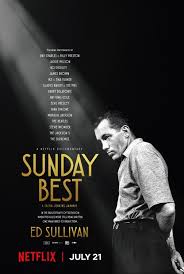
SUNDAY BEST: THE UNTOLD STORY OF ED SULLIVAN
US, 2025, 90 minutes, Colour.
Interviews: Harry Belafonte, Berry Gordy, Jackie Jackson, Smokey Robinson, Dionne Warwick, Otis Williams.
Performances by: Ray Charles, Billy Preston, Jackie Wilson, Bo Diddley, James Brown, Ike and Tina Turner, Gladys Knight and the Pips, Harry Belafonte, Nat King Cole, Elvis Presley, Nina Simone, Mahalia Jackson, The Beatles, Stevie Wonder, The Jackson 5, The Supremes.
Directed by Sacha Jenkins.
Ed Sullivan was one of the earliest television celebrities, hosting his own show. He completed 25 years as host, finishing in 1971 – and dying three years later.
For Americans, in their millions, who watched his show every Sunday night, he was a welcome figure in their homes. For those who observed him from afar, he seemed somewhat of severe face, rather stilted introductions. In fact, early in his career, there were complaints about his unsmiling presence, some even claiming that he had a steel plate in his head (and he received many sympathetic letters!).
This is a very sympathetic portrait of Ed Sullivan, using a great deal of footage from the 1930s to the 1970s, often his own words, and, as indicated, some voice impersonation of his words.
Sullivan began his career as a journalist, interested in writing, then becoming a sports journalist and significant in his field. He was then transferred to theatre and Broadway, and from the mid 1930s was a popular host for many years of an annual concert. This brought him to the attention of CBS and the offer of hosting a show – but with some scenes of critique of his poor performance and bad reviews.
However, Sullivan had an ability for tapping into talented performers, offering opportunities for a whole host of stars – and the film incorporates substantial performances from many of these stars, as indicated in the above credits, which means that we are not only watching Ed Sullivan but we are getting a strong impression of the Ed Sullivan show.
One of his most significant stances was against racism, welcoming a whole host of African-American performers, especially with Harry Belafonte in the early 1950s, Belafonte challenging him, their forming a very strong friendship. And there was great hostility to the show in the southern states – although, it seems, a number of people did watch the show in their homes without letting this be known. To highlight this theme, there are quite a number of inserts of footage of racism and segregation of those years, Rosa Parks, a number of politicians from the South.
By the end of this documentary, audiences will have a very favourable impression of Ed Sullivan as a person, despite the limitations of his sometimes stern-looking presentation, his talent for promoting so many significant performers of the 20th century, and, importantly, his contribution to the breaking down of many racist attitudes of the period.
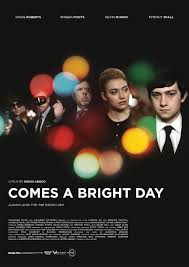
Comes a Bright Day
COMES A BRIGHT DAY
.
Craig Roberts, Imogen Poots, Timothy Spall, Kevin McKidd, Josef Altin, Anthony Welsh, Geoff Bell.
Directed by Simon Aboud.
A number of people, bloggers, have enthused about this blend of thriller and romance. However, a number of bloggers were not attracted by the film, critical of its credibility and performances. This review opts for the latter opinion.
The film focuses on a young man, Sam (Craig Roberts), a small job in a large hotel, but looking as if he was still at school. He is given a job by the manager, played by Geoff Bell, and goes to visit a friend who works as a cook, played by Anthony Welsh, they plan to own a restaurant. Then there is an encounter with an attractive customer, Mary (Imogen Poots) whom we have seen working in a jeweller’s shop managed by Timothy Spall.
On his way back, Sam calls into the jeweller’s shop to make a date with Mary when suddenly there is an invasion, two manic burglars, Kevin McKidd, quite over the top in terms of character credibility and performance. Then there is a police siege – rather confusingly filmed, and rather large for such a robbery.
Most of the film consists of conversation between the three held as hostage after a sympathetic old lady whom we have seen at the hotel is callously shot. The two burglars are masked, frustrated, trying to find a way out, including tapping into the false roof of the shop to find an exit.
The conversation between the three and the attempts to deal with the situation, each of them becoming more forceful as the situation goes on, but it is not particularly interesting.
Ultimately, the trio is able to overcome the robbers and there are prospects of a happy ending.
Cranes Call, The
THE CRANES CALL
UK, 2024, 90 minutes, Colour.
Anna Neistat, Solomiia Stasiv.
Directed by Laura Warner.
A film about the Russian invasion and part occupation of Ukraine. It was released two years after the invasion. It was filmed on location in the Ukraine, in Kyiv, in country villages, in towns. There are also sequences focusing on the main researcher, with her family, in Paris and in New York.
The film was sponsored by a number of organisations for peace, and in the step belonging to the Clooney Foundation for Justice.
The title comes from a poet heard towards the end of the film, cranes calling and their call is that Ukraine will find peace.
What is significant about the film and makes such a powerful impact is that it is a close-up investigation of war crimes. The audience is introduced to the chief researcher, Russian-born Anna Niesten, researching war crimes for 20 years in Chechnya, Georgia, Syria… Her oldest son works with her in the research, her husband and younger children moved from Paris to Ukraine during the film.
At the opening, there is an attack on Kyiv, drones, and the need for the research team to take shelter. But, this is the opportunity for Anna to meet Solomiia with two brothers fighting on the front, her acting as translator, becoming more fully involved with the research.
The value of the film is the audience being invited to accompany the research party and be present for all kinds of meetings, interrogations, visits to sites, personalising the preparation for Dossiers for war crimes, charges which can be brought up by countries outside Russia and Ukraine.
There is a meeting with an older mother, the town occupied, the threats of rape not just as is one punishment but as an outlet for drunken troops. She is willing to give testimony. There is a discussion with a man who had been and abducted, held in a dark cell, tortured, electrodes and currents, gas masks. There is an interview with a man who describes the bombardment, his attempts to save his wife and children, the sadness of the discovery of his wife’s dead body, eventually finding his son.
One of the factors for the research is finding documents left behind by the occupying Russian troops, finding names, details about commanders, finding papers, USB with photos, some local papers produced during occupation.
The audience gets to know and, very articulate about her work, her motivations, her intentions, and the personal drama for Solomiia as she accompanies Anna.
Newspaper and news on television items indicate the presentation of war crime Dossiers to various international authorities. This documentary personalises all of this, and admiration for those who spend their time, energies, experiencing dangers, in searching out interviewees and documents.
And, in the 2020s, not only war crimes by the Russians in Ukraine, but the war in Gaza, civil war in Sudan, persecutions in Myanmar…
Naked Gun, The
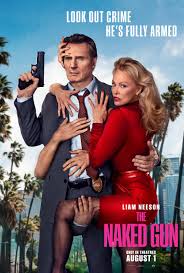
THE NAKED GUN
US, 2025, 85 minutes, Colour.
Liam Neeson, Pamela Anderson, Danny Huston, Paul Walter Hauser, CCH Pounder, Kevin Durand, Eddie Yu..
Directed by Akiva Schaffer.
Many of us enjoyed the three Naked Gun spoofs decades ago as well as the television series, Police Squad. Here is an entertaining opportunity to revive memories as well as enjoy this present comedy.
Were audiences expecting Liam Neeson to be the new Leslie Nielson? The screenwriters were wary and came on the solution that Liam Neeson should be Frank Dreben all Jr, like his father, but not exactly like his father, paying homage to his father (as well as having his father intervene in the final confrontation in the form of an owl!!).
But the thing is that Leslie Nielson (and there is an amusing assonance with Liam Neeson almost looking/sounding like Leslie Nielson?) Leslie Nielson played everything not only straight-faced but almost granite-faced, not aware of his double takes on situations, probably not even aware that he took a first take. But, Liam Neeson is a more dramatic character, much more expressive with his face, and while he does play everything somewhat straightfaced with a touch of dumb and dumber, he is also sending up his so many tough guy performances in thrillers for the last almost 20 years.
Needless to say, the film is absurd, but that is what we want. A megalomaniac trying to control the world, a device to send humans back to their animal state, corral them, tame them and send them back to re-create the world. Danny Huston definitely fits the bill as the villain, as if in a James Bond film, except of course his willing participation in his final humiliations.
And, here is Pamela Anderson, offering a performance as she did in The Last Showgirl, able to play along with the comedy and, at moments, sending up her glamorous Baywatch image of the past. And her screeching jazz delaying tactic! Paul Walter Hauser plays the son of George Kennedy’s original performance – and there is a sly joke at the expense of O. J. Simpson.
As with the originals, a lot of the jokes are basic puns and misunderstandings but, in the context they get more of a laugh and they would in real life! E.g. “take a chair…”; Response “no, I’ve got enough at home”. And then she does take the chair!
So word humour, situation and absurdity humour, sexual innuendo (and a bit beyond) humour, and mostly coming one joke quickly after the other which means we can laugh out loud or just perhaps a continuous giggle or have, mostly, a smile on our face full-time
And, of course, if we enjoy this one, there may be a 2 ½, just like the original series.
Horrors of the Black Museum
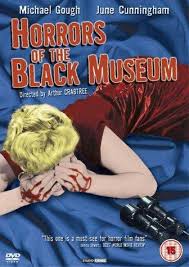
HORRORS OF THE BLACK MUSEUM
UK, 1959, 95 minutes, Colour.
Michael Gough, June Cunningham, Graham Curnow, Shirley Anne Field, Geoffrey Keen.
Directed by Arthur Crabtree.
With Hammer Studios moving into horror with Dracula and Frankenstein in the mid to late 1950s, there was a movement towards horror films in British production. Michael Powell’s Peeping Tom appeared in 1960.
While very dated, very, this film is part of that horror movement in the UK which was to flourish in the 1960s and 1970s. Surprisingly the Dir is Arthur Crabtree who had significant films in the 1940s and 1950s, especially at Gainsborough studios, starting with Madonna of the Seven Moons.
The star of the film is the younger Michael Gough, a blend of the charming and the sinister, in many films but becoming internationally known for his role in Penny worth in the Batman films of the 1980s and 1990s. Here he portrays a journalist and author, specialising in crime, always in contact with Scotland Yard, appearing at scenes of crimes, but with his own Blackcap Museum (Scotland Yard having its own such Museum) with all kinds of bizarre instruments and tableau is of crimes. He has an assistant who is completely under his control, played by Graham Curnow.
There is a series of gruesome murders, especially in the opening sequence with a glamorous young blonde looking through a pair of binoculars and her eyes being pierced. And there are several other murders throughout the film, including the elocution of the doctor, and the Revelation that the journalist is in control of situations, creating crimes, especially committed by his assistant, even on an outing at a fair with his girlfriend, played by Shirley and field.
Geoffrey keen is the leading Detective. June Cunningham has a long sequence interacting with Michael Gough and then going to a bar and dancing as if another Diana doors with dance movements like Rita Hayworth’s Gilda.
In a British pulp fiction kind of way, the film is interesting but, it is more of a curiosity of British filmmaking in the late 1950s.
Bride Hard
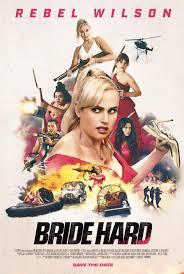
BRIDE HARD
US, 2025, 103 minutes, Colour.
Rebel Wilson, Anna Camp, Stephen Dorff, Justin Hartley, Anna Chlumsky, Da' Vine Joy Randolph, Michael O'Neill, Sam Huntington, Colleen Camp.
Directed by Simon West.
Whether the screenwriters for Bride Hard had comic spoofs like The Naked Gun series in mind when they were plotting, creating eccentric characters, imagining extreme situations, this is how Bride Hard has turned out. It is definitely over-the-top. And, if you are making this kind of entertainment which gets away with all kinds of parody, then, why not?
This is definitely a comedy thriller for the female audience. The bride and her bridesmaids and maid of honour get the opportunity to do all kinds of action stunts that are usually reserved to the male stars. It is definitely a girl-triumph comedy adventure.
The film has been directed by Simon West who made his mark in his early films with action shows like Con Air, The General’s Daughter, the first Lara Croft film. He knows how to direct action.
This is very much is Rebel Wilson’s film, drawing on her screen presence, using her Australian accent, her ability to send up herself and her image. And get away with it. The film opens with some credits flashback sequences to a developing friendship between two girls growing up. Now, 30 years later, one of them is getting married, reaches out to her best friend whom she hasn’t seen for a long time, to be maid of honour. A collection of other girlfriends will be the bridesmaids – including Anna Chlumsky (My Girl and Veep) quite compelling in her intensity as the bridesmaid, rich family background, who likes to control everything and wants to be maid of honour. And, Oscar-winner for The Holdovers, Da’ Vine Randolph is boisterously raucous.
There are some male agents but the one in charge is a woman. There is the intended groom, Sam Huntington, but he takes something of a secondary place, especially after a shot in the leg and can’t be as active as the women.
And, of course, the villain is a man, with Stephen Dorff playing it exactly right, self-confident, arrogant, at first bewildered by the female agent, then confrontations, battle of wits, battle of muscles – and, of course, his defeat.
While the title reminds us of Bruce Willis and Die Hard, the film opens with the emphasis on the bride, a lavish prenuptial dinner, and Rebel Wilson’s Sam needing to take part in a sting and criminal chase. So, while the girls drink and enjoy themselves, Sam is out on Spy Hard ultra-action, outdoing Bruce Willis at any time, and rivalling, at least, Jackie Chan and/or Bruce Lee.
Sam is reluctant to go to the wedding because of the break with her best friend but is ordered by her spy chief, also her psychiatrist supervisor, to get some balance in her life. And, it all goes from there, an extraordinary lavish mansion and grounds, the arrival of the criminals to steal the gold bars in the family vault, and an opportunity for Rebel Wilson to do extraordinary feats of brains and brawn. But, happily, in the last part of the film, all the bridesmaids get the opportunity to go into action.
Obviously very silly, but enjoyably so. Actually, the whole thing is quite absurd – but, as noted, enjoyably so.
Four Letters of Love
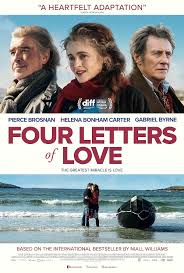
FOUR LETTERS OF LOVE
Ireland, 2024, 125 minutes, Colour.
Pierce Brosnan, Gabriel Byrne, Helena Bonham Carter, Fionn O'Shea, Donal Finn, Ann Skelly, Imelda May, Norma Sheehan, Pat Shortt,
Directed by Polly Steele.
There are some and written letters at the end of this Irish film but throughout, the four letters are literally L-O-V-E.
The screenplay is by the novelist, Niall Williams, from his 1997 novel which has been published in 20 countries. If the novel has had a following, this pleasing Irish tale could also build up a following.
The film is told from the point of view of the son of the central character, William, who, saying that he was inspired by God, suddenly got up from his desk job in his older age determined to go off to the Irish coast to paint. He is played very effectively by Pierce Brosnan, sympathetic, sometimes puzzling, obsessed with his quest for painting, strange treatment of his wife and difficulties in relating to his son, Nicholas (Fionn O’Shea).
In the meantime, the audience is introduced to a parallel story, a family on the West Coast, a poet-teacher, Muiris, a ruggedly convincing Gabriel Byrne, his busy wife, Margaret, Helena Bonham Carter, a cheerful son, Donal Finn, and an exuberant daughter still at school, Angela Skelly.
Each story has its intense drama and we know that they will eventually come together.
The film is Catholic in atmosphere, an amount of God language, a sad and sudden accident and impairment, the daughter sent to an ultra-strict convent school with grim-face severe nuns and happily running away, the local priest and ceremonies, and reflection on God, God’s seemingly harsh interventions, God’s will, but also miraculous interventions in our world.
While there are some scenes in Dublin, most of the action takes place in the Irish countryside and coast, ruggedly beautiful. The performances are fine, the screenplay bringing the two stories together dramatically – and with some pervading spirituality.
Throughout the significant performance is that of Fionn O’Shea as the son Nicholas, confiding his story, a creative young man, wanting to be a writer, not understanding his father, craving some kind of affection, wilfully going after him to the coast, and then encountering the poet’s family, being welcomed, finding a home, and, beset by an infatuation with the poet’s daughter, who, herself, has married a charming but feckless young man who had helped her when she was running away from the school.
There is the potential for tragedy as the girl’s mother, Margaret, does not approve of the love, does her best to curtail it, this very much involving the literal four written letters of love. But, as we hoped for, a move towards some resolution, reconciliations, greater understandings, and the triumph of pervading love.
- The international popularity of the novel? The novelist writing the screenplay?
- The Irish setting, late 20th century, Dublin, workplaces, homes, travel through the countryside, the West Coast, the cliffs and the beaches, the town, homes, school, churches? The boarding school with the sisters? The musical score, the Irish music, the contemporary songs?
- The two stories, their development, the characters, some interconnections, and the two stories coming together?
- The title, the actual letters at the end of the film, the emphasis on the four letters spelling the word, Love?
- The initial focus on William and his story, his age, his work, humdrum, a final store, change of heart, his seeing it as God-inspired, leaving, going home, his relationship with his wife, her dismay, the lack of relationship with his son? His leaving, packing, travelling to the West Coast, setting up, the painting? The accident, the water, the impact on the painting? It’s surviving, competition, a claim?
- William and his return, the drama with his wife, his son wanting some affection, his decision to follow his father? In the same bus as Isobel, going his way?
- The Core family, Murals and his teaching, poetry, blocks, creativity, Margaret, loyal, tense, concerned about her children, love for her husband? Shawn, his music, Isobel and her wireless, the sequence on the cliff, her daring standing on the edge, Sean and his music, his sudden collapse, the consequences for the family?
- Isabel, going off to school, travelling with her father, the severity of the nuns, her running away, the encounter with XXX, the time together, the enjoyment, her returning? His arrival, the full story about the funeral, her leaving, the sisters with a moment of compassion, her returning, her expulsion? Happy to be expelled? The consequences for her, with XXX, in love, the discussions with his mother, the decision to marry, the wedding? His inability to respond, the break?
- John, getting the painting, using it as a prize, Murals and his poem, winning, the painting in the house – that is only being revealed at the end, and as being symbolic of the whole story?
- Nicholas, being the narrator, the older Nicholas looking back, his comments on his father, his father’s life and work, his mother? His being taken in by the family, staying in the house? Becoming part of the household? Infatuation with Isabel?
- The religious dimensions of the film, William and his initial vision, the light on the paper, his drawing? The religious ceremonies, the Catholic background with the severe school? The parish, the ceremonies, funerals and weddings, the contribution of the priest? William and his reappearances, ghostly?
- Shawn, incapacitated, wheelchair-bound? His sudden cure, a divine intervention, standing up, recovering his voice, his mind, his music?
- Margaret and her not wanting Nicholas to marry Isabel? Isabel and the difficulties, her facing up to them, confronting her husband?
- Nicholas, writing the letters, poetic, giving them to Margaret Post, her going into the town, destroying the letters, her subterfuge is with Nicholas? Finding reading one, on the cliffs, her change of heart?
- The final happy ending, the four letters, the four letters of Love?
My Oxford Year
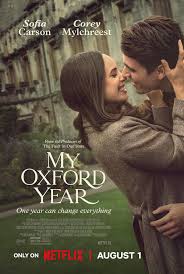
MY OXFORD YEAR
US, 2025, 116 minutes, Colour.
Sofia Carson, Corey Mylchcreest, Dougray Scott, Catherine McCormack, Harry Trevaldwyn, Esme Kingdom, Nikhil Parmar, Poppy Gilbert.
Directed by Allison Burnett.
My Oxford Year is a romantic comedy. Its central characters are in their 20s so that is the target audience.
It begins well but moves into very familiar material, touches of the cliche, touches of the trite in establishing a relationship, moving to emotions and jealousies, and then a final reveal which changes the perspective on the characters. And, it has a finale which, on the evidence of the narrative, seems impossible – or highly improbable.
The focus is on a young woman, with a good job at Goldman Sachs but who has had had a dream of studying literature in Oxford. She is from New York, a Hispanic family. When she arrives in Oxford, she is overwhelmed and the film offers scenes of Oxford, nostalgic for those who have been there, attractive for those who have not. She is Anna, played by Sofia Carson.
A car drives by, driving through a puddle and splashing her - entrenching. Then she encounters the driver, obviously wealthy, with a friend, hiding from a woman in a fish and chip shop. Interactions between Anna and Jamie, played by Corey Mylchreest (who, in fact, is five years younger than Sofia Carson). She goes for her lecture for the professor she wanted to listen to who has had a new job and, the new professor is Jamie. So, some prickly episodes, battle of the sexes.
When she is put upon in her first visit to a pub, he comes to her rescue, taking her to his favourite kebabs shop, and, too instantly, she is kissing him. After some hesitation they begin a relationship, too soon for credibility, declaring that each of them just wants to have fun.
There are some academic moments, some glimpses of classes and reading of poetry and interpretation, some tutorials, but very little insight into her academic career over the months which means that her becoming the professor at the end of the film defies credibility.
So romantic comedy and its variations in the Oxford context, with scenes of the anniversary Ball, the races on the Thames, atmosphere. But, something of a break, Anna and jealousy, discovering the truth about Jamie, his health, the death of his brother, alienation from his father. The tone of the film then does become much more serious leading to clashes, reconciliations, illness and death.
There may be an appeal to younger audiences but older audiences may well become impatient with characters and development of the themes.
Last Rodeo, The
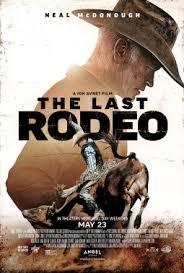
THE LAST RODEO
US, 2025, 116 minutes, Colour.
Neal McDonough, Mykellti Williamson, Sarah Jones, Christopher McDonald,
Graham Harvey, Ruve McDonough, Daylon Swearingen.
Directed by Jon Avnet.
The Rodeo is a great tradition of the American south and west. The raiding of the bulls, the skill of the riders, balance, control, the bulls in motion, the 8 seconds, achievement – and, those assisting, those protecting the riders after falls, and the roar of the crowd.
And, it is all here in this story of a past champion, Joe Wainwright, some flashbacks to his achievement, memories of severe injuries and care, but now a proud grandfather, encouraging his grandson, Cody, riding a bull, playing baseball, especially with the disapproval of his mother, Sally, all indicating that this will be a story of family, love, clashes about being protective and overprotective…
But, a dramatic turn – and the audience will immediately see where this will go. Which doesn’t really matter because the audience will be on side for a happy ending, no matter what the difficulties. Yes, the screenplay is emotional, perhaps at times it is manipulating our response, but this is what this kind of earnest film intends. (And one wonders whether the anti-sentimentalists would really like it to end unhappily!)
Neal McDonough has been a character actor for many years and is obviously committed to this project, taking the central role of Joe, cowriting the screenplay, and producing it with his wife, Ruve McDonough, who also appears as his wife. Graham Harvey has a solid role as the grandson, the onset of his illness, the need for surgery, his mother, concerned but having to face more realities. Sarah Jones is his mother.
So, grandfather Joe decides that he will enter the upcoming rodeo in Tulsa, enlisting the help and support of his old friend, Charlie (Mykelti Williamson), a good man, past injuries, help from Joe, a sense of humour and a strong sense of faith.
There are some difficulties along the way, especially in registration, making demands of an old friend now a manager, Jimmy Mack, played by Christopher McDonald. So, quite a number of scenes of Joe making demands, the young riders sometimes supportive sometimes scoffing, the excitement of the rides themselves, the physical repercussions for the riders, the desperate competitiveness and Joe’s single-minded determination to win and get the money to cover the surgery expenses for Cody.
This is a film from Angel Studios whose philosophy is to make films for the family and films with faith dimensions. Charlie is the man of faith here, comfortable with God-talk, with his Bible. Joe, on the other hand, is the American Stoic, the tough male, rather humourless, determined not to take charity from others because self-sufficient, but having to learn that life’s events are not just about him, but he has to think of others, appreciate others, become open to receiving help in love. To that extent, this is an Angel Studios faith film.
Somebody rightly commented that with grandfather, daughter, grandson, this is a family film for each of the generations.
- The status of the rodeo in American culture? Texas, Oklahoma…? Skill of the riders, the popularity with the audience?
- The title, the tone, Joe and his age, career, past champion? The family situation, his daughter and grandson, their talents and ambitions? The brain tumour, his wife, Cody, insurance, the cost of the surgery? His determination to ride and win?
- The setting, Edna as a Texas town, homes, streets, the landscapes? The musical score?
- The flashbacks, seeing Joe and his achievement? With Charlie, Charlie’s wife, with Rose? The happy memories? The story, the travels, Rose and her tumour, her death? Joe and his helping Charlie? Helping Jimmy Mack? Sally and her having to look after her father, his desperate injuries? Cody, no explanation of his father, his age, ambitions to ride the bull, his mother’s disapproval, baseball, the ball hitting his ear? The diagnosis, MRI, the brain tumour, the need for surgery, the cost? Not enough insurance?
- Joe, his character, Stoic, American tough, macho male, not wanting help from others, lacking humour? Emotional investment in his grandson? The clashes with his daughter, yet love? His decision to go into the competition, having thrown away the invitation, the difficulties?
- Sally, her age, experience, skills in the past, the death of her mother, caring for her father, her son, protective? Response to his illness, the MRI, hospital, present at the hospital, clashing with her father, yet watching his performance, phone calls, his visit with Charlie, the reconciliation, the reflections about their past?
- Joe and his going to Charlie, their past, Charlie and his wife, happy life, his past injuries, helping Joe, Joe and not responding, the long years of silence, Charlie hurt? His response to Joe’s proposal, laughing, helping, travelling with him, camping out in the van, Joanne Charlie and the pressure on the organisers, with Jimmy Mack, past memories?
- Joe, determination, arriving, not taking no for an answer, the registration, with Jimmy Mack, Jimmy able to organise, Jo’s acceptance, the encounter with the young riders, there disdain, Billy Hamilton and the rivalry, some hostility from the others?
- The rodeo sequences, the various riders, the eight seconds, surviving, falling, the scores, Joe and his ride, succeeding? The buildup to the second ride and his achievement, the re-ride? The scores?
- Joe and his behaviour, the phone call from his daughter, the lead up to the fight, the police, questions about his eligibility to ride? Joe, the pressure about Cody and another operation, Charlie and his persuading Jimmy Mack to lend the plane? The ride, the visit, the storm, the return?
- The commentators, Jo resenting Jimmy Mack knowing about Cody? Charlie and the news, the commentators, Jimmy setting up an appeal for Cody, the crowd and the one-minute silence of prayer for Cody?
- The final ride, Joe’s achievement, falling, concern about his welfare? And the transition to 6 months later without knowing the result?
- Six months later, the family, Cody playing baseball, well again, Sally and her supportive presence? Joe, happy, the reconciliation? Charlie and his wife happy, Charlie getting the prize of the truck? That Joe came second, the surgery expenses covered, and his donation of the rest of the money to the hospital?
- A film from Angel Studios, the Faith dimension, Charlie, career, talk about God, the opening of the Bible, the support of the Psalm verse, Joe and his resentment towards God, and Charlie’s telling him it was not about him but about everyone else, Joe, religious moment, the crucifix? A family film? A faith film?
