Displaying items by tag: Helena Bonham Carter
Enola Holmes 3
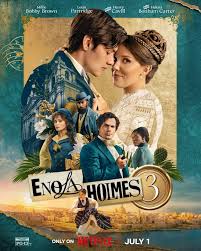
ENOLA HOLMES 3
UK, 2026, 105 minutes, Colour.
Millie Bobby Brown, Henry Cavill, Helena Bonham Carter, Billy Partridge, Himesh Patel, Sharon Duncan-Brewster, Hattie Morahan, Susan Wikoma, Joe Azzopardi.
Directed by Philip Barantini.
Enola Homes is the sister of Sherlock and Mycroft, the creation of Nancy Springer in a series of popular novels. This is the third of the books to be filmed. It presupposes most of the central characters and the cast return for this version. Millie Bobby Brown is lively and older. Henry Cavill returns as a sombre Sherlock. And, there is the creation of their mother character, a rebel, explosives, demonstrations, somewhat alienated from her family, Helena Bonham Carter enjoying the role.
The marriage is to take place in Malta, most of the action there, Malta and British occupation (and with some sequences railing against British colonialism) and some complications with the military and justice.
Enola (alone spelt backwards) the talks to camera and explains that the good film starts with a wedding – but, she hesitates, his pursued by Dr Watson with the news that Sherlock has been kidnapped. She is committed to finding her brother, using his methods to deduce what has happened to him.
She is in love with the Duke of Tewkesbury, played again by Louis Partridge. Then his mother is also abducted and there is intense deliberation to discover what has happened to Sherlock.
At the beginning, the audience has been introduced to a plot focusing on Tewkesbury, and Moriarty, now a female villain played by Sharon Duncan Brewster, pursues Sherlock and takes him.
Sherlock does leave a clue on the mirror, the name of the Afghan town,Khost. So, questions about Afghanistan, the role of Tewkesbury’s father, Afghan soldiers, payment, doubledealing, cover-ups…
Which all leads to various adventures, and Enola going into action, exposes, confrontation with Moriarty – and happy ending and the possibility for a fourth episode.
- The popularity of the series? Sherlock Holmes sister? Comparisons with Sherlock? Her skill as a detective?
- The British settings, the action taking place in Malta, the vistas of Malta, landscapes, the cities? The musical score?
- Enola, her age, from the previous films, relationship with Sherlock, comparisons, her relationship with her mother, eccentricities? Seeing her at work as a detective, using Sherlock’s methods? Her commentary throughout the film, looking to camera?
- The opening, a wedding, Tewksbury at the altar, the congregation, no bride, her decision-making, getting into the carriage, pursued, Dr Watson, the news of Sherlock’s abduction? Her becoming involved, leaving Tewksbury at the altar?
- The character of Sherlock, his reputation, his letters, logical, not emotional, the interactions with Enola, with Dr Watson, Watson reminiscing about the relationship, the Team, his diaries? Knowing in advance, the past with Moriarty, at the dinner in Malta, seeing the soldiers, pursuing him, disappearance?
- The prologue, England, Moriarty in jail, being freed, the name Tewksbury, her mission, the implication of the British officers in Malta?
- Enola, her pursuit of the soldier, his being killed, the local police, the interrogation, the British officials intervening, her freedom? Her pursuit of the woman, the warning, the woman killed? Her looking for clues after Tewksbury’s mother was kidnapped, finding the medals? Using Sherlock’s methods, reflections?
- The local revolutionary, following Enola, the confrontations and fight, his motivations, against the colonialism of the British, and seeing the colonialism in action?
- Tewksbury, the past stories, relationship with Enola, the scenes of proposal, her acceptance, the bond between them, the swimming sequence? His mother’s abduction? Working with Enola? Dr Watson and his collaboration?
- The arrival of Eudoria, her personality, and dominance, with her daughter, the wedding, her reputation explosions, collaborating with the investigation, going to the headquarters, wanting the documents, the attack on the soldier, the search, finding information about Afghanistan, the gold, the stealing? Sherlock and his clues, writing the name Khost?
- Moriarty, the past with Sherlock, vengeance, her plan, the commission from the British, her setting up all the clues, luring Enola along the way, her vengeance and killing her agents the abduction of Tewksbury’s mother, the scenes in the cell, the water, interrogation, pouring out the water?
- Tewksbury, the explanation of the cave, Enola working out where the gold was, finding it?
- The buildup to the final confrontation, her putting the gun on Moriarty, Moriarty and the explosives, the local soldiers, then Moriarty’s squad, the shootout?
- The release of the mother, the expose of the officials, the gold the betrayal, the hiding, the discovery, the exposure of the British? Tewksbury and his disappointment with his father?
- Enola, whether she should become lady Tewksbury or not, the class issues, the jokes about class, Enola and the discussions with Tewksbury, his giving up his title?
- An enjoyable Holmes adventure, Sherlock, Enola, Moriarty? And the future?
Agatha Christie's Seven Dials
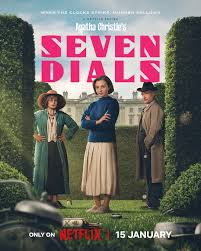
AGATHA CHRISTIE’S SEVEN DIALS
UK, 2026, 150 minutes, Colour.
Mia McKenna-Bruce, Edward Bluemel, Martin Freeman, Helena Bonham Carter, Hughie O'Donnell, Alex Macqueen, Dorothy Atkinson, Mark Lewis Jones, Tim Preston, Ella-Rae Smith, Iain Glen, Nyashas Hatendi, Navhaan Rizwan, Corey Mylchreest.
Directed by Chris Sweeney.
2026, another British three-part series based on an Agatha Christie novel. In fact, the 1929 novel was a sequel to her book, The Secret of Chimneys.
With three parts, the series has the opportunity to create an atmosphere, 1925, still memories of World War I and sadness with those lost. And, once again, an Agatha Christie style British location. And, an occasion which starts happily, even jokingly, leads to a death and an investigation, and the person solving the mystery the young Lady Eileen Brent, nicknamed Bundle.
There are all the Agatha Christie ingredients from her 1920s imagination. And, a strong cast led by Mia McKenna Bruce and such veterans as Helena Bonham Carter and Martin Freeman.
There is always room for another Agatha Christie mystery.
- Adaptation of Agatha Christie’s 1929 novel? Sequel to The Secret of Chimneys, the return of the central characters?
- The television version, the 1925 setting, the stately mansion, grounds and interiors, costumes and decor, vehicles, trains? The musical score?
- The adaptation of the novel, different emphases, the presence of Lady Caterham? Her role, the end?
- The opening, Spain, the spectacular scenery, the empty bull ring, the lone character, the atmosphere, menace, the bull, the goring? The inventor and his wife, the rendezvous, the spy, the gun, her shooting the wife, the inventor shooting her? The puzzle, 1920, no explanations – and the audience having to wait until the very last minutes for the explanation?
- 1925, Lady Caterham, her status, poverty, the house, memories of her dead husband, the story about her son killed in World War I, hosting the Cootes, husband-and-wife, disdain for them, the presence of the foreign office, the young representatives? Bundle, her nickname, Lady Eileen, the encounter with Gary Wade, the promise of the proposal? His friends, the masks, the clocks to wake him up?
- The next morning, Bundle finding the body, his letter to his sister, the mention of Seven Dials, the continued reference to Seven Dials, the poor neighbourhood, being rebuilt, the club, Bill taking Bundle their, the presence of Andrew, the former servant?
- Bundle, the intrepid heroine of this kind of Agatha Christie story, her age, background, curious, forceful? The to and fro with her mother? Interrogating the maid, the poison? The interrogation of Bill and Ronnie, the contact with Jimmy Thesiger?
- The presence of Superintendent Battle, the interactions with Bundle, his following her, the phone call to Scotland Yard? The continued encounters, her defying him, his trying to protect her?
- Bundle and her questioning of Ronnie, discovering him murdered?
- Audience suspicions, for the murder of Gary, for the murder of Ronnie? And the motivations? George Lomax, politics, national security?
- The hosting of the party, George Lomax and persuading Bundle, Sir Oswald and Lady Cootes, the inventor, audience having seen him already, the demonstration of the invention? The range of guests? Suspicions? Lomax and his embarrassing proposal?
- The poisoning of the inventor, the stealing of his life’s work? Battle and the police, the closing of the grounds? Bundle, at the window, the ivy, the issue of the gun thrown from the window, the one set of footprints?
- The situation, the guards at the door, Jimmy and his being shot in the arm, Sir Oswald and the finding of the gun, Battle getting him to demonstrate throwing it? The presence of Lorraine, upset, her relationship with Gary? Her disappearance?
- The pursuit, the car, the drive to the station, getting the train, confronting Lorraine, confronting Jimmy, to stop the train, Bundle, the gun, Jimmy explaining the situation, the plot with Lorraine, the setup and his shooting his arm, throwing the gun…?
- The contact for the information, Bundle going to find the contact, discovering her mother, her mother’s behaviour, resentments about her dead son, class status, poverty, relationship with her daughter? Bundle pulling the gun on her mother? Battle arriving?
- The aftermath, Bundle getting used to it, Andrew arriving with the gun, the club, the masked members, Battle and the revelation, the final revelation about Bundles father and his mission? The invitation to her to join the group?
- The Agatha Christie characters, ingredients, atmosphere – and screenplay writers adding to the plot complications, especially the suspects, Sir Oswald and his wife and misdirection, the solution?
Four Letters of Love
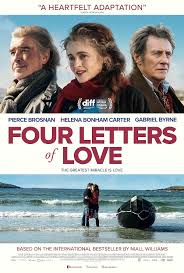
FOUR LETTERS OF LOVE
Ireland, 2024, 125 minutes, Colour.
Pierce Brosnan, Gabriel Byrne, Helena Bonham Carter, Fionn O'Shea, Donal Finn, Ann Skelly, Imelda May, Norma Sheehan, Pat Shortt,
Directed by Polly Steele.
There are some and written letters at the end of this Irish film but throughout, the four letters are literally L-O-V-E.
The screenplay is by the novelist, Niall Williams, from his 1997 novel which has been published in 20 countries. If the novel has had a following, this pleasing Irish tale could also build up a following.
The film is told from the point of view of the son of the central character, William, who, saying that he was inspired by God, suddenly got up from his desk job in his older age determined to go off to the Irish coast to paint. He is played very effectively by Pierce Brosnan, sympathetic, sometimes puzzling, obsessed with his quest for painting, strange treatment of his wife and difficulties in relating to his son, Nicholas (Fionn O’Shea).
In the meantime, the audience is introduced to a parallel story, a family on the West Coast, a poet-teacher, Muiris, a ruggedly convincing Gabriel Byrne, his busy wife, Margaret, Helena Bonham Carter, a cheerful son, Donal Finn, and an exuberant daughter still at school, Angela Skelly.
Each story has its intense drama and we know that they will eventually come together.
The film is Catholic in atmosphere, an amount of God language, a sad and sudden accident and impairment, the daughter sent to an ultra-strict convent school with grim-face severe nuns and happily running away, the local priest and ceremonies, and reflection on God, God’s seemingly harsh interventions, God’s will, but also miraculous interventions in our world.
While there are some scenes in Dublin, most of the action takes place in the Irish countryside and coast, ruggedly beautiful. The performances are fine, the screenplay bringing the two stories together dramatically – and with some pervading spirituality.
Throughout the significant performance is that of Fionn O’Shea as the son Nicholas, confiding his story, a creative young man, wanting to be a writer, not understanding his father, craving some kind of affection, wilfully going after him to the coast, and then encountering the poet’s family, being welcomed, finding a home, and, beset by an infatuation with the poet’s daughter, who, herself, has married a charming but feckless young man who had helped her when she was running away from the school.
There is the potential for tragedy as the girl’s mother, Margaret, does not approve of the love, does her best to curtail it, this very much involving the literal four written letters of love. But, as we hoped for, a move towards some resolution, reconciliations, greater understandings, and the triumph of pervading love.
- The international popularity of the novel? The novelist writing the screenplay?
- The Irish setting, late 20th century, Dublin, workplaces, homes, travel through the countryside, the West Coast, the cliffs and the beaches, the town, homes, school, churches? The boarding school with the sisters? The musical score, the Irish music, the contemporary songs?
- The two stories, their development, the characters, some interconnections, and the two stories coming together?
- The title, the actual letters at the end of the film, the emphasis on the four letters spelling the word, Love?
- The initial focus on William and his story, his age, his work, humdrum, a final store, change of heart, his seeing it as God-inspired, leaving, going home, his relationship with his wife, her dismay, the lack of relationship with his son? His leaving, packing, travelling to the West Coast, setting up, the painting? The accident, the water, the impact on the painting? It’s surviving, competition, a claim?
- William and his return, the drama with his wife, his son wanting some affection, his decision to follow his father? In the same bus as Isobel, going his way?
- The Core family, Murals and his teaching, poetry, blocks, creativity, Margaret, loyal, tense, concerned about her children, love for her husband? Shawn, his music, Isobel and her wireless, the sequence on the cliff, her daring standing on the edge, Sean and his music, his sudden collapse, the consequences for the family?
- Isabel, going off to school, travelling with her father, the severity of the nuns, her running away, the encounter with XXX, the time together, the enjoyment, her returning? His arrival, the full story about the funeral, her leaving, the sisters with a moment of compassion, her returning, her expulsion? Happy to be expelled? The consequences for her, with XXX, in love, the discussions with his mother, the decision to marry, the wedding? His inability to respond, the break?
- John, getting the painting, using it as a prize, Murals and his poem, winning, the painting in the house – that is only being revealed at the end, and as being symbolic of the whole story?
- Nicholas, being the narrator, the older Nicholas looking back, his comments on his father, his father’s life and work, his mother? His being taken in by the family, staying in the house? Becoming part of the household? Infatuation with Isabel?
- The religious dimensions of the film, William and his initial vision, the light on the paper, his drawing? The religious ceremonies, the Catholic background with the severe school? The parish, the ceremonies, funerals and weddings, the contribution of the priest? William and his reappearances, ghostly?
- Shawn, incapacitated, wheelchair-bound? His sudden cure, a divine intervention, standing up, recovering his voice, his mind, his music?
- Margaret and her not wanting Nicholas to marry Isabel? Isabel and the difficulties, her facing up to them, confronting her husband?
- Nicholas, writing the letters, poetic, giving them to Margaret Post, her going into the town, destroying the letters, her subterfuge is with Nicholas? Finding reading one, on the cliffs, her change of heart?
- The final happy ending, the four letters, the four letters of Love?
Curse of the Were Rabbit
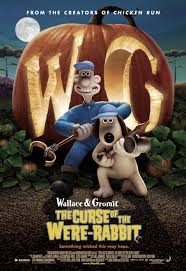
WALLACE AND GROMIT IN THE CURSE OF THE WERE-RABBIT
UK, 2005, 85 minutes, Colour.
Voices of Peter Sallis, Ralph Fiennes. Helena Bonham Carter, Liz Smith, Geraldine McEwan, Mark Gatiss.
Directed by Nick Park, Steve Box.
Wallace and Gromit have become British icons – and one of Britain’s best exports. Their creator, animator, Nick Park, brought them to the screen in 1989 in the Oscar-nominated A Grand Day Out. They won their Academy Award in 1993 with The Wrong Trousers and again in 1995 for A Close Shave. Wallace and Gromit were popular the world over.
Now they appear in their first feature-length film. And they have another success on their hands, topping the US Box Office on its opening weekend at the beginning of October. But the makers received bad news as well when the production studios in Bristol, the Aardman company, burnt to the ground the same weekend. While they lost decades of film history, many of the clay models were out on exhibition and were not destroyed.
The films themselves are indestructible. They have great appeal for both children’s audiences and for adults.
As the title indicates, the film is something of a spoof of horror movies. And that is a smart move. After all, so many horror stories have become classics of literature and cinema. Older audiences will have quite a lot of fun noticing the parallels with horror movies and the amusing send-ups. Of course, it starts with the play on werewolf. This time the monster is a gigantic rabbit who has an enormous appetite for vegetables. This is especially disastrous for the village because all the inhabitants are desperately tending extraordinarily sized pumpkins and gardens full of veg to win the competitions at the forthcoming fair. Gromit himself is growing a giant marrow. Wallace, of course, does not like vegetables at all. He loves cheese.
Wallace is an inventor (and we see quite a few of the inventions from the previous films as well as a machine for collecting rabbits out of lawns – a kind of giant vacuum cleaner – without injuring them). Not only does he now create a rabbit Frankenstein creature, trying to brainwash the rabbits to hate vegetables, he also becomes Dr Jekyll and creates his alter ego Mr Hyde.
When the going gets touch, the people turn on the rabbit just as they do in Son of Frankenstein – and there is the potential for a bride of the Were-Rabbit. But, when the rabbit is pursued, he seizes the lady of the manor and climbs a tower as did King Kong of old. Just when you thought, the writers might have run out of ideas, they set up Gromit like a British Snoopy and create an air battle modelled on World War I and the attack of the Red Baron. You see how inventive they have been.
The script is also funny and witty. In the middle of the chase, Gromit turns on the car radio and it is playing Bright Eyes, the theme from Watership Down! Some of the jokes have mild and amusing innuendo that will be lost on the smaller audiences.
Nick Park has done wonders with the clay characters, patiently working with stop-motion photography for years. It is extraordinary the expressions he can create – especially with Gromit who does not speak but whose facial gestures are worth a thousand words.
The voices are wonderful as well. Peter Sallis has been supplying the voice of Wallace for years and it would be hard to imagine Wallace without him. The villain of the piece, Victor Quartermain, a bounder who wants to marry Lady Tottington for her manor and money and hunt down rabbits with his rifle, is played by Ralph Fiennes sounding far more vigorous than in his films, a real moustachio-twirling performance. Lady Tottington is Helena Bonham Carter, more lively and funny than she has ever been as well.
Fans of Wallace and Gromit will also welcome the musical score with the familiar anthem from the previous films. The Curse will keep you smiling.
One Life
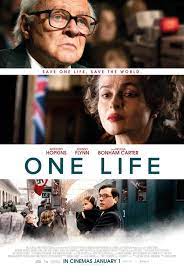
ONE LIFE
UK, 2023, 110 minutes, Colour.
Anthony Hopkins, Johnny Flynn, Helena Bonham Carter, Jonathan Pryce, Lena Olin, Romola Garai, Adrian Rawlins, Marthe Keller, Alex Sharp, Ziggy Heath, Samantha Spiro.
Directed by James Hawes.
There is great symbolism in the name of this film, British Nicholas Winton, one life and what he achieved. There is also the symbolism of anyone saving one life and that being an achievement.
In 2000 there was a popular documentary, narrated by Judi Dench, Oscar-winner for Best Documentary, Into The Arms of Strangers: Stories of the Kindertransport,, documenting a significant rescue of Jewish children from Czechoslovakia in 1938-1939. The children had been stranded, ousted by the Nazis after the occupation of the Sudetenland, many of their parents destined for the camps. A group of British helpers and locals, with the connections of Nicholas Winton, a young banker from London, getting the approval of the rabbi and the authorities, organising British passports for the children, adopting families and a financial deposit, were able to save 669 children on train journeys from prior to London. With the invasion of Poland September 1939, many children ready to move, but the program halted.
There were several other documentaries on Nicholas Winton and the children, especially the trilogy of films All My Loved Ones (1999), Nicholas Winton - The Power of Good (2002), Nicky's Family (2011) by Czechoslovakian (born in Bratislava, Slovakia), Matej Minak.
Here is a drama, rather than a documentary, based on the characters and events. And, as might be expected, the film is a very moving experience.
The framework of the screenplay is the 1980s, the older Nicholas Winton, retired, at home with his wife, expecting a grandchild, clearing the house and destroying some old documents, but finding a significant scrapbook of 1938-1939, photos of the children, newspaper articles, and Winton wanting it to find a significant home. In this he was aided by several authorities but especially by Robert Maxwell’s wife, articles, television programs.
And, of course, the strength of the film is in Anthony Hopkins’ screen presence and performance, Hopkins performing this role in his mid-80s. Veteran Swedish actress, Lena Olin, plays his wife.
Throughout the film there are strong flashbacks to what actually happened in Prague, versatile actor Johnny Flynn plays the younger Nicholas Winton, a concerned Britain, banker, friends in Prague, visiting, wanting to do something, the locals, including Romola Garai as Doreen and Alex Sharp as Trevor, are initially wary but all work together to identify the children, photograph them, list details, arrange with rather severe bureaucrats in London for passports, find adoptive parents, get financial deposits for the trip and the immediate settlement.
Nicholas Winton was helped by his German-born mother, very supportive and determined, especially in confronting authorities, a fine performance by a vigorous Helena Bonham Carter.
Audiences familiar with Nicholas Winton will have seen footage (available on YouTube) of the famous television program, reviewing Nicholas Winton’s life, where the compere asked anyone in the audience who had been helped by Winton to stand up. All those in the studio audience stood. A very moving moment at the time, and now in the film.
One Life is a reminder that there were so many in Europe who shielded and hid Jewish families, many who rescued them, and, as always, lest we forget.
- The story of Nicholas Winton and the rescue of the children from Czechoslovakia? Audience knowledge of Nicholas Winton, the documentaries about him and the transport children?
- A true story, the 1930s, the anticipation of World War II, anti-Semitism, Nazi expansion? The arrest of adult Jews, the children, stranded, their rescue by train? Adoption in England?
- The initial focus on the older Nicholas Winton, as played by Anthony Hopkins, the 1980s, his age, his marriage, children, home, retirement? The insertion of the flashbacks to 1938, Johnny Flynn as the younger Nicholas Winton, his mission and its achievement? The screenplay moving backwards and forwards in time, anchored in Anthony Hopkins’ strong screen presence, and Johnny Flynn’s persuasive performance, determination, hesitation, achievement in the past?
- 1938, Nicholas Winton, his strong-minded mother, German, coming to the UK with her husband, Jewish background? The changing of the name during World War I? A strong influence on her son? His role as a banker, conventionally British, of the time? Yet his concern, his friends in Czechoslovakia? His decision to go to Prague, the encounter with the group, the meeting with Doreen, her scepticism, Trevor, the local members, their concern, social action? The dangers? The imminent German invasion of the Sudetenland?
- Nicholas, his determination, his organisational skills, money and finance, raising donations, contacts in England? Working with the group, the visits of the rabbi, the Rabbi and his scepticism? Persuaded? Nicholas and his meeting the people, especially the children, their conditions, squalid, poverty, the parents, the wary father and then his change, fearing that Nicholas was a German authority? The range of photos, the young girls, their age, the little boys? Later sequences of Winton looking at the photos, wistful, remembering, regretful?
- The return to England, the character’s mother, her understanding, support, going to the officials, the issue of the passports, the hesitation of the bureaucrats? The personal appeal to the bureaucrat, his family, his agreement, supplying the passports?
- The organising of the children, getting all the details, the lists, the files, coordinating the train trips, the passports, organising the adopting families in England, and the financial deposit? The energy of the film in the sequences in showing the urgency, Nicholas and his mother, and those working in Prague, Doreen and Trevor, the locals?
- The scenes of the trains, the children, the farewells and grief, the hopes of the parents, arriving in England, the families, the allotments? Separation of families?
- The news of the invasion of Poland, the stopping of the program, the last train, the guards on the train and their treatment of the children, looking down on the adults accompanying them?
- The war, 669 children saved, the vast number unable to be transported?
- The 1980s, Nicholas and his wife, her fussing, wanting the house cleared, his throwing out rubbish, files, but the folder and the scrapbook, memories of Trevor? His going to visit the authorities, decisions for the scrapbook in museums? His wanting something more active? The connection with Robert Maxwell, going to see Lady Maxwell, her interest, the news items, reporting?
- The television program, Your Life, Nicholas vaguely watching it, his wife not liking the program? His being invited, the tracking down of some of the children and what happened to them in England? The program, his being in the front row, sitting next to one of the children, the reconciliation?
- The re-creation of the famous television program, Nicholas and his wife present, other two children next to him, the praise of his life, and the invitation to anyone in the audience who had a connection with the rescue children to stand up, everybody in the audience rising? The emotion?
- Prague, Doreen and Trevor, the information as to their surviving, subsequent work?
- The title of the film, saving long life, contributing to saving many lives?
