Displaying items by tag: Jonah Hauer King
House of Dynamite, A
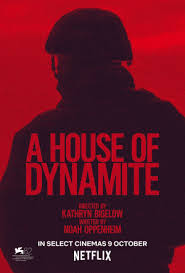
A HOUSE OF DYNAMITE
US, 2025, 119 minutes, Colour.
Idris Elba, Rebecca Ferguson, Gabriel Basso, Jared Harris, Tracy Letts, Anthony Ramos, Moses Ingram, Jonah Hauer-King, Greta Lee, Jason Clarke.
Directed by Kathryn Bigelow.
Highly explosive.
And, it is beyond highly explosive when there is a threat of nuclear destruction. And this is what A House of Dynamite dramatises, immersing the audience in the crisis, and asking the audience to decide what they would do, what decision they would make, in this world-grave situation.
Over the decades there have been quite a number of films about the nuclear threat. Several notable films emerged after the Russian-US confrontation in October 1962, the missiles of October. And the issue is dramatised in the many films and miniseries about JF Kennedy, especially 13 Days. In 1963-1964, there were Failsafe, Seven Days in May and the frighteningly satiric Dr Strangelove or; How I Learned to Stop Worrying and to Love The Bomb. There were a number of films in the early 80s in the same vein, Testament, The Day After.
But, here we are in the mid-2020s, Russian invasion of Ukraine, tensions with China, conflicts on the India-Pakistan border, Israel, Gaza and the Middle East, the bombing of Tehran…
This is an intense film, directed by Kathryn Bigelow who won an Oscar for her immersion in war, The Hurt Locker, then went on to the search for Osama bin Laden, Zero Dark Thirty. She brings the same tension to this film, giving a hypothetical scenario, the launching of a nuclear missile by an unknown attacker, threatening an American city, attempts to neutralise it, failures, a small window of time to ward off the attack, to make international contacts, diplomacy, the issue finally coming down to the decision of the American President.
The way that the drama heightens audience attention and anxiety is to introduce us to the wide range of officials in war departments, the White House, command posts in Alaska, crisis management groups in American cities, press briefings in Washington. Very quickly, the audience is introduced to, gets to know, sees in action, a wide range of experts, the pressure on them, intel coming in, changes in information, personal pressures, the demand for quick thinking, prudence, risk-taking, issues of responsibility and consequences.
In contact with Russian authorities, there is the powerful opinion of General Brody, Tracy Letts, strong hawkish stances. Important is the opinion of the Deputy National Security adviser played by Gabriel Basso, caught outside the White House, difficulties with connections, crowds, security getting into buildings, all the time having to make changing assessments as information comes in. His opinion is that the options for the president are national surrender or national suicide.
Just as the countdown is approaching, the screenplay goes back in time, the second part of the film focusing on the President, Idris Elba, enabling the audience to realise, even more fully, the responsibility of the President and his decision, personal cost, repercussions. And, memories of the version of Tom Clancy’s A Clear and Present Danger, the integrity and intelligence needed for the President with his finger on the nuclear button.
At each stage of nuclear fears over the decades, and the films dramatising the crises, audiences have been forced to focus very much on the strengths and weaknesses of incumbent presidents, Kennedy, Johnson, Reagan, George W. Bush – and, in 2025, Donald Trump.
A demanding film, an uncomfortable screen experience, and the film challenging each of us in the audience as to what decision, surrender or suicide, that we would make.
- Consciousness of the arms race, nuclear weapons proliferation, the danger of a nuclear attack? In the 21st-century?
- The dramatising of the possibility of such an attack? How plausible given 21st-century technology, surveillance, speed of reaction and information, possibilities for halting the attack?
- The screenplay, establishing the scenario of the attack, the situation in Alaska, the Armed Forces, their intelligence, their position near Russia? The recognition, communication? The officer in charge, his reaction, going outside into the snow? Contacting Washington? The role played during the attack?
- The screenplay and the narrative in Washington DC, the ordinariness of the day, Olivia Walker, at home, with her husband, depositions in Washington, going to headquarters? Her position, security issues, authorities, fellow workers? The significance of this room, security, the range of personnel, the backgrounds, personalities, interactions?
- The information about the attack, not identifying the source, the range of speculation? The film’s detailing the activities of each person, the responsibilities, their judgements, their personal reactions and the interplay for decisions?
- The connection with the various military personnel, shown in their situations, the Secretary for Defence, his location, personality, abilities, the connection with his daughter and contact with her, protecting her? On the move, his contact with the Deputy National Security Adviser? The adviser outside, the crowds, making his way to the office, phone calls, decisions, advice, security, entering the building? His being finally required to make an observation, Suicide or Surrender?
- The links with General Brady, his personality, staff, experience, at a distance, but surveillance connection? His hawkish attitudes? Listening for advice, following it, his assessment, the risk of defeat and humiliation?
- The failure to stop the missile? The visualising this on the screens? The repercussions for all concerned, disappointment, dismay, continuing planning? The uncertainty of the origins?
- The connection with the Russians, the disavowing the attack, the delays, the consultations, decisions and advice?
- The transition to the President, the screenplay going over the same time period, the activities of the President, his young Security Adviser in the car with him, the pressures on him, the social activities, everything genial, the crowds, the message, the president having to escape, the car, the advice?
- The personality of the president, his integrity, intelligence, capacity for decision-making, the range of the dilemmas presented to him, the personal repercussions for his wife and family, the nation, the advice of suicidal surrender?
- The screenplay not giving the final decision? Throwing it to the audience to empathise and identify with the situation, the decisions to be made, for the audience to make their decision and appreciate the basis for their decision?
I Know What You Did Last Summer/ 2025
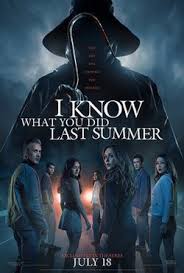
I KNOW WHAT YOU DID LAST SUMMER
US, 2025, 111 minutes, Colour.
Madelyn Cline, Chase Xui Wonders, Jonah Hauer-King, Tyriq Withers, Sarah Pidgeon, Billy Campbell, Sarah Michelle Gellar, Freddie Prinze Jr, Jennifer Love Hewitt, Gabrieltte, Austin Nichols.
Directed by Jennifer Kaytin Robinson.
in 1997 there was a very popular thriller, a group of young people involved in an accident, covering it up, but eventually targeted, with a Grim Reaper-disguised slasher pursuing them, a threatening note with the title of the film, I Know What You Did Last Summer, and a group of young stars becoming popular at the time, Freddie Prinze, Sarah Michelle Gellar, Jennifer Love Hewitt, Ryan Philippe, engaging the popular young audience of the time.
Almost 30 years later, the same title. Ironically, the production company is called Original Films. Not exactly! However we discover that this is not a remake. Rather, it is a sequel – and one of the characters stating that there were similarities to the events of 1997 and that the killer in this one decided to wreak vengeance by using the events and twists of the past as a “template” for this series of revenge killings.
While twentysomethings might immediately engage with the central characters as the film opens, a gathering, an engagement party, 4th of July, Southport North Carolina, fireworks, an older audience might find them often irritating, sometimes alienating. However, after the accidental death episode and the cowardly decision to cover it up, the film does get that much more interesting.
And, then the killer appears – or is shrouded like The Grim Reaper with metal sickle. The group covering up the accident and the death raise themes of irresponsibility, co-responsibility, fear, concealment, callousness. When two people not associated with the cover-up are killed, it seems skewiff However, after a while the culprits are attacked, a limited number of suspects, some gruesome fights and killings, some tension and sudden shocks.
Perhaps the young cast will have their moments in the future but their acting here is akin to soap opera styles. And this is particularly marked when some of the original cast turn up in their characters from 1997, Jennifer Love Hewitt, Freddie Prinze and, a device to introduce Sarah Michelle Gellar in her character from 1997 in a nightmare sequence for one of the targets.
When the main suspect, the local pastor, who has a connection with the person who was killed in the accident, is also disposed of, there is a certain curiosity or more of who is behind it all – and, some twists and a final revelation, probably not expected for most audiences.
Which means that this is a slash-thriller for younger audiences and tolerant older audiences.
