Displaying items by tag: Tilda Swinton
Problemista
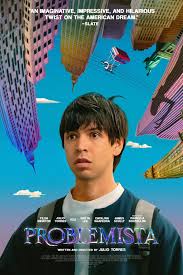
PROBLEMISTA
US, 2023, 105 minutes, Colour.
Julio Tores, Tilda Swinton, RZA, Isabella Rossellini, Catalina Saavedfa, James Scully, Greta Lee.
Directed by Julio Tores.
What is a problemista?
Writer, director, actor, Julio Tores, born in El Salvador, with his strong career in television background, popular in the US, dramatises an answer.
Anybody looking at the cast before watching the film will be quite surprised to find Tilda Swinton and Isabella Rossellini in the cast as well as rapper RZA.
Tores plays Aleyandro, dreaming of being an artist, to design toys, applying for a job with Hasbro, rejected, then connecting with a cryogenic company – and a mission to recover 13 paintings by an artist who is being frozen, the commission from his haughty wife, played by Tilda Swinton, another very different performance. (If one wanted to see a haughty woman, imperiously impatient, continually demanding, momentarily relenting, then Tilda Swinton’s performance is well worth catching.)
All kinds of problems and complications, a range of characters and undermining Aleyandro – but his support from his mother and a reassurance at the end that his dreams well worthwhile.
- Julio Tores, writing, acting, directing? His career and background?
- The title, the tone, creative word? Aleyandro and his life and career?
- The El Salvador background, Aleyandro and his mother, her fostering him, his art, the dream of the cave?
- The surrealist comedy? Realism and fantasy? American style, Latin American style?
- The New York locations, the apartments, business offices, the Freeze Corporation and cryogenics, the art world and galleries, the affluent world, immigration officers? The musical score? Aleyandro, as a child in El Salvador, the relationship with his mother, her fostering his art? The move to New York, his aim, toy design, the Hasbro models, his applications, internship?
- Bobby, the dead artist, the nature of his art, cryogenics, the large paintings, 13 eggs? Aleyandro and the accident and the freezing? 30 days to deporting?
- Elizabeth, Bobby’s wife, her character, sharp, demanding, angry, petulant behaviour? Aleyandro assisting her, planning the exhibition, his migrant status and no pay, subletting his room, Craigslist jobs?
- The character of Bingham, hostile, undermining Elizabeth? The quest for the paintings, finding 12 of the 13, Dalia, past student, Bobby’s affair with her, Elizabeth’s jealousy and harsh review, Aleyandro’s apologetic letter? Dalia giving the 13th painting?
- Disputes with Elizabeth, Aleyandro and the filing system, the bitter phone call and argument, the imagining the dragon in the fights at the cave? Demands for copies, the freight issues and expenses, Aleyandro and his sex work? And the Hasbro development of one of his toys?
- Paralegal, the immigration officer, the development of the show, the dragon dream and Elizabeth? On the cable car? Arriving late, all the paintings sold?
- Aleyandro, reconciliation with his mother?
- Elizabeth, the decision to be frozen, her giving him the name of the Hasbro exploiter of his invention?
- The transition to the future, or reunited, Aleyandro is an old man, his success as a toy designer?
Ballad of a Simple Player
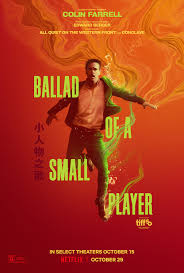
BALLAD OF A SMALL PLAYER
Germany/UK, 2025, 101 minutes, Colour.
Colin Farrell, Tilda Swinton, Fala Chen, Alex Jennings, Tony Lau.
Directed by Edward Berger.
The small player here is a gambler, an addict, a fraudster, conman, posing at times as an English Lord, upper British accent, affluent clothing style and yellow gloves, but, really, an ordinary Irishman. Whether this drama fits the description of the ballad is a significant question. There have been ballads about rogues in the past, about highwaymen, for instance, so here is a realistic/stylised telling the story of this life of the Lord who is just Riley.
The film has been written and directed by German Edward Berger. After a significant career in Germany, he achieved international success with his German Oscar-winning version of All Quiet on the Western Front. His next film was in Britain, his version of Robert Harris’s popular novel of the papacy, Conclave, also an award winner.
In comparison, this ballad is something of a small film.
The setting is Macau, described as the gambling capital of the world, with night light overview scenes that make it resemble an Oriental Las Vegas. While there are many scenes in the narrow streets with touches of poverty, some harsh apartments, and a visit to an island off Hong Kong with wooden houses on the water and wharfs, the overall emphasis is on the lavish, sometimes more than lavish, hotels and casinos, spaciously-appointed rooms, restaurants with expensive a la carte banquet meals, and the vast expanses of the gambling halls themselves. By the end of the film, the audience will feel that they have been immersed in this rather enclosed life of Macau.
And the Simple Player? He is played by Colin Farrell with a blend of quiet, intensity, guile, some moments of conscience, but…
We do hear his back story eventually, no integrity there, robbing a wealthy old woman and absconding to the gambling capitals and settling in Macau. He passes himself off as Lord Doyle, popular with the staffs until he is unable to pay his debts. We see him particularly unlucky at the baccarat table, trying to outdo a wealthy old lady. He doesn’t. Then an investigator arrives in the unexpectedly strange character, calling herself Betty, really Cynthia, another extraordinary variation in looks, hairstyle, manner of speaking, manner of walking, by Tilda Swinton. (And here a suggestion to wait until some sequences between them during the final credits.)
There is usually some sadness in the ballad. The sadness here focuses on a woman assisting at the tables, giving Riley credit, his following her and her helping him, inviting him to the island where she lives – and, perhaps ballad -like again, falling victim to his cunning and addiction.
Then back to the tables. Back to luxury, symbolised by some surprisingly gluttonous sequences by Riley, continually overreaching, an encounter with another British conman, Adrian (Alex Jennings), building up to 2 climaxes. The first is a $1 million bet at the baccarat table. The second is Riley wandering through the streets during a Chinese celebration and having to face up to reality, the reality which the Gospels long ago asked: what does it profit anyone to gain the world and lose their soul?
- The director, acclaim? The smaller scale film? International flavour?
- The Macau settings, the gambling capital, night sequences, day sequences, the overview of the city – Las Vegas -like? The hotels and interiors, the casinos and interiors, the streets? The ferries, to Hong Kong, the island and the sea, the houses on the water? The musical score, at times heavily orchestral, at times quiet?
- The title, the storytelling, the focus on the character, activities, fate, crises, decisions, a ballad? The inflated title of Lord Doyle? The reality of an Irishman called Riley?
- Issues of gambling, audience interest, sympathies, Macau, so much gambling, the vast casinos, the clientele, Asia, International? The baccarat tables? The gambling, the amounts of money, winnings, losing, debts, debts accumulating? Sympathy towards gambling and gamblers, addiction – or not?
- Colin Farrell, presence and performance, as Lord Doyle, British accent, manner, clothes, gloves, hotel, at the baccarat table, the old lady, the challenge, his losing? At the desk, the demand for payment, his excuses? The encouragement of the man at the door? The suggestion for the rainbow casino?
- The reality of Riley, the posing of Lord Doyle, the revelation of the stealing of the money from the old lady, her wealth, yet the vast amount, travelling, to Macau, his addiction, his behaviour in his room, extravagance, meals and drinking?
- The encounter with Cynthia Blythe, her name of Betty, her presence, Tilda Swinton’s presence and performance, hairdo, dress, shoes, idiosyncratic? Watching him, the selfir in the elevator? His pursuing her, the confrontation, the camera, the truth about her, her investigation, the company, her threats? His taking the camera, evading her? The deal, the money, the promise of the dance? His disappearance?
- The presence of Dao Ming? Charming, encouraging him, the money? His going to see her, following her, her apartment, the conversations, the later card about the island, his escaping to the island, her support of him, encouraging him to jump into the water, his waking on the wharf? Going to the house, the locked door, opening it, finding the money, putting it away, then stealing it all, returning to Macau? Carrying the bag’s?
- The sequences of Riley eating, gourmet, extravagant, likeness, being sick?
- The encounter with Adrian, the debt? Adrian and his personality, calm, the meal, the conversation, leaving Riley to pay?
- At the baccarat table, the old lady challenging him, his winning 7 nines in a row, everybody watching, his reputation? Paying off the debt at the hotel?
- The decision about the one-off game, risking all his money, Adrian and his disguise as a Prince, the tensions of the game, not winning immediately, Riley eventually winning?
- His talking with the old lady, wanting to find Dao Ming, the revelation of her suicide, lack of money, the background of her family in China? The impact on Riley, responsible for her death?
- In the celebration, the processions, Riley and his money, his decision to burn the money? Credible for his character? Credible for the theme of the film? And his future…?
Room Next Door, The
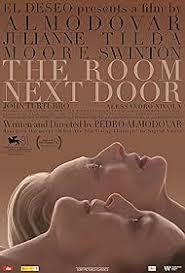
THE ROOM NEXT DOOR
Spain/US, 2024, 107 minutes, Colour.
Julianne Moore, Tilda Swinton, John Turturro, Alessandro Nivola, Juan Diego Botto, Roel Arevalo, Victoria Wingo, Alex Hogh Andersen.
Directed by Pedro Almodovar.
After directing two films in English, including The Human Voice with Tilda Swinton, Spain’s most celebrated contemporary director, Pedro Almodovar, has now made his first full-length film in English. It is based on an American novel by Sigrid Nunzi. It won the Golden Lion in Venice, 2024, for Best Film.
One of the difficulties for Almodovar aficionados in watching the film is adapting to hearing English rather than Spanish. There were some complaints that the English dialogue sounded somewhat stilted. Whatever the complaints, the important focus is on the actresses who deliver the lines and the intensity of their performances.
The film opens with Ingrid, Julianne Moore, signing copies of her new book, learning that her friend from the past, Martha, Tilda Swinton, is in hospital for treatment for terminal cancer. At first the film works as two friends meeting again, reminiscing about the past, especially for flashbacks to Martha’s teenage years, her encounter with Fred and his experience of the Vietnam war, the birth of their daughter, Michelle.
So far, so expected in a portrait of strong female friendship.
However, the narrative then veers into medical, ethical, moral and legal questions about assisted suicide.
Audiences will have a range of views on this topic. One might note that if all there is in this life on earth, then why cannot individuals take their lives at the time they decide. For those who believe in the afterlife, there are many moral questions. And, there is the status of assisted suicide and euthanasia in different parts of the world in terms of legislation and criminality.
All these issues come to the fore but always in the context of the friendship. Martha is a strong-minded woman, mistakes in the past, but finding her fulfilment in life as a war correspondent, celebrated, but completely alienated from her daughter, her daughter always wanting to know more about her father, Martha unable to fulfil her daughter’s wishes. With some failure in the experimental treatment she is undergoing, she decides that she will end her life, her own decision, her own time, buying a euthanasia pill on the dark web, a woman who wants to end her life with control and dignity.
And, the room next door? Martha rents spectacular mention in upper New York state, asking Ingrid to be with her, not participating in the suicide itself, but assisting in making the last days of Martha’s life days of content. Ingrid is quite emotional, hesitant at first, fearful of death itself, going along with Martha’s plans, but needing some kind of outlet, a sympathetic trainer at the gym, the reappearance of an old flame who has strong views on everything, John Turturro.
And, there is the plan for dealing with the police, denying knowledge, set answers, legal support. There is an unsympathetic police investigation by Alessandro Nivola.
Almodovar wants the audience to appreciate the issue, the emotions, the moral issues, personal responsibility and independence.
However, for the average audience, while this important issue is dramatised on screen, the setting is affluent, very affluent, American society, healthcare and drugs available, the comforts of wealth and a mansion to die in, not the ordinary experience of most moviegoers, an important issue but in another world of which they will never be part.
And, as expected, the final scenes will leave the audience confirmed in beliefs about assisted suicide or challenged ethically, legally, morally.
- The films of Pedro Almodovar, his Spanish sensibility, his films over the decades, continuing his themes, the focus on women, the focus on sexuality, homosexuality, the Catholic church, religion? Now in English language, in the US context? And the theme of death?
- The New York settings, the book signing, apartments, hospitals, restaurants? The New York State countryside, Woodstock, the mansion, interiors, the gym, restaurants? The musical score?
- The first part of the film and the friendship between the two women? The strong presence of Tilda Swinton and Julianne Moore? Working together? Establishing Ingrid as an author, the art world, writing for magazines, the success, apprehensions about death? Encountering stellar, the news of Martha’s illness? Visiting Martha, the past friendship, working together, Martha and her work correspondence (and the flashbacks, the dangers, with the photographer, encountering the two Carmelites), her relationship with her daughter, the flashbacks to the scenes with Fred, the Vietnam war, PSD, the night together, his leaving, marrying, the fire and his death? Martha and the alienation from a daughter, her daughters questioning about her father?
- Martha and the flashbacks to the war, the discussions with the photographer,
- Martha, Almodovar’s themes of sexuality, homosexuality, the two Carmelites, the relationship, the discussion about war, vows, sexuality in the context of war and destruction?
- Her illness, the diagnosis, the medical staff, the experiments, partial success, ultimately not successful, to continue with the procedures or not? The issue of death, planning her death, the pill from the dark web, her plan?
- Ingrid, her own story, memories of Damien, Damien and his relationship with Martha, the renewed friendship with Martha, talking, listening, sharing? The proposal about assisting at the suicide? Martha saying she had asked others, appreciating Ingrid’s apprehensions about death?
- Ingrid, her dilemma, emotional response, values response, moral and ethical response, legal issues? Are pondering, the decision?
- Martha, the renting of the mansion, comfortable, the plan for the room next door, Ingrid choosing the downstairs room? And packing, settling in, the time together, further reminiscences? Martha and her strong determination cop the time of her own choice, not wanting to compromise Ingrid legally, the plan for the police? Her leaving the letter for Ingrid, the letter for the police?
- Martha, the emotional effect, coping and not, going to the gym, the sympathetic trainer, unable to hug, but her feeling hardened? The encounter with Damien, the conversations, his offer of legal help?
- The signal for the door to be open or shut, Ingrid seeing the door shut, her grief, and discovering the wind had blown the door shut? Her going out, the time with Damien, Martha deciding that this was the time, setting everything up, going out to sit peacefully, her death?
- Ingrid discovering her, grief, the letter, contacting Damien, the interrogation by the police, the officer and his faith and strip perspective, not believing Ingrid? The lawyer coming, planning to file a complaint against the officer?
- Damien, the past, relationships, sexuality, with Martha, with Ingrid, his talk, no questions, his philosophy, doom, the end of the world? The legal support for Ingrid?
- Leaving Ingrid with the emotional experience, the legal experience, her own values? And the audience response, depending on their attitude towards an afterlife or no afterlife, the right to end life, emotional, legal, ethical and moral perspectives for decisions?
