Displaying items by tag: Tim Van Someren
Othello/ 2026
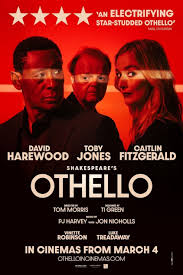
OTHELLO
UK, 2026, 165 minutes, Colour.
David Harewood, Toby Jones, Caitlin FitzGerald, Vinette Robinson, Luke Treadway, Tom Byrne, Peter Guinness, Rose Riley.
Directed by Tom Morris, Tim Van Someran.
In theatre history, Othello stands with Shakespeare’s King Lear, Hamlet, Macbeth, as the four great tragedies. There have been many film versions including Orson Welles, Laurence Olivier, Anthony Hopkins, Laurence Fishburne, David Oyewolo… and very interesting portrayals of Iago, Michael McLemore, Bob Hoskins, Frank Finlay, and, especially, Kenneth Branagh.
For centuries, this play has been acclaimed as Othello’s downfall, the downfall of a great man, victim of a character flaw, in Othello’s case, susceptibility, especially to jealousy.
Looking at this filmed theatre piece, emphasis on dialogue and performance rather than setting and staging, it looks and sounds now far more like the Tragedy of Desdemona, the woman, victim of domestic violence, victim of Othello’s jealousy and rage, wounded pride, Desdemona is misunderstood, undervalued. But this is also the tragedy of Emilia, again a forthright character, being deceived and used by her malicious husband, Iago.
This version emphasises the unsubtle character Othello. David Harewood has a strong presence, deep baritone, poise as a general but this gradually disintegrating as he is deceived by Iago. He is the straightforward, successful soldier taking Iago for granted, then his exuberantly joyful acceptance of love from Desdemona.
This Iago of Toby Jones (unlike the interiorly devious Kenneth Branagh in the 1995 version) is military, ambitious, thwarted, racist, going step by step on his destructive path, not really interiorising his ploys, but taking advantage of a situation as it comes, not so much a well-thought-out plan, but capably exploiting each opportunity as it arises.
Desdemona is a strong-minded woman, her own woman, forthright, loving, in no way suspicious, equal to Othello, taken aback by his jealousy, loving but defiant to the end. This is a very strong performance by Caitlin FitzGerald (though her sometimes noticeable American accent is a distraction). Desdemona is an ideal contemporary woman but still one who is a victim of-taken-for-granted masculine superiority which becomes, in tragic fact, misogynistic murder.
And, in the latter part of the play, Emilia, a fine strong performance from Vinette Robinson, becomes a vigorously fearless facer of facts, who speaks out in Desdemona’s defence, shaming Othello, defying Iago. But she is also a victim of fatally masculine violence. Toby Jones’ interpretation of Iago is inherently misogynistic towards both Desdemona and Emilia, as well as denigrating Bianca (who is also used by the otherwise charming Cassio).
Using some perspectives from the psychology of Carl Jung, this interpretation of Othello and Iago is that they are military men in war and in the alleged peace times, direct, living in the present, using their own logic and seriously deficient in awareness of possibilities in life and relationships – or becoming trapped in the deadly conspiracies – jealousy for Othello, ambition, position and status for Iago.
In the 21st century, the title can be Desdemona.
Macbeth/2025
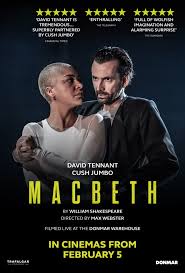
MACBETH
UK, 2025, 114 minutes, Colour.
David Tennant, Cush Jumbo, Cal MacAninch, Noof Ousellam, Moyo Akande, Casper Knopf, Jatinder Singh Randhawa, Rona Morison, Brian James O'Sullivan, Ros Watt, Benny Young
Directed by Max Webster; Capture directed by Tim Van Someren.
For just over 400 years, Shakespeare’s Macbeth, The Scottish Play, has been regularly performed. And, there have been several film versions including those by Orson Welles, Roman Polanski, filmed stage versions with Kenneth Branagh, Ralph Fiennes, and the basic plot being used for several gangster films like Joe Macbeth and Geoffrey Wright’s version updated to Melbourne.
In the last decade there have been Justin Kurzel’s version with Michael Fassbender and Marion Cotillard as well as Joel Coen’s version with Denzel Washington and Frances McDormand.
But, here is Macbeth with a Scottish accent. And a number of the other characters as well. And it is a striking performance, especially with his accent, by popular film and television star, David Tennant. At the outset, he makes Macbeth’s character his own and doesn’t let go. Sometimes, Lady Macbeth seems to dominate in interpretations. However, here she is played by Cush Jumbo, strongly intense but never dominating Macbeth himself.
The rest of the cast is an ensemble, often standing in a row at the back of the stage, then emerging and taking on quite a range of characters. And there is a racial mix in the cast as well as two actresses taking on male characters, especially Ross and Malcolm. And amongst the ensemble are musicians playing on stage.
And, considering the stage, it is a white square, surrounded on three sides by the audience (wearing headphones so that they hear the Shakespearean language well and extraneous sounds are excluded). At times there can be some props carried on stage including the weapons. And, at the end, behind the stage there is a colourful nature panorama. The minimalist staging of the play works particularly well, making demands on the imagination of the audience.
But, one might say the triumph of this version is the decision to use close-ups throughout the film, bringing the audience so close to Macbeth himself, to Lady Macbeth in her scheming as well as in her guilty madness, to all the characters. But, best of all is the decision to have Macbeth, David Tennant, frequently in close-up, looking and speaking straight into camera, intense, confiding in us the audience, trying to make us complicit in his decisions, in his regrets, in his ruthlessness, in his ultimate disillusionment.
This certainly makes this version of Macbeth worth seeing, brief, running under two hours, on the move, intense for performers and for the audience.
This version has another special surprise. Often the Porter sequence is omitted.
It is intended are some comic atmosphere/relief before the full tragedy descends on us. In this version, the director has decided to do some stand-up comedy, touches of broad appeal, the comedian as the Porter, Jatinder Singh Randhawa, engaging with the audience, asking about their headphones, joking but eventually moving into the Shakespeare text. Quite a memorable interlude.
The director of the play is Max Webster, significant in the UK his creative work. However, there has to be a credit for the director for the “Capture” of the play for the screen, Tim Van Someren. His use of the close-ups has been praised, and, often, the camera looking straight down on stage and characters, keeping the camera moving for the action, a sense of stillness for the soliloquies and the reflections.
This version of Macbeth reminds us of the richness of Shakespeare’s language and the quotations we remember, the political complexities of the plot, the psychology of the downfall of an ambitious man and his supportive wife – there can be many more versions.
