Displaying items by tag: Ayo Edebiri
Opus

OPUS
US, 2025, 104 minutes, Colour.
Ayo Edebiri, John Malkovich, Juliette Lewis, Murray Bartlett, Melissa Chambers, Tony Hale, Stephanie Suganami, Amber Midthunder.
Directed by Mark Anthony Green.
Although it was chosen to screen and the Sundance Festival, Opus received fairly negative critical reviews and failed at the box office.
However, if you want something interesting that is not always predictable, with some themes inviting reflection, you could do worse than see Opus. (This review is in favour.)
At first we are taken into the contemporary media world, press and magazines stories, radio and television, the world of music and entertainment. And the central character is Ariel, played by a Ayo Edibiri, a lively and versatile young performer, award-winning for her role in the TV series, Bear, but also very in films, after the Hunt, Ella McCay. She is young, ambitious, wanting to do research, write stories. Her rather jovial insensitively ambitious boss is played by Murray Bartlett.
There is a lot of talk in the film about a singer and media star of the 1990s, Alfred Moretti, who has been absent from the limelight for 30 years. Suddenly, he sends an invitation for the launching of a new album, Ariel specifically included in the invitation.
And, then, transition to the deserts of Utah and a remote, rather lavish, mansion and site, the home of Moretti.
One of the great advantages of this film is the fact that John Malkovich plays Alfred Moretti, not what we might expect of a star of the 90s but he soon convinces us with his smooth talk, storytelling, charm, eccentricities, then his actually singing and his eccentric dance movements and visual and suggestive imagery. And, John Malkovich can do it (and he could even do variations on his persona in the 1999 Being John Malkovich).
But, the welcoming scene is overdone, lavish, and Ariel and ourselves noticing so many people on the property, dressed uniformly in blue, children and adults, education, workplaces – and then the word is mentioned, “cult”. If this sounds an intriguing mixture, it is.
All guests, including Juliette Lewis as a television host, are treated with great hospitality, exotic meals, their host singing with intriguing lyrics, their all being fitted out with new wardrobes. But, then the move towards some dramatic violence.
The sinister aspects of the cult soon emerge, and Ariel trying to escape, trapped, getting loose – and Moretti making a speech with all his followers standing with champagne flutes (and audiences who remember the mass suicide in Jonestown will be thinking of that). And they drink.
But, that is not exactly how the film ends – some more intriguing characterisation, the fate of Moretti, Ariel having success with a bestseller about her experiences, and the suggestion that the atmosphere of cults with charismatic leaders and power over their followers is still among us.
- The life and work of Alfred Moretti? His career, retirement, his commitment to the Level?
- The world of the media, print, radio, television, New York, offices? The journey through the Utah desert? The centre, the buildings, the grounds, interiors? Costumes and decor?
- The range of songs, the lyrics, dramatising the musical style and performance of Alfred Moretti? And the sinister aspects of the cult?
- The focus on Ariel, age 27, skill in writing, wanting to be a journalist, stories, interactions with Stan, his gentle demeanour, but wanting to do the writing with her notes, taking credit?
- The reputation of Alfred Moretti, his career in the 1990s, evocative, provocative, lyrics, visual imagery, movement and gestures? After 30 years? The prospect of a return?
- Invitation, Ariel, the discussions with her friend, anxious for a career? His urging her to create perspective? her being invited, joining the group, Stan, Clara and her past relationship media, Bianca, paparazza, Emily, The influences, Bill and the media, interviews, previous clashes with Moretti? The personalities, eager to be associated with Moretti? The plane, the welcome, the lavish treatment, the travel on the bus, the instructions, through the desert, the arrival? The fans outside, the touch of the fanatic?
- John Malkovich as Moretti, an idiosyncratic personality, the charm, sinister aspects, his speeches, jokes, his songs and performance, the welcome to the guests, renewing old acquaintances? His speech, the dinner, talking with Ariel, her questions? The emergence of the current atmosphere, the people of all ages, education, work, craft? Concierges and guards? Jorg and his story at the meal, telling her real? The others with their personal stories?
- The Level, Levellers, the philosophy behind the cult, religion, achievement, talent, democracy, the emergence of those who are talented, brands and intelligence? Moretti and his leadership, the episode with the oysters and the searching for the pearls?
- Ariel and her experience, the concierge on guard, the bubblegum sounds, listening to the song in the room, the screens and surveillance, everybody listening to the song? Ariel, going jogging, running through the compound, all the encounters? And the discussions with Moretti?
- Bill, the massage, his talk, his being killed, the body in the way, Ariel and her fear not noticing it?
- The day proceeding, Emily and her disappearance, the later appearance in the cushion, the diagnosis, her face, contortions, her death? The tour, Stand being shot with the arrow, the boys apology? Ariel and becoming more suspicious?
- The gathering, the performance of the song, eccentric, mannerisms, the lyrics? Moretti and his reaction, the press conference, asking the question, Ariel and her knowledge of Julius Caesar and her answers? The appearance of Emily? Clara and her wig, being pulled? Stan and his being stabbed? Ariel, disturbing Moretti, her escape?
- Ariel, trying to escape, wanting to leave, the sinister attacks on her, the little girl and her friendship, the puppet show, the rats and the critique of Billie holiday?
- Ariel, in the attic, the concierge coming through the window, her being captured, bound with Clara? The sympathetic member, cutting her bonds, information about her escape? The fire?
- Her running, the pursuit, climbing the fence, the fan outside (the previous scenes of the fans and their posters), Ariel taking his car?
- Two years later, the flashback to the police arriving, the members of the cult drinking the champagne, assumptions that it was like Jonestown, the revelation that they were going throughout the world, permeating all kinds of jobs for the Level to overcome? Moretti in jail?
- Ariel, the publication of the book, her success, visiting Moretti in jail, his admitting the murders, his manipulating her to write the book and publicise him?
- The TV interview, the interviewer wearing the Level pearls… And the future?
Ella McCay
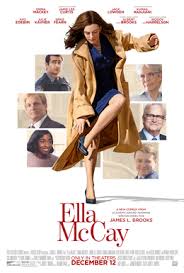
ELLA McCAY
US, 2025, 115 minutes, Colour.
Emma Mackey, Jamie Lee Curtis, Albert Brooks, Julie Kavner, Woody Harrelson, Kumail Nanjiani, Spike Fearn, Ayo Edebiri, Jack Lowden, Rebecca Hall.
Directed by James L. Brooks.
In many ways an old-fashioned film, with an appeal to older audiences or those who like their entertainment as variations on familiar social themes and relationships. It was written and directed by James L. Brooks, released as he turned 86. He has had a long career, originally on television (writing and producing hundreds of episodes of The Mary Tyler Moore Show, Lou Grant, Taxi) and then producing almost 800 episodes of The Simpsons.
Ella McCay is reminiscent of his award-winning and multi-nominated films, Terms of Endearment, Broadcast News, As Good as it Gets.
While the film opens with the central character in her teens during the 1990s, the main action takes place in 2008. Ella McCay is, in fact, at age 34, the Lieutenant Governor of her state, a determined woman, idealistic (and one blogger suggested, interestingly, that she may be neuro-divergent). When the governor, played by veteran Albert Brooks (star of Broadcast News) is appointed to a presidential position, she becomes Governor.
But Ella (Emma Mackey, who could pass as the sister of Anne Hathaway and Margot Robbie) has had a difficult childhood, seen in the flashbacks, her patiently loving mother (Rebecca Hall), her seemingly carefree, womanising father (Woody Harrelson), her psychologically damaged brother (Spike Fearn) but relying on her devoted and very forthright aunt (Jamie Lee Curtis stealing every scene when she appears). Her mother dies. She loses contact with her father, unable to forgive him.
One of the enjoyable features of the film is the narration by Ella’s assistant, Estelle. She is played by Julie Kavner – and Simpsons’ audiences will immediately hear her and remember that she has been the voice of Marge Simpson for those hundreds of episodes.
Most of the action takes place over the couple of days in which she assumes the role of Governor, potential for her social benefits plans which alienate opposition, which are often too overwhelming for her own party, full of great intentions.
Then, behind-the-scenes, serious dealing with her seemingly agoraphobic brother, the arrival of her father who wants reconciliation, the audience discovering that she is married, her high school sweetheart (Jack Lowden) and some relational consequences some of which test her as well as audience tolerance. And, then there is the press, government protocols, potential scandals, political exploitation…
James L. Brooks, throughout his career, has been a man of optimism, hopeful endings. And audiences with social consciences will be strongly in favour.
However, the ending would have been in the spirit of the Obama and Biden administrations. The achievement that Ella McCay accomplishes in social outreach to those in need and which audiences enjoying the consequences the film would have been the immediate target of Elon Musk and his DOGE cutbacks, and the staff for these operations would have been immediately the target of minimising diversity in US public works. Ella McCay is not the kind of film that would be supported by the MAGA movement.
- The films of James L. Brooks, family relationships, political issues, 20th century popular styles? For the 21st-century?, Comedy, screwball touches?
- The picture liberal USA, politics, social concern, released in the first year of the second Trump administration, the contrast?
- The style of the film, introduction, flashbacks, the strong cast? The musical score?
- Introduction to Ella, Lieutenant Governor, age, experience, ambitions? Relationship with Bill, the genial governor, his promotion, prepared, her succeeding him?
- The flashbacks, and her brother as children, the sadness of her mother, the philandering of her father, the boy withdrawn, Ella unforgiving, the move, and her staying with aunt Helen, aunt Helen’s criticism of her brother, her growing up cared for by Helen? Encouraging her? And Helen’s forthright character, expressing herself?
- The action taking place over several days, Bill, his personality, getting his position, talking with Ella, the social issues, his not being supportive, his warning about others reactions to her? The announcement, her meeting the press, her response to the press?
- The situation with her husband, the flashbacks, her high school sweetheart, the courtship, Helen’s disapproval, his staying the night, at the window, chasing him, the confrontation with Ella, the truth? His personality, his mother and ambitions, the marriage, Helen talking to him, his declaration? The marriage, the issue of the government room, the sexual relationship and regulations, the issue of the journalist, his telling the journalist, paying off the journalist?
- And her husband, his ambitions, surveying the room, his expectations, building up to the confrontation with Ella, upset, urged on by his mother, conference, his lying about the cheque, the effect on Ella, talk of the divorce, his anger?
- Ella, her concern about her brother, agoraphobic, age, personality, job, memories of Susan, the drugs and stimuli, Ella confronting him, the drugs, staying with him, the issue of his father and the emails, upset?
- The announcement, her speech, the notes from Bill, her not mentioning her husband?
- Ella, her driver, the conversations, his support of her, taking her to her brother, his partner, financial issues, the overtime, Ella upset, taking responsibility for their overtime? Apologies?
- Her brother, Susan, the past, getting in touch, the visit, the conversations, her stances, the kiss, going out for the meal, his future?
- Ella and her father, the sadness of her mother’s death, the years of separation, his arrival, his psychologist girlfriend, wanting him to reconcile, to get his children’s forgiveness, with Helen, his meeting with Ella, their discussions? The final confrontation, her inability to forgive him?
- Estelle, her voice-over, her personality, devotion to Ella, the work in the office, shielding her, advising, confronting her husband? Her character?
- Ella, her working with her team, the long meetings, members going to sleep, the aims of her legislation?
- The press conference, the truth, the response of the journalists, literally falling over themselves, her being knocked down, the concern? The support of Helen? Decisions to be taken, her strong stands? Bill and his advice, the discussions with the party leadership, her personality, the deals, finding a solution?
- The success of her legislation, social concern, success? (And images of 2025 in contrast with the first year of the Trump administration?)
After the Hunt
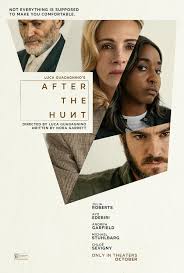
AFTER THE HUNT
US/Italy, 2025, 138 minutes, Colour.
Julia Roberts, Ayo Edebiri, Andrew Garfield, Michael Stuhlbarg, Chloe Sevigny.
Directed by Luca Guadagnino.
We can puzzle about the title. And the nature of the hunt. And the aftermath.
There are several senses and themes, honesty, integrity, issues of sexual assault in the aftermath of the #Me Too movement. And, for the aftermath, there is a very long, still scene, silent, at the end of the film, giving the audience time to think, perhaps to adjust judgements. And, there is an aftermath postscript, five years later.
To appreciate After the Hunt, it is important to ask who the target audience for the film actually is. It is certainly not the general audience looking for entertainment. Most would be bored, sometimes baffled, especially with the discussions and vocabulary – even when spoken by such a star as the popular Julia Roberts. After all, this is a drama set at the Ivy League university range of Yale. In the background is professional eagerness to achieve tenure and the academic and personal perils of losing it. There are tutorials that sound recondite and abstruse, theses on theories in the abstract.
And the cast of characters is strongly in this vein, difficult to like, let alone identify with even in a crisis of accusations of sexual assault which, if not true this time, probably true at another time, a focus on the presumptuous male. Then the victim, young, from a highly privileged generation, very self-conscious, drawing conclusions from the fact that she is black, queer, her parents huge donors to Yale, the staff feeling obliged to promote her, issues of genuine study and accusations of plagiarism. She is played by Ayo Edebiri (from television’s The Bear). The accused is a lecturer, also seeking tenure, played by Andrew Garfield.
In fact, at the centre is Alma, Julia Roberts’ character, a tough surface, brittle manner, intellectual, complex emotions in the present situation, confidante of the accuser, but also going back into her past memories and crises. Her husband is a psychoanalyst, played by Michael Stuhlbarg, provides an anchor for the audience, loving support of his wife but also critical and prone to act out this criticism, like playing booming music to upset her as she wakes each morning, or interrupting her during a serious conversation.
So, the faculty and discussions, board meetings, the student counsellor (Chloe Sevigny) and issues of confidentiality. Luca Guadagnino has directed challenging issues in films for 20 years, best known for Call Me by Your Name and Challengers. There is definitely emotional complexity (especially the revelation of hidden secrets and guilt) but couched in cerebral interchanges and arguments.
When the film was screened at the Venice film Festival, there were 50% love responses, 50% haste responses… And there is like and dislike 50% each way for this reviewer.
- The title? The actual hunt? The aftermath?
- The Yale setting, the reputation of Yale, the Ivy League, wealthy students, wealthy donors, board and management, the philosophy faculty? University sequences, home sequences, street and restaurants…? The range of the musical score? Pounding, quiet, background?
- Target audience, not the popular audience, the philosophy faculty, the philosophical discussions and issues, language and vocabulary, the tutorials and the discussions? Abstract?
- The introduction to the main cast, the University, the tutorials, Alma and the students, the discussions, their personalities? Maggie and her presence? The party, Alma and Frederic getting ready, their guests, Hank, Maggie? The immediate impressions of each, Alma, her age, Julia Roberts, more brittle personality, emotions and control? The issue of tenure? Hank, personality, lecturing, the issue of tenure? Maggie, her age, black, queer, her parents and donations, her thesis, praise, the underlying issue of plagiarism? Frederick, the host, his relationship with his wife, psychoanalysis, contribution to the discussions?
- The aftermath, Hank and drinking, escorting Maggie? Maggie approaching Alma, the accusation? Maggie’s reaction? Her relationship to Hank, memories of the past, his reputation with women? Her reaction to Maggie, the issue of plagiarism? The effect on Alma? Her relationship with Frederick, his support, the loud music in the morning, the issue of inviting Maggie to dinner? Her delay, Frederick and his reaction, Alma and Maggie talking, the loud music, his coming in and out?
- The authorities, the faculty, the discussions, with Alma, the Counsellor doctor, her presence, discussions with Alma, confidentiality? The like and dislike between them? Ultimate decisions? Hank, the issue of tenure, his being fired after the accusations? Alma and the tenuous situation?
- Alma, the discussions with Frederick, the revelation about her past, the seduction, her cooperation, age 15, the man, her devotion, the break, her accusation, his suicide? The consequences for her, immediate, over the decades?
- The encounter with Hank, his plea, the attraction, the kiss, her rejection?
- Maggie, her background, her family, the thesis, the plagiarism, sense of privilege, the issue being queer, her partner and explanations, being black? Her determination, the accusations, the case?
- Alma and the later tutorial, the students, the abuse, her responses, the silent student?
- Audience identifying or not with the characters, the issues? Judgement on Hank, judgement on Maggie? Alma and Frederic, the discussion – and the very long take, allowing the audience time to consider?
- Five years later, Maggie, still at the University, the meeting with Maggie, the discussions, Maggie and her career, her attitudes towards Alma, letting retribution go, not quite reconciliation? Alma and Frederic together? The future?
