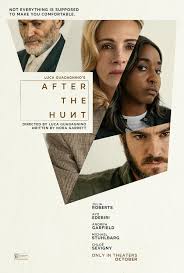
AFTER THE HUNT
US/Italy, 2025, 138 minutes, Colour.
Julia Roberts, Ayo Edebiri, Andrew Garfield, Michael Stuhlbarg, Chloe Sevigny.
Directed by Luca Guadagnino.
We can puzzle about the title. And the nature of the hunt. And the aftermath.
There are several senses and themes, honesty, integrity, issues of sexual assault in the aftermath of the #Me Too movement. And, for the aftermath, there is a very long, still scene, silent, at the end of the film, giving the audience time to think, perhaps to adjust judgements. And, there is an aftermath postscript, five years later.
To appreciate After the Hunt, it is important to ask who the target audience for the film actually is. It is certainly not the general audience looking for entertainment. Most would be bored, sometimes baffled, especially with the discussions and vocabulary – even when spoken by such a star as the popular Julia Roberts. After all, this is a drama set at the Ivy League university range of Yale. In the background is professional eagerness to achieve tenure and the academic and personal perils of losing it. There are tutorials that sound recondite and abstruse, theses on theories in the abstract.
And the cast of characters is strongly in this vein, difficult to like, let alone identify with even in a crisis of accusations of sexual assault which, if not true this time, probably true at another time, a focus on the presumptuous male. Then the victim, young, from a highly privileged generation, very self-conscious, drawing conclusions from the fact that she is black, queer, her parents huge donors to Yale, the staff feeling obliged to promote her, issues of genuine study and accusations of plagiarism. She is played by Ayo Edebiri (from television’s The Bear). The accused is a lecturer, also seeking tenure, played by Andrew Garfield.
In fact, at the centre is Alma, Julia Roberts’ character, a tough surface, brittle manner, intellectual, complex emotions in the present situation, confidante of the accuser, but also going back into her past memories and crises. Her husband is a psychoanalyst, played by Michael Stuhlbarg, provides an anchor for the audience, loving support of his wife but also critical and prone to act out this criticism, like playing booming music to upset her as she wakes each morning, or interrupting her during a serious conversation.
So, the faculty and discussions, board meetings, the student counsellor (Chloe Sevigny) and issues of confidentiality. Luca Guadagnino has directed challenging issues in films for 20 years, best known for Call Me by Your Name and Challengers. There is definitely emotional complexity (especially the revelation of hidden secrets and guilt) but couched in cerebral interchanges and arguments.
When the film was screened at the Venice film Festival, there were 50% love responses, 50% haste responses… And there is like and dislike 50% each way for this reviewer.
- The title? The actual hunt? The aftermath?
- The Yale setting, the reputation of Yale, the Ivy League, wealthy students, wealthy donors, board and management, the philosophy faculty? University sequences, home sequences, street and restaurants…? The range of the musical score? Pounding, quiet, background?
- Target audience, not the popular audience, the philosophy faculty, the philosophical discussions and issues, language and vocabulary, the tutorials and the discussions? Abstract?
- The introduction to the main cast, the University, the tutorials, Alma and the students, the discussions, their personalities? Maggie and her presence? The party, Alma and Frederic getting ready, their guests, Hank, Maggie? The immediate impressions of each, Alma, her age, Julia Roberts, more brittle personality, emotions and control? The issue of tenure? Hank, personality, lecturing, the issue of tenure? Maggie, her age, black, queer, her parents and donations, her thesis, praise, the underlying issue of plagiarism? Frederick, the host, his relationship with his wife, psychoanalysis, contribution to the discussions?
- The aftermath, Hank and drinking, escorting Maggie? Maggie approaching Alma, the accusation? Maggie’s reaction? Her relationship to Hank, memories of the past, his reputation with women? Her reaction to Maggie, the issue of plagiarism? The effect on Alma? Her relationship with Frederick, his support, the loud music in the morning, the issue of inviting Maggie to dinner? Her delay, Frederick and his reaction, Alma and Maggie talking, the loud music, his coming in and out?
- The authorities, the faculty, the discussions, with Alma, the Counsellor doctor, her presence, discussions with Alma, confidentiality? The like and dislike between them? Ultimate decisions? Hank, the issue of tenure, his being fired after the accusations? Alma and the tenuous situation?
- Alma, the discussions with Frederick, the revelation about her past, the seduction, her cooperation, age 15, the man, her devotion, the break, her accusation, his suicide? The consequences for her, immediate, over the decades?
- The encounter with Hank, his plea, the attraction, the kiss, her rejection?
- Maggie, her background, her family, the thesis, the plagiarism, sense of privilege, the issue being queer, her partner and explanations, being black? Her determination, the accusations, the case?
- Alma and the later tutorial, the students, the abuse, her responses, the silent student?
- Audience identifying or not with the characters, the issues? Judgement on Hank, judgement on Maggie? Alma and Frederic, the discussion – and the very long take, allowing the audience time to consider?
- Five years later, Maggie, still at the University, the meeting with Maggie, the discussions, Maggie and her career, her attitudes towards Alma, letting retribution go, not quite reconciliation? Alma and Frederic together? The future?
