Displaying items by tag: Clifton Collins Jr
Train Dreams
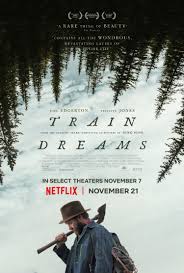
TRAIN DREAMS
US, 2025, 102 minutes, Colour.
Joel Edgerton, Felicity Jones, William H.Macy, Clifton Collins Jr, Alfred Hsing, Paul Schneider, Nathanial Arcand, John Diehl. Narrated by Will Patton.
Directed by Clint Bentley.
Here is an impressive piece of Americana. It is based on an award-winning novella of the same name by Dennis Johnson, 2011. It has been written and directed by Clint Bentley, with his collaborator, Greg Kweder, who were Oscar-nominated for the screenplay for the recent Sing Sing.
This is a film about a very ordinary American, Robert Granier, birth to death, from the 1880s to the 1960s, an extraordinary span of change. In most ways, Robert Granier could be considered to have lived what might be called “an unremarkable life”. As a boy, not knowing who his parents were, sent to live in a small town, accepted, growing up there, ordinary jobs around the town, the years passing, nothing particularly much happening.
By the time he is 30, he is working as a logger, chopping the trees, sawing them, out on locations, the railways, laying tracks, building bridges, but just one of the group of similar men, most rather introspective, the silent types, dedicated to their work.
Robert Granier is played by Australian Joel Edgerton, a fine performance, and because of his not being conversational, the film has a frequent voice-over, by actor Will Patton, who is able to articulate what the quiet Robert cannot: his ordinary life and work, encounters with his fellow workers, surprise at the prejudice against the Chinese and shock when the workers throw one of the Chinese over a bridge, later feeling guilt about this occasion, and, on a return home, encountering Gladys, Felicity Jones, at church, she initiating the friendship which leads to marriage, the building of a house, the birth of their daughter, joy for them both, but a surprising joy for Robert.
The film moves at a measured pace, offering the audience a lot of time for reflection, opportunities for a ruminative response, even offering moments that could lead to meditation on life and its meaning. And, there are the dreams, Robert’s happy dreams, after a destructive fire unhappy dreams and hauntings.
Out in the forests, there are some interesting characters, especially William H Macy as Arn, an explosives expert, friendly, chatty, a sad death but an influence on Robert.
There is some hope for Robert later in his life, an encounter with a nurse from World War I, Kerry Condon, who is billeted at one of those towers built to observe and prepare for wildfires. And, finally, after living in his house without any amenities for so many decades, he ventures into the city, the 1960s, space exploration – and the offer of a ride in a small plane, to see the world from a bird’s point of view, but an exhilarating experience which brings back, visually on the screen for the audience, his images and memories, the people who were influential in his life, reminding him and us of his unremarkable but humanely ordinary life.
- Popularity and awards of the original novella? The adaptation close to the spirit of the novella?
- A piece of Americana, in the 19th century into the 20th, into the 1960s? From birth to death? A life lived, well-lived? The transition from the 1880s to the 1960s, the title and the symbolism of the railroads, branching out, travelling communication and, at the same time, the destruction of forests, the laying of tracks, building bridges? The train dreams of the development of the United States?
- The photography, the forests, the railroads? The trees, the loggers work? The house and building it, the interiors? The various camps? The visits to the town? The photography of the fire? Going to the lookout? The later visits in the 20th century? The atmospheric and meditative score?
- The use of the narration, the tone of the voice-over, the voice-over important because of the silence of Robert?
- The range of dreams, Robert’s imagination, subconscious surfacing, happy memories, nightmare memories, imaginative fantasies about his wife and daughter?
- Robert’s story, from the 1880s to the 1960s? His background, scenes as a boy, no knowledge of his parents, living in the town, growing up? A silent boy, introverted? Growing up, work, moving to logging, the logging community, the experience of prejudice against the Chinese, the man thrown over the bridge, the effect on Robert and his consciousness, conscience? Going to church, Gladys and her approach, their keeping company, her saying it was a marriage and they need a ceremony to ratify it, life together, the birth of the baby, the joy of the baby, the details of life at home? His coming home in the happy reunions?
- The details of Robert’s life, seemingly unremarkable but ordinary, his quiet, reflections? The friendships amongst the loggers? The preacher and his story, the pursuer arriving and shooting him? African-American? Arn, his age, explosives expert, the failure, success, his friendship with Robert, the conversations, the tree hitting him, affecting his mind, his death, the burial and the words?
- Returning home, the train rides, the fire, its intensity, the burning of the house? Robert returning, loss, grief?
- Robert, at home, gradual rebuilding, life alone, the years passing? The encounter with Billy, getting old, his loss of memory, thinking Arn was still alive? And Robert getting older?
- His work, the carriage and horses, carrying the goods? His quiet life, the encounter with a large bear? The dogs becoming part of his life?
- Clare, giving her the lift, her job, nurse during the war, the death of her husband? Friendship, conversation, shared wisdom? Her work, the tower, and the view from the tower?
- The years passing, Robert’s simple life, none of the amenities and technical developments of the 20th century? The decision to go to Spokane, the 1960s, space exploration, the man calling out to take him into the air, the realm of the birds? His going on the flight, the experience, some transcendence in his life?
- In the flight, the opportunity for the images of his life to recur, the range of people in his life, the sadness and happiness in his unremarkable life? And his death?
BoondockSaints,2, The: All Saints Day
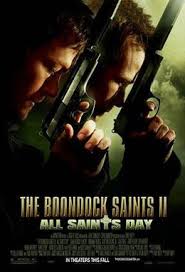
THE BOONDOCK SAINTS: ALL SAINTS DAY
US, 2009, 118 minutes, Colour.
Sean Patrick Flanery, Norman Reedus, Billy Connolly, Clifton Collins Jr, Julie Benz, Peter Fonda.
Directed by Troy Duffy.
This sequel definitely presupposes audience knowledge of the first film. In 1999, the original focused on gang warfare in Boston, details of the Boston Mafia and the Italian culture, criminals as well as on the McManus family, and the Irish Mafia.
In both films, the McManus twins, very much a product of Irish Boston, son of a killer, and exercising vigilante violence against their enemies, were played by Sean Patrick Flanery and Norman Reedus. And the father is played by veteran Billy Connolly.
While there is a very different opening for this sequel, the rest of the action when the brothers return from Ireland to Boston is very much in the vein of the first film, the picture of the various branches of the Italian Mafia and their crimes, internecine violence, Judd Nelson appearing as one of the leaders.
There is a setup involving the death of a priest in Boston, a hired killer but the murder set up as imitating the style of the McManus twins. This is a situation to draw the brothers who have been working on farms, to come back – and, on the boat on the way, they encounter part of the Mexican Mafia in the form of Clifton Collins Jr and his Mexican connections. He becomes part of their team.
The McManus family has a priest cousin in Boston who comes to Ireland to inform them about the murder. At the end of the film, when he gives some kind of refuge to the FBI Agent who oversteps the bounds of the law, played by Julie Benz, he is seen to be in connection with the detective from the first film, played by William Dafoe, whose death has been faked and who is still living quietly but with influence on combating crime in Boston.
Many of the scenes are quite over the top in terms of violence, glee of the brothers and their Mexican ally in the violence, the FBI agent at her toughness and rivalry and then collaboration with the detectives who were working with the brothers 10 years earlier.
The crass language of the dialogue is incessant, may be taken for granted by the characters portrayed, but much of it too much and too constant for the audience. And, it might be noted, that there are a lot of verbal attacks on enemies using homophobic slurs, something which pervades the attitudes of the McManus family.
During the film, there are flashbacks to the history of Noah McManus, a young man, diffident, witness to murders, changing in his attitude, becoming a killer himself, and eventually living remotely on a farm in Ireland, Billy Connolly. However, as the plot progresses, it is revealed that his past friend and then enemy, deadly enemy, Louis, is now nicknamed The Roman and has engineered the situation, the murder of the priest, to lure Noah back to the United States and confront him.
There was to be a third episode and the Wikipedia entry is a detailed history of the on-again – off-again progress of this project.
Bricklayer, The
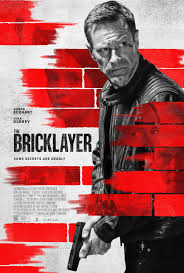
THE BRICKLAYER
US, 2023, 110 minutes, Colour.
Aaron Eckhart, Nina Dobrev, Clifton Collins Jr, Tim Blake Nelson, Oliver Trevino, Ilfenesh Hadera.
Directed by Renny Harlin.
This action thriller is based on the novel by former Marine and FBI agent for 20 years, Paul Lindsay, writing under the name of Noah Boyd. The screenplay has changed the agency from the FBI to the CIA.
Renny Harlin has made action thrillers for several decades, especially Die Hard 2. There is quite a mixed quality to his work. The action sequences are very strong – even though Aaron Eckhart is the hero, bricklayer, agent, is able to defeat all kinds of tough opponents, though in one sequence succumbing to just one of them! However, Eckhart is strong and tough in the role.
The villain is seen at the opening, Clifton Collins Jr, a disaffected agent, turning Road, wanting to expose the CIA and its many tentacles in Western cultures, secret assassinations…
The central character is a very prim, first, agent played by Nina Dobrev who accompanies the bricklayer to Greece where the action takes place. Quite a number of complications, assassination of journals, a political assassination attempt, a final confrontation between hero and villain despite a bonding in the past.
Tim Blake Nelson is the CIA boss.
More or less as expected.
- The title? The cover for the CIA agent? His explanation of his liking the work, precision, well fitting?
- The CIA, action throughout the world? Attitudes Western countries? Covert operations? Assassinations and targeting? Reactions?
- The realism of the screenplay? Or far-fetched?
- The opening, the journalist, Victor Radek, his purpose, her reporting, the photos and or sitter? Shooting her? The next journalist on the list? The group politician on the list? His making a case, disrepute of the CIA?
- The introduction to Steve Vail, Philadelphia, working on the building, the bricks, precision? Contact O’Malley? The meeting with Kate? The explanation of the situation? His decision to go to Greece, with Kate?
- The subtext of Miles Davis, music, records, the gift from Victor Radek, Tye with the collection of records, indication of her guilt?
- Kate, her CIA work, the office, re-examining the photos, discovering Radek?
- The flight, the interactions between the two, her self-importance, professional, his attitudes, Frieda? The arrival, posing as husband and wife, the hotel, the range of surveilance? Going to meet Patricio, his skills, the vehicle, IT and tech?
- She’s three, to the social, meeting with Tye, the past relationship, the discussions, her being bureau chief? The later encounters with her, at the apartment, the music?
- The attack on the journalist and the square, the protesters, Constantine and his speeches, Radek and his communication with Vail, motivations, memories, the death of his family? The decoy and Vail following, the shooting? The escape, the pursuit, talking with Radek?
- Vail and his visiting the club, the thug and his respectability, the fights? The credibility of Vail and his ability to conquer so many attackers? Yet in the office, his being overcome? The dangers for Kate, her involvement, with the vehicles? And the use of tracking devices?
- Vail, the memories and flashbacks with Radek, his family, his job is with the CIA, the promised to transfer his family, the Russians, the killing his family? Vail, the deal with Radek that he could disappear?
- The car chase, Radek’s escape, with the camera on the building, male or knocking it, the assassination attempt failing? Konstantin and his change of attitude, rescued by the CIA?
- Final confrontations, Radek’s death, the suspicions about O’Malley, the vast transfer of the bid calling? Vail and his suspicions, going to Tye, the confrontation, her death?
- The end, the interview with Kate and O’Malley, his being upset about suspicions, offer of promotion to Kate, her refusal? And Vail going back to his bricklaying?
