Displaying items by tag: Guy Middleton
Champagne Charlie
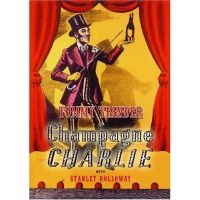
CHAMPAGNE CHARLIE
A, 1944, 75 minutes, Black-and-white.
Tommy Trinder, Stanley Holloway, Betty Warren, Jean Kent, Robert Wyndham, Guy Middleton, Austin Trevor.
Directed by Cavalcanti/Albert Cavalcanti.
Tommy Trinder was a popular entertainer, singer, especially on stage, radio and some films. Here he stars as a musical singer of the 1860s, George Leybourne, composer of a number of popular songs of the time, especially Champagne Charlie and The Daring Young Man on the Flying Trapeze.
This film appeared in 1944, during World War II, appealing to public spirit, the popular songs of the 19th century, the music halls – some morale boosting during the war. It was directed by the Brazilian born director, Albert Cavalcantiy, who moved to Europe, to England, working on documentaries and then a number of feature films including Dead of Night.
Featuring alongside Tommy Trinder is veteran singer Stanley Holloway (20 years before he immortalised Alfred Dolittle in My Fair Lady).
Trinder plays a miner coming to London with his brother who wants to become a fighter but whose lungs have prevented this because of his work in the mines. His brother, however, is a success as a singer, catching the eye of the manager of the theatre, Bessie, played by Betty Warren, who has an attractive young daughter, dancer, played by Jean Kent. She is being courted by a young upper-class gentleman.
The singer is persuaded to change his name to George Leybourne, success, Trinder bringing alive the songs (some of which written by screenwriters for the film, a range of songs emphasising different kinds of alcohol). He comes to the attention of a rival singer, well-established, played by Stanley Holloway. There is rivalry between them, especially in the range of songs on alcohol, each trying to better the other in performance and popular response. Ultimately, one challenges the other to a duel, neither prepared for it, doing some training with pistols, and a farcical encounter.
At the time, it would seem that the musicals were under threat from the theatres, complaints about drawing audiences away from theatre. The father of the young gentleman courting Bessie’s daughter is in charge of the commission – and, it is revealed that he was courting Bessie back in the past, his father intervening against lower class wedding, his now repeating it for his son. There are hearings about musicals with the two singers and Bessie giving evidence. Ultimately, the Lord comes to visit the theatre music hlal and is welcomed by everyone – and, happy ending all round.
George Leybourne’s song, Champagne Charlie was so popular that he was nicknamed with it.
A film from England’s past, the war years – but, for those interested in old-fashioned rollicking stories and, especially, the musical songs and the invitation to join in, a pleasing entertainment.
Man About the House, A
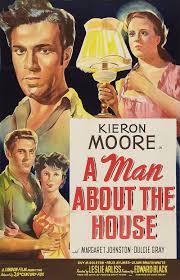
A MAN ABOUT THE HOUSE
UK, 1947, 99 minutes, Black-and-white.
Margaret Johnston, Dulcie Gray, Kieron Moore, Guy Middleton, Felix Aylmer.
Directed by Lesley Arliss.
A rather low-key melodrama based on a popular novel of the time by Francis Brett Young. This was the period in British cinema of Great Expectations, Black Narcissus. But there were also quite a number of colourful melodramas, sometimes based in Italy as was this one.
Two unmarried sisters run a school in London but receive a bequest from an uncle, a substantial income each year as well as a home in Italy, outside Naples. The sisters are played by Margaret Johnston (Australian-born, stage actress, in films from the 40s to 1968) and Dulcie Gray, with a long career in films. Introduced here is the Irish actor Kieron Moore, retiring from films in 1974, notable for his performances from Vronski with Vivien Leigh in the 1948 Anna Karenina. Guy Middleton and Felix Aylmer were regulars in many British films and these decades.
The film opens in a rather prim London, transfers to Italy, the older sister being very reserved and arrogant, the younger sister more enthusiastic. They encounter Salvatore, the manager of the estate. The older sister gradually mellows and falls in love, the younger sister observing but then falling in love with a doctor who visits. Salvatore is the life of the community, but the audience will at some stage begin to be suspicious, this confirmed, as he is poisoning his wife, resentful that his family which owned the estate has been taken over by the English.
A melodramatic and artificially staged fight between Salvatore and the doctor, the older sister recovering and never knowing her husband’s plans.
Certainly not to the taste and style of the 21st-century audience. Rather, more interesting as an example of British filmmaking in the postwar period.
Never Look Back
NEVER LOOK BACK
UK, 1952, 73 minutes, Black-and-white.
Rosamund John, Hugh Sinclair, Guy Middleton, Henry Edwards, Terrence Longden, Brenda de Banzie.
Directed by Francis Searle.
A brief second feature from 1952, a curio item for those interested in the British film industry in the late 1940s, early 1950s. And it has a cast of British character actors, including an early appearance by Brenda tde Banzie and an uncredited appearance by Harry H.Corbett as the guard in the prison.
This is a film about lawyers and crime, raising ethical issues, about a defence lawyer having personal issues with the man she is defending.
Rosamund John plays a lawyer who has become a KC, celebrates with another lawyer who is in love with her, Hugh Sinclair. However, she is committed to her career. She is sent congratulatory flowers and remembers a man she had fallen in love with in Italy years earlier. He then arrives, evokes memories of the past, says he has fallen on hard times and she offers him the couch for the night, knowing that it might risk her reputation.
The visitor has mentioned his girlfriend and, the next morning, she is found dead. He is arrested. The lawyer decides to defend him against the advice of her partner and his father. And the circumstances mean that her friend lawyer is to be the prosecutor.
Much of the second part of the film is in the court, the interrogation of witnesses, the defendant clearly moving towards a guilty verdict, especially when a woman of dubious reputation, played by Brenda de Banzie, testifies that she saw the defendant at the time of the death, his lawyer interrogating the witnesses to try to find extenuating circumstances. When it seems that he will be guilty, the defendant causes a tantrum in the courtroom, appealing to the lawyer to defend him. She resigns, later going to the witness box and admitting the truth.
Found not guilty, there is confrontation between the defendant and the prosecutor, and the clear indications that the murderer had set up the situation, to have an alibi when he went out to kill his girlfriend.
The moral issues and legal issues are set out clearly – but, with a rather sudden happy ending.
