Displaying items by tag: Aubrey Dullin
Nouvelle Vague
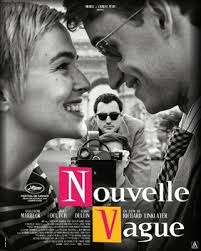
NOUVELLE VAGUE
France/US, 2025, 106 minutes, Black-and-white.
Guillaume Marbeck, Zoe Deutch, Aubry Dullin, Adrien Rouyard, Antoine Besson, Bruno Dreyfyrst, Benjamin Clery.
Directed by Richard Linklater.
1959. A quiet1950s was about to end. The revolutions of the 1960s were about to begin.
It was an outstanding period for French cinema. France already had at the first public cinema screenings, then a great tradition of directors, writers, performers. But, in the mid-50s, a group of young cineastes contributed to the magazine, Cahiers du Cinema. They knew film. They loved analysing film in all its aspects. They became noted critics. But, many of them had a great yen to get behind the camera, not only to write, but to direct. They were symbolic of the New Wave, the Nouvelle Vague.
In many ways, this is their initial story. The screenplay highlights three names, François Truffaut, Claude Chabrol and, the subject of this film, Jean-Luc Godard. Truffaut is seen having a great triumph at the Cannes Festival with The 400 Blows. Claude Chabrol was beginning a long career especially with crime thrillers. And, Godard was edgy, dissatisfied with not having directed, all kinds of ideas but lacking the means to put them into action.
This is the story of the key production in Paris in 1959 which was released under the title A Bout de Souffle, best known from its English title, Breathless.
American director, Richard Linklater, obviously has a passionate admiration for the French New Wave. Right throughout the film, well known and not so well-known cinema figures are named when they appear on screen, celebrated directors like Robert Bresson and Eric Rohmer, stars like Juliette Greco, cinematographer, Raoul Coutard. And, where possible he has employed lookalike actors for the central characters. He has chosen actors cannily resembling Truffaut, Chabrol and Godard, dark glasses and cigarettes. And, for the star of the film, Jean-Paul Belmondo, almost exact replica in Aubry Dullin. The other star of the film was the American, Jean Seberg, and Zoe Deutch certainly brings Seberg to life and a marvellous resemblance.
Godard is a driven creator, great faith in himself, easily able to disregard the pressures of the producer, the feelings of his stars, inventive in his camera style, wanting spontaneity, not writing screenplays in advance, capitalising on the moment. He is presented as something of an egotistic genius – and, Breathless and his subsequent career show that he was not entirely wrong! (Godard died in 2021, at the age of 91, 138 directing credits, certain writing credits – a career of six decades.)
This film also offers a marvellous opportunity to observe the process of filmmaking, the role of the writer and director, the choices by cinematographer and collaboration with the creative artists and his camera/cameras. We appreciate the location photography, stunt work, the many takes, the pressures on the cast, issues of make up, black-and-white photography, and the moods and whims of Godard as a decides to film, take a break, suddenly end filming for the day…
While the film shows a genial Belmondo and his collaboration with Godard, the portrait of Jean Seeberg is more complex, at the beginning her career, her success with St Joan and clashes with Otto Preminger, her coming to France, reacting to the situation, some immediate alienation from Godard’s ideas and processes, but sticking with it. (Recently Kristin Stewart starred as the actress in Seberg; however that portrait film begins after the completion of Breathless and tracks FBI interest in her life and career and political implications.)
Probably Nouvelle Vague has limited interests for the general public – but it is an opportunity for those who love cinema, for those aspiring to work in cinema, for those who remember the films from the era to have a film experience worth relishing.
- The title and expectations, audience knowledge of the Nouvelle Vague, French cinema, 1950s, Cahiers du Cinema, critical background, intellectual background, cinema technical background?
- Richard Linklater making this French film? The French screenwriters, his American perspective, admiration for the Nouvelle Vague?
- The decision for black-and-white photography, the parallels with the cinematography for Breathless? The audience sharing the experience of cinematography, 1959?
- The significant characters in this period, the directors, Truffaut, Chabrol, Godard? The choice of actors who physically resemble them? The range of other characters, their names coming up on screen to identify them? Directors, Robert Bresson at work, actors, producers, cinematographers, agents…? A sense of documentary realism along with this creative fiction?
- 1959, François Truffaut and the success of The 400 Blows at Cannes? His influence, friendship with Godard, Godard going to Cannes for the event? Chabrol and his thrillers? Eric Rohmer and other directors?
- The focus on Godard, his previous career, age, wanting to direct, his theories, his philosophies, wanting spontaneity, activity, with cameras, with the cinematographer, hand-held, concealed, moving in the streets, the cast? The producers – and his clashes?
- The choice of the topic, influence of Truffaut, Jean-Paul Belmondo, the actor physically resenting him, the choice of Jean Seberg and the actor resembling her?
- Jean Seberg, her career, St Joan, Preminger, husband, manager, come to Paris, the encounters with God guard, finding him difficult, the interactions, the style of filming, wanting spontaneity, no screenplay? Seberg, American, personality, film star, in Paris, with the press?
- The scenes of shooting the film, Godard erratic, time of, early closure, days off, his moods. discussing the ideas, Belmondo and his collaboration? The discussions with Raoul Coutard and his expertise as cinematographer, blending with Godard? Close-ups, dialogue, the kisses, the action in the street, the gangster sequences…?
- The effect on Godard, the touch of narcissism, perfectionism, spontaneity, ideas, relentless, clashes with the producer?
- Ultimately completing the film, Belmondo’s long run through the fields, prospects, the new style? The impact of the final sequence and the close-up?
- The final information, the careers of Truffaut and Chabrol, Belmondo and his success, Seberg and her career, the importance of Breathless and its influence on filmmaking, Godard himself and a 60 year career?
