Displaying items by tag: Peter Malone's Movie Reviews
Lesbian Space Princess
LESBIAN SPACE PRINCESS
Australia, 2024, 87 minutes, Colour.
Voices of: Shabana Azeez, Mark Samual, Gemma Chua-Tran, Brodan Kelly, Jordan Raskopoulos, Richard Roxburgh, Zachary Ruane.
Directed by Emma Hough Hobbs, Leela Varghese.
Certainly a different and forthright title.
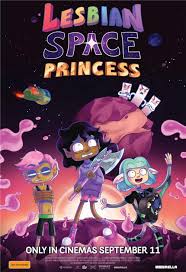
An Australian animated film, 2-D, bright colours, exaggerated, comically styled, with music, plenty of ambiguous humour, and, in the film as well for a quest, a flagship for queer comedy. Clearly, a great deal of enjoyment for the gay and lesbian community – and it can be seen as a cheeky challenge to those who are wary and to those who do not approve.
There is a great deal of voice talent in the various female characters, and, in the humour of the group of four, the White Straight Maliens, all looking like Casper the friendly ghost, continuous oddball debating between themselves, often very funny when they appear.
However, the central character is Saira, considered the dullest Princess in the galaxy, reserved, awkward, difficulty in relationships, encountering some musicians, but, finally, going in quest to rescue Kika from her captivity by the Maliens, with her swagger, almost the opposite of Saira.
So, a range of oddball characters, adventures in space, a personalised ship with the voice of Richard Roxburgh, combat, disappointments, self-assertion, happy ending.
The film won the long-standing Teddy Award for LGBTQI+ films at the 2025 Berlin film Festival.
Honey, Don't
HONEY, DON'T
US, 2025, 89 minutes, Colour.
Margaret Qualley, Aubrey Plaza, Chris Evans, Charlie Day.
Directed by Ethan Coen.
Back in the day, as they say, Hollywood used to churn out brief, B-budget, action melodramas, often as supports to the main feature. One of the words used to describe these shows was “hard-boiled”.
Which comes to mind as we watch Honey, Don’t. It has been co-written by director, Ethan Coen, with his wife, Trisha Cooke. It is a follow-up to their similar hard boiler, Drive Away Dolls – and a third film in this trilogy has been planned. Ethan Coen, with his brother Joel, The Coen Brothers, built up an enormous reputation over 30 years with a great variety of entertaining films. Directing separately now, Joel went on to make his version of Macbeth with Denzel Washington and his wife, Frances McDormand. Ethan, on the other hand, has gone in the direction that was foreshadowed by their very entertaining, Fargo.
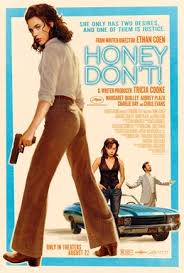
Honey of the title is Margaret Qualley (who starred in the previous film). She is a private eye out in the California desert area of Bakersfield. She is tough. She is single-minded. She is tall. She walks with a very self-confident and stylish sashay. She meets her clients, very direct in discussions, investigates. In her private life, she has lesbian relationships, especially with a policewoman played by Aubrey Plaza.
The film opens with a mysterious death, a car accident – not! Of course – a mysterious woman stealing a ring from the body of a dead woman… The dead woman had the day before contacted Honey for an appointment. Honey is now investigating.
There are a lot of eccentric supporting characters around Bakersfield, in the bar, the shops, and Charlie Day at the police headquarters forever trying to chat Honey up and make a date, seemingly oblivious of her reality.
But, some of the leads point to an evangelical church in the town and its pastor, played by Chris Evans. Over the years and with some revelations, some of the pastors have been exposed as double or triple standards in their behaviour, rousing up their congregations with vigorous holy exhortations, making their congregations dependent on them, and, privately, sexual predators. And Chris Evans, formerly Captain America, makes the Rev Drew Devlin, one of the sleaziest of all pastors, with his sermons on the importance of submission and then exercising overmastering with fragile members of the community.
Ethan Coen and Trisha Cooke have written what seems often a slapdash screenplay, and that seems to be something that they intended, memories of the past, small budget, eccentric characters, strange episodes, leaving the impact to the audience the supply some of the connections. For once, the screenplay and the film could have actually been longer – especially for a comeuppance of the Rev Drew Devlin.
Idiosyncratic as we watch, and Margaret Qualley commands the screen.
Man with No Past
MAN WITH NO PAST
US, 2025, 102 minutes, Colour.
Adam Woodward, Jon Voight, Marton Csokas, Charlotte Vega, Philip Winchester, Charlotte Weston, Jeff Alexander.
Directed by James Bamford.
A thriller with a difference – but whether it will appeal to audiences is another question.
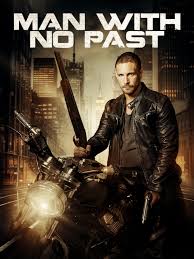
Adam Woodward plays a man was lost his memory, wakes up in a hotel, is taken in by the proprietress and becomes friends with her daughter. There are local troubles, a wealthy entrepreneur wanting to build in the district, protests against the project, and a sinister character who is an advisor to the entrepreneur but has a group of folks at his disposal. His name is Soach = chaos in reverse!
While this is something of an expected narrative for the present, the hero, Ryder, involved in the exposure of the project, there are three flashbacks in which all the characters reappear in different guises.
There is World War II, 1943, the entrepreneur now a military leader with his sinister adviser, the rounding up of patriots, their executions and Ryder confronting the authorities. There is also a return to the 16th century, and the atmosphere of witchcraft and persecutions. And, it is back to the Roman Empire with a variation on the same scenario, dangers, the Emperor, his advisers, the women in variations on the theme and Ryder as the hero.
Of particular interest for film buffs, Jon Voight is the entrepreneur as well as the authoritarian figure in the flashbacks. And, expertly sinister, Marton Chokas is chaos personified, malevolence personified.
- The title, the focus on Ryder? The present, the various sequences in the past?
- Science psychological fiction, possibility, credibility?
- The present, filmed in Bulgaria, the city views, the bar, high-rise, executive offices? Neighbourhoods and slums? The World War II setting? The Roman setting? The mediaeval English setting? The musical score?
- Setting the tone, 1943, Nazi occupation, the commander, his adviser, his henchmen, the troops, the hostages, the plea, the executions? The two sisters? Ryder, his immersion, destruction of the Germans? The return to the sequence? The commander more sympathetic, the subordinates and their business?
- The present, Ryder awakening, not knowing who he was, the accommodation, going to the bar, the encounter with Stella, with Morgan, at home, accommodation? The psychological experiences, going back to back into the past? The constant presence, the commander, the Iago-like adviser, the ruthless henchman?
- The Roman setting, gladiator, combat, the Emperor returning thumbs up? The English section, the Middle Ages, the defence of the poor?
- The issue in the present, the businessman, building the city, owning the land, his advisers? Soach, the opposite of chaos? Iago-like? His presence, sinister, appearance, in each age, having the ear of the controller, his own agenda, commanding Jack? The plans, the abduction of the businessman’s daughter? Setting it in motion, the range of foot soldiers, Ryder included? Businessman and his wife? The plans?
- The businessman, his calling off the abduction? Ryder, his reaction, the foot soldiers and their shooting, Ryder killing them all? The wounding of the businessman? The final encounter with Jack? The buildup to the final encounter with Soach?
- The background at the bar, Morgan, her friendship, her reappearing in the past, the young girl, the businessman’s daughter and the threats, Stella, stepping in in each past scenario, friendly, supportive of Ryder? The romance?
- Ryder, his death, the funeral, the body in the coffin, the women and the businessman present, Morgan turning around, Ryder dead, smiling – and into his future?
Ragazzo dai pantaloni rosa, Il/ The Boy with Pink Pants
IL RAGAZZO DAI PANTALONI ROSA/ THE BOY WITH PINK PANTS
Italy, 2024, 114 minutes, Colour.
Samuele Carrino, Sara Ciocca. Andrea Arru, Claudia Pandolfi.
Directed by Margherita Ferri.
It is something of a surprise to hear that this film was the most successful Italian film at the Italian box office of 2024. But, it is a significant film, well worth seeing and reflecting on.
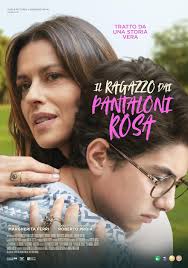
This is the story of a young boy, Andrea Spazzacatena, his family, his loving mother, continually absent father, younger brother. He is successful at school, rather quiet in his way, musical talent, intelligent, love of sports, all kinds of possibilities before him. And, he is played by the young Samuele Carrino, completely convincing in this complex role.
In fact, this is a film about bullying, school bullying, physical and psychological and emotional confrontations at school, joking and humiliations, betrayals of trust, and the pressures of social media. The film is based on a book written by Andrea’s mother, Teresa, who has spent the years since her son’s suicide in 2012 campaigning against this bullying.
The film is intended for a wide audience, even young ones and so a decision was made that the actual suicide would not be visualised, with the effect that younger audiences can watch the film, experience the impact and be able to deal with the theme and issues.
The technique for the film is the voiceover by Andrea, stating that as the film was being made he would be turning 27 – and then the reality that he had died in 2012. Andrea takes us back over his difficult birth, his happiness in his family life and the strong bond with his mother, dealing with his absent father, his abilities at school and a priest suggesting that he should audition for a choir which would sing at the Vatican and entertain the Pope. He is successful and enjoys the experience.
But there is a complication with his friend at school, Christian, a year older, repeating the year, admired by Andrea, even with some moments of infatuation. But Christian is the self-confident type, able to make jokes about Andrea, and yet asking him for help with his studies. The counterbalance in Andrea’s life is his friend Sara, someone on the outer, but perceptive about what is happening to Andrea, warning him about Christian, but sharing a great friendship, confidante, going to the cinema, able to put some steadiness in Andrea’s life with the complications coming from his initial faith in Christian and Christian’s turning on him, encouraging the others at school to mock Andrea.
And the title? His mother had bought Andrea a new pair of trousers, put them in the wash, dye running, their turning out pink. He is happy but, of course, this leads to some taunting, even the boys at school writing his name as Queercatena.
The screenplay invites the audience to observe Andrea, and to appreciate him, to share in his emotional confusion, to feel the cumulative effect of his experiences at that age, to share with him the solemn evening before he dies, with his mother, his final message, and the ultimate sadness of his unnecessary death.
A film to be recommended for parents, teachers, students, who are involved with school and family bullying.
- Expectations from the title? A young boy, puberty, issues, bullying?
- The film based on the book by the boys mother, her campaign about school bullying?
- Italy, the 2000, Rome, the atmosphere of the city, homes, schools, cinemas, the beach, the funfair? And the visit to the Vatican? The musical score, piano, singing?
- The device of the voice-over, of the dead Andrea? At age 27, his looking back from his death?
- Andrea’s life, the difficulty of his birth, his mother and strong connection with her, his father’s comment, the absent father, the separation? Andrea remembering his childhood, family life, his younger brother, watching the DVDs? At school, his talent, music, the priest suggesting he go to train in the Vatican choir, the audition, his getting a place, the issue with Christian, his not getting a place, their discussions? The performance, the Pope and the bishops, his parents present?
- Andrea and his friendship with Sarah, her age, at school, her being on the outer, the ups and downs of the relationship, her wise advice, listening to him, going to the films, the choosing of the films, the discussions? A warning him about Christian?
- Christian, older, repeating the class, popular student, looking down on Andrea, jokes against him, yet asking him to help him with his studies, Andrea drawn in by Christian, helping him, yet the double standards of the friendship? And seras warnings?
- Andrea and his age, the transition to high school, the challenges, Christian going to another school, the separation, yet his turning up? Mr and the others in the class? Mocking Andrea? The effect on Andrea, trying to assess it, cope? Is mother support? Sarah?
- The title of the film, the pants, his delight, washing them, the colour running, pink pants? The comments on the pants, colour, putting queer in his name, insinuations?
- The cumulative effect of Andrea and his age, dealing with Christian, with the mockery, at school, online, the preparation for his death, with his mother, with Sarah, quietly, his room?
- The decision of the filmmakers not to show the death, making the film more available to the younger audience?
- The significance of the film in highlighting school bullying and its dire consequences in suicides?
Bad Guys 2, The
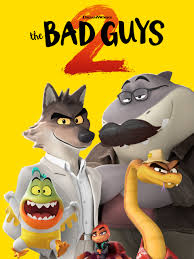
THE BAD GUYS 2
US, 2025, 104 minutes, Colour.
Sam Rockwell, Marc Maron, Awkwafina, Craig Robinson, Anthony Ramos, Zazie Beetz, Danielle Brooks, Natasha Lyonne, Maria Bakalova, Alex Borstein, Richard Ayoade, Lilly Singh, Kelly Stables.
Directed by Pierre Perifell.
Everybody enjoyed The Bad Guys in 2022. So, here we are again. There is a special Australian interest in this very American animated production. The series of The Bad Guys, graphic novels, designed for children’s audiences, was written by Australian author, former actor, Aaron Blabey. He also serves as executive producer for this film.
So, what would we expect, if we did not know the series, from a movie called The Bad Guys? Whatever it might have been, most audiences will be satisfied, many will be highly entertained.
The characters are well drawn, quite individual, a charming wolf who is the mastermind of The Bad Guys, a slithering snake who wants to be bad, a petite tarantula who is adept at computers and technology, a rather cumbersome shark with a genial personality able to adapt to many situations, and a piranha who likes baring teeth and taking over. And there are some other interesting principal characters, the governor of the state, Diane, a pleasant and attractive fox, a do-gooding Professor, minute, a guinea pig, and a large, forward bending, teeth baring, intense police chief. And, as can be seen by the credits, there is a very talented voice cast.
Actually, these paragraphs came from the review of the first film. So, this sequel will mean that the characters are very familiar, Wolf and the wisecracks, love for Diane, the secrets of the other characters, especially the police chief who is now Commissioner.
In many ways this screenplay is a repetition of the first film, the newly rehabilitated Bad Guys, trying to make good in the world, then suspected of going to the bad, their being set up by a criminal group of female characters. There is a huge climax at a wrestling match which is a cover for stealing the competition winning but which contains a highly desired element.
Then, unexpectedly, the action becomes cosmic, spacecraft, travel into space, a giant station and everyone involved in confrontations and battles.
One of the main advantages for all audiences is that the screenplay is quite humorous, a lot of repartee and banter, some ironies, not just for the young but engaging enough to entertain older audiences.
- The popularity of Aaron Blabey’s books, graphic novels series? Characters, adventures?
- The style of the animation, each of the distinctive characters, settings, conventions, prisons, cells, public meetings, the laboratories, the wrestling match, the crowds, the sea of crowds in pursuit, space, spacecraft, the giant plant, conflicts, special effects and stunts? The musical score?
- The title, the group of animal characters, their reputation, philosophy of life, camaraderie? An interesting group of characters? Plus Professor Marmalade, plus Diane, plus the police chief? The introduction of the trio of villains, female, Susan and Snake and flirting, people in the wrestling, Kitty Cat and the mastermind?
- The dialogue, the humour, wit, repartee? Engaging for younger audiences? Entertaining for adult audiences?
- Audience interest in each of the characters, Wolf as leader, his appearance, manner of speaking, self-confidence, thinking himself as a Big Bad Wolf, mastermind, the various crimes and robberies, his plans, his repartee? Reform, lack of opportunities, the romance with Diane and then meetings?
- Snake, drawing, voice, characteristics of snakes, wanting to be bad, feeling betrayed by Wolf when he becomes good? Skills in the plots, slithering, x-ray eyes? Voice? Suspected of being the thief? The relationship with Susan? The betrayal and disillusionment?
- Tarantula, many fingers, adept at technology, her voice, loyalties?
- Shark, large, variety of voices, impersonations, as female, as male, improvising, meeting people, singing, providing diversions?
- Piranha, teeth, small, vicious, taking over at times, performing and attracting attention?
- Diane, the governor, the smooth fox, charm, political career, condemning the Bad Guys, her interviews? Her wanting them to be reformed? Handing over to Professor Marmalade? Her supervision, the revelation that she was a jewel thief, her reform, being good, helping people? Her being abducted, the video of her past identity, in the spacecraft, helping Wolf, the final romantic ending?
- Professor Marmalade? His very British voice? Guinea pig? Diminutive? With Diane, and the revelation about the theft?
- The police chief, now Commissioner, large, her teeth, her walk, vigorous, always on the attack, wanting to get the Bad Guys? The encounter with Wolf, the element, the belt, the robbery, the wrestling match, the further revelations, the solution, and her plan to show that the Bad Guys had died, but they are about to become secret agents?
- Susan, her charm, with caps late, the seduction, the revelation, the wrestling match, the peak, setting up The Bad Guys, Kitty Kat and her personality, thief, the gang?
- The plans, the vast centre, into space, the Bad Guys versus the bad females, battles, Diane and her intervention, the fights? And the transition to the Bad Guys being mourned, dead but heroes?
- The Commissioner and her plan, the agents, the car, the romantic ending – and the plans for the next sequel?
Big, Bold, Beautiful Journey, A
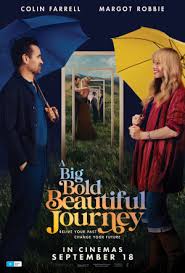
A BIG, BOLD, BEAUTIFUL JOURNEY
US, 2025, 108 minutes, Colour.
Colin Farrell, Margot Robbie, Phoebe Waller-Bridge, Kevin Kline, Jennifer Grant, Hamish Linklater, Billy Magnusson, Sarah Gadon, Lily Rabe. Voice Jodi Turner Smith.
Directed by Kogonada.
The title certainly sounds big and bold. And, the popular stars, Colin Farrell and Margot Robbie, can be considered beautiful. And the question is how this all comes together.
While it can be labelled as a romantic comedy, the film is also an imaginative fantasy, and the clue is given in the tag for the advertising: relive the past, change the future.
The initial focus is on David, in New York, American mother, Irish father, Irish accent. He has to drive to the wedding of a friend. And, almost immediately, the storytelling takes on the touch of the surreal. When he goes to rent a car, there is a difficult door to open, a vast open space, two cars, two strange characters at the desk, The Mechanic (and it takes a while to recognise this white-haired gentleman as Kevin Kline) and The Cashier, the immediately recognisable Phoebe Waller-Bridge, her English strangely German-accented. David goes through some puzzling tests, like an audition, but eventually gets the car which has an interactive local guide.
Then, at the wedding, there is Sara, up-front but this covering some diffidence. They meet, don’t exactly click, but then find that The Mechanic and The Cashier have contrived to bring them together. And so the journey begins.
The way that they relive the past is going through a strange set of doors, many of them out in the woods. David goes to a lighthouse that was a refuge in his past, relives an episode from his school days. Sarah goes through a door and enters a Museum that she frequented with her mother, as well as a visit to her mother dying in hospital. A moving sequence is where David encounters his father at the time of his birth – and then later has to identify as his father reaching out to his younger self. And, there are several other episodes with the two encountering each other.
In fact, it would be interesting to hear a marriage counsellor or a therapist and their response to this film, because in many ways, the reliving in the past to change the future means a lot of discussion, a lot of self-reflection, a lot of challenges to honesty about the self, experiences to appreciate the influence of parents, discover what is special about themselves.
Because of the status and the ages of the two stars, this is a film to appeal to a middle-aged audience rather than a younger audience. And it will give older audiences their opportunity to think about reliving their past and its effect on their present and future.
There is quite some beautiful American country scenery. Margot Robbie has proven that she has quite some charm on screen. But, it is very interesting to see Colin Farrell in this role, a great number of close-ups and the fact that throughout the film he is communicating a great deal through his intense facial performance. And to this extent, he is more endearing to the audience than Margot Robbie.
Audiences who surrender to the film’s imagination, will enjoy it and appreciate an occasion for reflection. But, there is the danger with this kind of film that audiences in a hurry will not have the patience to slow down and surrender to it.
- The title and expectations? The stars and expectations?
- The advertising tag, relive the past, change your future?
- The blend of realism and fantasy? Romance? Touches a romantic comedy? Surreal storytelling?
- The American setting, the city, streets and apartment doors, the lane, the rain – and continuing throughout the film, the rental car door, difficulty opening, the vast space, the two cars, the Cashier and her manner, dialogue, comic, mysterious? The help of the Mechanic? The interview with David, the photos, the car, the GPS, his taking the car, the drive to the wedding, the voice and the directions?
- The wedding, rain, his friends, the encounter with Sarah, tantalising, his not dancing, smoking, conversations, Sara dancing, his saying he didn’t dance, later denying it, and the scene during the final credits?
- The conversations, the revelations of character, David, Irish-American background, reserved, diffident, the focus on Colin Farrell’s face throughout, acting through his facial responses you audiences? The focus on Margot Robbie, beauty, glamour, upfront, discussions about hurting? Their leaving?
- David and his driving, diverted, the hamburger, seeing Sarah, the tone of the conversation, developing interactions, the car not starting, travelling together?
- The nature of the journey, audience accepting the realism of the characters, yet the contrivance of the car rental, the voice, the directions?
- The doors in the woods, the different doors, going back into the past, experiencing the past as adults but reliving the past, characters, discoveries, new awarenesses?
- David and his journey, visit to the Lighthouse, unsatisfactory, the high school, his age, in the musical, How to Succeed in Business, song and dance, the girl and his infatuation, telling Sarah about her response, going through the process again, the performance on stage and the disruption, the actress saving the situation, Sara saving the situation with singing? The audience and the applause? David’s parents and their response?
- David and his parents, the hospital sequence, seeing his father, learning about the difficulties of his birth, his father’s sadness? Encouragement? His journey into the past, seeing his younger self, the issue being special, his self-doubts? Being his father, reassuring his younger self?
- Sarah, her visits to the past, her devotion to her mother, her absent father and disregard, her mother’s death scene, confession that she was in an affair with her teacher, missing her mother’s death? Her participation in David’s story, especially singing in the school? The scenes in her room, the posters for musicals? Her going back into the past, aged 12, her mother’s devotion, watching Big and Sara’s previous explanation of her mother’s self giving? The conversation, on the bed, peace, reconciliation, her leaving? Her mother letting her go?
- Sarah and her visit to the Gallery, her mother’s favourite place, friendship with the guard, the range of paintings, the couple with their heads painted over – and David and Sarah later in the same position, the discussions, Sarah and her mother’s death, the Gallery, the relationship with the teacher?
- The scene at the table, the two couples, coming together, the woman and the conversation with David, love, leaving her, the issue of loving too much? Loving too much with Sarah, the man at the table, her walking out on him?
- The parting, David driving home, his wanting to go home, Sara driving and her wanting to go home? David and the intervention of the Cashier and, at the hotel, of The Mechanic? Challenging David? His returning the car, talking about Sarah, the meaning of the journey, going home?
- Sarah, returning the car, her having to make a decision, going to his house, his sitting on the steps, using the GPS?
- The final speech, their both understanding themselves, having spent time together, knowing each other and their compatibility, the difficulties and tensions, love, the final kiss in the future? Dancing in the final credits?
Emmanuelle/ 2025

EMMANUELLE
France/US, 2024, 107 minutes, Colour.
Noemie Merlant, Will Sharpe, Naomi Watts, Jamie Campbell Bower, Anthony Chau-Sang Wong, Chacha Huang.
Directed by Audrey Diwan.
There have been many films which derive from 1959 novel Emmanuelle, by Emanuel Arsnn (a name for a French/Thai actress and the suggestion made that the novel was written by her husband).
In the 1970s, the first film version, starring a young Sylvia Kristel, raised a lot of controversy, issues of sexuality and sensuality, a woman’s sexuality and sensuality, backgrounds of morality and amorality, and an attempt to break through expectations of censorship in the 1960s and 1970s. For many audiences, it was seen as a welcome liberation from previously moralistic imposed regulations.
Quite a number of other films, which derive from the original, tended often towards exploitation.
Critics and many of the audiences and bloggers, have taken a very negative view towards this film, considering it boring, too restrained in this depiction of sexuality and sensuality, a focus more on words in conversation rather than sexual activity and pleasure. And, certainly, there is a great deal of focus on words, on the encounter with the central character and lengthy exploratory conversations.
And, the criticism, that no Noemie Merlant, an actress with considerable reputation, Portrait of a Lady on Fire, Tar, Lee, in her mid-30s is far too old for the role, especially in comparison with Sylvia Kristel in her early 20s.
However, some critics make the case for the film, highlighting that 2024 is half a century on from 1974 and the original film, the presentation of sexuality and sensuality on screen has moved considerably from that time, what is permitted in the mainstream, what is relegated to pornography. There may have been a great deal of daring in the 1970s, not necessary in the 2020s, more straightforward presentation for an audience more accustomed to seeing presentations of sexual activity and reflecting on the human, the psychological aspects of sexuality.
Another commentary suggests that, in fact, Emmanuelle is, of course, the central character, but all the rest of the characters are aspects of her personality, through which in terms of conversation as well as sexual contact, are ways in which she can explore, articulate, herself, her identity, her role in the business world, her communication with men, communication with women, her stands as regards “feminism” in the 21st-century.
The film has an interesting supporting cast including Naomi Watts as the hotel manager in Hong Kong, veteran Hong Kong actor, Anthony Chau-Sang Wong and Will Sharpe as the enigmatic gambling businessman at the hotel with whom she has several conversations, his questioning her, testing her as she has a sexual encounter with one of the hotel staff. And, there is an enigmatic Englishman, Sir John, played by Jamie Campbell Bower.
Not for every audience. And, the intended audience has been particularly negative.
Ballad of Wallis Island, The
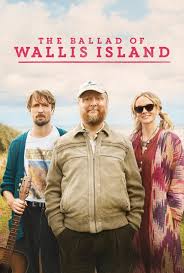
THE BALLAD OF WALLIS ISLAND
UK, 2025, 99 minutes, Colour.
Tom Basden, Tim Key, Carey Mulligan, Sian Clifford, Akemnji Ndifornyen.
Directed by James Griffiths.
This is one of those small films that has the power to grow on its audience as we continue to watch. It has an unexpected story, a mixture of unusual characters, and the location off the coast of Wales, Wallis Island.
It is worth keeping in mind the use of the word Ballad in the title. While there is a narrative plotline, the differing episodes are like the stanzas of a ballad, letting the audience/listener make the connections in their feelings and imagination rather than the screenplay’s spelling them all out.
So, what to make of a musician with his guitar being rowed to the shore of the island, having to step into the water but, of course, splashing face down in it, and the roly-poly gentleman on the shore with a placard of welcome? But it does set the tone.
In fact, the film is based on a short film by the two stars, Tom Basden as the musician and Tim Key as the host on the island, made with the director, James Griffiths, as long ago as 2007. Obviously, this is a labour of love, long love.
If this opening sounds intriguing, then what follows is very much in this vein, life on the isolated island, which does have a shop and an attractive storekeeper, Amanda, tours around the island for visiting birdwatching groups (but we only hear about this).
Herb, the musician, has had a successful career, especially in the past with his singing partner, Nell. And, Charles, the owner of the mansion, is the number one fan. In fact, the reason Herb has arrived is that Charles has booked a gig for him to perform on the beach. And has offered £500,000 for the performance, which will help Herb in a new solo album.
Complication! Charles has not told Herb that he has invited Nell to come to perform with him. She is played by Carey Mulligan and arrives with her partner in life, Michael (Akemnji Ndifornyen). So, a kind of comedy of errors ensues (and some performances of the songs). There is quite an amount of verbal sparring.
While we understand the characters of Herb and Nell, part of the enjoyment is getting to know Charles, living alone, wealthy, eccentric, to say the least, and a constant babbler when trying to think what to say. He is a blend of the irritating and the engaging.
Everything doesn’t progress as Charles had imagined and hoped for. And it doesn’t progress as the audience might have expected either. But, the screenplay does hold out an optimistic point of view, that there is hope for us all no matter what has happened in our lives and where we find ourselves.
- The ballad, the ballad style of moviemaking, episodes like verses of the ballad? And the focus on Wallis Island?
- The setting, the initial be variables of the island, the sea, the shore, the beach, the cliffs, the roads, the vegetation, the mansion and interiors, the shop, and the setting for the gig on the shore?
- The music, the style of former decades, ballads, the lyrics, the various songs played throughout the film? And the final concert?
- Herbs story, musician, composer, collaborating with Nell, the records, the relationship, his going solo, her not continuing with him, nine years? His happy memories, some bitterness? The invitation from Charles, coming to the island, her thinking it a hotel, the number and the audience? Coming ashore, the water, falling in, the mobile phone and the need for rice to dry it? Walking up the hill, the mansion, the room, the taps, the bath? The effect on Herb?
- The impact of Charles, on the beach, the welcome, awkward, chatter? Eccentric? The fan, booking the concert, the payment? Awkwardness with the water, the walk up the hill, the room, his sense of judgement and awkwardness? His story, winning the lottery twice, the travels, buying the mansion, the death of his wife, his love of the music, the gig for the anniversary? Continually talking? The tennis game, the visits to the shop, the money for the payphone, the relationship with Amanda, the shop, her son? His awkwardness?
- Nell and Michael arriving, herbs surprise, managing the situation? Nell and her personality, her story, the music, the separation, with Michael, the relationship, her pregnancy, making chutney…? The gift for Charles? Her reaction to Herb?
- The discussions, Michael and his attitude, the taunts, birdwatching, relationship with Nell, going on the tour, wanting to see puffins, his return, the success of the tour, Nell having gone, the confrontation with Herb, his leaving?
- Nell, her personality, love of the music, the discussions, reminiscences, the special day for the island, going to the beach, writing the names, the balloons, setting them off? The rehearsals for the music, singing together, no appraising the situation, her decision to leave?
- The effect on Herb, moods, phoning to his agent, the prospect of the solo album, not wanting to do the gig? The encounter with Amanda, the rice at the shop?
- The difficulties with Charles, the decision to leave, the timetables, irregularity of the boats? His going for the swim, Charles interpretation, Charles having to be rescued? Herb recovering the message on the balloon?
- Final decision, the invitation for Amanda, her arrival, Charles surprised, going to the setting, her playing the music, the meal afterwards? Happiness?
- Herb, self appraisal, the issue of the money, the agent, Nell not liking the cover of the album, his departure, the farewell, the hug, the suitcase, and finding the apples in it?
- The aftermath, Charles and Amanda, tennis, the money on the table, her leaving the money behind? His self-reflection, decisions for his future?
Toxic Avenger, The/ 2023
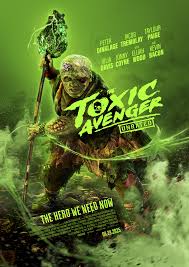
THE TOXIC AVENGER
US, 2023, 100 minutes, Colour.
Peter Dinklage, Jacob Tremblay, Taylour Paige, Kevin Bacon, Elijah Wood, Julia Davis, Louise Guerriorio, David Yow, Annette Badland, Macon Blair, Lloyd Kaufmann.
Directed by Macon Blair.
The Toxic Avenger was the title of a horror film of 1984, produced by the small-budget Troma Studios, specialising in horror films under the leadership of its director, Lloyd Kaufmann. Kaufmann made several sequels to the original. Almost 40 years later, he wanted to make a new version of The Toxic Avenger, thought himself too old to direct this version, has a small role in the hospital sequence, but handed on direction to writer-actor, Macon Blair (who also appears as Dennis).
This film had a larger budget, was produced by 2023 but failed to get a distributor. However, it was released in 2025, some enthusiasm for the distributors, but many negative comments from the bloggers.
This is a film which has its cake and eats it at the same time! It capitalises on the horror traditions, especially those of the small budget special effects – many exceedingly gory, of course, but an emphasis more on splatter and blood instead of grim dark horror. And it has something of a distinguished cast.
In the original, the toxic avenger was a nerdish young man. This time the central character is played by Peter Dinklage, working in a large factory, sinister in its experiments and Big Pharma, a cleaner, stepfather to a teenager, Jacob Tremblay.
On the one hand, the through line of the plot has an emphasis on family, relationships, the death of a mother, the son and his relationship to his stepfather, the boy at school, trying to dance but ridiculed, the father with a terminal diagnosis, the consequences of the stepfather’s transformation, and the role of the boy. This story pervades the film.
And there is also the through plot of the critique of corrupt corporations, Mafia and gangster connections, inept CEOs and their vanities, the sinister accomplices, the henchmen team of would-be rock stars who are commissioned to kill all opponents. Which means that the film is a critique of corrupt businesses, the consequences for public life and health.
The nerd of the original film is now a journalist but is killed off at the beginning, bequeathing his mission of exposure and condemnation to another journalist, played effectively and generally seriously by Taylour Paige. She is under threat and pursued throughout the whole film, eventually working with the Toxic Avenger and to save his son.
When the janitor invades a big dinner and confronts the CEO, played, with self-important nonchalance, by Kevin Bacon with Julia Davis as his loyal assistant, he asks for some money to cover his doctor’s bills after the terminal prognostic and the refusal of the company to pay his insurance. Pursued, he is involved in mishaps from the factory and overwhelmed by toxic sludge, emerging disfigured (and an actress performing the action of the janitor while Peter Dinklage speaks the lines). And he has a toxic atomic mop. A determined man with a mission.
The film is very much a horror-allegory about corruption in society and the need to rise against it. It certainly plays parody at times, overall satire – but, often in the spirit of spontaneous skit.
Clearly, from the title and the posters, only the horror aficionados at will be wanting to see this film – some satisfied, many dissatisfied. However, film buffs, seeing the list of the cast, may be curious to see how they handle this kind of horror satire.
Signorinella/ Little Miss
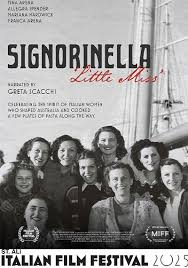
SIGNORINELLA: LITTLE MISS
Australia, 2025, 86 minutes, Colour.
Greta Scacchi, Celestina Mammone, Mary Marino, Cathy Harris, Allegra Spender, Carla Zampatti, Franca Arena, Tina Arena
Directed by Angelo Pricolo, Jason McFadyen, Shannon Swan
A very interesting and entertaining documentary.
While Australia has the oldest inhabitants in the world, its indigenous people, since 1788, Australian history has been of migration, interactions with the indigenous, prejudice and frequent violence, succeeding generations, initially from Britain, Ireland, and the Chinese at the goldfields, Jewish migrants from Europe, and then success of migration from European countries over decades, then migrants from Asia, like the Vietnamese, and, in the 21st-century, migrants from troubled countries in Asia and Africa. And, a feature of the success of migration is was that each was greeted with some kind of initial scepticism, hostility, name-calling, shunning, but an eventual acceptance.
Which is the background to the story of Italian migrants from the 1930s and, especially, the aftermath of World War II. And even more particular focus is that of the migration of Italian women.
The producers have gathered a group of genial and articulate women, some in their late 80s, and from a range of ages, some of the women actual migrants when they were children, others the next generation. In the documentary is narrated by Greta Scacchi, International actress, Italian/Australian background.
Of course, while the documentary is for all audiences, it will have a very strong appeal to a women’s audience. It is a pleasure, sometimes humorous, sometimes very serious, to listen to the stories, of young girls working on farms, young women pregnant driving tractors, gathering hay, working in the canefields…
And all enjoying the Italian traditions, memories of the homeland and traditions, issues of language, the vast distances from Italy to Australia, the period of arranged marriages, the upset of World War II, Australian suspicion of Italian fascism, the internment of the men during the war, and the women and having to maintain farms, business, and families.
But, the next generation shows how several Italian women had enormous talent, seized opportunities, created businesses with international repercussions, like I was and party and fashion, (with commentary by her politician daughter, Allegra Spender), Marianna Hardwick also in fashion, but several women with creative companies from establishing popular markets to chemical-free drying of fruits. And, there is the strong politician, Franca arena, her contribution also to multilingual radio and SBS television. And, in the entertainment field, singer Tina Arena and Young Talent Time.
For a documentary which runs just under an hour and a half, many interesting people to meet and listen to, at an effective historical overview of the contribution of Italian women to Australian life.
