Displaying items by tag: Colin Farrell
Ballad of a Simple Player

BALLAD OF A SMALL PLAYER
Germany/UK, 2025, 101 minutes, Colour.
Colin Farrell, Tilda Swinton, Fala Chen, Alex Jennings, Tony Lau.
Directed by Edward Berger.
The small player here is a gambler, an addict, a fraudster, conman, posing at times as an English Lord, upper British accent, affluent clothing style and yellow gloves, but, really, an ordinary Irishman. Whether this drama fits the description of the ballad is a significant question. There have been ballads about rogues in the past, about highwaymen, for instance, so here is a realistic/stylised telling the story of this life of the Lord who is just Riley.
The film has been written and directed by German Edward Berger. After a significant career in Germany, he achieved international success with his German Oscar-winning version of All Quiet on the Western Front. His next film was in Britain, his version of Robert Harris’s popular novel of the papacy, Conclave, also an award winner.
In comparison, this ballad is something of a small film.
The setting is Macau, described as the gambling capital of the world, with night light overview scenes that make it resemble an Oriental Las Vegas. While there are many scenes in the narrow streets with touches of poverty, some harsh apartments, and a visit to an island off Hong Kong with wooden houses on the water and wharfs, the overall emphasis is on the lavish, sometimes more than lavish, hotels and casinos, spaciously-appointed rooms, restaurants with expensive a la carte banquet meals, and the vast expanses of the gambling halls themselves. By the end of the film, the audience will feel that they have been immersed in this rather enclosed life of Macau.
And the Simple Player? He is played by Colin Farrell with a blend of quiet, intensity, guile, some moments of conscience, but…
We do hear his back story eventually, no integrity there, robbing a wealthy old woman and absconding to the gambling capitals and settling in Macau. He passes himself off as Lord Doyle, popular with the staffs until he is unable to pay his debts. We see him particularly unlucky at the baccarat table, trying to outdo a wealthy old lady. He doesn’t. Then an investigator arrives in the unexpectedly strange character, calling herself Betty, really Cynthia, another extraordinary variation in looks, hairstyle, manner of speaking, manner of walking, by Tilda Swinton. (And here a suggestion to wait until some sequences between them during the final credits.)
There is usually some sadness in the ballad. The sadness here focuses on a woman assisting at the tables, giving Riley credit, his following her and her helping him, inviting him to the island where she lives – and, perhaps ballad -like again, falling victim to his cunning and addiction.
Then back to the tables. Back to luxury, symbolised by some surprisingly gluttonous sequences by Riley, continually overreaching, an encounter with another British conman, Adrian (Alex Jennings), building up to 2 climaxes. The first is a $1 million bet at the baccarat table. The second is Riley wandering through the streets during a Chinese celebration and having to face up to reality, the reality which the Gospels long ago asked: what does it profit anyone to gain the world and lose their soul?
- The director, acclaim? The smaller scale film? International flavour?
- The Macau settings, the gambling capital, night sequences, day sequences, the overview of the city – Las Vegas -like? The hotels and interiors, the casinos and interiors, the streets? The ferries, to Hong Kong, the island and the sea, the houses on the water? The musical score, at times heavily orchestral, at times quiet?
- The title, the storytelling, the focus on the character, activities, fate, crises, decisions, a ballad? The inflated title of Lord Doyle? The reality of an Irishman called Riley?
- Issues of gambling, audience interest, sympathies, Macau, so much gambling, the vast casinos, the clientele, Asia, International? The baccarat tables? The gambling, the amounts of money, winnings, losing, debts, debts accumulating? Sympathy towards gambling and gamblers, addiction – or not?
- Colin Farrell, presence and performance, as Lord Doyle, British accent, manner, clothes, gloves, hotel, at the baccarat table, the old lady, the challenge, his losing? At the desk, the demand for payment, his excuses? The encouragement of the man at the door? The suggestion for the rainbow casino?
- The reality of Riley, the posing of Lord Doyle, the revelation of the stealing of the money from the old lady, her wealth, yet the vast amount, travelling, to Macau, his addiction, his behaviour in his room, extravagance, meals and drinking?
- The encounter with Cynthia Blythe, her name of Betty, her presence, Tilda Swinton’s presence and performance, hairdo, dress, shoes, idiosyncratic? Watching him, the selfir in the elevator? His pursuing her, the confrontation, the camera, the truth about her, her investigation, the company, her threats? His taking the camera, evading her? The deal, the money, the promise of the dance? His disappearance?
- The presence of Dao Ming? Charming, encouraging him, the money? His going to see her, following her, her apartment, the conversations, the later card about the island, his escaping to the island, her support of him, encouraging him to jump into the water, his waking on the wharf? Going to the house, the locked door, opening it, finding the money, putting it away, then stealing it all, returning to Macau? Carrying the bag’s?
- The sequences of Riley eating, gourmet, extravagant, likeness, being sick?
- The encounter with Adrian, the debt? Adrian and his personality, calm, the meal, the conversation, leaving Riley to pay?
- At the baccarat table, the old lady challenging him, his winning 7 nines in a row, everybody watching, his reputation? Paying off the debt at the hotel?
- The decision about the one-off game, risking all his money, Adrian and his disguise as a Prince, the tensions of the game, not winning immediately, Riley eventually winning?
- His talking with the old lady, wanting to find Dao Ming, the revelation of her suicide, lack of money, the background of her family in China? The impact on Riley, responsible for her death?
- In the celebration, the processions, Riley and his money, his decision to burn the money? Credible for his character? Credible for the theme of the film? And his future…?
Big, Bold, Beautiful Journey, A
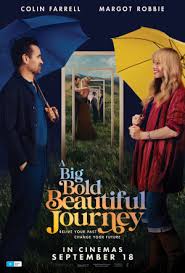
A BIG, BOLD, BEAUTIFUL JOURNEY
US, 2025, 108 minutes, Colour.
Colin Farrell, Margot Robbie, Phoebe Waller-Bridge, Kevin Kline, Jennifer Grant, Hamish Linklater, Billy Magnusson, Sarah Gadon, Lily Rabe. Voice Jodi Turner Smith.
Directed by Kogonada.
The title certainly sounds big and bold. And, the popular stars, Colin Farrell and Margot Robbie, can be considered beautiful. And the question is how this all comes together.
While it can be labelled as a romantic comedy, the film is also an imaginative fantasy, and the clue is given in the tag for the advertising: relive the past, change the future.
The initial focus is on David, in New York, American mother, Irish father, Irish accent. He has to drive to the wedding of a friend. And, almost immediately, the storytelling takes on the touch of the surreal. When he goes to rent a car, there is a difficult door to open, a vast open space, two cars, two strange characters at the desk, The Mechanic (and it takes a while to recognise this white-haired gentleman as Kevin Kline) and The Cashier, the immediately recognisable Phoebe Waller-Bridge, her English strangely German-accented. David goes through some puzzling tests, like an audition, but eventually gets the car which has an interactive local guide.
Then, at the wedding, there is Sara, up-front but this covering some diffidence. They meet, don’t exactly click, but then find that The Mechanic and The Cashier have contrived to bring them together. And so the journey begins.
The way that they relive the past is going through a strange set of doors, many of them out in the woods. David goes to a lighthouse that was a refuge in his past, relives an episode from his school days. Sarah goes through a door and enters a Museum that she frequented with her mother, as well as a visit to her mother dying in hospital. A moving sequence is where David encounters his father at the time of his birth – and then later has to identify as his father reaching out to his younger self. And, there are several other episodes with the two encountering each other.
In fact, it would be interesting to hear a marriage counsellor or a therapist and their response to this film, because in many ways, the reliving in the past to change the future means a lot of discussion, a lot of self-reflection, a lot of challenges to honesty about the self, experiences to appreciate the influence of parents, discover what is special about themselves.
Because of the status and the ages of the two stars, this is a film to appeal to a middle-aged audience rather than a younger audience. And it will give older audiences their opportunity to think about reliving their past and its effect on their present and future.
There is quite some beautiful American country scenery. Margot Robbie has proven that she has quite some charm on screen. But, it is very interesting to see Colin Farrell in this role, a great number of close-ups and the fact that throughout the film he is communicating a great deal through his intense facial performance. And to this extent, he is more endearing to the audience than Margot Robbie.
Audiences who surrender to the film’s imagination, will enjoy it and appreciate an occasion for reflection. But, there is the danger with this kind of film that audiences in a hurry will not have the patience to slow down and surrender to it.
- The title and expectations? The stars and expectations?
- The advertising tag, relive the past, change your future?
- The blend of realism and fantasy? Romance? Touches a romantic comedy? Surreal storytelling?
- The American setting, the city, streets and apartment doors, the lane, the rain – and continuing throughout the film, the rental car door, difficulty opening, the vast space, the two cars, the Cashier and her manner, dialogue, comic, mysterious? The help of the Mechanic? The interview with David, the photos, the car, the GPS, his taking the car, the drive to the wedding, the voice and the directions?
- The wedding, rain, his friends, the encounter with Sarah, tantalising, his not dancing, smoking, conversations, Sara dancing, his saying he didn’t dance, later denying it, and the scene during the final credits?
- The conversations, the revelations of character, David, Irish-American background, reserved, diffident, the focus on Colin Farrell’s face throughout, acting through his facial responses you audiences? The focus on Margot Robbie, beauty, glamour, upfront, discussions about hurting? Their leaving?
- David and his driving, diverted, the hamburger, seeing Sarah, the tone of the conversation, developing interactions, the car not starting, travelling together?
- The nature of the journey, audience accepting the realism of the characters, yet the contrivance of the car rental, the voice, the directions?
- The doors in the woods, the different doors, going back into the past, experiencing the past as adults but reliving the past, characters, discoveries, new awarenesses?
- David and his journey, visit to the Lighthouse, unsatisfactory, the high school, his age, in the musical, How to Succeed in Business, song and dance, the girl and his infatuation, telling Sarah about her response, going through the process again, the performance on stage and the disruption, the actress saving the situation, Sara saving the situation with singing? The audience and the applause? David’s parents and their response?
- David and his parents, the hospital sequence, seeing his father, learning about the difficulties of his birth, his father’s sadness? Encouragement? His journey into the past, seeing his younger self, the issue being special, his self-doubts? Being his father, reassuring his younger self?
- Sarah, her visits to the past, her devotion to her mother, her absent father and disregard, her mother’s death scene, confession that she was in an affair with her teacher, missing her mother’s death? Her participation in David’s story, especially singing in the school? The scenes in her room, the posters for musicals? Her going back into the past, aged 12, her mother’s devotion, watching Big and Sara’s previous explanation of her mother’s self giving? The conversation, on the bed, peace, reconciliation, her leaving? Her mother letting her go?
- Sarah and her visit to the Gallery, her mother’s favourite place, friendship with the guard, the range of paintings, the couple with their heads painted over – and David and Sarah later in the same position, the discussions, Sarah and her mother’s death, the Gallery, the relationship with the teacher?
- The scene at the table, the two couples, coming together, the woman and the conversation with David, love, leaving her, the issue of loving too much? Loving too much with Sarah, the man at the table, her walking out on him?
- The parting, David driving home, his wanting to go home, Sara driving and her wanting to go home? David and the intervention of the Cashier and, at the hotel, of The Mechanic? Challenging David? His returning the car, talking about Sarah, the meaning of the journey, going home?
- Sarah, returning the car, her having to make a decision, going to his house, his sitting on the steps, using the GPS?
- The final speech, their both understanding themselves, having spent time together, knowing each other and their compatibility, the difficulties and tensions, love, the final kiss in the future? Dancing in the final credits?
