Displaying items by tag: Carey Mulligan
Ballad of Wallis Island, The
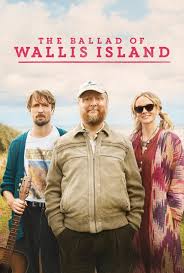
THE BALLAD OF WALLIS ISLAND
UK, 2025, 99 minutes, Colour.
Tom Basden, Tim Key, Carey Mulligan, Sian Clifford, Akemnji Ndifornyen.
Directed by James Griffiths.
This is one of those small films that has the power to grow on its audience as we continue to watch. It has an unexpected story, a mixture of unusual characters, and the location off the coast of Wales, Wallis Island.
It is worth keeping in mind the use of the word Ballad in the title. While there is a narrative plotline, the differing episodes are like the stanzas of a ballad, letting the audience/listener make the connections in their feelings and imagination rather than the screenplay’s spelling them all out.
So, what to make of a musician with his guitar being rowed to the shore of the island, having to step into the water but, of course, splashing face down in it, and the roly-poly gentleman on the shore with a placard of welcome? But it does set the tone.
In fact, the film is based on a short film by the two stars, Tom Basden as the musician and Tim Key as the host on the island, made with the director, James Griffiths, as long ago as 2007. Obviously, this is a labour of love, long love.
If this opening sounds intriguing, then what follows is very much in this vein, life on the isolated island, which does have a shop and an attractive storekeeper, Amanda, tours around the island for visiting birdwatching groups (but we only hear about this).
Herb, the musician, has had a successful career, especially in the past with his singing partner, Nell. And, Charles, the owner of the mansion, is the number one fan. In fact, the reason Herb has arrived is that Charles has booked a gig for him to perform on the beach. And has offered £500,000 for the performance, which will help Herb in a new solo album.
Complication! Charles has not told Herb that he has invited Nell to come to perform with him. She is played by Carey Mulligan and arrives with her partner in life, Michael (Akemnji Ndifornyen). So, a kind of comedy of errors ensues (and some performances of the songs). There is quite an amount of verbal sparring.
While we understand the characters of Herb and Nell, part of the enjoyment is getting to know Charles, living alone, wealthy, eccentric, to say the least, and a constant babbler when trying to think what to say. He is a blend of the irritating and the engaging.
Everything doesn’t progress as Charles had imagined and hoped for. And it doesn’t progress as the audience might have expected either. But, the screenplay does hold out an optimistic point of view, that there is hope for us all no matter what has happened in our lives and where we find ourselves.
- The ballad, the ballad style of moviemaking, episodes like verses of the ballad? And the focus on Wallis Island?
- The setting, the initial be variables of the island, the sea, the shore, the beach, the cliffs, the roads, the vegetation, the mansion and interiors, the shop, and the setting for the gig on the shore?
- The music, the style of former decades, ballads, the lyrics, the various songs played throughout the film? And the final concert?
- Herbs story, musician, composer, collaborating with Nell, the records, the relationship, his going solo, her not continuing with him, nine years? His happy memories, some bitterness? The invitation from Charles, coming to the island, her thinking it a hotel, the number and the audience? Coming ashore, the water, falling in, the mobile phone and the need for rice to dry it? Walking up the hill, the mansion, the room, the taps, the bath? The effect on Herb?
- The impact of Charles, on the beach, the welcome, awkward, chatter? Eccentric? The fan, booking the concert, the payment? Awkwardness with the water, the walk up the hill, the room, his sense of judgement and awkwardness? His story, winning the lottery twice, the travels, buying the mansion, the death of his wife, his love of the music, the gig for the anniversary? Continually talking? The tennis game, the visits to the shop, the money for the payphone, the relationship with Amanda, the shop, her son? His awkwardness?
- Nell and Michael arriving, herbs surprise, managing the situation? Nell and her personality, her story, the music, the separation, with Michael, the relationship, her pregnancy, making chutney…? The gift for Charles? Her reaction to Herb?
- The discussions, Michael and his attitude, the taunts, birdwatching, relationship with Nell, going on the tour, wanting to see puffins, his return, the success of the tour, Nell having gone, the confrontation with Herb, his leaving?
- Nell, her personality, love of the music, the discussions, reminiscences, the special day for the island, going to the beach, writing the names, the balloons, setting them off? The rehearsals for the music, singing together, no appraising the situation, her decision to leave?
- The effect on Herb, moods, phoning to his agent, the prospect of the solo album, not wanting to do the gig? The encounter with Amanda, the rice at the shop?
- The difficulties with Charles, the decision to leave, the timetables, irregularity of the boats? His going for the swim, Charles interpretation, Charles having to be rescued? Herb recovering the message on the balloon?
- Final decision, the invitation for Amanda, her arrival, Charles surprised, going to the setting, her playing the music, the meal afterwards? Happiness?
- Herb, self appraisal, the issue of the money, the agent, Nell not liking the cover of the album, his departure, the farewell, the hug, the suitcase, and finding the apples in it?
- The aftermath, Charles and Amanda, tennis, the money on the table, her leaving the money behind? His self-reflection, decisions for his future?
Spaceman
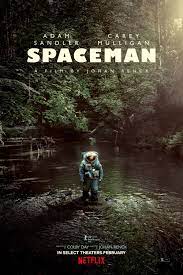
SPACEMAN
US, 2024, 103 minutes, Colour.
Adam Sandler, Carey Mulligan, Paul Dano, Kunal Nayyar, Isabella Rossellini, Lena Olin.
Directed by Johan Renck.
Spaceman is certainly a generic title. It could suggest a film about space exploration. It could suggest dramatic conflicts in space. And, it could suggest a variation on a space Odyssey.
In fact, there is something of all three possibilities here.
The star is Adam Sandler, many audiences not expecting to find him in such a serious performance after his decades of comedies, broad comedies, romantic comedies. However, in collaboration with Netflix, he has appeared in some serious roles including Uncut Gems and a particularly affecting performance as a coach in Hustle.
And, it should be said at the beginning, that Adam Sandler acquits himself very well as the spaceman, Jacub.
There is a technology side of this kind of film, the vast space craft in the future, its capacity for travelling even as far as Jupiter, the enormous interiors of the craft as well as all the signs for its maintenance, progress, and communication with. And, with a huge pink cloud hovering over Earth for several years, this is also space exploration, a mission with a single spaceman, well trained and prepared, already six months out on his travel towards Jupiter to discover the nature of this pink cloud.
But, in a different kind of way, it is also something of a space Odyssey. In 1968, Stanley Kubrick brought the phrase, Space Odyssey, into our vocabulary (over a year before the 1969 moon landing). While there is a great deal of space exploration in Kubrick’s masterpiece, there is also a philosophical (even theological) probing of what is beyond human experience, the transcendent, symbolised in that film by a vast evenly planed monolith, appearing in prehistoric times, but also present and moving through the future universe. (And one can think of such films as Gravity, First Man, Ad Astra.)
But, this time the transcendent is introduced highly imaginatively, a giant spider creature tarantula-like, an alien whose community has been destroyed, who is a survivor, interested in preserving humans, learning the language, trying to understand the motivation of the exploration. He is called Hanus and is voiced persuasively by Paul Dano.
At first, Jacub is wary, hostile, but with the conversations and the questions, gradually a report between the two, Hanus and his probing, Jacob, having already experienced some personal crisis with his wife leaving him and not communicating with him, forced to look into himself, testing himself about what he really values, even risking everything to rescue Hanus.
Which means that the transcendent themes and the personal, family themes are brought together.
Carey Mulligan plays Jacub’s disaffected wife, Lena Olin has a cameo as her mother, and Isabella Rossellini has a significant cameo role as the very businesslike public relations person behind the mission.
The film has been directed by Johan Renck, prolific video music video director, also of the challenging television series, Chernobyl.
- The title and focused? Expectations? Space exploration? A space Odyssey?
- The director, his reputation, videos, television series, Chernobyl? Adam Sandler in the central role, audience expectations, comic, serious?
- The vision of the future, space exploration? The strange pink cloud hovering over earth? The origins in Jupiter and beyond? The boundaries of the universe, its mystery, evolution, origins? Spacecraft and their complexities, the single spaceman? Contact with control? The visuals of the craft, space, of the mystery?
- Jakub? The original novel, Czech Republic, keeping the characters and setting? His life, the flashbacks, relationship with his father, informant, politics, his death? A cloud hovering over him? The flashbacks and the encounters with Lenka, love, flirting, the marriage, her pregnancy, the miscarriage? His professionalism, but his absence? Always being away, next pregnancy? The decision to leave him? The videos and his memories, his not living up to them? Attempts to contact her, moving away? Her refusal, going to stay with her mother, the contacts and the excuses, the cover? The effect on him?
- The contact on the ground, Peter, friendship, the contact, the support, the subterfuge about Lenka leaving, the press conference, Tuma and her poise, PR, covering the situation, her authority, going to visit Lenka, not communicating that she had left? The visit and talk?
- Jakub, his vision, exploration, the mystery are science, transcendence?
- Hanus and his appearance, the form of the spider, the visuals of the spider, size, movement, threat? Real? An alien, his voice, explanation of origins, the attack, adrift, learning and observing about humans, language? Initial interactions with Jakub? The voice and tone to Paul Dano?
- Lenka, the present, her reaction to Jakub, leaving, the message, going to see her mother, her mother support, the pregnancy, memories of happy days, the miscarriage, sadness, Jakub and his absences? The appeal to her to make contact?
- Hanus, his presence, Jakub’s initial reaction, fear, antipathy, the breaking down the barriers, the pace to suit with Hanus, the talk, the revelation, the cosmic dimensions, origins, the interactions between the two, companionship, emotions, Hanus in space, Jakub and the rescue? The effect of Hanus always referring to Jakub as “skinny human”.
- The breaking of the mission, the change in Jakub, the journey becoming personal? And the commitment to Hanus?
- The robbery with the South Koreans, mentioning them, the pursuit, the rescuing Jakub and his working with them?
- His future, possible reconciliation?
- A 21st-century variation on a space Odyssey?
Maestro
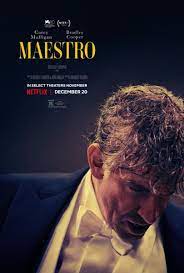
MAESTRO
US, 2023, 130 minutes, Black and white and Colour.
Carey Mulligan, Bradley Cooper, Sarah Silverman, Maya Hawke, Sam Nivola, Josh Hamilton, Matt Bomer, Miriam Shor.
Directed by Bradley Cooper.
A striking film, to say the least.
Leonard Bernstein was one of the great American musical figures of the 20th century. He was a composer. He was a teacher, especially through television programs as well as in person. He was a conductor, vigorous in his interpretations and his effect on his orchestras. The general public probably knows him best as the composer of the music for West Side Story.
This film is a portrait, not a biography.
And it is the work of actor, Bradley Cooper, successful in his acting career but making his mark as a director in his version of A Star is Born, 2018, he taking the role of the musician on a downward spiral, featuring Lady Gaga as the rising star, and winning an Oscar for the song, Shallow.
And, he has been more acclaimed for Maestro. It is a very personal project, co-writing the screenplay, directing, playing Bernstein, careful attention to his manner and mannerisms, especially in some powerful conducting sequences, careful attention given to make up for his appearance and, especially, convincing ageing.
The portrait moves around in time. It opens with the older Burnstein playing the piano and revealed to be involved in television episode. It then makes a transition to when he is in his mid-20s, in a relationship with a musician, suddenly asked to take over the conducting of an orchestra when the impresario falls ill – and is so successful that he becomes famous. This portrait of Bernstein shows the musician, with a number of gay relationships over the decades.
However, Bernstein was also married for several decades and this portrait is also the story of his relationship with his wife, an actress from Chile, Jewish background, Felicia Montenegro Cohen. She is played by Carey Mulligan, an impressive performance, ageing over the decades, loving, supportive, disappointed, managing, a final terminal illness.
The film opens in black and white and, with the marriage, turns into bright colour.
Much of the music comes from Bernstein himself, the opening of West Side Story played at the beginning of a tense sequence, the chorus from Candide played during the final credits, other orchestral pieces.
While the film shows the relationship between Leonard and Felicia, her career, the wedding, the children, family life, friends and associates, the musical world, some musical fantasy based on the sailors in On the Town, classes, the children growing older, the daughter’s concern about rumours she has heard about her father and her mother dampening them down, there is also the tribute that Bradley Cooper makes to Bernstein as a conductor.
There are two fine sequences with Bernstein conducting, Beethoven, and then a six minute sequence of Bernstein conducting Mahler’s Resurrection in Ely Cathedral, doing justice to Mahler’s music but also Cooper and doing an extraordinary impersonation of how Bernstein conducted. (And this can checked with some actual footage of the conductor during the final credits.)
A tribute to Bernstein and a reminder that, on the one hand, someone can be a genius and, on the other, feet of clay.
- Audience knowledge of Leonard Bernstein? Musician, composer, teacher, conductor? His compositions, television programs of instruction, On the Town, West Side Story, Wonderful Town, Candide?
- The film as a portrait rather than a biography, a portrait rather than a music documentary? Audience expectations? The tone of the title – and of his car’s numberplate later in his life!
- "A work of art does not answer questions, it provokes them; and its essential meaning is in the tension between the contradictory answers."
- A Bradley Cooper film, conception of the film, co-writing, producing, directing, and his performance? Bernstein over the years, young, ageing? The effect of the make up? And the performance, resemblance to the real Bernstein, and the power of the conducting sequences?
- The black-and-white and colour usage, black-and-white in the past, success in life, colour? The into cutting of the scenes, flashbacks? The opening, the older Burnstein playing the piano, being filmed, interviewed?
- Bernstein’s reputation, his break as a conductor at age 25, musicals, collaboration with other composers like Aaron Copeland, with choreographers like Jerome Robbins, lyricist like Stephen Sondheim? Taking the place of celebrated conductor, Bruno Walter? Television connections, theatre connections?
- The introduction to Bernstein, with David, his sexual orientation? Age 25, the phone call, taking Bruno Walter’s Place, success, acclaim? The succeeding years, compositions, the fantasy sequence of the sailors, Nancy Free, Felicia present, and On The Town, the attraction of the sole sailor dancing? The comedy with Adolph Green and Betty, Comden?
- The meeting with Felicia, Carey Mulligan’s performance, background, South American, Jewish, her accent? Coming to the party, the friendship with Leonard’s sister, introduced to Leonard, his charm, comic touches?
- The issue of Bernstein’s homosexuality and his marriage? The authentic gay relationships, often transient? The authenticity of his love for Felicia? As dramatised in the film, as performed by Bradley Cooper, a long-standing love, devotion, the children, his love for them?
- Felicia, her career, auditions, understudy, friends, their praise of her, her getting her opportunity, Broadway, success? Her marriage, the effect, devotion to her children and family? And her knowledge of Leonard and his relationships?
- The range of his career, mentions of West Side Story and its opening score used for a tense situation? The many television episodes of instruction? Conducting Beethoven? And the powerful seen in Ely Cathedral for Mahler’s Resurrection?
- The passing of time, the children, birth, growing up? The years with Felicia? Her catching him in the corridor with a man, her being upset, the sequence of their fight? And Felicia relating the story to Leonard’s sister?
- Their daughter growing up, the issue of the rumours about his orientation, her discussion with her mother, her mother not wanting it revealed, the daughter being satisfied? Yet, later, and her discussions with her father?
- Phylicia, the cancer, the diagnosis, the discussions, Leonard and his concern, the children? Her decline, dying in his arms? The aftermath, the family grief, the father and children?
- The later sequences, Bernstein in old age, the rehearsals available to the public, the young man conducting, Bernstein interrupting, techniques, sense of the music? The relationship with the young man indicating the continued affairs?
- Bernstein, genius, creativity, energy and enthusiasm, relationships and love, feet of clay?
