Displaying items by tag: Marianne JeanBaptiste
All My Sons. National Theatre Live
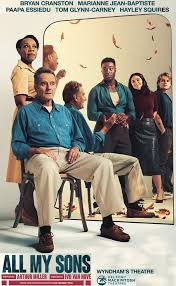
ALL MY SONS: NATIONAL THEATRE LIVE
A, 2026, 146 minutes, Colour.
Brian Cranston, Marianne Jean-Baptiste, Hayley Squires, Paapa Essiedu, Tom Glynn-Carney, Aliyah Odoffin, Cath Whitefield, Richard Hansell, Zach Wyatt, Charles Dark.
Directed by Ivo van Hove
This is the second National theatre live production of Arthur Miller’s 1947 play, All My Sons. The previous version, 2019, featured Sally field and Bill Pullman.
This time Brian Cranston, who established his reputation with television, Breaking Bad, and many film roles, plays Joe Keller, the ordinary American, manager of a plant during World War II, experiencing a cover up any inadequate product leading to the death of 21 pilots and his spending time in jail, his partner still in jail. This 2026 version features interracial marriage with Marianne Jean-Baptiste powerfully playing his wife, mourning the death of her son believing he will return, with a hold over her husband.
The other central character is the surviving son, Chris, played by Paapa Essidu (including a ring in his ear). This is a man of integrity, love and his father, believing the best, urging all those he knows to be at their best. Hayley Squires is the girlfriend of the deceased brother, but in love with Chris, waiting for his call, now visiting, separated from her father, Joe Keller’s partner, who is in jail. There is also her brother who resents the father, Tom Glynn-Carney, who visits his father and learns his version of what happened.
Other characters include the neighbours, an idealistic doctor who served in war, his money-preoccupied wife, the neighbours on the other side, the wife and daughters, the husband preoccupied with horoscopes, trying to prove that the alleged day of death of the older son was in fact a lucky day and he could not have died.
The set is very simple, rather dark, outside the entry to the house, at the opening, a tree falling to the ground during a storm, it remaining there as a large log, which means that the actors have to be walking around the log or walking over it, more than a touch distracting at times. There is also a huge circle above the door, like the sun or full moon, a light, and some of the characters passing by and the climactic event happening there.
The film shows Joe Keller, amiable, with the neighbours, supporting his surviving son who works in the company, strong relationship with his wife. The tension is with Ann, the older brother’s girlfriend arriving, the mother not wanting to hear of the death of her son, and in love with Chris and vice versa.
There are no intervals, only brief music (with music by Johnny Cash and Leonard Coen). There is a highly emotional scenes, especially with the mother, finally building up to the revelation of the letter by the older son written on the day that he died, knowing the truth about what his father had done. The mother is overwhelmed, so is Chris, his ideals shattered, questioning the possibility for his future – and the challenge of his judgement on his father.
His father’s final argument is family is more important, love for his sons, living with failure, but money and security being most important. When this is shattered, Joe weeping, beginning to face the truth, he makes his fatal decision.
All My Sons is to be seen in the context of Miller's following play, The Death of a Salesman, and the issues of race in A View from the Bridge. Miller is writing about ordinary Americans and families, the aftermath of World War II, the generation of fathers, their characters, work, family relationships, especially to their sons.
Book of Clarence, The
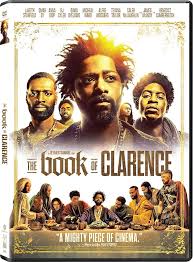
THE BOOK OF CLARENCE
US/Italy, 2023, 129 minutes, Colour.
LaKeith Stanfield, Omar Sy, R.J.Cyler, Anna Diop, David Oyelowo, Alfre Woodard, Teyana Taylor, Micheal Ward, Caleb MacLachlan, Marianne Jean-Baptiste, Eric Kofi Abrefa, James McAvoy, Benedict Cumberbatch, Chase Dillon, Nicholas Pinnock.
Directed by Jeymes Samuel.
The Book of Clarence can be recommended for all kinds of reasons, first of all, that it is nothing like what we might expect! It has been written and directed and musical score, by British musician, Jeymes Samuel, stage name The Bullits. His previous film was The Harder They Fall, a strong Western, a focus on black Americans in the 19th century, victims, dominating, urging the audience to look again at their familiar image of the American West.
The Book of Clarence is billed as a comedy biblical adventure! And it is. And, even though the focus is on Clarence, this can be seen also as a very strong Jesus film, though in plot terms, he is a supporting character.
Once again, the cast is either African-American or of West Indian descent. A glance at the cast indicates popular names like Omar see, David or no, Alfre Woodard, Marianne Jean Baptiste. The exception being Benedict Cumberbatch, playing Benjamin the beggar in the early part of the film and then being transformed, actually by Jesus himself, and making points about false Messiahs at the end of the film. James McAvoy leads the white cast of obnoxiously Roman soldiers.
But, back to Clarence, played engagingly by the very talented LaKeith Stanfield. In fact, the film opens with a kind of Ben Hur chariot race variation, introducing Clarence, avery 21st-century, in fact, in the Jerusalem neighbourhood, the Jerusalem “hood”. He is something of a con man, is in debt to a local loan shark, though in love with his sister, into drugs, but also more often into bad luck.
But, impressed by Jesus and his followers, especially since it turns out that Clarence is, in fact, the apostle Thomas’s twin brother (who is mentioned but not named in the Gospels). Clarence actually applies to the apostles to be the 13th but is turned down, Thomas himself very disdainful of his brother, and Judas urging Clarence to prove his worth by going to a gladiator school and freeing the gladiators – which means that we have besides Ben Hur, homage to Spartacus and gladiator.
But, what makes the Jesus connection even more interesting, and Jesus does appear very sympathetically at various times throughout the film, Clarence is impressed by acclaim for Messiahs and so sets himself up with his friends, refused baptism by John the Baptist, but nevertheless going around preaching, organising fake miracles, profiting highly.
But, can it last? There has been a spoiler right at the beginning of the film with Clarence being crucified. And in suffering, he parallels Jesus, and antagonistic young fellow actually help him carry the cross to Calvary. Clarence does have a conversion experience, compassion, charity beyond himself, some redemption.
It is then that Benjamin emerges, Jesus having giving him money, and a gift for multiplying money which Benjamin spreads around, Benedict Cumberbatch looking like a traditional image of Jesus, but self-seeking and a false Messiah.
The film ends very respectfully of Jesus, a visit to Clarences tomb, and hope of resurrection.
Not what we might have been expecting, but always interesting, entertaining, and, certainly, thought-challenging.
- Title, striking, biblical overtones? The work of the director, writing, directing, music, race issues?
- The locations for Jerusalem, the Italian town of Metairie and its presence in other biblical films? The vistas, buildings, the roads, the sea?
- The first century A.D. variation on Boys in the Hood, the Jerusalem Hood, drugs, gangsters, gambling, debts? Vengeance?
- The musical score, the range of songs, the final credits?
- The three chapters for the Book of Clarence? The introduction, Clarence and his mission, the crucifixion? The beginnings of the parallels with the Gospel story of Jesus?
- The acknowledgement of Roman Empire films, Ben Hur, gladiator…? The influence of biblical films, Jesus films? In the central character and Brian in the Life of Brian?
- The opening race, introducing Clarence, Mary Magdalene and her defiance, Elijah as Clarence’s friend? The chariot race in Ben Hur, the excitement, the Gypsy area, the intervention of Cabbage and his domination, the crashes, taking Clarence’s coat? The bond between a lighter and Clarence, as brothers, his reaction to the loss? The visit to Jedediah, the confrontation, Clarence and his attraction to Marigny, Jedediah’s sister? Her reticence, shyness? The banter between Clarence and Jedediah? The time limit?
- Thomas the apostle, called Didymus, the twin, in the Gospels? The imaginative interpretation of Thomas and his twin? Thomas, leaving their mother, following Jesus, stern, loyal to Jesus, 10 minutes older, but deriding his brother, a nobody, doomed to failure? Their various encounters? Clarence and his challenge, Thomas’s reaction to Clarence’s behaviour? Clarence and his visit to the apostles? His suffering and Thomas coming to apologise, reconciliation? Clarence and the scenes with his mother, his debts, after the race, her encouragement, smelly? Her reflections on his life, on Thomas? Encouragement on the way of the cross, at the crucifixion?
- Clarence and his fascination with Jesus, the significance of the visit to Mary and Joseph, Mary and her explanations, Clarence and the mistaking of the Immaculate Conception for the virgin birth, Mary and her convictions about God’s presence? Joseph, his presence, supporting Mary, calling Clarence a dumb ass?
- Clarence and his need to raise money, his observing of Jesus, the failed Jesus walking through the on guard, the claim of Messiah? Clarence, not believing in God, defying belief? His theory that knowledge was more important? But his idea of impersonating a Messiah, with the help of Elijah? His paralleling of Jesus miracles, raising the dead, curing the sick…, Elijah performing? The taking up of the collection from the crowd gathering? Believing him as a Messiah? His preaching, the effect on him, those collection of money?
- His visit to the apostles, the encounter with Judas, Judas and his taunts, urging him to go to the gladiator slaves, confront the torturer, get the release of the prisoners? Clarence going, the reaction of the torturer, singling out Barabbas, the challenge to the fight, Clarence and his moves, Barabbas and his reactions, the torturer allowing Barabbas to go? Barabbas joining the troop of the wood-be Messiah?
- The encounters with the Romans, white, their arrogance, the reaction to Barabbas, the officer and his javelin is, throwing them out Barabbas, Barabbas and his defiance, escaping, and his nickname of Immortal?
- Clarence, the effect on his charade, the slaves, getting a conscience, taking the money and buying back the slaves, freeing them? Judas and his response?
- The encounter with Jesus, Mary Magdalene, the adultery, the parallel of John chapter 8, Jesus and the stones, is suspending them in the air, their falling, defying the authorities, letting Mary go free, the friendship with her?
- Jedediah, the party, with Varinia, declarations to her, the upset, his feeling betrayed by her?
- The presentation of the Last Supper, acknowledgement of da Vinci’s painting? The two issue with Judas, betrayal, the scenes with the Jewish authority in the 30 pieces of silver, Judas and the promise of betrayal, at the supper, the issue of Mary’s gravy, the taste, his going out?
- Jesus, knowing he was betrayed, waiting for the moment, accompanied by Mary?
- His arrest, the Romans, the encounter with Pontius Pilate, Pontius Pilate and his manner, racial superiority, arrogance, interrogation, the sympathy with Clarence, Clarence and his commitment, defiance, the parallels with Jesus before Pontius Pilate? Condemned to be crucified?
- The visuals of the way of the cross, the Jesus parallel, the defiant crowds, his mother in the crowd, encouraging him, Elijah and the encouragement? On Calvary, the vivid nailing to the Cross, raised, Henning, hanging, the presence of Benjamin, the past encounters with Benjamin and his spurning him, not recognising him, Benjamin and his worldly defiance? The Romans, the decision to pierce Clarence’s side? Again the Jesus parallel?
- Benjamin, the begger, spurned by Clarence, the later scenes of his banking, the encounter with Jesus, the money, his clean himself up, becoming like the traditional portrait of Jesus, his gift of being able to multiply the money? His arrest, a false Messiah accusation, being crucified?
- Clarence, the burial, the stone, the breaking up of the stone, Jesus entering, tender with Clarence, raising him to new life? Immortality?
- The overall effect of the film, the serious, the comic touches, the criticisms of blasphemy, the Christian defences against accusations of blasphemy? The enjoyment of a biblical epic? Jesus figure treated seriously and with respect? And Clarence paralleling Jesus and becoming a Christ figure?
Hard Truths

HARD TRUTHS
UK, 2024, 97 minutes, Colour.
Marianne Jean-Baptiste, Michele Austin, David Webber, Tuwaine Barrett, Ani Nelson, Sophia Brown, Jonathan Livingstone.
Directed by Mike Leigh.
Mike Leigh has been a significant writer-director in British cinema for many decades, creating the screenplay, getting his cast to improvise to create the dialogue. He has won many awards. He has made a great impression by dramatising British life – awards for films like Naked, Secrets and Lies, Another Year, Vera Drake… And he also made historical dramas especially Topsy-Turvey on Gilbert and Sullivan, and Mr Turner, about the artist.
This is a film from Mike Leigh in his 80s, delayed by the covid experience, partly financed from Spanish sources. But, it is set in London, in suburban streets and houses, looking around the district, in Trafalgar Square, but also in homes, hairdressers, doctors’ surgeries, the dentists, supermarkets, the areas of ordinary life.
The central characters come from families originally from the Caribbean, close-knit. But, they are seen in the context of contemporary British multicultural life.
At the centre is a middle-aged woman, Pansy, an extraordinary performance from Marianne Jean-Baptiste, so effective in Leigh’s Secrets and Lies. One reviewer referred to a “knockout performance”. Not entirely wrong because the nature of the performance is the knockout expression of Pansy’s continued anger, focused on herself, resentful, critical, unable to see the good in others or anything, and prone to extraordinary verbal outbursts which, for some may seem very funny, but for others may seem very serious, and concern about Pansy’s mental health.
At home, she is fussy, obsessively tidy, door shut, fears of insects, alarmed at a fox in the garden, continually criticising her long-suffering husband, a builder, continually criticising her 22-year-old unemployed son. She is concerned about her health, wants to sleep, continually angry.
A significant time is Mother’s Day, her cheery sister who has two lively daughters, is a hairdresser who looks after her sister but also becomes the butt of criticism, suggests they visit their mother’s grave at the cemetery. Pansy uses all kinds of excuses to delay her decision but eventually goes, is unhappy at the cemetery is her sister cares for the grave, reminisces about her mother’s severity and favouritism of her sister. She is persuaded to go to her sister’s house for dinner, her husband and son there, she refusing to eat, silent and critical while the others try to cope. But, this is to be something of a breakthrough, some moments of hysterical laughter, weeping – but will this be enough?
There is audience sympathy for the husband, silent and long-suffering, a back injury at work, a moment with a tear. And puzzle about the son, wondering whether he is on the spectrum, silent, in his room, computer games, books about planes, model plane.
Leigh’s home dramas are slices of life. And, in real life, Leigh is he something of a curmudgeon himself and we wonder about what is projecting onto the character of Pansy and what he is saying about life’s hard experiences.
- Mike Leigh film, expectations? The title, hard, grim – but the truth?
- The British settings, suburbs, homes and streets, buildings sites, offices, wandering central London, the hairdresser’s…? The musical score?
- The focus on British citizens, originally from the Caribbean, traditions, families, connections, language?
- Issues in multicultural England?
- Pansy Duncan, her story, her background, age, marriage to Kurtly, the years, attitude towards her son, Moses, her contact with her sister, styling hair, the conversations, her nieces?
- Pansy, angry with the world, the reasons, memories of her mother and criticisms of her mother, her mother relying on her, her sister the favourite? Expectations? Relationship with her husband, demands on her son, her fastidious cleaning, keeping the door shut, insects, seeing the fox? The daily routines, wanting to sleep, concentration on her health, everything focused on her?
- Marianne Jean-Baptiste at her performance, screen presence, her outbursts, verbal, complex, edge, at home, in the street, at the supermarket, inspecting the sofas and the attendant, and her hurried exit from the store, her behaviour towards the doctor, towards the dentist? Unrelenting? Audience response to such outbursts? Hearing them as funny? Hearing them as serious? Concern about her mental health? And her inability to get help, receive help?
- Kurtly, quiet, patient, at work, with Virgil, Virgil and his conversations, the details of their work, curtly coming home, the harsh reception, criticism of him snoring, her time in bed, not preparing the meal, the getting the chicken take away? At work, his back, Virgil helping him home, Pansy and her reluctance to help, his sitting quietly, his tear?
- Moses, age, no job, perhaps on the spectrum? Playing the games, books on planes, the model plane? Wandering around, his being taunted by the boys in the street? Mother’s Day, the continual attacks by his mother, his continued eating? Size? Buying the flowers for his mother, her reaction? With his cousins, the meal? His finally going for the walk, sitting in Trafalgar Square, the pleasant young woman, offering the sweets, talking, his smile? Future?
- Chantelle, at the salon, her charm with the customers, the chatter? With Pansy? Doing her hair? The conversations? The arrangement to go to the cemetery, Pansy on and off, sharp with her sister? The phone calls? Her dressing up, going, the episode at the cemetery, the flowers, Pansy sitting back, observing, not wanting to be there, the memories of their mother?
- Chantelle persuading Pansy to come for Mother’s Day, her daughters and cheeriness, the meal, Kurtly and Moses, at the table, Pansy and her refusal to eat, joining in the toast, leaving the room, Chantelle talking, not eating?
- Pansy and her outburst, laughter, tears? Some release? But not enough? Going back home, the same thing happening again?
- Chantelle’s daughters, seeing that work, discussions about the perfume, the haughty manager and her comments, the sympathetic manager? The other daughter, in the office, having to alter the files? The playfulness at home with their mother?
- A slice of life in the Mike Leigh fashion?
