Displaying items by tag: Sydney Sweeney
Christy
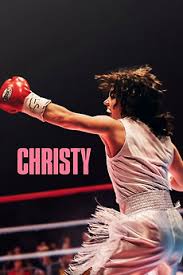
CHRISTY
US, 2025, 135 minutes, Colour.
Sydney Sweeney, Ben Foster, Katie O'Brien, Merritt Wever, Chad E. Coleman, Colman Pedigo, Ethan Embry, Jess Gabor, Bryan Hibbard.
Directed by David Michod.
Who is Christy? This would certainly have been an unanswerable question in 1989 when this film opens. But, during the 90s and into the2000s, Christy Martin became very well-known as a/the top female boxer in the US. And, this is her story.
The film is also a star vehicle for Sydney Sweeney (very successful in recent years in such films as Anyone But You, Immaculate, The Housemaid). This is her story from 1989 to 2010, something of a rags to riches tale but much more in terms of American sport as well as Christy’s own life.
Christy Salters is the daughter of a West Virginia coalminer, a quietly sympathetic father, a somewhat haughtily dominant mother, a supportive brother. She enters a boxing competition, a bit of a smash and bash through approach and wins. But, there is tension at the family table – especially because Christy has begun a relationship with her friend, Rosie, and her mother mightily disapproves. This theme will run through Christy’s life over the coming 20 years.
But, a boxing scout has seen her, recommends her to meet a coach, Jim Martin, who initially is offhandedly interested until he sees her potential talent, agreeing to coach, gradually taking possession of her career, of her life, proposing that they marry and work as a team, her agreeing despite herself.
Jim Martin is played by the talented Ben Foster, whose extensive career contains a number of screen villains, this one initially restrained but enthusiastic even as he trains her, finds fights for her, relishes her success – but, as with so many such stories, his wife’s abilities shine and he is forced to move more into the background with some devastating results.
But, the 1990s did not have a great number of female boxers. Christy is brought to the attention of entrepreneur Don King who takes her on, has her fight on television pay per view bouts.
As expected, there are many training sequences, fights, Christy becoming more and more confident, aggressive, boastful and challenging at press conferences, female boxers becoming more and more accepted, she becoming a national champion. In 2003, she has to fight Laila Ali, the daughter of Muhammed Ali, a crisis point in her career.
Sydney Sweeney is able to communicate the character, the pugnacious abilities, the talent for professional boxing.
In the final dramatic sequences of the film, 2010, there are huge crises in the relationship between Christy and Jim Martin, a violent atmosphere, her making contact again with her friend Rosie, the relationship issues arising, and no sympathy from her mother who idolises Jim Martin.
Which means that the latter part of the film is unexpectedly highly dramatic, challenging.
And, as with films based on actual characters, there is further information about Christy’s life after these events and some photos of the actual Christy Salters.
- Based on a true story? The world of boxing? Female boxers? The 1990s and the 2000s?
- Re-creation of the period, West Virginia, mining country, towns, homes? The contrast with the world of boxing, the various tournaments, venues, stadiums, theatres, gyms, offices? The transition to Florida, homes, affluence? Hospitals?
- The story of Christy, the opening, her place in the family, her relationship with Rosie, the attitudes towards lesbians, her relationship with Rosie? Her mother’s disapproval? The discussion about seeing a priest to set it right? The quiet father, the supportive brother? The silence of the table, the mother’s dominance?
- Christy seen at the fight, the knockout, her success, the money? Observers, seeing possibilities?
- The screenplay and taking key periods in Christy’s life, 1989 and the beginnings, 1995 success, 2003 crises and challenges, 2010 and the attempt on her life? The audience filling in the times in between?
- Her being scouted, to the gym, the first encounter with Jim, his disregard, forced to observe her, looking down on her, see her skills, his decision? Christy and her age, decisions, leaving home, enjoying her skills? The difficulty of the relationship with Rosie, disapproval of lesbians out of the closet?
- Christy and the details of her training, persistent, her skills, Jim training her, the others observing, helping her, Jeff and his sympathy?
- Jim, his personality, moving in with Christy, coaching her, his techniques, the personal regard, the proposal, her agreeing? Together, at home?
- Getting the fights, her tough attitudes, victories? The effect on her?
- The plan to meet Don King, his reputation, personality, Jim and his being put in his place, Don King and his response, the contracts, control, his associates, the buildup to her fights, pay-per-view, the opponents? The press conferences and her being forthright? Her nervousness, the buildup to the first part, Jim and his support? The opponent, the challenge, her victory? Her reputation?
- Her success, the role of Jim, his being put in the background, difficult times, the tension of the relationship? The buildup to the bout with the daughter of Muhammed Ali?
- The background of the fight with Lisa, Lisa and her personality, Jim getting her to train with Christy? Christy’s initial reactions? The time together, Lisa genuine? The impact for Christy? The buildup to the fight, the fight itself, her defeat? Being told off by Don King?
- Time passing, her success, controlled by Jim, concealing facts, not organising fights? The meetings with Rosie, Rosie and her support? The family, the continually going to the fights, the father’s pride, the support of the brother, the mother and her problems, being charmed by Jim?
- Christy, Jim and his personality, resentments, his brutal treatment at times, punching her, threatening to kill her? Talk with Rosie, her moving home, no support from her mother?
- Her return, the confrontation with Jim, his knife, stabbing her, on the floor, his shooting her, having the shower, her getting herself up, the car taking her to the hospital, the treatment, her recuperation?
- The aftermath of the attempt on her life, wanting to fight again, going to the gym, the support of the people at the gym, especially Jeff and his support throughout, his warning her, helping her?
- The gym, her being part owner, the future? The trial, facing Jim in court, her aggressive declarations? Putting it in the past?
- The family photos, photos with Lisa, information about her career, training, marrying Lisa, her social work for abused women?
Housemaid, The/ 2025
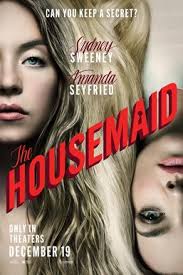
THE HOUSEMAID
US, 2025, 131 minutes, Colour.
Sydney Sweeney, Amanda Seyfried, Brandon Sklenar, Michele Morrone, Indiana Elle, Elizabeth Perkins.
Directed by Paul Feig.
Movie thriller fans may remember that titles which included maid or housemaid usually had sinister goings-on in the household. And audiences venturing out to see this version of the housemaid will not be entirely wrong. But, not in the way they might have expected.
The film opens with a young woman, Millie (Sydney Sweeney, anyone but You, Christie, Immaculate), driving up to a lavish mansion outside New York City for an interview with the lady of the house, Nina (Amanda Seyfried). Millie is warmly, exaggeratedly, made welcome, instantly hired, accommodation in the house, care for Nina’s daughter, anticipation of meeting her successful husband, Andrew. So, the opposite of sinister.
But…, the next day…
Millie really needs the job. She is on parole from a long sentence (explained later in the film), and is at pains to do the best she can. But, of course, from day to day, it is not enough, and it is Nina who is the character with the bizarre behaviour. Her charming husband, Andrew (Brandon Sklear) tries to support Milly. There is a complication in Nina’s little daughter obviously disliking Millie.
Just as the audience thinks the film is going in a relentlessly predictable direction, it certainly doesn’t!, Into the expected, there are all kinds of developments, some flashbacks, some past explanations, some twists and revelations.
Which means, of course, that any review has to stop any plot indications at this moment – except to warn audiences to expect the unexpected.
The film offers two tour-de-force performances by the two leading actresses. Brandon Sklenar is tall dark and handsome – and the object of envious gossip by the affluent mothers of the local PTA. Elizabeth Perkins has a cameo role as his haughtiest and most demanding of mothers.
As it turns out, The housemaid is a much more interesting and involving thriller than we might have anticipated.
- The title and expectations? The focus on the maid, the focus on the house, the owners?
- The mansion, the exteriors and the grounds, the vast interiors, furnishings…? The contrast with the parole office? The ballet school, the shops, the Broadway theatre, the lavish hotel? The funeral ceremony? The atmosphere for this kind of thriller? Atmospheric score?
- Audience expectations, the role of the maid, the onus? The predictability of the plot development? The sudden twist, unpredictable? And the building up of twists and explanations? The climax and the solution?
- The focus on Millie, her arrival, the car, the mansion and the grounds, the interview with the Nina, her exuberance, instantly hiring her, the tour of the house, introduction to her daughter, the upstairs room and the need of the window opening, the deadbolt and a key? The arrival of Andrew? The visit of his stern mother? And the opening sequences reinterpreted in the light of later explanations?
- Millie, revelation of the parole, the interviews, her need for a job, the accommodation, staying with a family? The later revelation of her crime, the man attacking the student, her killing him? The sentence and her serving it? Her behaviour in the house, cleaning, cooking, the hostility of the young daughter, the gradual revelation of Nina and her temperament, harsh commands, contradictory commands? Writing her journal?
- Andrew, his taking her side, comforting her, the expenses and his repayment? Nina giving her the lavish clothes? Again in the light of later explanations?
- Nina, her erratic behaviour, moods, angers, devotion to her daughter, the treatment of Millie, picking up her daughter, the clothes, the possibility firing, Millie cleaning, Nina relenting, the support of Andrew? Nina and the notes for her speech, accusing Millie and throwing them out, the meeting with the mothers and their gossip, their liking Andrew? Millie hearing everything?
- Nina, being away with her daughter, the booking for the theatre, the hotel, Andrew persuading Millie to go, the sexual encounter? The phone, the fact that Nina was seeing everything? Her return, Andrew ordering her to leave? Her storming away?
- Nina, meeting with her daughter, composing of the letter for her to read, the narration and the new interpretation of what had happened, the flashbacks, her pregnancy, at the office, the humiliation, Andrew supporting her, the relationship, the wedding, Andrew’s mother? The issue of pregnancies, Andrew’s wish, the buildup to the clashes between them, a different interpretation of what had happened, the issue of her hair and the colour roots, his locking her in the attic, the transformation of his character, abusive, self-centred, the demand for the hairs and follicles, making Nina do it again, her desperation?
- The revelation of Nina, knowing all about Millie, the plan,? Her intentions?
- Millie, Andrew supporting her, the issue of the crockery, his mother, the bonding between them? Her infatuation with Andrew?
- Andrew turning on Millie, locking her in the attic, the same treatment as for Nina, his demand about cutting herself? Doing it? The gardener at the door, Millie dropping the plates, packing, not washing the pieces, the bag, Andrew giving her the piece to cut herself?
- His unpleasant character, the taunts, self-centred? Millie having the knife, her attack on him, locking him in? Her demand, the issue of the front tooth and his charm for women, the pliers, pulling it out?
- Nina, coming back, to rescue Millie, for the truth? Her mistake, unlocking the door, Andrew escaping, pushing Nina down the stairs, the meeting of the two women, their collaborating, Nina urging Millie to run, the confrontation of Andrew, pushing him over the banister, his death? The help of the gardener to tidy the situation?
- The police, the interrogation of Nina, her plausible story, the police officer and the story of her sister, Andrew destroying the sister, the policewoman and the wound in the neck, creating a plausible accidental scenario?
- The funeral, Andrew’s mother, her speech about teeth, the mothers and their commentary and gossip?
- Millie, at the funeral, Nina and her daughter leaving, Millie applying for the job, needing giving the recommendation? The new wife talking about difficulties with her husband…, The knife…?
Immaculate
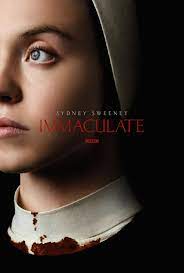
IMMACULATE
Italy/US, 2024, 89 minutes, Colour.
Sydney Sweeney, Alvaro Morte, Simona Tabasco, Benedetta Porcaroli, Dora Romano, Giulia Heathfield de Renzi, Giuseppe, Lo Piccolo.
Directed by Michael Mohan.
When Christians hear the word “Immaculate”, they usually think of the Virgin Mary, perhaps remembering the Immaculate Conception or the Virginal Conception of Jesus – many confusing the two. And the connection for this film, Immaculate? The connection is correct. Many Catholics would be interested in knowing what the connections in this film are, especially when they discover that it is, basically, a horror film.
This review will first make a comment on how it works as a horror film as such – which is how it will be viewed by most audiences around the world, audiences not familiar with the Catholic themes, viewing it without much awareness of the references. In fact, looking at the immediate response by bloggers and commentators on the Internet Movie Database, most of them do not mention the religious themes at all, for them it is another horror film.
So, a horror film. It is well-made, an initial shock of a character buried alive, the background of Cecilia, the central character, her arrival in Italy, a sense of foreboding, strange characters, dreams, her becoming a victim, pregnant, the mystery behind the pregnancy, her revolt, increasing blood, shocks, grim deaths. As a horror film, within its genre and conventions, above average.
Then the Catholic atmosphere of the film. One is tempted to state “over-the-top” or, even “bonkers”. The background of Cecilia (Sydney Sweeney) is well-established, a childhood accident in the ice, saved, her feeling of God choosing her for a vocation, her parish closing for lack of parishioners, the invitation to travel to Italy, to a convent, making her vows and working with young nuns assisting in aged care for a large number of elderly sisters.
Not what you would expect, especially a number of odd characters, the large number of elderly sisters and care, some bizarre behaviour, rather sect -like community with its own resident Cardinal, priest chaplain and deacon.
But, halfway through, the plot has an unexpected revelation that moves it out of what seems to be supernatural invention to the reality of bizarre science fiction, a convent variation on the Rosemary’s Baby theme.
For interested Catholic audiences, the plot twist demands attention and leads into the realm of religious fanaticism and expectations of the Second Coming. These themes will find their place (and analysis) in future articles and books on films with Catholic themes.
For horror fans, yes. But not for those who do not like films they see as exploiting the Church. But, despite the bonkers, it does have interesting religious themes.
- Blend of horror and religion? Catholic traditions? Sect communities and aberrations? The opening, the nun getting up, trying to escape, the locked gate, her being buried alive?
- The title, overtones of the Virgin Mary, the virginal conceptions? Nuns and the vows of chastity?
- The American background, Cecilia, her life and the parish, the accident, saved, sense of called by God? Travel to Italy, the deacon meeting her, travel to the countryside, the imposing building, aged care for the sisters, from 1632, the catacombs underneath? The large community, the aged sisters, the younger sisters and their care? The resident priest? The resident deacon? The resident Cardinal?
- The Catholic traditions, but inventions by the writer, the nature of the convent and community, behaviour, rituals, chapel, prayer, the choir, the rooms with the nuns, the habits, the young nuns, the making of vows? Community life?
- The musical score, Schubert’s Ave Maria?
- Cecilia, age, experience, goodwill, the powers, the encounters with Isabelle and her severity, the encounters with Gwen, smoking, swearing, her past story, attitudes? The older sisters, attending them, dementia, physical illness, deaths? The role of the Superior, severity?
- The dialogue in Italian, subtitles, the dialogue in English, Cecilia not understanding Italian?
- Cecilia, her dreams, the sinister? Time passing, the ups and downs? The discussions with the priest, his enthusiasm and encouragement? The Cardinal, his presence at the convent, receiving the vows, Cecilia kissing his ring, the deacon and his work?
- The interrogation of Cecilia, intrusive, sexual behaviour? The revelation that she was pregnant? The reaction of the sisters, dressing her as the Virgin Mary, veneration, special meals, treatment? Isabelle and her reaction? When?
- The change in the middle of the film, the revelation of the laboratory, the symbolism and reality of the name nail, brought by St Helena, the relic of the blood and bone of Jesus? The laboratory, the priest and his genetics and science training, the deacon assisting, the impregnation of the nuns? For a birth of the Messiah? An aberrant faith?
- The explanation of the nuns with the red feet, Cecilia and the symbol burned onto her foot, the tour of the laboratory, the range of foetuses, failures over 20 years, the range of nuns in the conference, the elderly and the experiments? Isabelle and her suicide?
- The signally of the trimesters, the effect on Cecilia? The community? Everybody venerating her?
- The pregnancy, coming to tern, the effect on Cecilia, behaviour of the nuns, the control of the priest, the doctor, the cardinal, Cecilia and her mental condition, physical? Wanting to escape?
- The buildup to the combination, Cecilia and her brutal attack on the Superior, strangling the cardinal, in the laboratory, the role of the priest, locking him in, his seizing her, the bloated, as beginning a cesarean cut, Cecilia’s attack on him, his being burnt and escaping? Fleeing through the catacombs? The terror, the pursuit, the final confrontation?
- The catacombs, the dead sister, final escape, giving birth, her reaction to the child, holy or demonic, getting the rock, crashing the child?
- The film working as a horror film irrespective of the religious themes? The use of Catholic themes and Catholic and religious response?
Madame Web
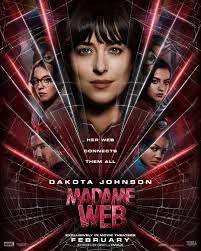
MADAME WEBB
US, 2024, 117 minutes, Colour.
Dakota Johnson, Sydney Sweeney, Isabella Merced, Celeste O'Connor, Tahar Rahim, Emma Roberts, Adam Scott, Mike Epps.
Directed by S.J.Clarkson.
This tale is almost the exact opposite of the Marvel Universe adventures. It is the villain who has the powers – and the lead, Dakota Johnson as Cassie Webb, has no superpowers except for some anticipatory glimpses of the future. As she says, she can see the future, “kind of…”.
This film was produced by Sony which seems to have the rights to Marvel stories connected with spiders, all the Spiderman films, the Venom films as well as Morbius. And, at one stage, someone does a riff on the well-known statement, this time the great responsibility has power!
This time Marvel has given us something of a Girls Night Out show – not too much to appeal to macho Marvel fans.
This is the Tale of the Threatened Three, three initially annoying and self-preoccupied 16 or so-year-olds (which does continue for a bit), targeted by a power-hungry maniac. His played by Tahar Rahim, a long way away from his excellent roles in French films. It is he who is the Spiderman variation, costume, mask, climbing walls, walking upside down on roofs, leaps from vehicle to vehicle – but no web.
Cassie Webb is an efficient New York fire department paramedic, working alongside the very nice Adam Scott whose sister-in-law, Emma Roberts, is pregnant and will provide an urgent setting for the climax. But Cassie has some strange hallucinatory moments, déjà vu as reality catches up with her glimpses. An accidental falling into the river in a locked ambulance leads to mysterious underwater lights and experiences. She doesn’t know why.
But, we do. We have seen the prologue to the film, in Peru, 30 years earlier, her pregnant mother searching for an exotic spider with mysterious healing powers. She is betrayed by her partner, Ezechiel (Rahim) who makes off with the spider, but has visions of three teenagers who will threaten his life. He has amassed a city-wide super surveillance system and goes in pursuit.
At one stage, Cassie trains the girls in CPR. Seems a bit tame – but, of course, it will be a key to saving Cassie after Ezechiel goes up in a spectacular explosion in a large fireworks factory – and crushed by a huge Pepsi Cola sign – Sony and Pepsi have an extensive promotion contract and business partnership.
Pregnant mothers and daughters, baby showers, teenagers flirting, female heroics…, As Marvel Universe tales go, a bit moderate.
- The Marvel Universe, a different perspective, female perspective, different presentation of superpowers?
- The film’s failure at the box office, the decline of the Marvel films?
- The reworking of the plot from the comics, the focus on Cassie, age 30, not having superpowers, strong personality, working with the New York fire department, paramedic, Ben, collaboration, driving, tending the wounded, banter? Responsibilities? Establishing her character, strong, then the moments of clairvoyance, déjà vu as reality catches up? A different lead for the Marvel Universe?
- The prologue, Peru, 1973, constant, pregnant, working with Ezekiel, the search for the spider, her finding one, the betrayal by Ezekiel, his violence, his escape with the spider? The local people, the spider people and their appearance, the shaman, her giving birth, her death? The baby in the water and the mysterious light and atmosphere?
- Ezekiel, 30 years later, his power, the elaborate surveillance system and his assistant, his vision of the three teenagers who will destroy him? His quest to find them?
- Cassie, the female atmosphere, the baby shower, the guessing game, her reluctance? The introduction to Mary, Ben’s care of her, Mary later appearing, about to give birth, the ambulance, the crisis?
- The clairvoyance, seeing the future, a kind of…? Her bewilderment? Trapped in the ambulance, into the river, the water, the lights, the effect on her?
- Cassie, the subway, finding the three girls, the threats, Ezekiel as the Spiderman variation, the pursuit? His vengeance?
- Cassie, with the three girls, their age, self-preoccupation, irritating to Cassie and the audience? Taking the cab, the bewildered driver, out into the countryside, telling them to stay? Her going to research her mother’s notes?
- The three girls, the different personalities, their backgrounds, neglected by their parents, selfish? The influence of each on the other? The decision to go to the diner, the food, flirting with the boys, dancing? Cassie, the research, returning, crashing the car into the diner, taking the girls, hiding them? Their becoming more compliant?
- Cassie and the trip to Peru, the bus, the countryside, the encounter with the shaman, learning the truth about her mother, her potential illness, the mother looking for the spider, to help Cassie’s health? The promise of the shaman to continue to help her?
- Ezekiel, on the trains, leaping from vehicle to vehicle, on the roof…? No web!
- The hospital emergency, the ambulance, making all the light screen, the crashes, Mary and the birth of the baby?
- The buildup to the climax, Cassie taking the girls to the previous site of the explosion, the fireworks factory? Setting up Ezekiel? And the request for the helicopter for the rescue?
- The climax, the fights, the confrontations, the girls, Cassie, memories of her mother, the fights, the explosions, the Pepsi Cola sign, crashing Ezekiel?
- All reconciled? Cassie and her future? Seeming indications of the three girls and superpowers, and the link with Madame Web?
Anyone But You

ANYONE ABOUT YOU
US, 2023, 103 minutes, Colour.
Sydney Sweeney, Glenn Powell, Gata. Alexandra Shipp, Hadley Robinson, Dermot Mulroney, Rachel Griffiths, Bryan Brown, Michelle Hurd, Charlee Fraser, Joe Davidson, Darren Barnett.
Directed by Will Gluck.
Romcoms! Their success depends on whether we want more romance or more comedy.
Shakespeare, over 400 years ago, offered a title, perhaps a definition: Much Ado about Nothing. (But he also offered a comedy of errors and stated that all’s well that ends well.) And, despite appearances and less than Shakespearian dialogue, Anyone but You is a contemporary, slight re-working of Much Ado, a Shakespeare quote to begin with and quotes turning up in all kinds of places to keep us on track.
Actually, Shakespeare had tried the basic plot but seems to have awarded the winner of the battle of the sexes with the less than equal macho title, The Taming of the Shrew. And there was a nine updated version called To Things I Hate about You, which it also serves as a title here.
It all starts in New York City and an amusing toilet-seeking disaster, one way of bringing Bea and Ben (as we remember Beatrice and Benedict of old) together, a quick bonding, then misunderstandings and hostility, or, rather, enmity. They are played with enthusiasm by Sidney Sweeney and Glenn Powell.
In fact, most of the action takes place in Sydney, all the characters are gathering for Bea’s sister, Halle and her wedding to Claudia. But Bea is something of a disappointment and her parents always intervening, making suggestions, wanting to control. So, in Sydney, multiple glossy appearances by the Harbour Bridge, the Opera House, the harbour and ferries – and a koala! And, heavens, there are Bryan Brown and Rachel Griffiths, he Claudia’s father, she Halle’s mother, with Gilbert Mulroney as her husband..
Writer-director, Will Gluck (comedies from Easy A to Peter Rabbit) tries to make the comedy broad enough for everyone (and does) but there are many jibes of antagonism hoping that this will be as you like it.
At one stage, a character remarks that something is “stupid but nice”. Yes, more or less.
- Romantic comedy? American style? 2023? And action in Sydney? The Australian tone?
- Based on Shakespeare, Much Ado about Nothing, the quotes and signs of themes throughout the film? Bea and Ben?
- The introduction to Bea and Ben, Shakespearian expectations, New York in the 2020s? The situation, Bea and the toilet, at the counter, Ben and his intervention, smooth talking, their walking, going home, his cooking, chatting, the night, her stealing away, returning, overhearing Ben’s derogatory remarks, upset? Her contacting her sister and friends?
- Six months later, the club, the party, the prospective marriage, Claudia and Halle, Halle as Bea’s sister, Peter and the connection, Bea and Ben meeting, immediate hostilities?
- The marriage in Australia, the flight, the two on the plane, Bea getting the cake, tangled in the seat? At the airport, Peter driving? Taken to the mansion, Sydney’s northern beaches?
- The insertion of location photography, the harbour bridge, the Opera house, the harbour, even the koala? Attraction for American tourists? But the difficulty of Beau, the rather dumb Australian hunk!
- The introduction to Claudia’s family, her genial father, her mother, family relationships, Australian? The introduction to Bea and Halle’s parents, very American, concerned about their daughter, their ambitions, controlling and interfering, law, not certain, secretly withdrawing? Her relationship with Jonathan, the break, her parents inviting him to the wedding, his awkwardness, the parents pressure?
- The sequences of tension between Bea and Ben, the taunts, the wisecracks, animosity? The plans to bring them together, Peter and Roger and their drama for Ben? Claudia and Halle for Bea? The couple realising what was being planned?
- The decisions, to appear as a couple? Conversations, pretence and then back to reality? The expedition to the country, the koala, the spider in Ben’s pants, the naked episode? The contrivance about the sunglasses on the yacht, swimming out? Issues of swimming?
- The portrait of the parents, the Australian laid-back, the interfering Americans? And Jonathan in the middle?
- Margaret, the past relationship with Ben, her being with Beau, provocative, wanting to rekindle the friendship, the various interventions, her being cautious, kissing Ben and Bea seeing it and misinterpreting?
- Beau, Australian slang, the shower sequence, uninhibited, sports, immoral not to go for the best wave to surf!
- Preparations for the wedding, travelling to the boat, the party, the Titanic joke, Bea in the water, Ben diving in, the helicopter rescue?
- The buying of the cake, returning home, the dog, the ribbon, the upset with the cake? The impact on Claudia and Halle?
- The buildup to the wedding, Roger presiding, his words about love, the declarations? The celebrations?
- Bea and Ben, getting closer, the kiss, the realisation, the night together, his sudden leaving, her misinterpretation? Hostility, leaving and going for a walk?
- Ben, the promise of meeting at the Opera House, going into the water, the rescue, deliver to the Opera House, the various proposals, his proposing?
- A happy ending all round, all’s well that ends well, Shakespearian ending, and many comedy of errors along the way, parents behaving well, the finale of a Romcom?
Reality
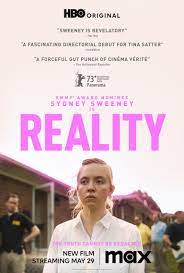
REALITY
US, 2023, 82 minutes, Colour.
Sydney Sweeney, Josh Hamilton, Marchant Davis, Benny Elledge, John Way.
Directed by Tina Satter.
Approaching this drama, about a whistleblower in 2017, a former member of the American forces, working as a linguist in the National Security Agency in Augusta, Georgia, we might think of the realities and ambiguities in the era of the Trump presidency, and realise this would be a good title, trying to come to grips with the reality of IT espionage and hacking and its exposure. And it is. However, on the very practical level, the central characters real name is Reality, Reality, Leigh Winner. And the irony of her surname, Winner, is not lost when she loses her case.
Originally a drama by Tina Satter, produced in 2019, during the Trump presidency, it is now an 82 minute film with screenplay by the director herself, but using the transcripts from the FBI interviews with Reality Winner when the have come to her house to question her. The film also uses the device of showing the text of the interviews as well as the screen monitoring the sound of the interviews. There is also another device, where aspects of the interviews are blacked out, the characters disappear momentarily from the screen. It is intriguing how this structure based on the interviews works dramatically.
Audiences watching the film may be thinking of Edward Snowden, Julian Assange, Chelsea Manning, the whistleblowers, the circulation of information, right or wrong…
Sydney Sweeney is very effective in the central role of Reality Winner, coming home with the groceries, finding the FBI, acquiescing in their interrogation and search of her house, quietly innocent, then the truth gradually revealed, her taking a document from the office, posting it to a magazine, her motivations, the issue of Russian hacking in the 2016 election, statements from the Trump administration, her reactions. While there are a few flashbacks to the office and her taking the document, most of the action is in the front yard and then in a furniture-less room in the house, making her composure and then lack of composure more credible and her admissions of what had happened. As audience, we observe, we listen, we puzzle, our sympathies are challenged, our integrity about right or wrong and whistleblowing.
While we can listen to the recordings, it is dramatically fascinating to watch the two central FBI agents, Josh Hamilton and Marchand Davis, the method they use, Marchand Davis and a certain sympathy with challenge, the main work for Josh Hamilton, laid-back, friendly, yet gradually becoming more penetrating in the questions, revealing what is known, making demands on Reality. It is also fascinating to watch the body language between the two agents, a nod of the head, an eyebrow raised, quick indications as to how to act. The other agents on the job, guards, the men searching the house, are not subtle at all.
It is on record that Reality Winner did go to jail, the irony that the information she sent to the publication for exposure was actually used on the floor of the House of Representatives soon after.
While the play was written and performed while Donald Trump was President, this film version is interesting to watch in terms of his bid for the 2024 nomination, the aftermath of the January 6th Capitol uprising, and the various charges being brought against him including, ironically, his taking of secret documents to Mar el Lago and the legal implications of this for him.
There have been several films about Julian Assange and Oliver Stone’s Snowden, with this film a helpful addition.
1. Title? The realities of espionage, international hacking, issues of treason and charges, in prison, the context of the 2016 presidential election campaign? And the fact that the central character, a whistleblower, was ironically called Reality and have the family name of Winner?
2. The screenplay based on a play, performed in 2019 during the Trump presidency? The film version released the year before the 2024 presidential campaign, the ambitions of Donald Trump, the charges against him, his enormous Republican support?
3. The screenplay based on transcripts of interviews between the FBI and Reality Winner? The visualising of the texts at times? The visualising of the soundwaves? And, at times, the blacking out of sense of material? And the disappearance of characters from the screen while these words were spoken?
4. Audience knowledge of the situation, stances towards Donald Trump, James Comey, the FBI and his rule during the presidential election, with Hillary Clinton, and his dismissal as FBI head, the presidential campaign of 2016, these events happening in the first half of the first year of Trump? The documentation about Russian hacking, interference in the election? Reality Winner and circulating the secret document, and the irony that as she went to prison, the issues were being discussed in Congress?
5. The action of the film, the suburban house in Georgia, the yard and the meeting with the agents, going into the house, so much of the action taking place in the empty room, no furniture? A touch of claustrophobic effect?
6. The nature of the performances, acting the words of the transcripts? The added advantage of performance, the FBI agents, their body language, threats, calm, encouragement, eyebrow raising, hints in movement…? And the body language of Reality, confident, the interrogations, gradually admitting the truth, worn down, nowhere to sit, the floor, a glass of water, the combination for her?
7. The effect for the audience seeing some flashbacks, Reality in the office, at work, the decision to take the document, her concealing it, the envelope, posting it?
8. Audience attitudes towards whistleblowers, the tradition of Assange, Manning, Snowden, the US government and imprisonment?
9. The portrait of Reality, just seeing her over the space of 90 minutes? The characters of the FBI agents, in charge, quiet, knowing the results but gradually eliciting the confession from Reality? The good agent-bad agent routine? The big agent and his supervision? The silent agents in their searching the house?
10. The overall effect of this experience, the personal look at Reality Winner and her attitudes, further career, her wanting to go into action, ideology, her decisions?
11. The overall effect for Americans, in the Trump era? For non-American audiences, looking on, observing, judgements?
