Displaying items by tag: Jack Lowden
Ella McCay

ELLA McCAY
US, 2025, 115 minutes, Colour.
Emma Mackey, Jamie Lee Curtis, Albert Brooks, Julie Kavner, Woody Harrelson, Kumail Nanjiani, Spike Fearn, Ayo Edebiri, Jack Lowden, Rebecca Hall.
Directed by James L. Brooks.
In many ways an old-fashioned film, with an appeal to older audiences or those who like their entertainment as variations on familiar social themes and relationships. It was written and directed by James L. Brooks, released as he turned 86. He has had a long career, originally on television (writing and producing hundreds of episodes of The Mary Tyler Moore Show, Lou Grant, Taxi) and then producing almost 800 episodes of The Simpsons.
Ella McCay is reminiscent of his award-winning and multi-nominated films, Terms of Endearment, Broadcast News, As Good as it Gets.
While the film opens with the central character in her teens during the 1990s, the main action takes place in 2008. Ella McCay is, in fact, at age 34, the Lieutenant Governor of her state, a determined woman, idealistic (and one blogger suggested, interestingly, that she may be neuro-divergent). When the governor, played by veteran Albert Brooks (star of Broadcast News) is appointed to a presidential position, she becomes Governor.
But Ella (Emma Mackey, who could pass as the sister of Anne Hathaway and Margot Robbie) has had a difficult childhood, seen in the flashbacks, her patiently loving mother (Rebecca Hall), her seemingly carefree, womanising father (Woody Harrelson), her psychologically damaged brother (Spike Fearn) but relying on her devoted and very forthright aunt (Jamie Lee Curtis stealing every scene when she appears). Her mother dies. She loses contact with her father, unable to forgive him.
One of the enjoyable features of the film is the narration by Ella’s assistant, Estelle. She is played by Julie Kavner – and Simpsons’ audiences will immediately hear her and remember that she has been the voice of Marge Simpson for those hundreds of episodes.
Most of the action takes place over the couple of days in which she assumes the role of Governor, potential for her social benefits plans which alienate opposition, which are often too overwhelming for her own party, full of great intentions.
Then, behind-the-scenes, serious dealing with her seemingly agoraphobic brother, the arrival of her father who wants reconciliation, the audience discovering that she is married, her high school sweetheart (Jack Lowden) and some relational consequences some of which test her as well as audience tolerance. And, then there is the press, government protocols, potential scandals, political exploitation…
James L. Brooks, throughout his career, has been a man of optimism, hopeful endings. And audiences with social consciences will be strongly in favour.
However, the ending would have been in the spirit of the Obama and Biden administrations. The achievement that Ella McCay accomplishes in social outreach to those in need and which audiences enjoying the consequences the film would have been the immediate target of Elon Musk and his DOGE cutbacks, and the staff for these operations would have been immediately the target of minimising diversity in US public works. Ella McCay is not the kind of film that would be supported by the MAGA movement.
- The films of James L. Brooks, family relationships, political issues, 20th century popular styles? For the 21st-century?, Comedy, screwball touches?
- The picture liberal USA, politics, social concern, released in the first year of the second Trump administration, the contrast?
- The style of the film, introduction, flashbacks, the strong cast? The musical score?
- Introduction to Ella, Lieutenant Governor, age, experience, ambitions? Relationship with Bill, the genial governor, his promotion, prepared, her succeeding him?
- The flashbacks, and her brother as children, the sadness of her mother, the philandering of her father, the boy withdrawn, Ella unforgiving, the move, and her staying with aunt Helen, aunt Helen’s criticism of her brother, her growing up cared for by Helen? Encouraging her? And Helen’s forthright character, expressing herself?
- The action taking place over several days, Bill, his personality, getting his position, talking with Ella, the social issues, his not being supportive, his warning about others reactions to her? The announcement, her meeting the press, her response to the press?
- The situation with her husband, the flashbacks, her high school sweetheart, the courtship, Helen’s disapproval, his staying the night, at the window, chasing him, the confrontation with Ella, the truth? His personality, his mother and ambitions, the marriage, Helen talking to him, his declaration? The marriage, the issue of the government room, the sexual relationship and regulations, the issue of the journalist, his telling the journalist, paying off the journalist?
- And her husband, his ambitions, surveying the room, his expectations, building up to the confrontation with Ella, upset, urged on by his mother, conference, his lying about the cheque, the effect on Ella, talk of the divorce, his anger?
- Ella, her concern about her brother, agoraphobic, age, personality, job, memories of Susan, the drugs and stimuli, Ella confronting him, the drugs, staying with him, the issue of his father and the emails, upset?
- The announcement, her speech, the notes from Bill, her not mentioning her husband?
- Ella, her driver, the conversations, his support of her, taking her to her brother, his partner, financial issues, the overtime, Ella upset, taking responsibility for their overtime? Apologies?
- Her brother, Susan, the past, getting in touch, the visit, the conversations, her stances, the kiss, going out for the meal, his future?
- Ella and her father, the sadness of her mother’s death, the years of separation, his arrival, his psychologist girlfriend, wanting him to reconcile, to get his children’s forgiveness, with Helen, his meeting with Ella, their discussions? The final confrontation, her inability to forgive him?
- Estelle, her voice-over, her personality, devotion to Ella, the work in the office, shielding her, advising, confronting her husband? Her character?
- Ella, her working with her team, the long meetings, members going to sleep, the aims of her legislation?
- The press conference, the truth, the response of the journalists, literally falling over themselves, her being knocked down, the concern? The support of Helen? Decisions to be taken, her strong stands? Bill and his advice, the discussions with the party leadership, her personality, the deals, finding a solution?
- The success of her legislation, social concern, success? (And images of 2025 in contrast with the first year of the Trump administration?)
Fifth Step, The/ National Theatre Live
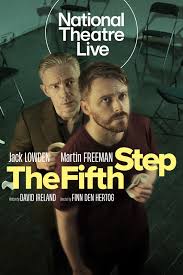
THE FIFTH STEP/NATIONAL THEATRE LIVE
UK, 2025, 82 minutes, Colour.
Jack Lowdon, Martin Freem an.
Directed by Finn Den Hertog.
An impressive dramatisation of the play by David Ireland, part of National Theatre Live. The title refers to the 12 steps of the Alcoholics Anonymous program, the Fifth Step, Confession.
The staging: this is theatre in the round or, specifically, a square stage, with the audience on all sides, visible during the whole performance. With only two in the cast, it is important that they move around so that the audience can see the various aspects of the performance, their walking, standing, sitting, removing the props and organising the stage. The running time is comparatively brief but there are several scenes, indicated by lights and the work of the cast in preparing for the next scene. There is a strong musical score.
Background of Alcoholics Anonymous: the reality of alcoholism, an illness, an addiction. The hold on an alcoholics, mental issues, physical, emotional, relationships. And the development of meetings, the AA plan, the 12 steps, the prayer, the religious dimension, God/religion/not.
The process: the sponsor, the choice of the sponsor, meeting with the sponsor and the arrangements, initial wariness, the raising of the gay issue of the sponsor, concern, curiosity about attitudes and behaviour. Luca, his age, experience, lack of experience, curiosity and concern. The contrast with James, his age, experience, his past sponsor, the actual issue, the aftermath and consequences.
Sponsorship: James, no drink for 25 years, the effect, the stories about his own supervisor, his marriage, son? The contrast with Luke and his age and lack of experience? The importance of power as regards the sponsor, the exercise of power, control, interests, decisions.
The portrait of Luca: age, appearance, clothes, manner, work on not, lack of education, long clash with his father, bad memories, the drinker, with his mates? Contemporary culture, sexuality, sexist, his language, focus. The drink and its effect. His myopia about his masturbation, 20 times a day, expectations of work, use of time. James and the recommendation for some religious experience, spiritual experience. The effect on him, able to quote the Scriptures, Old Testament/New Testament, the Jesus language, revivalist language. His genuine response, the issue of the woman at the church, married, the relationship, awkwardness, his response to James’s reaction about religion. Time passing, Luca not drinking, somebody reporting him as a drinking, but non-alcoholic, Luca adapting. Final crisis with James, the issue about the married woman, James talking as if the possibility was his own wife, the consequences for Luca, not wanting James as sponsor, and arriving and experiencing the step of Confession and the question of what would follow.
The ported James: his age, 25 years not drinking, his marriage, his son, has a best friend, not telling him about alcoholism, the background of his own sponsor, the gay man and the aftermath. The years of marriage, the issue of how strong the relationship with his wife, his son moving away from home. His attitude towards religion, saying he was a recovering Catholic, hostile to religion, but speaking of spiritual experiences, references to Buddhism, slights on Christianity. The issue of his being Luca sponsor, responsibility, power, his agenda. The melodrama of his suspicions about the woman and Luka’s relationship, as regards his own marriage and wife. Luca refusing him as sponsor and the effect on his emotions, future.
Effect for the audience of watching the stage play, a filmed version, the performance, the focus on the dialogue and words, the focus on action and the characters and performance. The involvement of the audience with the characters and the issues observing, emotional involvement.
