Displaying items by tag: Susan Sarandon
Calling, The/ 2014
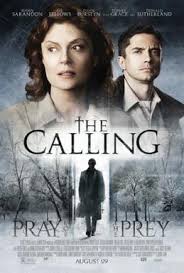
THE CALLING
Canada, 2014, 108 minutes, Colour.
Susan Sarandon, Gil Bellows, Ellen Burstyn, Topher Grace, Donald Sutherland, Christopher Heyerdahl, Ted Whitall.
Directed by Jason Stone.
The Calling is a little-known Canadian detective story. Made in Canada, especially in rather bleak, snowy country areas – with some trips to the city of Hamilton.
This is not a police thriller, not an action show. Rather, Fans will have to slow down, meet the detectives, learn their stories, discover the crimes, the forensic evidence, building theories, receiving clues, making connections, going into action to track the killer.
The star of the film is Susan Sarandon, Hazel, in charge of the police station in the country town, Gil Bellows her assistant. Then, Topher Grace comes the city, not immediately welcomed, but proving invaluable in terms of amassing clues and interpreting them. And they become more numerous.
The film states that it has a Catholic background, a visit to a church and, indeed. Donald Sutherland as a veteran priest, Father Price. However, the religious theory behind the killings is an invention of the screenwriter with very little reference to historical reality, and some of this expressed dates personalities, inaccurately (by Father Price) all kinds of conspiracies and secrecy in the early centuries of the church, range of beliefs in resurrection, believing human sacrifices to achieve resurrection. (And, at the end, when Father Price recites the Lord’s Prayer, he uses the Protestant version rather than the Catholic version.)
What is different is that the audience sees the killer rather early in the piece, initially suspecting him, seeing him in action with a little girl and his offering to heal her, then his contact with various victims, the detectives having photos of the victims, noting their mouths, their seemingly singing, and Father Price interpreting the words as a chant for liberation.
There are psychological problems, Hazel and her relationship with her mother, Ellen Burstyn, and Hazel.
The strong cast and the unusual case mean that is an interesting film thforose who enjoy detection.
- General sounding title, the ominous explanation? Religion, Catholic traditions, screenwriters inventions?
- The Canadian setting, the bleak snowy landscapes, the town, police precincts, homes, diners, the contrast with the Canadian cities? The musical score?
- The detective story, not a police thriller? Detection, the crimes, the clues, forensic evidence, theories, higher authorities, local jurisdictions, police, detectives, medical practitioners?
- Susan Sarandon as Hazel, her age, the back story, marriage, loss of her child, depression, suicide attempt, her back injuries, living with her mother, tension and love between them, waking up, drinking, eating, relationships in the town, Ray, working with her, collaboration, clashes? Andrew, his wife, clashes?
- The dead woman, throat slashed, her son and his arrival, the mystery, investigations, the back story? The post-mortem, theories?
- Wingate, his arrival, Hazel’s and Ray’s reactions, his leaving the city, his explanation about the death of his partner, the gay background? His enthusiasm, the investigation of a number of deaths, the phone calls, information, the photos, the study of the mouthes, the theory of the singing?
- The visit to Father Price, his explanations, the inaccuracy of historical and scriptural details, the screenplay’s invented theories about secrecy, about sacrifices, about victims, about resurrection? But Father Price’s beliefs, doubts, his age and experience, the discussions with Hazel? The impact on her, her religious background? The later revelation about Father Price, his illness, the theories, his helping the brothers, Gabriel’s suicide, his contact with Peter, his offering himself as a victim? His death?
- Catholic background, inaccuracies, the use of a non-Catholic Church, the Protestant recitation of the Lord’s Prayer, the invented theory about sacrifices and secrecy?
- Hazel, going to the city, the clash with Mason, not getting promotion, not getting extra help? The continuing investigations? Wingate, his contacts, the phone number, travelling to the countryside, following the suspect, the discovery of the artist, the formaldehyde body? The later revisit by the police, the body of the suicide brother, ready for resurrection? And the behaviour of the disciples?
- Wingate, coming to the house, the photos, Hazel examining them, her mother’s response, inviting him for the meal?
- The audience knowing the killer early, at the cafe, his tea, the waitress, her story, a little girl collapsing, his going to the house, initial fear, with the little girl, the tea, persuading her to drink, to sing? Hospital, seek, coming back to life, the reference to the Gospel of Mark, the raising of the little girl by Jesus?
- The issue of the mouthes, the song, the Latin, Father Price explaining the of theme of liberation?
- Wingate, going to the house, in phone contact with Hazel, Ray disapproving, risking her job? The killer, attacking Wingate, talking with Hazel on the phone?
- Hazel, at home, the arrival of the killer, the conversation with Hazel, her past, despairs, bound, urging her to drink, her will to live, his defeat, shooting himself?
- Detective work, the serial killer, religious beliefs, their motivations?
Six Triple Eight, The
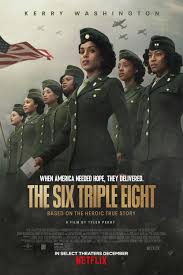
THE SIX TRIPLE EIGHT
US, 2024, 127 minutes, Colour.
Kerry Washington, Ebony Obsidian, Dean Norris, Shanice Shantay, Gregg Sulkin, Jay Reeves, Sam Waterston, Susan Sarandon, Oprah Winfrey.
Directed by Tyler Perry.
Inevitably many people who see this film will remember the 2016 drama of African-American women who were employed as part of the World War II effort, Hidden Figures.
This is a film written and directed by Tyler Perry, a significant influence in making American movies with African-American themes, with his own studios in Atlanta, Georgia, writing, directing, often appearing. While most of his films have had family and domestic themes, his now taken on the portrait of this significant group of women, their volunteering for war service, their treatment by the American military, their experience of racist discrimination and insult, their being given a mission, offered little support, even hindered, but a fine achievement in distributing in 90 days towards the end of the war, a huge amount of mail to and from those soldiers on war fronts.
While the film is based on actual characters and events, especially the leader of the women, Major Charity Adams, played with strong conviction by Kerry Washington, personal stories are introduced which gives a humane perspective to the military enterprise.
Initially, the film focuses on December 1943, young pilot crashing, his letter being taken by a passing soldier who has come from the trenches and placed it in the mail bag. Then, back to 1942, Philadelphia, the young man, Jewish, and his love for an African-American girl, Lena, her demanding mother and grandmother, who work in catering for events, the lyrical happiness between the two and his going off to war. With no news from him, Lena, Ebony Obsidian, volunteers for the war effort.
Some of the scenes parallel sequences in films about recruits arriving, the conditions, the severe officers, the physical demands on training, the variety of personalities, clashes and working together. Lena is the youngest and there is a focus on a group of women throughout the film, making the story more personalised.
The story is historically situated when the mother of a soldier has not heard from her son for three years, stands vigil at the Whitecap house, asked to see Eleanor Roosevelt, explaining the situation to her, to her husband the President, and Mary MacLeod Bethune, an American advocate for women in the war. (As a bonus, they are played by Susan Sarandon, Sam Waterston and Oprah Wnfrey.)
The key to the story is the women being assigned to go to Europe to work on the distribution of the huge amount of undistributed letters. Some of the heads of the military, especially General Halt, Dean Norris, are particularly demanding, obnoxious, blatantly racist, for example, horrified at black women reading the letters of white men. Obstacles are placed, the mail is kept at an old English school, conditions difficult, the women renovating their headquarters, working out logistics, not succeeding immediately, finding clues, Lena, especially, contributing while eventually getting that lost letter from the opening of the film and finding the young man’s grave.
The women’s achievement is not well acknowledged but they are acclaimed by a group at the railway station. However, the work was minimally recognised until decades later. In fact, there are many photos of the women at the end of the film, newsreel footage, and the actual Lena, aged 100, interviewed and reminiscing about the experience. And the military camp where they trained has had its name changed to include a tribute to Major Adams.
Many audiences were very much moved by watching the film. Those with military background raise quite a number of objections about the stage of battles, funerals, uniforms and many details which prevented them from being moved overall by the impact of this tribute.
- Based on actual characters and events? The final tributes, comments, photos and newsreel footage?
- The US, the atmosphere of World War II, those in service, those at home, communications, lack of information? The piling of the letters in England? The need for distribution? Morale for the soldiers?
- The work of Tyler Perry, producing, writing, directing? African-American stories, African-American issues? Issues of racism? American society?
- The prologue, 1943, December, the action sequences, the trenches, the soldiers going over, killed, bombings, the plane crash, the young soldier, the encounter with the plane, seeing the letter with the blood, taking it and putting it in the mail? The dead pilot?
- 1942, the focus on Lena, her age, at school, with her severe mother, with her grandmother, the home scenes? Friendly with Abram? His visit to the house, her riding in the back of the car, the exhilaration, his love for her, her shyness? Catering for the party, the bigoted girlfriend, standing in the way, insulting, the two going outside, the song, You made me love you…? The farewell? The impact on Lena, no news, thinking that Abram was dead, her family, the future, studies, her decision to join the army?
- The introduction of the African-American women and their war service? The range of those joining up, the film’s focus on the particular group, their characters, backgrounds, interactions, Jonnie May and her brashness, the more refined and religious young women? Lena in this group? The big number of women joining?
- The buses, arriving, the introduction of Major Charity Adams, in charge, her personality, the responsibility, her self-assurance, yet the continued attacks on her and her confidence, racism, prejudice against women? The development of her character throughout the film, the loyal assistant, the stern drills for the women, the training, her comments on Lena, the later speaking privately with her, affirmation, and her praise for her insight for the distribution of the male through the symbols on the envelopes? The mission, her meeting with the authorities, their contempt for her, lack of letters and orders, on the plane, in the UK, the derogatory remarks about the women, seem on the ship, the conditions, seasick, they’re coming off the ship, marching in order and taking the salute?
- The importance of the mission, lack of faith in the women, the character of General Halt, his personality, rigorous Army, racist, assertion of the white males, humiliating major Adams, the various confrontations, the final confrontation, Major Adams and her defiance? The possibilities of court-martial? The death of the women in the accident, the funeral, no military support, the chaplain, the severity of his sermon, the attack on Major Adams, her going to the office, finding his mail, spying on her, dismissing him?
- The logistics of sorting the letters, the vast number, the conditions, King Edward’s School, the cold, the accommodation, the women transforming it, making it habitable, even the beauty parlour, the cold, the vermin, the effect on the mail? Setting up, sorting, the slow sorting, the condition of the mail?
- The various ideas, names and categories, locations, maps and indications, Lena and her noticing the symbols, the map, greater flow of the letters? Of the continual hindrance by the bureaucracy, the army prejudice, the officers and their words and treatment of the women?
- Lena, her letter, going to the cemetery, reading the letter? His message? The attentions of Hugh, his background, service, intending to marry, the friendship with Lena, the dance, the song, her grief? The funeral, accompanying her to the cemetery, accompanying her back to the barracks?
- The women going on strike, Major Adams and her reaction, their applauding her?
- The background of the woman and not receiving any mail, standing outside the White House, Eleanor Roosevelt, bringing her in, the discussions, the visit of Mary McLeon Bethune, the pioneer for African-American women? President Roosevelt himself?
- General Hall, the death of Roosevelt, comments on Truman, his ridiculing of the women and their work?
- The ultimate success, the methods, within 90 days, the distribution of so much mail, the scenes of the men receiving it in the war areas, the families, the woman who stood outside the White House?
- The women at the station, the acclamation by the crowd?
- The final information, the lack of acknowledgement of the work, the women? Lena aged 100, the interview, her comments, the photos of the other women? And the renaming of the Fort – and the honouring of Major Adams?
Fabulous Four, The
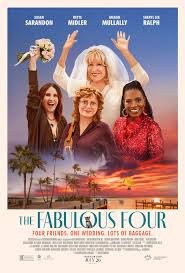
THE FABULOUS FOUR
US, 2024, 98 minutes, Colour.
Bette Midler, Susan Sarandon, Megan Mullaly, Sheryl Lee Ralph, Bruce Greenwood, Kadan Well Bennett, Timothy V.Murphy, Michael Bolton.
Directed by Jocelyn Moorhouse.
On the one hand, a 99 minutes promotion campaign for Tik-Tok. On the other hand, a 99 minutes promotion campaign for Tik-Tok.
The title is exciting. Fabulous. And the four are old friends, definitely old, stars Bette Midler born 1945, Susan Sarandon, 1946 and Megan Mullaly and Sheryl Lee Ralph in the mid-1950s. Their friendship in this story goes back more than half a century, back to college days and shared rooms.
But, Marilyn, an irrepressible Bette Midler, audiences enjoying her irrepressibability, is now a widow, takes off for Ernest Hemingway territory, Key West, Florida, where she and her husband of 48 years used to go on vacation. Suddenly, a chance meeting, engagement, marriage again and lots (and lots) of Tik-Tok, Marilyn confessing she is Tik-Tok addict.
What follows is extroverted, ebullient, so a psychology warning. Strong extroverts will be caught up in all the hoopla. Those more introvertedly inclined may well find this too much, possibly needing some breaks, long and frequent pauses when streaming viewing.
Marilyn’s two friends, Alice, a singer, drugs, promiscuous (Megan Mullaly from Will and Grace only much more so) is hard to take. Kitty, Sheryl Lee Ralph, a botanist, with family problems. But there is the very serious Lou, Susan Sarandon, a noted heart surgeon who has strong emotional responses from being once a best friend of Marilyn, now alienated.
Most of the action takes place in a gaudy-looking Key West, plus some affluent bars and mansions.
A lot of the action is frivolous, even farcical, hedonistic and everyone having a splashy good time. But Susan Sarandon and Bruce Greenwood bring some serious dimensions to characters and the situations. Some of their quiet conversations and self-revelations can be a bit of relief for the quiet audience, but long interruptions for those who want to get on with it. And, of course, ultimately there is a move towards apologies and reconciliation.
Surprisingly, the film was directed by Australian Jocelyn Moorhouse (Proof, The Dressmaker). She is certainly letting her hair down here, culminating in an all-dance sequence, “I can see clearly now, the rain has gone…”..
Calling these characters fabulous is, as the Americans might say, pretty much of a stretch.
