Displaying items by tag: Chloe East
Roommates/2026
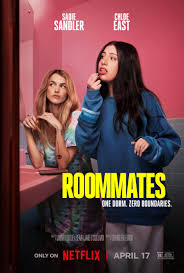
ROOMMATES
US, 2026, 107 minutes, Colour.
Sadie Sandler, Chloe East, Aidan Langford, Natasha Lyonne, Nick Kroll, Carol Kane, Megan Thee Stallion, Billy Bryk, Sarah Sherman, Steve Buscemi, Janeane Garofalo, Martin Herlihy.
Directed by Chandler Levack.
A long tradition of films about roommates, some sinister, some dramatic, some comic.
This film is produced by Adam Sandler’s company and features his daughter, Sadie, in the central role while other members of the family have various credits. And, it is very much on Adam Sandler -like comedy.
There is a framework to the main narrative, two college students bickering, screaming insults at each other, into the supervisor’s office where she tells a story. During the film we see its impact on the two angrily students – and, ultimately, some understanding and reconciliation.
The supervisor’s story has a focus on Devon, 18-year-old, high school, very supportive mother and father, Natasha Leonne and Nick Kroll, very good friends with her brother who is about to come out. In fact, he is her best friend. She is accepted at school but only just. She finds an outlet in sport activities.
She is about to go to college hoping to find a friend and roommate. Surprisingly she does and is all enthusiastic. She is going to study architecture and meets a senior student and feels she has a bond with him. The friend is played by Chloe East, Celeste.
Best friends, moving in together, out to socials, Celeste making sure that Devon comes out of herself. But, it does not last. Devon is irritated by Celeste’s sometime irresponsibility. Yet, her parents invite Celeste to visit and she makes friends with the young brother.
However, it becomes too much for Devon, having to pay for spring break plane trips, seeing Celeste kissing the architecture student…
Celeste plans with her brother a revenge scheme, building a model house for roommates, Devon presenting it on stage as part of her student competition, reenacting the difficulties with Celeste, naming her, Celeste incognito in the audience. Then Celeste humiliates the younger brother by putting up a huge poster about his going to the prom with a boyfriend.
The buildup to a confrontation between the two young women, Celeste putting the case that she comes from a wealthy dysfunctional family, mother with Alzheimer’s, and feels that Devon has been imposing her ideal family on her. Devon lights a fire, it spreads, the house burning down, Celeste’s father coming, her trying out at a number of schools, while Devon, because of the fire, is sentenced to 2 months in jail where she meets a dominating roommate whom she tells off – but, the fellow prisoner is only joking. End of film, they form a friendly partnership with architecture and design, best friends.
A film mainly of interest for the female audience, high school and college students, parents and grandparents (with a bizarre comic cameo by Carol Kane as Gigi, the grandmother). The male audience – perhaps a learning experience!
Heretic
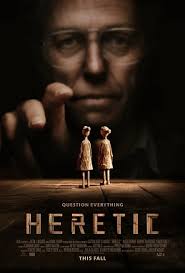
HERETIC
US, 2024, 111 minutes, Colour.
Hugh Grant, Sophie Thatcher, Chloe East, Topher Grace.
Directed by Scott Beck, Bryan Woods.
An arresting title. Heresy – but heresy from what faith?
It is not easy to categorise this thriller. On the one hand, there will be an audience who wants to see it as a horror film, an insane male character terrorising two young women, confining them in his house, continued threats, violence. And, this audience will be aware that there is a lot of religious discussion during the film but they will not find this very interesting, hearing it but not particularly taking note of it. The thriller tension is what is important.
On the other hand, there will be an audience who listens attentively to all the dialogue, the focus on churches, on religion itself, unbelief and its consequences – all presented in the context of a thriller of menace and ultimate violence.
And, this thriller is particularly different because of the presence of Hugh Grant. He has played some villains in recent films and television series but here he returns to the style that he used in so many of his romantic comedies. There are his sometimes stumbling manner, his ironic grimaces and self-deprecation, his immediate charm. But, as the narrative goes on, this becomes a very sinister charm.
One of the arresting aspects of the film is that it initially focuses on the Church of Latter Day Saints, the Mormons. (In fact, film information notes that the two actresses were brought up as Mormons, though no longer belonging to the church, and so know from the inside how they should play their roles.) They are young, earnest, chatting together initially about personal attitudes, one finding that watching a pornographic film confirms her belief in God, the of the more wary. And, they are ignored in the town as they offer leaflets, mocked by a group of girls wanting a self it with them.
But, their appointment is with Mr Reed who has told the church he is interested in Mormon beliefs. And so, Hugh Grant, Mr Reed, charming and welcoming, the girls cautious because they need to have another woman in the room with them, Mr Reed promising his wife in the kitchen, making blueberry pie, will join them. Of course, she does not. And, while he has trapped the girls, he continues with his conversation, asking them about their faith, talking about his religious investigations, studies and essays, all the time reassuring them even though they become more and more anxious, pretending to ring the church for rescue.
So, interest in the film will depend on how much audiences want to see as the menace continues, the consequences for the young women, trapped, wanting to escape, and, indeed, going down to the basement and discovering another weirdly sinister world. And the young women using their wits in desperate situations.
Those following the dialogue will be both enlightened and confused as it develops, Mr Reed using songs like The Air I Breathe and board games like Monopoly and the changes with further “iterations” as illustrations of how original experiences of faith lose their strength and power with further iterations. And he does come up with a solution, even as he horrifies the women and ourselves as we discover his secret and weird belief in raising women “prophets” from the dead. Control is his final answer, all the nature and core of all religion being control.
Audiences were not quite expecting this one!
1. Title, religious themes?
2. Orthodoxy and heterodoxy?
3. The Church of Latter Day Saints context, as a church, Joseph Smith and his testing religions, forming his own, his personal life, issue of polygamy, changing laws, evangelisation, sisters and brothers going out to visit, the Church authorities?
- The film as a psychological thriller, as a religious/religion-oriented thriller?
- The presence of Hugh Grant, his reputation, his acting style, his charm and idiosyncrasies, grimaces, eyebrows… Used to different advantage here?
- The plausibility of the plot, the church, the missionaries, their behaviour? Mr Reed and his house, his initial manner, the deception, the control, the discussions about the true religion, God, the trapping of the women in the house, the issue of raising from the dead, the revelation of the truth, Mr Reed and his believe in that true religion is control?
- The introduction to the two missionaries, the huge mountain, the seat, chat, the discussion about pornography, and the reinforcement faith? Sister Barnes and her reaction? Moving through the town, ignored by people, the girls with the photo and pulling sister Paxton’s skirt, climbing the steps, returning, the bikes, going to the Reed house, the appointment?
- Hugh Grant as Mr Reed, the welcome, the sympathy about Mormonism, the offering pie, the promise to meet his wife, her shyness, the drink, the candles? Taking their coats? The revelation about locking the bikes, the key in the wrong pocket? The beginning of the uneasiness?
- The thriller aspect, the women trapped, time passing, the pretence about phone calls, yet his saying that there was metal in the walls, no phone, the mechanism for locking the door? The possibly leaving at the back, the house built on the cliff, the two doors, belief in disbelief, his taunting them, the going down into the basement, the consequences in the basement, the apparition of the old woman, eating the pie, her death, the plan for her resuscitation? The desperation of the young women, the device of trying to get the matches?
- The theological aspect, audience interest in Mormonism, its history, Joseph Smith, his own behaviour, the comments about polygamy and the changing of the law, polygamy for promoting more children in the church? The further conversations about the different churches, about God, about belief, the testing of the girls? Mr Reed and his explanations about his study, the range of books on his library, his essays, his explorations, his playing of the music, The Air I Breathe, and his theory of iterations, from the original through the various developments, moving away from the original insight? The example of Monopoly on the boardgames in the developments?
- In the basement, Sister Paxton attacking Reed, his slashing Sister Barnes, her bleeding out, her coming again, bashing Mr Reed? Sister Paxton, the confrontation of ideas with Reed, her astuteness in noticing things, her escape, through the various doors, the discovery of the women in cages, his controlling them? Her shrewdness in noting what had happened, the conclusion of religion was Control? His agreement, the attack by Sister Barnes, her death? Sister Paxton and her working out that his control was to make them think that they were in control while he controlled them?
- The background of the elder, in the church, checking on the girls and their return to headquarters, his going to visit Mr Reed, his return with the pamphlet?
- The uncertain ending, the effect on Sister Paxton, Reed and his beliefs, control, his Satan -like theories?
