Displaying items by tag: Peter Malones Movie Reviews
Leviticus
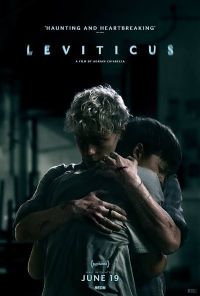
LEVITICUS
Australia, 2026, 85 minutes, Colour.
Joe Bird, Stacy Clausen, Jeremy Blewitt, Ewen Leslie, Mia Wasikowska, Nicholas Hope.
Directed by Adrian Chiarelli.
eviticus made quite an impression at the Sundance film Festival, comparison is made with some of the high profile horror features of 2026, the year of Backrooms and Obsession and box office success.
This film is in the Australian traditional horror, was filmed in the country town of Bacchus Marsh, an industrial atmosphere. It also has the benefit of successful young players, Joe Bird (seen to advantage in Talk to Me, as well as the loathsome associate in Wolfram), Stacy Clauson and Jeremy Blewitt. Respectable veterans of the Australian film industry also appear, Ewen Leslie, Mia Wasikowska, Nicholas Hope.
At the centre of the film is the relationship between the two young teenagers, still at school, shown initially horsing around, then the discovery of feelings of intimacy. However, the central character, Naim, is upset when he sees his friend, Ryan, making a connection with another boy, Hunter. They belong to a religious gathering in the town, and Naim denounces his friend.
The religious group bring in a deliverance minister who performs a ritual over the two boys. And, it is mentioned that this ritual cannot be revoked.
From a realistic setting, the film moves into the area of beyond the natural, horror modes, a doppelgänger of Ryan keeps appearing, strange struggles with only one protagonist visible, Naim in torment, pursued by the doppelgänger, fights, the death of Hunter, another meeting of the religious group.
In the meantime, Naim will has difficulties with his disapproving mother.
The film builds up tension, the idea of the visible and invisible doppelgänger, menacing, violence – culminating in nightmares in dreams and in real life.
On the one hand, there seems to be a cozy kind of ending – but, not as prominently with the usual mode of foreshadowing a frightening future, this time just a suggestion that there could be more trouble.
- The title, the Jewish Scriptures, prescriptions of Hebrew law, issues of sexuality, homosexuality?
- The Australian country town, industrial, homes, school, church? The countryside? The musical score?
- The film as straightforward drama, family, teenagers, school, identity, sexual orientation, behaviour? The religious group? The deliverance ritual?
- The film as drama with supernatural overtones, horror elements? The deliverance ritual? The doppelgänger? The tormented experiences? Not able to be reversed? The consequences?
- Naim, his age, shy and awkward, the tense relationship with his mother, at school, with Ryan, the snake devouring the frog, the later sequence in the laboratory, the scoffing students throwing the intestines of the frog at Ryan? In the old mill, the bond between the two young men, the wrestling, the kiss, the awakening for Naim? The repercussions for Naim?
- Naim later seeing Ryan and Hunter, the kiss, his reporting it?
- The church, fundamentalist, the gathering, the families all belonging, Ryan, his father? The Minister for the deliverance ritual? The ceremony, the two young men coming forward, implements, the candle ritual, the significance of the candle and light afterwards?
- The consequences, Naim, awkward, seeing Ryan, going to the photo booth, looking at the photos, Ryan’s behaviour, no one else visible?
- The consequences, the doppelgänger, Naim and his going to the service station, seeing Hunter and Ryan? Trapped in the building, seeing the death, upset, the police involvement, the therapist, the discussions with her, her helping, the limits and her help, the presence of his mother?
- The aftermath, the real Ryan, the doppelgänger Ryan, appearances, threats, violence, Hunter’s death, the funeral?
- Naim trying not to be alone, the continued threats of Ryan’s appearances, real, the doppelgänger? The effect on each?
- The deliverance ritual minister and the process not being able to be reversed?
- The continuing intensity, the effect on Naim, nightmares, imaginings, the reality, the presence of Ryan, the violent attacks?
- Naim‘s mother, her behaviour, attitudes, leaving him?
- Ryan, leaving, Naim and the encounters, the frightening violence, Ryan returning?
- The bus stop, Naim seeing Ryan, on the bus, the doppelgänger outside the bus, the two of them together, close, happy future – or the return of the doppelgänger seen outside the bus?
Freight
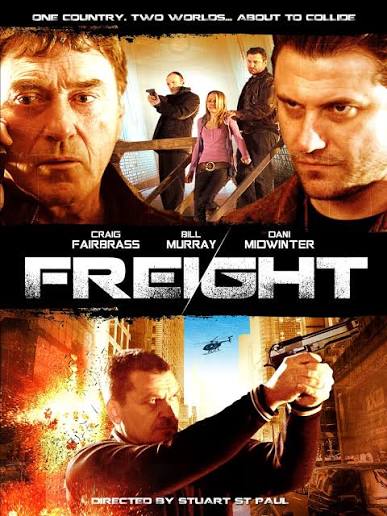
FREIGHT
UK, 2010, 92 minutes, Colour.
Billy Murray, Craig Fairbrass, Danny Midwinter, Sam Kennard, Luke Aikman, Zsolt Nagy, Jean Heard, Andy Tiernan , Laura Aikman, Matt Kennard.
Directed by Stuart St Paul.
This is a very grim British drama. It focuses on British and Eastern European gangsters, powerbrokers in England, Mafia types controlling the people smuggling, the women to clubs and prostitution, the men to cage fighting.
Whether freight will appeal to the general public is a question. It goes behind the headlines but its pessimistic picture of this kind of gang warfare and the exploitation of ordinary people is certainly hard to take.
Underlying it is a picture of decent human beings – but they are caught up in the violent and ugly world of gangs and people smuggling.
- The title, the opening credits sequences, the range of transport hubs, machinery, the world of freight? The actual freight and people smuggling, exploitation, prostitution, clubs, cage fights?
- The atmosphere of the 2000s, references to Britain, migration, jobs and employment, legislation? The final information about people smuggling?
- The establishment of the British family, Gabe, the patriarch, his history, business, working for the government, discovering corruption, exposes? Setting up his own business? Jed as his henchman? The role of his sons? The other members of the company, the prospective wedding, his daughter, his wife?
- The situation with the toilets, Stanni, the engagement, the job, on guard, into the toilet, the phone calls, the tracking, the destinations?
- The background of the Russian gang, Cristi as a leader, absolutely ruthless, immoral/amoral, cruel, emotional, merciless? The range of his subordinates, their jobs, their violence, the shooter and his ruthlessness, the compere for the fistfights and his brutality? The woman in charge of the trafficked women?
- The drama of the confrontation, Stevie and his coming home, working with his father? Sonny, his brother, on the site, financial difficulties, participating in the fight, hopes for the money and business, the actual fight, the brutality of his death? His brother, anger, and his shooting those responsible?
- The trucks, the men coming in, married couples, the men for the fistfights, the women to the clubs, the brutal misogyny, stripping, dancing, the nine-year-old girl and her illness? The supervisor of the dancers for the clubs? Cristi and his involvement?
- The abduction of Gabe’s daughter, the treatment, her mother and emotional collapse? Stanni and the engagement, her pregnancy?
- The buildup to the confrontations, their violence, shootings, letting people live? The fights in the cage, moving the venues for the fights? The fighter, the pressure on him, his wife and daughter, the death of his opponent, his meeting the family, plea, their acceptance, his presence with the final confrontation with Cristi, shooting?
- The violence of the confrontations, words, fights, shooting? Chases?
- Jed, involved in the search, his approach to Cristi, offering to fight? The involvement with the fight, the mayhem, pursuing Cristi?
- Gabe as the family man, his explanations, the confrontation with the gangs, his lamenting as to what was happening in the UK?
People We Meet on Vacation
PEOPLE WE MEET ON VACATIONS
US, 2026, 117 minutes, Colour.
Emily Bader, Tom Blyth, Sarah Catherine Hook, Lucien Laviscount, Miles Heizer, Jameela Jamil, Tommy Do, Molly Shannon, Alan Ruck,
Directed by Brett Haley.
This is popular material for audiences who enjoy romantic comedies. It is not one that critics liked, considering it too slight and undeveloped.
It is based on a novel by the popular novelist Emily Henry, has two attractive stars and some veteran comedians in support.
The central couple, she travelled journalist, he more retiring and introverted, have met in college, has been some summers travelling together – but there is now a distance between them. He is attending a marriage in Barcelona. She decides to travel to Barcelona to find out the truth about the relationship.
Familiar material, pleasant romantic leads, some emotional complications, some pleasant Spanish scenery…
- The target audience? Adults in their 20s and 30s? Older audiences beyond this kind of crisis?
- The title, the focus on the We rather than the people on vacation?
- A variation on the romantic comedy, lasting over 10 years?
- Introduction to Poppy, young, studies, going to Ohio, the lift with Alex, late, luggage, scatty, talking? Music, her story about growing up bullied, Alex’s reactions, listening, put off? The delay, the phone calls, having to spend the night, the setting up of the situation?
- Poppy in the present, vacations, seemingly alone, her comments? Discovery of her job? Success, her writing, her boss? The wedding in Barcelona, the invitation, her previous engagement, phone, deciding to go? The motivations?
- The continued story of Barcelona, the flight, encountering Alex, to the hotel, the preparations for the wedding, his brother and partner, Alex’s father, the interactions between Poppy and Alex?
- The flashbacks, over nine summers, the first, planning to go each year, the trip to Canada, the outback, and Alex coming out of himself, Poppy and her flirting, skinny-dipping and Alex losing his clothes, Adventurous Alex? The visit to New Orleans? Her being sick on the non-visit to Norway? The relationship between the two over the years, his relationship with Sarah, the audience not seeing her, break ups and on again? The contrast with Poppy, her relationship with the chef, then with Trey?
- The summer in Italy, the atmosphere, Sarah, the engagement, Alex and his ambitions, Sarah running the company? Poppy and her responses?
- The absence of two years, Alex breaking with Sarah, Bobby meeting Sarah at the airport and Sarah as a flight attendant and happy with life? The preparations for the wedding, the meetings between Alex and Poppy, repairing the past two years, the kissing, the reactions, the celebration of the marriage, the dancing, the atmosphere?
- The happy ending, the misunderstandings, Poppy resigning from her job, the encouragement of her boss, to live in Linfield coming together, and a very long preparation for their commitment to each other?
Pusher II
PUSHER II
Denmark 2004, 102 minutes, Colour.
Mads Mikkelsen, Leif Sylvester, Anne Sorensen..
Directed by Nicholas Winding Refn,
Review of the original film: Pusher has gained a considerable reputation since its first release in 1996. it was the cinema calling card, so to speak, for the writer and director, Nicolas Winding Refn, only in his 20s. This was a hard-hitting, visual film in its themes as well as its in its hand-held camera style and the vigorous and aggressive musical score top.
It starred Kim Bodnia, a powerful screen presence in Denmark at the period. His friend was played by Mads Mikkelsen, on the verge of a very successful career and international fame.
The film shows the seedy Copenhagen, drug dealing, the locals caught up in this drug world, the effect on their lives, relationships. It also highlights the influence of Eastern European criminals, a scene that was to develop in many films from Europe and, in extension, from the US.
Pusher II is the second film in a trilogy of Pusher films written and directed by Refn. Each film takes place in the same fictional Copenhagen underworld. The original Pusher follows Tonny's original partner Frank (Kim Bodnia), and his desperate attempt to raise money after a drug deal gone wrong. Pusher II references the events of this film several times. Charlotte comments on the scars on Tonny's head, a result of the beating he received from Frank. Milo later asks Tonny if he has seen Frank lately, as Milo wanted to kill Frank at the end of Pusher. This comment reveals that Frank disappeared after the events of that film, but it's not mentioned if he fled or was killed. (Wikipedia)
Fans of the Pusher films are very favourable towards this sequel. Others may find it rather graphic in its portrayal of gang violence, killings and torture, sexual sequences, language.
Raging Grace
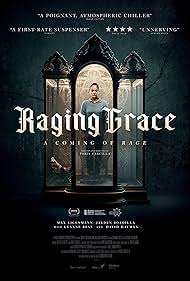
RAGING GRACE
Philippines/UK, 2023, minutes, Colour.
Max Eigenmann, Jaden Paige Boadila, David Hayman, Leanne Best.
Directed by Paris Zarcilla.
No, not amazing grace, a raging grace.
The writer-director of this film is British born in London of Filipino parents. He had a successful career with music videos but, during the Covid lockdown, experienced exploitation of Filipino migrants who are a strong presence in the British workforce. The result was Raging Grace.
On the one hand, the film has a lot to say about Filipinos in Britain, their status, their trying to get citizenship, the financial burdens and payment of organises, getting jobs, domestic, being humiliated and treated as servants.
This is all present in this film but in the context of something of a Gothic horror, the central character, Joy, finding a job in a mansion, hiding her daughter Grace in the mansion, at the behest of Katherine, who is allegedly looking after her uncle who has lost his memory. In fact, she is poisoning him. Then, Joy makes a counter medicine and he recovers.
Which means that the film then looks as if it will have a happy and nice outcome, the old man wanting to be called grandpa and favouring Grace, Katherine losing her status…
But, that would be too nice for the social themes – the old man, who has happy memories of a Filipino nanny, emerges just as racist and domineering as anyone else, leading to confrontations and some ultimate mayhem.
Raging Grace received many very favourable reviews from critics.
- The title, focus on the daughter rather than the mother? The anger, the raging?
- Filipino production, British production? Filipino perspective: migrants, workers, class distinctions, visas?
- The film as a psychological thriller, eerie, touches of the weird, touches of horror and imagination?
- The captions and theme indications throughout the film?
- Joy, her age, in England, her work, undocumented, with her daughter, her jobs and cleaning, the money for the visa and the harsh treatment of the agent, hiding her daughter in the accommodation? Pressures on her, the age of her daughter, telling her daughter her father was dead?
- English middle and upper classes, attitudes, condescending?
- The new job, going to the mansion, the encounter with Katherine, the sick uncle and his helplessness, the tasks, the accommodation, her return home, packing, hiding Grace, arrival, the large case, haul it upstairs, Grace to stay hidden? The various jobs, the cleaning of the house, the medication for the uncle? Katherine satisfied, going away for three days?
- Grace, her age, character, teasing her mother, her frights, mixing up the drinks of the food, laughing? In the house, mischievous, the room, the bed? Visiting the uncle? Having to hide from Katherine? Her following Katherine and the sleepwalking, the discovery of the body? Suspicion about the pills and their size?
- Activity during Katherine’s absence, the Filipino brew, feeding it to the uncle, his recovery, coming out of coma? His personality, his story about Gloria and the Philippines, living there, her coming to England? Saying Katherine was a fraud? The friendliness with Grace, getting Joy to call him Master? His revelation about Joy lying about Grace’s father?
- The return, the confrontation with Katherine, her being injected, her dreams and torment? Grace and Katherine and the revelation about the body?
- The range of nightmares and their visualisation throughout the film, for Joy, for Katherine?
- The uncle, the truth about him, malevolent, the story of Gloria and his wanting her to stay, Joy reading her letters to her mother? The confrontations with Katherine, the financial issues and power of attorney, possession of the house?
- The uncle and Grace, wanting her as a daughter, grandfather, his calling of the immigration officers, the arrival, the taking of Joy, Grace upset, wanting her mother, rejecting Grace?
- The fire, Katherine and Grace, the rescue, the death of the uncle, the burning of the mansion?
- Katherine, the disguises, meeting with Grace and Joy, the advice about immigration, finance, to confront the real father?
- The effect of the final scene, Joy and Grace arriving at the house, asking to see Grace’s father?
Monk and the Gun, The
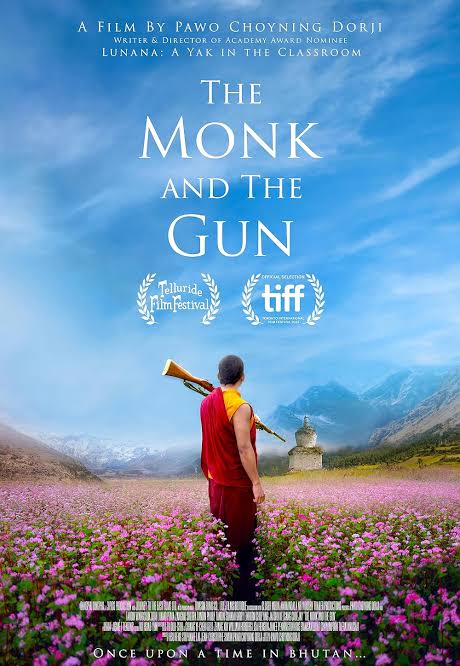
THE MONK AND THE GUN
Bhutan, 2024, 107 minutes, Colour.
Tandin Wamgchuk, Tandin Phubz, Kelsan Choejay, Tandin Sonam, Deki Lhamo, Harry Einhorn.
Directed by Pawo Choyning Dorji.
Setting is Bhutan, 2006, on the eve of an election. The film was nominated for an Oscar by Bhutan and reached the short list.
There are several strands of plot, the government is wanting the election to be a success and having rehearsals in villages so that the inhabitants learn how to vote. While this are serious repercussions, there are various comic elements in the holding of the rehearsal elections, loyalties, candidates, promises, family differences…
In the meantime, the monk at his shrine is wanting to build a monument and is anxious to have a gun from the American Civil War, ordering his servant to find it and bring it to him.
In the meantime, an American gun collector is also searching for the 19th century gun, hiring a guide, finding the gun in possession of an old man, the old man changing his mind, the monk’s servant also pursuing and getting possession of the gun. There are also bargains to find other guns as payment for the antique gun. And the police also are suspicious of the American and what he is doing and the issue of guns.
Ultimately, it all comes together with the monk wanting to bury the Civil War gun in the base of his monument, a symbol of peace. And, the American, saved from the police, and his substitute guns presented also as a gift.
Serious, important themes, a perspective on Bhutan, and some wry humour as well.
- A film from Bhutan? Atmosphere, locations, the people, history? 21st century? Democracy?
- The location photography, the beauty of the countryside, the fields and crops, the town, homes, the Buddhist shrine, the gatherings for the mock election, the coming of television, communications? The musical score?
- The introduction of three storylines? The monk, in meditation, his servant, the radio, information about the election, his asking him to get three guns, audience presupposition about the use, violent, his comments about freedom in society, assumptions that he was against the elections? The focus on Benji, at home, his wife and dialysis, his leaving for several days? The focus on the family, the husband and his political support, his wife and the pressure from her mother, their daughter at school?
- The bringing of the three stories together, four days until full moon? The travels of the supervisor to the country town, her attitudes, democracy important, her assistant, their plans? The servant and his search for the gun? Benji and the American, the search for the Civil War gun? The intersections of the three stories?
- The servant and his robes, walking the countryside, going to the old man, the explanation about the gun, the old man giving the gun as a tribute to the Lama? The servant in town, hearing about the election, not knowing about it, watching the television, James Bond and 007? In the countryside, Benji and Harry, the discussion about the gun, their promise of two guns, giving the gun to the Lama, the promise of the two guns?
- Harry, tour guide, with Harry, the quest for the gun, the travel, meeting the old man, the courtesy, the bargain, the history in the Civil War, money issues? The promise? The old man, the next day, the servant, giving the gun for the Lama? Their chasing the servant, the discussion, bargaining, going to the night club, the contacts, the rendezvous, collecting the guns? The police, the phone call to Benji’s wife, her contacting him? The arrival in the town, the ceremony, the police, the giving of the guns? Seeing the Civil War gun buried as tribute? Harry persuaded to throw in the Kalashnikovs? The speech of the Lama, advice about peace, Harry participating, and the humour of his being presented with the giant phallus?
- The family, the father and his campaigning, the daughter wanting the eraser, her father forgetting, criticised at school? The wife, asked to assist with the mock election? Meeting the representative, the discussions? The little girl and the eraser, the drawing, the gifts?
- The explanation of the mock election, the three colours and what they stood for, rounding up the people, registering them, reluctance, the actual election, the colours, the vote for the king and the preservation of the past? The representative, her disappointment, being invited to the ceremony by the Lama?
- Democracy in Bhutan, the king, benign, resigning, wanting elections and democracy, the people and their traditions, the range of opinions expressed throughout the dialogue, people happy, content with what they had, the possibilities of political infighting, threats to their way of life…?
- The happy finale, the ceremony, Harry and his phallus, the burying of the guns, the spiritual meaning of this? And the final information about the actual elections?
Little Brother
LITTLE BROTHER
US, 2026, 102 minutes, Colour.
John Cena, Eric Andre, Michelle Monaghan, Christopher Meloni, Sherry Cola, Ego Nwodim, Caleb Hearon, Ben Ahlers,
Directed by Matt Spicer.
Little Brother is an amusing comedy with many raucous moments. The film has an MA certificate, and there needs to be an alert for sensitive viewers. Stand-up comedian, Eric Andre, as Marcus, the Little Brother, refers to some of the human as “inappropriate” and “crude”. Response to this kind of humour will vary from sensibility to sensibility. And, the references usually are to sexuality, sexual issues, bodily functions… And, these are all here. It raises the question about sensitivities, the difference between crude and crass, and issues of how robust a sense of humour can be.
There is great deal of sentiment and values in the screenplay along with the “inappropriate”. John Cena plays a thing realtor in New York City, always with his eye on his older brother, the very successful entrepreneur, played by Christopher Meloni. And he has a devoted wife, Michelle Monaghan, as well as two young sons – already exhibiting the clash between the brothers.
In his younger days, Rudd, John Cena, has befriended a Little Brother, Marcus, who continues to value the everlasting friendship which, of course, Rudd has forgotten. Marcus has checked himself into an establishment, undergoing therapy, desperate and corresponding with Rudd – but, all the correspondence, building up a friendship, is actually with Rudd’s assistant, Mia (Sherry Cola).
Then he arrives in New York, a dominating character, all the behaviour associated with stand-up comedy, jokes, and going into action. In the meantime, Rudd is auditioning for a reality TV show, with the most pressing and obsequious producers, arrival realtor wanting his show.
Rudd’s wife is most welcoming, realises the tension in the marriage, is supportive of Marcus, welcoming him into the home – with all kinds of mayhem and disastrous consequences. But, he charms the producers and becomes an essential part of the reality show, everything being filmed, Rudd becoming more depressed and jealous, Marcus enjoying the experience, even the older brother joining in.
Ironically, Rudd wrapped is to be presented with the annual Big Brother award, to be presented by Marcus – but, even more complications, Rudd taking some drugs and behaving badly, completely misunderstanding the relationship between his older brother and Marcus and their wanting to do good for Rudd, going to the awards at walking out after giving up his speech. But, the producers always working with AI are able to substitute photos of the real characters on the stand-ins…
Eventually, of course, Rudd has to come to his senses, reconcile with family, find out the truth about Marcus and bring him into the family.
The film is able to balance the sentiment, even some sentimentality, with the roughness and rudeness of the humour. Its heart is, ultimately, in the right place.
Bones of Crows
BONES OF CROWS
Canada, 2022, 124 minutes, Colour.
Grace Dove, Philip Forrest Lewitsky, Remi Girard, Karine Vanasse, Ayssa Wapanatahk, Michelle Thrush, Glen Gould, Gail Maurice, Carla-Rae, Caro Gww, Patrick Galloway,
Directed by Marie Clements.
Bones of Crows is a significant Canadian film, a narrative examination of the recent history of the Cree nation, glimpses of their life in the early 19th century, the focus on the early part of the 20th century, moments of freedom, the imposition by the government, the rounding up of the children, taking them from their parents alleging that the children would better cared for an educated, better living in the Residential Schools. (A film parallel to these themes would be the Australian Rabbit-Proof Fence and the taking of indigenous family children from their families.)
Life in the Residential Schools was oppressive, dramatised here by a harsh nun, in her habit, the asserting of her religious vocation, but a sadistic approach to discipline and the children (though, she is allowed in the screenplay, some moments of repentance and apology). And the clergy managed the residential schools, the focus here on Father Jacobs, the chaplain, condescending in his attitude towards the Indians, promoting the central character, Aline, and her skill in piano playing, and an impressive sequence where she plays the piano with a group of clergy having an extra large and hearty meal. There seems to be a sympathetic Deacon who teaches Aline to play the piano and support her – though, at the end, a damning revelation about his previous behaviour.
There are World War II sequences, Aline and code and radio communication, Adam, her husband, war and the experience of Holocaust survivors and the effect on him and depression.
There are sequences over decades, backwards and forwards in time, the intercutting highlighting influences and consequences.
Ultimately, Aline in her 80s is part of commissions to consider the past, especially a visit to the Vatican, an audience with Pope Benedict XVI and the Archbishop present who had sexually attacked her in the past.
Significant but hard themes and an indictment of government and church authorities.
An IMDb note: At one point in the film, Prime Minister John A. MacDonald is quoted to justify the starvation of Indigenous children held in residential schools. In 1882, MacDonald gave a speech in the House of Commons where he addressed the systematic starvation of Indigenous populations who relied on rations from the Canadian government. In MacDonald's words, "I have reason to believe that the agents as a whole ... are doing all they can, by refusing food until the Indians are on the verge of starvation, to reduce the expense."
A Wikipedia note: The film was shot partially at the Kamloops Indian Residential School. Although the revelation of 215 unmarked gravesites at the school took place just one week before shooting was to start, the Tkʼemlúps te Secwépemc nation encouraged production to proceed because of the importance of getting residential school stories publicized and told.
- Canadian history, the Cree nation, racist history, oppression, the government, the Catholic Church?
- The opening, the images, bones, crows, Indian traditions?
- Images from the 19th century, the Cree, pioneers, conflicts?
- The range of time eras throughout the film, from the 1920s and 30s, through the 50s and 60s, to the early 21st-century? The intercutting? The effect for the drama, different revelations of different characters in the eras, and audiences seeing the influences and the effects?
- The exuberance and freedom in the 1930s, the families, riding the horses, the traditions, dancing?
- The reality of the residential schools, the rounding up of the children, separation of boys and girls, families broken, the scene of the distressed mother and her children being taken, blaming her husband, the later sequences and effects?
- The focus on the two sisters, their age, vitality, in the school, the rigidity of the regime, the nun, her severity, discipline, in the name of her vocation, in the name of Christ and the church? The scenes of daily life, classes, hard work, the dormitories…?
- The Deacon, his seeming support of Aline, at the piano, his hands on hers, her skills, the recognition, the sequence of the priests, the Bishop, her playing, enjoying the large lunch, the priest and his recognition of her talents, wanting to promote her? The Deacon, becoming priest, Bishop, the revelation of the assault, the confrontation at the Vatican at the end?
- The nun, her jealousy of Aline, the discipline, hurting her, her fingers, the consequences? Sadistic, the girls walking in line, heads bowed? The nun given the opportunity to reflect on what she had done?
- The cutting to the war, and her skills, the uniform, Adam, his past, memories of the past, the wedding? The severe consequences, his war service, the concentration camp and his presence, the effect, his drinking, violence, the family life, their daughter’s? His death?
- Aline, the years go by, her life, the daughters, social work, her sister?
- Perseverance and her story, in the residential school, the contrast with Aline, later, the addiction, prison, Aline looking after her children?
- The greater involvement in rights for the Indians, the Cree traditions? The role of the daughters, their skills, careers, support of their mother? The decades passing?
- Racism, Canada, civil rights, the commissions, the representation of the Vatican, the meeting with Pope Benedict XVI, the Archbishop present, Aline and her speech, her age, convictions, the accusations, the Archbishop walking out, later speaking with her? Some kind of vindication?
Minions & Monsters

MINIONS & MONSTERS
US, 2026, 90 minutes, Colour.
Voices of: Pierre Coffin, Alison Janney, Christophe Waltz, Zoe Deutch, Bobby Moynihan, Jeff Bridges, Jesse Eisenberg, Phil LaMarr, George Lucas, Trey Parker.
Directed by Pierre Coffin, Patrick Delage.
We have been living with the Minions, enjoying their mischievous company, since Despicable Me in 2010. With their size, yellow colour, one or two eyes, their distinctive language and chatter, their willingness to serve diabolical masters like Gru, audiences now have expectations of them, enjoying when they turn up in the movies (and in a range of commercials!).
The children’s audience will enjoy all the shenanigans here, the origin story of this group of minions, setting sail, settling in different lands, the various tyrants that they served, and, of all things, their finally arriving in the American West, pursuing a bandit and a train, discovering that it actually was being filmed. They are in Hollywood in the 1920s.
For the adult audience, especially movie fans, there are all kinds of references to early movies, experiments by Edward Muybridge, the Lumiere Bros, George Belies and the moon, and jokes recreating Charlie Chaplin in the cogs sequence in Modern Times, Harold Lloyd on his ladder in Safety Last, and glimpses of Buster Keaton, references to Citizen Kane, Hooray for Hollywood, We’re in the Money… and, the contemporary Hollywood Museum which has George Lucas himself. an exhibit in a glass case, asking to be released from his contract! In fact, this Minions film is really an homage to the movies and, especially to Hollywood in the 1920s, styles of filmmaking, the studio moguls, the directors, camerawork, introduction of sound, awards.
The main characters are the artistic James and his affable friend, Henry, and the good-natured Ed. In Hollywood, they do get a chance to make a movie – but, with the book of spells and their reading them out loud, strange creatures emerge. The culmination of the film is a kind of big gooey Godzilla equivalent, destroying LA in its path. Which means some kind of heroics, the massing together of the minions (which often happens throughout the film from early rowing in prehistoric boats to crowding on vehicles in Los Angeles and, incidentally, breaking the Hollywoodland sign).
A glance at the cast list shows that there is very strong voice talent.
All’s well that ends well, everybody happy with James’s movie, screening at the Chinese theatre, applause, awards, and, at last during the final credits, some upstaging of Gru. So, where to next! And soon!!
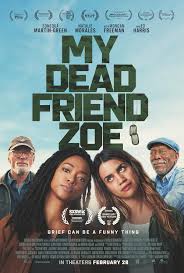
My Dead Friend Zoe
MY DEAD FRIEND ZOE
US, 2024, 103 minutes, Colour.
Sonequa Martin-Green, Natalie Morales, Ed Harris, Morgan Freeman, Gloria Reubin, Utkarsh Ambudjar.
Directed by Kyle Haussmann-Stokes.
The American involvement in Afghanistan has produced many significant films this one being produced after the withdrawal of America under the Biden administration.
While the focus is Afghanistan and sequences there, it is very much a film about PTSD and consequences from any war. There are action sequences, deaths. But there are also strong friendships.
The central character is Merit, who bonded with Zoe during their time in Afghanistan. When she returns home, experiencing some disturbance after her war experiences, she goes to a therapist. Various techniques, including the empty chair and Merit talking to Zoe.
However, Zoe is ever present to Merit, sharing everything, Merit’s relationship with her mother, and, especially, with her grandfather, another strong performance by Ed Harris, who lives alone, eccentric, his own war service, and the family wanting to move him to an aged care home.
But, while there is great companionship between Merit and Zoe, Zoe was killed in Afghanistan and Merit has to let her go, finding a friend at the aged care home, working with a therapist, her reactions to her mother, and the influence of her grandfather.
The film is based on the experiences of the director who served five years as a paratrooper in Afghanistan.
- A film about war, PTSD, relationships, grief?
- 2016, service in Afghanistan, the Afghan sequences, war action, camaraderie, friendships, deaths? The aftermath, the return home, PTSD, settling, family relationships and responsibilities, therapy?
- The title, that Zoe was dead not immediately revealed? The focus on Merit, age and experience, the war, Afghanistan, the friendship with Zoe, not coping, her mother, her grandfather, his war experience, his home by the lake, the boat, his daughter wanting him to go a to home? His tantrums about the garbage bins? The impact on Merit, seeking help?
- Merit and Zoe in Afghanistan, the happy times, sharing?
- The therapy sequence, the present, commenting, Merit’s response, the empty chair?
- Audience liking the comedy and drama and the feeling of the sequences with Merit and Zoe, in ordinary life, the visit to the cemetery, on the grandfather’s boat…? Zoe as a character, full of life? Her being an alter ego for Merit’s interior life, enabling her to accept her life?
- The therapy sessions, the range of veterans, their issues, the possibility for voicing them, sharing, mutual help? The role of the supervisor, his empathy? Also severity, making demands on Merit?
- The grandfather, military, service, success, old-age, dementia onset, his daughter and her concern, the home, Merit and her help?
- Merit, the home for the aged, her encounter with Alex, his personality, his work, and together, the video games, sharing?
- The buildup to the finale, Merit and the future, her life, letting Zoe go, standing on her own feet – and the final revelation, Zoe, in Afghanistan, the friendship, the experience of her death?
- And the final plea and information for veterans, therapy, PTSD?
