Displaying items by tag: Peter Malone's Movie Reviews
Vanya
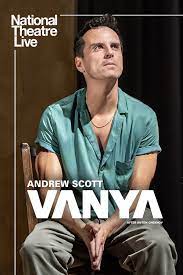
VANYA
UK, 2023, 100 minutes, Colour.
Andrew Scott.
Directed by Sam Yates.
This is a filmed version of a celebrated theatrical performance by Andrew Scott in a contemporary version of Anton Chekhov’s Uncle Vanya.
For those not familiar with the plot of Chekhov’s famous play, it would be recommended to check out a synopsis, a general impression of the drama, the characters and their interactions so as to be able to identify the characters here, generally with Chekhov’s names but Marina becoming Maureen, for instance, and references to Ivan more than Vanya.
And, the setting is transferred from Russia to an estate to Ireland, a farm, Ivan/Vanya the manager, his relationship with his niece, Sonia, his response to his uncle, the pompous filmmaker, Alexander, with his new younger wife, Helena, who is the object of attraction by the local doctor, Michael. There is also the local friend, Liam and his wife.
Identifying the characters is important because the key aspect of this theatrical piece is that Irish actor, Andrew Scott, plays all the roles. It is a very impressive tour-to-force, Scott alone on stage, altering his voice, establishing mannerisms, stylised movement to indicate characters, the use of his body and limbs to indicate different characters, stances, walking, from Scott who is simply dressed in shirts and trousers and shoes.
As well as the acting, Scott has to do quite an amount of stage business throughout, lights on and off, going into cupboards and out, a gimmick to indicate a wolf whistle, boiling the kettle, cup of tea, bottle of alcohol and continually lighting up…
For Chekhov lovers, the noticing of the parallels and adaptations will be intriguing. For those not familiar with Chekhov, it may be quite an effort to follow the whole play and its thrust, its themes of age, regrets, loves and relationships, vanities, the range of the faults and foibles of human nature.
For those watching Vanya on streaming, it may be helpful to turn on the subtitles – which indicate which character is actually speaking.
So, whether Chekhov and Uncle Vanya are familiar or not, this hundred minute piece is well worth seeing to be amazed at the talent and skills of one actor holding the stage. While the audience is shown and audience applause is heard, audiences watching this film version will be glad that they are seeing close-ups of Andrew Scott and his performance, enhancing the intensity and communication.
Blond One, The/ Il Rubio
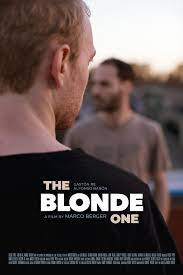
IL RUBIO/ THE BLOND ONE
Argentina, 2019, 117 minutes, Colour.
Gaston Re, Alfonso Baron, Melina Irusta, Charlie Velasco.
Directed by Marco Berger.
Il Rubio literally means the Blond One.
This is a drama from controversial Argentinian director, Marco Berger. He attained some international fame and notoriety with his drama, Taekwondo, the gathering of group of men and some women at a resort, their time together – especially with homoerotic undertones and overtones. He repeated this theme to a larger extent, sometimes more graphically, often exaggeratedly, in his 2021 film, Horseplay.
By comparison, this drama is very quiet, more intense, more thoughtfully written and performed.
The subject is a gay relationship in the context of Argentina at the beginning of the 21st-century. It opens, with a touch of Taekwondo, with a group of friends, fellow workers, gathering together, watching television, football, the comments, gradually revealing some of the characters, especially Juan, who works on a building site, who is known to have a girlfriend who visits regularly. On the other hand, he is renting one of the rooms of the lodging to a fellow worker from another town, Gabriel, very quiet. He is the Blond One.
Berger relies for his communication of feelings very much on close-ups, all throughout the film, close-ups of faces, juxtaposition of faces, suggesting closeness to leave the school is in standing, travelling in public transport, the school is close-ups of fairly explicit sex scenes.
Taking this for granted, we explore the tentative, tentative touching, relationship developing between Juan and Gabriel, Gabriel taking something of a quiet initiative, Juan responding, both acknowledging their sexual orientation but Juan not wanting it to be known, continuing his relationship with his girlfriend who becomes pregnant, Gabriel rather silent, often withdrawn, moody.
Gabriel’s wife has died suddenly leaving him with his young daughter who stays with Gabriel’s parents in the town. The scenes between father and son, with his mother also, have a liveliness and vitality and charm.
When Juan entertains some visitors from his childhood, there is a suggestion of a relationship with one of them, disturbing Gabriel, who broods. While Juan wants to continue his double life, it is sometimes too much for Gabriel.
Ultimately, when Juan girlfriend is pregnant, he asked Gabriel to leave to make the room available for the baby, a parting, and the finale with Gabriel back with his daughter.
In terms of the dramatising of a gay relationship, this is a quietly intense film, illuminating the two personalities, their drives, helping us to understand the nature of the love, the psychological repercussions, the consequences for the men’s lives.
Blood and Gold
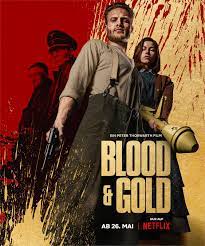
BLOOD AND GOLD
Germany, 2023, 98 minutes, Colour.
Robert Maaser, Maria Hacke, Simon Rupp, Alexander Scheer, Roy McCrerey, Jordis Triebel, Stephan Grossman, Petra Zieser.
Directed by Peter Thorwarth.
While watching Blood and Gold, many film buff audiences may well be thinking of Quentin Tarantino and his treatment of the war, Nazis, in Inglorious Bastard s. This story is certainly told with this Tarantino tone, other commentators mentioning spaghetti westerns. Some note a Finnish film release in the same year, Sisu, with some similar themes.
The film opens with German soldiers pursuing another, Heinrich, shooting at him, finally capturing him in the forest, charging him with desertion, hanging him, taunting him about his suffering, then abandoning him. Fortunately, Elsa, a young woman who works a farm with her brother, finds him, cuts him down, cares for him.
Just as he’s about to leave, disillusioned with his part in the war for six years, wife and child killed, but a daughter still alive whom he wants to find, the Germans arrive at the farm with consequent mayhem. The brother is mentally impaired and taunted, the sister is about to be assaulted but Heinrich comes to the rescue, and the beginning of the elimination in mayhem of the Nazis. Heinrich and the couple escape into the mountains but the brother is concerned about the pregnant cow and her being milked, returns, is taken, put in the belltower of the church where he pushes out a soldier, gets the gun, but the stereotypical Nazi commander shoots him. His sister attacks the commander and he takes her, intending to keep her as his companion.
So, quite a set up for bad Nazi behaviour, the reason for being in the village is that they know an ousted Jewish family had left gold behind, realising that the Mayor and his associates had taken the gold, but then a complication with the local priest and a local woman, the hiding of the golden the church, explosives inside, and then a shootout within the church. Then the GIs arrive and find the gold!
Heinrich and Elsa the only survivors.
Tarantino tone but not the ironic subtleties of his films – rather, a violent entertainment and the demolition of those bad Nazis.
- Title? Expectations? Fulfilled?
- A drama in the exploitation tradition, suggestions of spaghetti westerns, Tarantino and Inglourious Basterds, perils with the Finnish Sisu?
- Atmosphere of World War II, Spring 1945, the retreating Germans, occupations of towns, the SS, cruelty and vengeance? Their search for gold? Behaviour, attitudes (touch of caricature in the commander, his wounded face, removing the mask, the ring in his eye socket), the cruelty of the Sergeant, brutality, attempted rape? The other men? And receiving news of the downfall of Berlin?
- The opening, Heinrich, being pursued, his skills, captured, condemnation, charge of desertion, the hanging? The German departure, Elsa, cutting him down, reviving him? The history, the death of the family, Paule and his mental state, the farm, Rita the cow? Heinrich about to leave?
- The Germans in the town, the mayor and his Nazi uniform, appeasing the Germans, offering hospitality at his inn, his wife and family, the revelation of the background of the gold, the ousting of the Jewish family, his colleagues and Sonia wanting the gold, the flashbacks to digging for it, finding the Bible against stealing, disputes amongst themselves, going to the priest, with Irmgard, the fight amongst themselves, killing the mayor?
- The Germans wanting supplies, going to the farm, the insults to Paule, the attempted rape? Heinrich on the roof, his attack, Elsa helping, the fights, the defeat of the Germans? The later return, Paul with the cow, capturing him, shooting the cow, taking him to the bell-tower, his pushing out the German, the guns, his being shot?
- On the run, Heinrich and Elsa, Paule wanting to go back to the cow, leaving, the returning?
- The further attacks on the Germans, blood and gore? Heinrich and Elsa coming back to the town, the help of Irmgard, the priest? Elsa attacking the official after his shooting Pauel? His taking her, his story about Rebecca and shooting her, wanting Elsa, giving her the ring, the night, her seeing his suicide pill, her performance, the pill in her mouth, kissing him and inserting the pill (seen through the socket of his wounded jaw)? His death? Escape?
- Heinrich, the wounds, tended by Irmgard? The priest? The relationship? The gold? The plan and set up?
- The greedy trio, the priest going to the church, removing the lid, the gold, the explosives and the consequences? The arrival of the Germans, Heinrich, Elsa to the rescue, the continued shootings? Irmgard and her hunting rifle, stabbing the brutal Sergeant? Sonia surviving?
- Heinrich and Elsa, leaving the town, finding the daughter?
- Sonia, the gold, the American GIs, destroying the vehicle, finding the gold? And Sonja surviving?
- Adrenaline pumping exploitation entertainment?
Madame Web
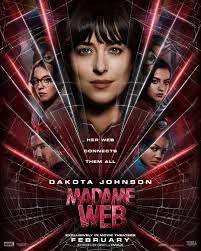
MADAME WEBB
US, 2024, 117 minutes, Colour.
Dakota Johnson, Sydney Sweeney, Isabella Merced, Celeste O'Connor, Tahar Rahim, Emma Roberts, Adam Scott, Mike Epps.
Directed by S.J.Clarkson.
This tale is almost the exact opposite of the Marvel Universe adventures. It is the villain who has the powers – and the lead, Dakota Johnson as Cassie Webb, has no superpowers except for some anticipatory glimpses of the future. As she says, she can see the future, “kind of…”.
This film was produced by Sony which seems to have the rights to Marvel stories connected with spiders, all the Spiderman films, the Venom films as well as Morbius. And, at one stage, someone does a riff on the well-known statement, this time the great responsibility has power!
This time Marvel has given us something of a Girls Night Out show – not too much to appeal to macho Marvel fans.
This is the Tale of the Threatened Three, three initially annoying and self-preoccupied 16 or so-year-olds (which does continue for a bit), targeted by a power-hungry maniac. His played by Tahar Rahim, a long way away from his excellent roles in French films. It is he who is the Spiderman variation, costume, mask, climbing walls, walking upside down on roofs, leaps from vehicle to vehicle – but no web.
Cassie Webb is an efficient New York fire department paramedic, working alongside the very nice Adam Scott whose sister-in-law, Emma Roberts, is pregnant and will provide an urgent setting for the climax. But Cassie has some strange hallucinatory moments, déjà vu as reality catches up with her glimpses. An accidental falling into the river in a locked ambulance leads to mysterious underwater lights and experiences. She doesn’t know why.
But, we do. We have seen the prologue to the film, in Peru, 30 years earlier, her pregnant mother searching for an exotic spider with mysterious healing powers. She is betrayed by her partner, Ezechiel (Rahim) who makes off with the spider, but has visions of three teenagers who will threaten his life. He has amassed a city-wide super surveillance system and goes in pursuit.
At one stage, Cassie trains the girls in CPR. Seems a bit tame – but, of course, it will be a key to saving Cassie after Ezechiel goes up in a spectacular explosion in a large fireworks factory – and crushed by a huge Pepsi Cola sign – Sony and Pepsi have an extensive promotion contract and business partnership.
Pregnant mothers and daughters, baby showers, teenagers flirting, female heroics…, As Marvel Universe tales go, a bit moderate.
- The Marvel Universe, a different perspective, female perspective, different presentation of superpowers?
- The film’s failure at the box office, the decline of the Marvel films?
- The reworking of the plot from the comics, the focus on Cassie, age 30, not having superpowers, strong personality, working with the New York fire department, paramedic, Ben, collaboration, driving, tending the wounded, banter? Responsibilities? Establishing her character, strong, then the moments of clairvoyance, déjà vu as reality catches up? A different lead for the Marvel Universe?
- The prologue, Peru, 1973, constant, pregnant, working with Ezekiel, the search for the spider, her finding one, the betrayal by Ezekiel, his violence, his escape with the spider? The local people, the spider people and their appearance, the shaman, her giving birth, her death? The baby in the water and the mysterious light and atmosphere?
- Ezekiel, 30 years later, his power, the elaborate surveillance system and his assistant, his vision of the three teenagers who will destroy him? His quest to find them?
- Cassie, the female atmosphere, the baby shower, the guessing game, her reluctance? The introduction to Mary, Ben’s care of her, Mary later appearing, about to give birth, the ambulance, the crisis?
- The clairvoyance, seeing the future, a kind of…? Her bewilderment? Trapped in the ambulance, into the river, the water, the lights, the effect on her?
- Cassie, the subway, finding the three girls, the threats, Ezekiel as the Spiderman variation, the pursuit? His vengeance?
- Cassie, with the three girls, their age, self-preoccupation, irritating to Cassie and the audience? Taking the cab, the bewildered driver, out into the countryside, telling them to stay? Her going to research her mother’s notes?
- The three girls, the different personalities, their backgrounds, neglected by their parents, selfish? The influence of each on the other? The decision to go to the diner, the food, flirting with the boys, dancing? Cassie, the research, returning, crashing the car into the diner, taking the girls, hiding them? Their becoming more compliant?
- Cassie and the trip to Peru, the bus, the countryside, the encounter with the shaman, learning the truth about her mother, her potential illness, the mother looking for the spider, to help Cassie’s health? The promise of the shaman to continue to help her?
- Ezekiel, on the trains, leaping from vehicle to vehicle, on the roof…? No web!
- The hospital emergency, the ambulance, making all the light screen, the crashes, Mary and the birth of the baby?
- The buildup to the climax, Cassie taking the girls to the previous site of the explosion, the fireworks factory? Setting up Ezekiel? And the request for the helicopter for the rescue?
- The climax, the fights, the confrontations, the girls, Cassie, memories of her mother, the fights, the explosions, the Pepsi Cola sign, crashing Ezekiel?
- All reconciled? Cassie and her future? Seeming indications of the three girls and superpowers, and the link with Madame Web?
Flag Day
FLAG DAY
US, 2021, 109 minutes, Colour.
Dylan Penn, Sean Penn, Hopper Jack Penn, Kathryn Winnick, Josh Brolin, Regina King, Beckham Crawford, Jadyn Riley, Bailey Noble, Norbert Leo Butz.
Directed by Sean Penn.
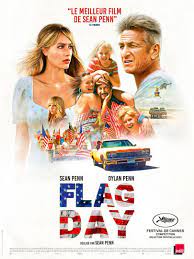
Flag Day was not widely seen on its release in 2021. However, it is worth seeing as a piece of Americana. It is a true story, based on a memoir by journalist, Jennifer Vogel.
Another reason for seeing the film is that it has been directed by Sean Penn who, over 30 years, directed a number of interesting films including Indian Runner, The Crossing, but not so successful with The Last Face. He had not appeared in any of the films he had directed but he does appear here. And, significantly, his adult children are played by his actual two children, Dylan Penn, Hopper Jack Penn. And, many note, how strongly, especially facial features, Dylan Penn resembles her mother, Robin Wright.
Flag Day is symbolic for Americans, patriotism, sense of identity – and this motif continues throughout the film, especially visuals of celebrations and parades. It is significant for John Vogel, a sense of entitlement, despite the strange arc of his life.
The film is told in flashback from the perspective of Jennifer Vogel, sequences in 1975, happiness with her father and mother, but a beginning realisation that her father is unreliable, piles of debts, disappears, and, as her mother frequently insists, he is a liar. But, abandoned, the mother takes to drink and the children decide to walk out on her, returning to their father. But, after a happy summer, he cannot manage them and returns them to their mother. Mixed happy and unhappy childhood, different images of mother, father.
The narrative moves on six years, Jennifer in rebellion, black hair, drugs, failing at school, unreliable company, hostile to her mother, abandoning her brother, walking out, seeking her father. She does attempt something of his rehabilitation, believing that he could change, but… Even to his robbing a bank and sentenced to prison.
Jennifer in herself has ambitions to be a journalist, despite fabricating references, her sample essays when her a place at the University, leading to successful journalism, a glimpse of this (and with a small cameo from Britain Eddie Marsasn) in an attempt to expose the poisoning of the water system of Minnesota.
However, her father has come back to see her after release from prison, but she still finds him a liar – and suddenly, on television, sees the post police in pursuit of him, the crash, choose one all shooting himself and, a return to the scene at the beginning where in 1992, Jennifer is told that her father had been an expert in counterfeit money producing.
Audiences interested in complex and dysfunctional American families may find this film of interest – but an affirmation in some ways of family with Sean Penn working with his children.
- The title, American identity, the holiday, the parades, the inclusion of glimpses of Flag Day throughout the film, in connection with John and his beliefs?
- American settings, Arizona, Minnesota, the seasons? Poor neighbourhoods, homes, interiors? The contrast with the lake and their holiday atmosphere? The countryside, moving around? Newspaper offices? University of Minnesota? The musical score?
- Sean Penn acting and directing, his children in the central roles?
- The introduction, the story about John, his death, printing the money, its quality, Jennifer, the close-ups on her face, wanting to touch the money, her grief? The framework for the flashbacks and her memories of her father?
- The voice-over, Jennifer telling the story, love for her father, disappointment in him, disillusionment, the final grief?
- The family, the children, the holiday, the enjoyment, John and his care for his children? Jennifer’s comments, the happy sequences but his moving out, Jennifer looking out the window? His disappearances? The consequences for their mother, her drinking, the debts John piled up, the hard years? The children walking out, wanting to be with their father? Finding him, his relationship with Debbie, cheerful times?
- John, Sean Penn’s presence, performance, age, background, marriage, the children, seeing himself as an entrepreneur, the various jobs, money? Continual revelation of his lying? With the children, not being able to manage the children? The bus, returning them to their mother?
- Six years passing, Jennifer failing at school, company, drugs, her black hair, clashes with her mother? Her brother, his age, subservient in the house? The confrontation with her mother, walking out?
- Seeking out her father, his reaction, her hair, his situations, his explanations, her moving in?
- Jennifer, her wandering times, the effect on her, wanting to change? Wanting to change her father, sprucing him up, his hair, clothes, briefcase, his applications for jobs? Seeing him go to work, seeming success? Jennifer suspecting the truth, his empty briefcase?
- Jennifer, her own ambitions, journalism, the approach to the University, writing the sample articles, the discussion with the Dean, fabricating her references, his having the photo of her father in prison, asking her what she wanted to do, to make an impact? Allowing her to the University, the years passing, her graduation, her mother and brother present? The reconciliation with her mother?
- John, money, the decision to rob the bank, the wig and the disguise, seemingly successful, the chase, the arrest,, the mark on his forehead from the wing her disillusionment with him? The money in the letterbox, her leaving it?
- His years in prison, her not getting in contact? Her success, the years passing, her investigative journalism, the pollution of the water, the interview with the executive, seeing the chase on the television, the crash, her father shooting himself?
- And back to the beginning, the money, touching it, memories of her father? Her own later success in writing the memoir?
Ride On
RIDE ON
Owner, 2023, 126 minutes, Colour.
Jackie Chan.
Directed by Larry Yang.
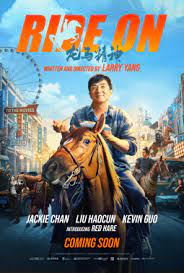
High entertainment for Jackie Chan fans. If this had been his last film, it would have been a popular summing up of his life and career. However, it is far from his last, and, while this was made when Jackie Chan was in his late 60s, he is still continuing into his 70s.
Here Jackie Chan plays an ageing stunt double and stuntman, with a particular skill in acting and writing with his horse, Red. But, the requests are not coming in. He has some good connections with producers and actors in the past and he is offered some opportunities. With some he is successful. But, at the end, he fails in a spectacular stunt. So, some sad aspects of ageing and losing one’s skills and powers.
However, the filmmakers continue to delight the audience by inserting quite a range of clips from Jackie Chan films and some spectacular fights, stunts, enjoyable memories – and that throughout the film.
Jackie Chan is a strong screen presence, always has been. He can deal with the action, no problem. And, in most of his films, he is genial, sympathetic, as he is here.
However, there is a strong back story, concerning the horse, concerning his daughter.
Flashbacks show the difficult birth of the foal, Jackie Chan caring for it, the immediate bonding, a kind of psychic and spiritual bonding which continues throughout their life together, Red are being all of his master’s commands, sensing what should be done, even at times going down on his knees and bowing to him. Those who enjoy movies with horses will enjoy this aspect, so strong throughout.
But, the stuntman has neglected his family, especially his daughter who resents him, comes to challenge him. However, they do begin to bond and she is very supportive of him and his horse.
The other aspect of the film focuses on money, some complications from a company and its executives who send legal representatives to take back Red, quoting all kinds of legal and financial documentation. The stuntman asks help from his daughter. She asks help from her boyfriend, rather timid even when the stuntman tries to teach him some martial arts moves. They are rather amateur and they have difficulty in helping the stuntman to keep his horse.
The film seems to be ending when the big stunt fails and Red is reclaimed.
But the film does go on, sad with the sacrifice the stuntman makes as read is taken from him, the farewell, the horse chasing the vehicle, not wanting the master to leave, going into decline and pining.
Common sense, practicality and sentiment all take over at the end – and, as we would wish, happy reconciliation all round.
A pleasing and entertaining testimony to the film genius, presence and stunt work of Jackie Chan.
Inseperables
INSEPARABLES
Argentina, 2016, 108 minutes, Colour.
Oscar Martinez, Roderigo de la Serna, Alejandro Flechner, Carla Peterson.
Directed by Marcos Carnevale.
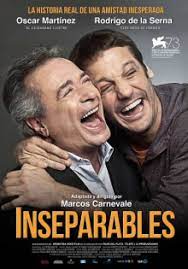
This film was based on an original story, the care for a wealthy quadriplegic ‘n is French-Algerian carer. Originally, there was a documentary, 2003,A la vie, a la mort.
However, the story became a worldwide celebration with the French version of the film, Les Intouchables, many nominations many awards, including the best actor for Omar Sy. He played the carer and veteran French actor, François Cluezet, played the quadriplegic. The two actors work very well off each other, the comedy, the serious aspects, the interdependence.
There have been a number of remakes, an Indian version, Oopari, an American version, The Upside, with Kevin Hart and Bryan Cranston as the two, and with Nicole Kidman. The present film is the Argentinian version, the same story but with a strong Latin flavour.
Veteran actor, Oscar Martinez, plays Felipe, the quadriplegic, often very serious, but with very many sequences of him grinning and laughing. The carer, this time an Argentinian, with a background of bank robbery and prison, is played by Roderigo do la Serna (the associate of Che Guevara in The Motorcycle Diaries, and, surprisingly after seeing him here, playing the young Jorge Bergoglio, and Pope Francis, in the 2016 drama of his life, They Call me Francis.)
The film follows the original in some detail, the crankiness of the quadriplegic and his search for carers, his whim in taking on the carer, here called Tito, listening to his views of music in his frankness and demands, teaching him something about art and personal response, a sequence with chamber music in a wide range of classics and Tito’s response to their application but his turning the occasion into a Latin rumba, the chamber Orchestra joining in.
Key to the film are Felipe’s loyal assistant and secretary, Yvonne, the gardener, and the secretary, Veronica, who becomes the subject of Tito’s amorous attentions – but who thwarts him at the end with her personal relationships.
Each version had a touch of the rowdy, especially through the characters who played the carer. At first, some audiences might find Tito rather irritating but, in his attention to Felipe, the bond between them, some comic sequences, he becomes more likeable.
- Based on a true story, the original documentary, the original French film, Intouchables, the American remake, Upside, the Indian remake, Oopari? Comparisons?
- The true story of the quadriplegic wealthy man, Felipe, his need for an assistant, his observations of Tito, Tito is feisty with the gardener, feisty about his pay, Felipe liking him, offering him the job?
- The character of Felipe, background, accident, widower, his daughter and her wilfulness and problems, quadriplegic, confined to his chair, in need of help, Yvonne as his loyal assistant, members of the household, the gardener, Veronica?
- The character of Tito, background, robbery, jail, his mother and her criticisms, his visit, her ousting him, the glimpse of the rest of the family? Getting a job, concerned about money? Carefree attitudes, the true story of his parents, his mother’s death, his aunt bring him up, his younger brother and his criminal life? Drugs? Lack of responsibility?
- The opening, the speed, the police, the bets, to hospital, the joke? The flashback?
- Felipe and the effect of having Tito, humour, continually laughing, the correspondence with the attractive woman, the photo, her cards, the date and its awkwardness? The domestic scenes, the bath, clothing…? Felipe and his dependence? Tito, the response, friendship, jokey, making Felipe laugh? The scenes about the paintings and their costs, his criticism, the $11,000? The musical evening, the range of chamber music, Tito and his comments about what each evoked, his taking over with the rumba music, the dancing, the chamber orchestra joining in?
- Tito and his flirting with Veronica, the scenes between them, his asking Eve on about Veronica talking? And the final revelation of Veronica and her relationship?
- Tito, likeable, Felipe liking him, but wanting him to have a further career, letting him go, the interviews with the prospective carers, their behaviour, inadequacies, his nightmares, waking, Yvonne helping, Tito returning?
- Tito in the setting up of the beach, the date?
- Tito and his brother, care, telling the truth to Felipe? Helping the family?
- A cheerful look at a serious subject?
Lost in the Woods
LOST IN THE WOODS
Australia, 2023, 80 minutes, Colour.
Directed by Daniel Clarke.
Daniel Clarke was named South Australia’s journalist of the year, 2023. He has brought his investigative journalist talents to this documentary, spending time with the inhabitants of Kangaroo Island, off the South Australian coast.
The documentary is an investigation, offering the audience a variety of opinions, voices, locals, parliamentarians, business representatives, farmer. It is over to the audience to evaluate the credibility of each of the speakers, appreciate their particular perspective, note the contrasts in perspectives, political decisions, economic decisions.
Kangaroo Island has been a centre for the development of farming, with some land clearing, in the first part of the 20th century. With its wildlife, it is also a centre for tourism. This film highlights the farming and agricultural aspects of the 20th century, the change of policy in planting thousands and thousands of blue gums in the early 2000s but their rapid growth, many seeing them as a weed, a pest, with toxic leaves, leading to rapid growth, farmers selling some of their land for profit for the extension of these trees.
There were discussions about the timber industry, but the island has no port and there were many discussions about two locations, the economics, the suitability, distance from the timber and logging, aspects and the holiday homes of the wealthy and politicians. There are fiery exchanges through the commentators throughout the film, especially concerning the Deputy Premier of South Australia, her decisions, her resignation.
Needless to say, the farmers are down-to-earth, earthy in their comments, their memories, the regrets. The main representative of business is a very smooth talker, saying that he is seeking the truth, sometimes casually dismissive of the comments of the locals. There is the editor of the local paper, a local media politician, mutual criticisms. And, more lately, environmentalists, the issue of clearing the logging, the preservation of animals, the status of koalas and their being considered the rabbits of the trees…
What brought all this to a head was a lightning strike in late 2019, coinciding with the devastating spate of bushfires all over Australia, and extraordinary destruction. The tree plantations went up in smoke and the consequent discussions about clearing the land, the unsuitability of the blue gums (except, as one says, the need of toilet paper during the pandemic), the role of the companies who bought the land and their responsibilities in clearing or not.
Throughout the film, informative aspects and statistics are provided, the amount of land burnt, the number of trees, only two people killed in the fire, surprisingly, the eventual statements by the company he declined to take part in the film about intentions for clearing the land.
A significant documentary for an Australian audience, for international audiences especially in the context of climate change, consideration of land use, carbon emissions, logging, environmental issues, in danger, the culling of koalas…
Mercy Road

MERCY ROAD
Australia, 2023, 86 minutes, Colour.
Luke Bracey, voice of: Toby Jones.
Directed by John Curran.
On Mercy Road there is no mercy.
This is a very intense film, focusing on a man driving a car through the night, his momentarily getting out of the car, but the camera inside the car, focusing on the man, on the dashboard, on his face, on the continued phone calls and his responses. He is played, even more intensely, by Australian actor with international career, Luke Bracey.
The audience has to pay attention, listening to the man and his sometimes confused outbursts, the range of phone calls he gets, commanding sum to be listened to, cancelling others. We gather that he has committed a crime, that a man, business connection, husband of his ex-wife, has been killed. But, his more frantic about the disappearance of his young daughter.
In the pounding score reinforces this frantic atmosphere, often desperate.
By contrast with the anxieties of the driver, there is the caller whose voice is very calm, controlling, giving advice, driving directions, information about his daughter, about the dead man, about the ex-wife, seemingly detached, called in to handle situations. And the voices that are British actor, Toby Jones.
Filming inside a car has been a test of many directors, an expert was a bus tourist Army from Iran. But, there was also the British drama, Locke, with Tom Hardy behind the wheel, and a desperate situation.
The phone calls heighten the tension. Apart from the calmly sinister voice of the mediator, there are phone calls from community services concerning the daughter, some contact with his ex-wife, and, somewhat out of the blue, business partners expecting him to turn up for work. They have a cumulative effect.
Some audiences may find this a drive to claustrophobic and intense. On the other hand, it is a bold experiment by American director, John Curran, Chappaquidik,, The Painted Veil, who spent some time in Australia and directed films like Praise and Tracks.
- The title, the location, the tone?
- Australian production, the Australian star, voices? Of the menacing voice of Toby Jones? The musical score? Tone, intensity?
- The situation, the father, searching for his daughter, relationship with his ex-wife, with her husband, the business deals, his contracts and commitments? The confrontation with the husband? The threat to his daughter?
- The film within the car, his momentary stepping outside the car, the camera within, the focus on the driver, his face, the spaces of the car? The phone? The intensity of the pace, the editing?
- The character of the driver, his background, favours, drinking, the broken marriage, his daughter, business partner? The crime, the murder, driving, getting away, the night?
- The voice, sinister, controlling, knowing everything about the driver, his daughter, statements of detachment? Being present in crises? Control? The psychological pressure, the conversations? Threats and menace yet calm? The directions, the turns, the destinations? The information about his wife, her husband, the death? The taking of the daughter?
- The intensity of pressure, the phone calls, his business associate expecting him to turn up, putting them off? The voice control, excepting calls, refusing calls? The social welfare calls, the information, the appeals? His wife? Her following his directions? Her fate?
- The buildup to saving his daughter, communication with his daughter, his crime, sense of guilt, defiance? Desperation?
Dear White People
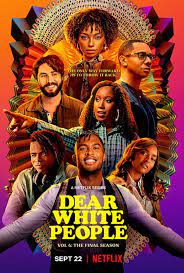
DEAR WHITE PEOPLE
US, 2014, 108 minutes, Colour.
Tyler James Williams, Tessa Thompson, Kyle Gallner, Tayonah Parris, Brandon P.Bell, Malcolm Barret or t, Dennis Haysbert.
Directed by Justin Simien.
A very successful satirical comedy from 2014, raising racial issues, African-American issues in a university context. The film was popular and led to the creation of a series with the same title, beginning in 2017, and employing the same writer-director, Justin Simien.
At the centre is Samantha, played by Tessa Thompson, who subsequently had a very successful career on television and in films, including Thor epics. The location is a rather Ivy League University campus, with veteran Dennis Haysbert playing the Dean.
Some critics have noted that most of the characters are narcissistic, ambitious. And this guides their interactions, writing and publishing, campus politics, campus relationships.
A film very much of its time in its characters and drama – but, the underlying themes, racial issues and tensions, continue.
- The title, the tone, the African-American perspective and attitude towards Caucasians?
- The campus setting, the Dean, official, office, management, staff, students?
- The University atmosphere, familiar from other campus films? The score?
- The accusation that the characters were narcissistic? The characters, ambitions, privilege?
- The focus on Samantha, personality, charm, intensity, her aims, interactions with Troy, breaking the relationship, the new boyfriend, Caucasian? Interactions with Lionel?
- Lionel, gay, shy, awkward, seemingly adrift in this world, interactions with African-Americans, with whites? Adopting styles, dress, hair?
- Troy, personality, relationship with Samantha, his ambitions? Her new boyfriend, Caucasian?
- The Dean, his stances, policies, economic situation, interactions with students?
- Campus elections, the politics, exercises of power and personalities?
- The party, its racist themes, parody?
- The film as a satire? The film as serious? The blend? The impact?
- An interpretation of African-American and race situations on campus, the 2010s? The end, and the different awareness of the different characters?
