Displaying items by tag: John Bentley
Golden Ivory
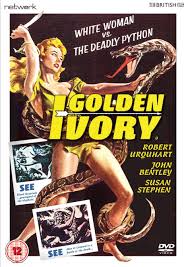
GOLDEN IVORY
UK, 1954, 80 minutes, Colour.
Robert Urquhart, John Bentley, Susan Stephan, Alan Tarlton, Howard Wood, Tom Lithgow, Maureen Connell.
Directed by George P.Breakston.
There are a number of British action adventures filmed in Africa, especially in Tanganyika, in the Kenya area, Where No Vultures Fly and its sequel West of Zanzibar. 1955 saw the film about the uprising on the Mau Mau, Simba.
The presupposition that this area of East Africa was British East Africa, part of the British Empire. But, the 1950s saw the immediate prelude to the movement for independence in African nations. The presumption in this screenplay is that Britain is still a colonial power – but some indications of collaboration, working together, some movements towards equality. But not yet.
The setting is 1890, some settlers moving inland from the coast, with two experienced guides, white guides, and some African servants. There is some drama between the two brothers, a touch of the Cain and Abel story, their adventures, hunting, and the prospect of ivory as well as discoveries of gold (but is turning out to be pool’s gold). There is an older man who has been involved in fights and killings. There is the parent generation and some of the younger generation – and, of course, some romance.
In this way, the film resembles the American Western – even to a rolling score reminiscent of such films as The Big Country.
Africans are the Massai and there are confrontations between the tribes, the leaders, discussions, the role of the witch doctor, the role of the chief – and possibilities for some kind of peaceful settlement.
With Robert Urquhart as a sympathetic lead, the audience is drawn into some of the action as well as some of the issues.
Inexplicably, the overseas title was The White Huntress, not really relevant (and there is little ivory in the film as well!).
Calling Paul Temple
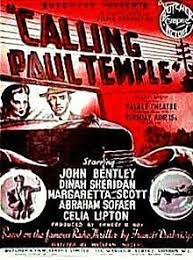
CALLING PAUL TEMPLE
UK, 1948, 92 minutes, Black-and-white.
John Bentley, Dinah Sheridan, Margaretta Scott, Abraham Sofaer, Celia Lipton, Jack Raine.
Directed by Maclean Rogers.
This is the first two films focusing on writer and detective, Paul Temple, played by John Bentley with Dinah Sheridan as his wife. The second film, 1950, was Paul Temple Triumphs.
The significant contributor to this film is the writer, Frances Durbridge, popular with his many novels, the Paul Temple series going to radio for over 30 years, later at 24 part television series with Francis Matthews as Paul Temple. John Bentley himself featured in quite a number of small-budget British supporting features in the 1950s but was very successful in the television series, 255 episodes, Crossroads, from the mid-60s to the mid-70s.
The film opens on the train, a mysterious death, a signature on the blind, REX. It appears that this is one of a series of murders, investigated by various police, and interest from Scotland Yard, calling in the the assistance of Paul temple with his writing and detective skills. And, in this story, strongly assisted by his wife in all investigations.
Surprisingly, the next sequences in a nightclub, many affluent guests, a spacious singing and dancing area, and a performance, attractively provocative, by Celia Lipton. And, then more surprisingly, another song. However, we have seen in her dressing room she has written a note for the police to give them information about the murders. During a performance, she collapses and dies.
As expected, there is quite a range of suspects, a particular focus on a dpctpr, played by Abraham Sofaer, three of his patients have been killed. Then there is a strong, sometimes mysterious presence of his assistant, played by Margaretta Scott.
For audiences who enjoy this kind of small-budget, supporting feature film, the type of story so popular in television series to come, there are plenty of suspects, moments of danger, twists, even including the Dr hypnotising his assistant and forbidding her to give information.
And, as a bonus, there are many sequences actually filmed in Canterbury, in the streets, hotels, cafes, Cathedral, ruins of friary’s…
There is a twist in the solution, the common denominator being Egypt’s prior to World War II. However, there is something of an anti-climax because audiences enjoy the unmasking of a significant murderer race here he is not such an interesting and dramatic character!
