Displaying items by tag: Deborah Mailman
Wolfram
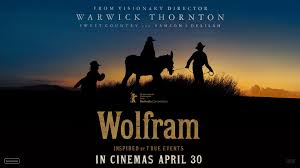
WOLFRAM
Australia, 2026, 100 minutes, Colour.
Deborah Mailman, Pedrea Jackson, Thomas M.Wright, Errol Shand, Matt Nable, Anni Finsterer, John Gibson, Natasha Gorey Furber, Eloise Hart, John Howard Ferdinand Hoang. Aidan Du Chiem.
Directed by Warwick Thornton.
Over the years, writer-director, Warwick Thornton, has become one of Australia’s most important indigenous filmmakers. For almost 20 years, his dramas have highlighted these themes, especially in central Australia, award-winning films like Samson and Delilah, Sweet Country, The New Boy, and, now, Wolfram.
Sweet Country were set in the 1920s, confrontations between white landowners and black uprisings, the police… Wolfram is set in the 1930s, prospectors, white Australians and a number of Chinese, in Central Australia, prospecting for Wolfram/tungsten. They have leases, have charge of aboriginal children, who are able to go down into the mine shafts, small, working in the narrow dark, sending up samples. They are quite young,have lost connection with their parents, now at the mercy of these white men, harsh, drinkers. The re-creation of these mining settlements, out in the harsh desert, is disturbing.
But the drama has several chapters, introducing a range of characters then gradually bringing them together for final confrontations, and some reconciliations.
In many ways and visual styles as well as in the action, Wolfram is in the vein of American westerns. There is the local town, the pub version of the American saloon, the women at the bar, the men customers. And in ride two characters, sinister in look and manner, one, who is ruthlessly violent, played by Errol Shand, and his young associate, naïvely absorbing the racism and enjoying the violence, Joe Bird. They want information about a contact who has a lease, Kennedy, played by Thomas M. Wright. Kennedy is retired now, has a young indigenous man working for him, Philomac, played by Pedrea Jackson, showing the taken-for-granted contempt for the aborigines and the demands made on them.
In the meantime, there is another story element, the aboriginal mother with her baby, played by Australia’s leading indigenous actress, Deborah Mailman. She is travelling with a Chinese miner, but cutting her hair, leaving the tufts and beads on trees, hoping that her children will find them and follow her. She is quiet, sad, another victim of racism in the 1930s. (On the other hand, the Chinese characters, out searching for Wolfram, are sympathetic – and, the audience appreciating their martial skills when they tangle with the white villains of the drama.)
For Warwick Thornton, this is dramatising the harsh past, acknowledging the truth for aboriginal people, holding up an often unwanted mirror to the behaviour of brutal and racist Australians. And, sadly in the time of the Uluru Statement from the Heart, films like this are still a needed challenge.
- Title, the metal, mining, prospectors, labour, white owners, and Chinese working?
- The films of Warwick Thornton, indigenous themes over two decades, Australian indigenous history? Racist? Critique of the remnants of convict culture? Christian and religious references?
- The various strands of the plot, the signalled chapters of the film, the range of characters, connections, coming together?
- The opening, the hammer and the chisels of the rock, mining for Wolfram? The young children, the audience assuming through the film that they were boys, the hard work, the treatment, Billy, his hold over them, his drinking, harshness, the later collapse and his death? The flashbacks and his relationship with Pansy? The children taken from their mother? The back story?
- Pansy, with the baby, grieving, sitting contemplating, patting her hair, the beads, leaving the signs on the trees and branches for her children, her partner, his racial background, travelling the sulky, over the countryside, searching, not going to Queensland? The recurring images of Pansy?
- Kennedy, his lease, his home, the shed, living alone, except for Philomac, servant, Kennedy and his demands, Philomac and his age, no explanation of his background, his work, the treatment? Subservient? Yet intelligent young man?
- Casey Martin and Frank, Casey Martin and his appearance, sinister, rough, riding into town, the pub, the woman at the bar, her dress, attitude, payments, chitchat, the young girl persisting? The men in the pub, attitude towards the visitors? Going to the store, supplies, the owner, his aboriginal wife and their reaction? The issue of the lease, his giving information about Kennedy?
- The couple riding through the countryside, coming to the mining area, the various workers, the tense, the diggings, explosions, the explosions underground? The encounter with Billy? With the children? Riding, finding Kennedy, his paranoia, the reunion, the humiliating Philomac, staying in the shed?
- The children, their hard work, going down into the mines, the gelignite the explosions, Billy, his collapse? The child with the donkey, riding through the countryside, the picture of the child wandering? Finally meeting at Kennedys? The child finding the charred remains of the old aborigine, his having worked for Kennedy, Martin and Frank killing him?
- The presence of the indigenous tribes, suddenly appearing, the Elder, the young girls, the water, the women washing, the young girl watching, Martin and his brutality, the killing? The aborigines meeting with Philomac, not helping, walking away? The ultimate confrontation with Martin, the violence, the women, his being killed?
- Martin and Frank going into the town with Kennedy, searching for Philomac and the children, their ability to hide in the caves, observing the brutality with the aboriginal women? The steering of Kennedy, his collapse, injuries?
- In town, in the bar, the woman at the counter, the discussions with the owner, treating Kennedy, breaking the binding?
- Philomac and the children, encounter and the Chinese, the friendly reception, the meals, sleeping, intending to leave, the work, the discovery that the children were girls, the toilet scene, the laughing, going down into the shaft, the rope, the girl falling down, Philomac falling, the young Chinese falling down? The rescue, the injuries?
- The intention to move, to Queensland, going into the town, the Chinese and his encounter with Frank, the fight, martial arts, the strangling? Martin discovering this, his leaving town with vengeance, his own death?
- Pansy, the travel, seeing the sulky coming through the fields, the happy reunion, including with Philomac?
- The 1930s, Australian history, the treatment of the indigenous people, the brutal white people, exploiting, humiliating, yet their racist attitudes, low intelligence, and brutality? Warwick Thornton’s films and their challenge to the interpretation of post-1788 Australia?
Kangaroo/ 2025
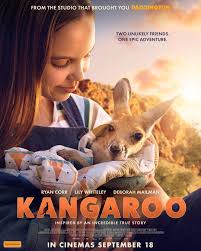
KANGAROO
Australia, 2025, 107 minutes, Colour
Ryan Corr, Lily Whiteley, Deborah Mailman, Wayne Blair, Ernie Dingo, Trish Morton-Thomas, Brooke Satchell, Rachel House, Roy Billing, Clarence Ryan, Rick Donald, Rob Carlton, Genevieve Lemon, Shaun Martindale.
Directed by Kate Woods.
A film that definitely lives up to its title, not just a kangaroo, many kangaroos and a lot of little joeys. This is an enjoyable film aimed at all the generations, a family entertainment.
We soon realise that the story is familiar enough, that we know what is going to happen but the enjoyment is seeing how it happens. The film opens in the red centre of Australia, near Alice Springs, a young girl running with the kangaroos. She is Charlie, Lily Whiteley, sad at the death of her father, living with her mother (the always welcome Deborah Mailman), some tantrums, missing school, looking after joeys. She bonds with her grandparents, Wayne Blair and Trish Morton-Thomas.
But then the film cuts to Sydney, Bondi Beach, a rather vainly self-important TV weather forecaster, Chris Masterson, played by Ryan Corr. Always after self-promotion, he rushes rashly to save a dolphin – but with dire consequences for the dolphin and for his TV career. In hopes for a new start in Broome, he drives his luxury car cross-continent. (In fact, there is an ugly backlash against Chris Masterson, extreme trolling on social media, insults, online bullying, placards and demonstrations, played for laughs but this experience in reality is vengeful and cruel not so very funny.)
People in the ouitback do not take kindly to city slickers like Chris Masterson. And, when he comes to Silver Creek, they all know who is and mock him.
Then, the dramatic impact. He hits a kangaroo on the road, discovers that there is a joey in the pouch, rescues it – and begins his serious path to caring for kangaroos and for some kind of self-redemption. The opening notes that the film is inspired by a true story and, as often at the end, there are photos of the real Chris – and, in the credits, he is there as wrangling the kangaroos for the film.
As expected, he meets Charlie, there is a bonding with the kangaroos, he is delayed in Silver Creek for the car to be repaired (by Charlie’s uncle played chucklingly by Ernie Dingo). The townspeople are initially mocking or sarcastic, especially Jessie, Rachel House, who runs the local, and Murray, Roy Billing, who sits sipping but is a learned old codgers and tutors the local children.
But, the invitation is to see kangaroos especially Roger, the battling kangaroo, and experience the beauty of the Australian outback, kangaroos in motion, protecting the joeys, Charlie facing her crises, Chris in a lot of farcical situations but eventually coming through, townspeople coming onside, the enjoyment of the local dry river boat race, and, social media having the opportunity to redeem itself, lots of postings and videos of Chris with the kangaroos and his becoming something of a national hero.
Happy ending that continues to the present – and this film will do no harm to tourist possibilities for central Australia.
- The title and so many kangaroos and joeys? Kangaroos and their place in Australia? As perceived from overseas?
- The Northern Territory settings? Mountains, the deserts, the towns, Alice Springs? The musical score?
- The introduction to Charlie, alone, running with the kangaroos? Her situation, mourning the death of her father, the photos, the kangaroo totem, his links? Charlie, resentment towards her mother, her behaviour towards her mother? Her grandparents and the bonds? Aloof from the other kids at school? Looking after the kangaroos, in her room, her mother disapproving? Her not going to school?
- The transition to Chris Masterson, Bondi beach, the weather, Liz as his producer, the stunts? The criticism of his style and personality? The situation with the dolphin, his going in, trying to save the dolphin, promoting himself, the aftermath, the death of the dolphin, the reason for its taking refuge?
- The social media response, hostility, bullying, the ugly side of social media and condemnation? The television authorities, his being sacked? People demonstrating, placards, shouting, abuse?
- The possibility of a new job, the discussions with Joel, the promises, Broome, his decision to go by car, out in the countryside, arriving at Silver Creek, the flash car, the kids, his reaction, the city slicker, presumption, the bad impression with Jessie, her mockery, Murray at the bar, his education, teaching the kids? Chris leaving, the drive, preoccupied, passing Charlie, hitting the kangaroo, its death, retrieving the joey? Caring for it, taking it into the town, Jessie’s harsh reaction, the butcher and his meat, the authorities?
- Charlie and her uncle, driving, joking, the mechanic, to fix the car? Charlie, meeting her grandparents, going to the shed, the joke about the toilet, the comedy of Chris in the uncomfortable surroundings, with Liz, the joey? The increasing number of joeys to look after, meeting Rosie, the discussions with her, going to Alice Springs, the vet, advising that Liz be put down? His reaction?
- The gradual transformation of Chris, not so much focusing on himself, putting up with the hardships? Charlie, the bond, finding more joeys, finding Roger, big, pugnacious, the increasing number of kangaroos, the extension of the compound, the fighting confrontation with Roger and Chris losing? The townspeople becoming more interested?
- The focus on the children in the town, the races, together, school, sports, the attitude towards Charlie? The change, the kangaroos, the helping Charlie to abduct the kangaroos?
- The adults in the town, the indigenous presence, characters, aboriginal law, Charlie’s father and his art, Rosie curating the exhibition, Charlie and Chris looking at her father’s painting of the kangaroos? Jesse as tough, her restaurant? Murray, drinking, cheerful, with the kids, range of subjects and learning? The butcher, coming at night with his friends, the Wake in Fright scenario, Jessie warning them off? The women of the town? The flirty woman of the shop? The officer at the police station? And the tourists, and Chris driving the bus?
- The celebrations, the boat race, like the race in the Todd River at Alice Springs, the variety of boats, dressing up, the race itself, Charlie and the kangaroos, the elderly women coming through and winning? The happy atmosphere?
- Chris, the bad reputation, everybody in Silver Creek knowing about him, the mockery? His work with the kangaroos, social media and the reverse of abuse, fame, the followers, the celebration, his becoming a celebrity? The phone calls to Joel and the fiasco of his career? Charlie and her removing the gasket and his car delayed? Liz, her arrival, the proposal for the show, his dilemma?
- The townspeople, not wanting him to stay? Charlie, upset, taking the joeys, the bus, driving into the desert?
- Chris, his dilemma, his ambitions, his being accepted and welcomed, in the car, driving to find Charlie, his collapse in the desert, not staying in his car, the phone calls to advise him, Charlie finding him, Roger finding him, the rescue?
- Chris, the decision to stay, his being welcomed, friendship and acceptance? In the care for the kangaroos? His finding his place, Charlie and his challenge about her aloneness after her explanations about her father, her being welcomed by the kids are school, playing football, her kick?
- Inspired by a true story, and the photos at the end? The sanctuary for the kangaroos? And the real Chris actually ranking the kangaroos for the filming?
Runt
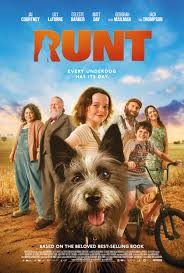
RUNT
Australia, 2024, 91 minutes, Colour.
Jai Courtney, Lily LaTorre, Matt Day, Jack Thompson, Deborah Mailman, Genevieve Lemon, Jack LaTorre, Celeste Barber, Joel Jackson, Sarah Roberts, Tom Budge.
Directed by John Sheedy.
Everybody loves Runt – well, everybody except the archvillain, Fergus Fink. Even those who might profess themselves as non-dog lovers are quickly on the side of Runt. He is a stray, mixed breed, chased around the town by the authorities and angry shopowners where he has nabbed some sausages. But, he is small, non-threatening, and often, as the Americans say, he is “cute”.
We are in a West Australian town in the middle of a long, long drought, threats to the farmers, threats to the economy, and the vain and greedy landowner with the significant pun in his name, Earl Robert-Barren, Jack Thompson enjoying himself playing most arrogant! We are in sympathy with dad, Joe Courtney, inheriting the land from his father, and grandfather, an inventor, and in sympathy with mum, Celeste Barber (very nice but a bit too often the target of complaint about the terrible pies she makes). And a lively gran is at home, Genevieve lemon.
But the focus is on the children, especially Annie, 10 years old, played very confidently by Lily LaTorre. She instantly bonds with Runt and he becomes part of the family. Also at home is her older brother, Max (played by Lily’s actual older brother Jack LaTorre) who videos all his action stunts building up an extraordinary fan following and providing some exciting moments as well is plot developments with his daring-do.
After establishing the family characters and their problems, attention turns to the local fair, especially a competition an Agility Course Championship involving a whole range of dogs speeding through quite a complex obstacle course. Enter the moustachioed villain, Fergus Fink (veteran Matt Day as we have never seen him before), moustachioed, glittering cape, histrionic and narcissistic performance, straight out of old-time pantomimes. Naturally, a great deal of rivalry, and a problem because Runt is unable to perform when anyone is watching. His whole focus is on Annie so no audience to see his victory. Of course, Runt winds, enabling Annie and Runt to go to the national championships, to the scorn of Fergus Fink and, again of course, his hostility and cheating. But the goal is to compete in London, Annie and Runt qualifying but the town rallying together to get enough money to pay the air fares in London accommodation.
With Matt Day and Jack Thompson providing pantomime villain action, the film is also something of a fairytale – especially a fairy godmother in the form of Deborah Mailman, a past champion, stepping in, with charm, to help Annie and Runt in their training.
By this stage all of us, non-dog-lovers included, are in for hope for Runt’s success and the downfall of Fergus Fink. No spoilers here – but it does not all turn out as we might have expected. The spoiler is, but really no spoiler at all, a very happy ending for everyone – and including rain!
An enjoyable film, from Western Australia, with characters who, in the old days, were called battlers as they tried to survive.
- The title, the term, the underdog?
- Western Australian setting, farms and drafts, the country town and life, atmosphere, homes, the sheep, homesteads, the dam, the dry river, drought atmosphere (and the final rains), dog trials, the transition to London, atmosphere, the competitiveness? The musical score?
- The theme of the past, the Aussie battlers, making a living, exploitation by the wealthy, families keeping together?
- The introduction to Runt, being chased around the town, stealing the sausages…? The meeting with Annie? Immediately bonding? Runt and his look, attractive, shy with people watching, dependent on Annie?
- The family background, the father, the farmer, the inheritance from his grandfather and father, the inventions, rainmaking, his work with the sheep, the fences, but his interest in horticulture? The clash with Earl Robert Baron? Relationship with his wife, with Annie, with Max? His mother living with them? An engaging family? And the frequent jokes about the mother’s bad cooking and pies?
- Max, his age, his derring-do, all the stunts, filming, the many followers on social media? Going up the tower, the grandfather’s rain making machine, failing – but the later success?
- Grandmother, living at home, tough, supportive? The later meeting with Bernadette and their getting on?
- The competition, the fair, the fairground and entertainment, again the jokes about the pies, the dogs, the introduction to Fergus Fink, pantomime character, pantomime villain, boastful, his dog, his put upon assistant? The competition? The hurdles for the dogs, the speed?
- Annie, wanting to enter, with nobody watching, the time, winning? Fink’s reaction?
- The visit with Bernadette, her past, with dogs, the advice, support, training?
- The national trials, the prospect for London, Runt and the decision to have the eye shield, the reaction of Fink, his own display, the cheating? Stealing the shield?
- Life in the town, the school, shops, the police, and everybody gathering to collect money to pay for the fares to London?
- The trip to London, the poor accommodation, going to the competition, the crowds, the commentary, Runt, Fergus Fink? Runt and his being unwilling to run, the response of the crowd? The disappointment, and supporting Annie in front of the crowd, the response? Fink and his comeuppance?
- The return home, the rain, the dam overflowing, the river filling, Earl Robert Baron and his comeuppance? The welcome home, Annie and the promotions, the father and his plans and growth?
Total Control 3
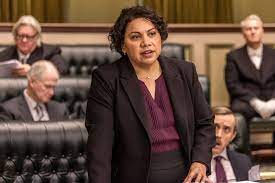
TOTAL CONTROL/ SERIES 3
Australia, 2024, 6 x 60 minutes, Colour.
Deborah Mailman, Rachel Griffiths, Rob Collins, Wayne Blair, Wesley Patten, Huw Higginson, Anthony Hayes, Steph Tisdell, Benedict Hardie, Rosie Lourde, Lisa Hensley, Jozef Beer, Catherine McClements, Fayssal Bazzi, Maya Stange.
Directed by Wayne Blair, Jub Clerc.
The first series of Total Control made such an impact in 2019 that in 2021 the second series went to air on the ABC. Deborah Mailman as Alex Irving, politician, the central character, won many awards. Rachel Griffiths was a strong presence. There were dramatic complications about First Nations people, Alex and her life in Queensland, in Parliament, dependence on Rachel, their clashes. This was developed in the second series, also developing the relationship between Alex and her brother Charlie, Rob Collins, leading to strong tensions. There was also the relationship between Alex and her son, Eddie, Wesley Patten. And there was a great deal of political conflict.
This is taken for granted in the third series, Alex initially seen in Queensland, with her new advisor, very patient and sympathetic Jolie, Steph Tisdell. Alex is campaigning, challenging the government for floods in the North. This sets a pattern for her behaviour throughout this series, as an independent in the House of Representatives, outspoken, always challenging, confronting the new prime minister of a minority government, played by Wayne Blair (who also directed three episodes). She clashes with her brother Charlie, now married, his wife expecting, his working for the prime minister on policy and documents.
And, there is the continuing relationship, friendly and hostile, with Rachel, the latter wanting an alliance of independent members, difficulties in finance, possibilities of corruption, investigative journalist with threats. And there is the continued concern of Alex for her son, his being in Canberra, at a special school, involved in protests against racism, planning to be an exchange student.
There is also the issue of Alex’s health, her incessant work, collapse, surgery, secrecy.
The fifth episode is well worth seeing, parliamentary sitting, Alex warning the prime minister that she would be a threat, proposing amendments, the cause of social justice for the young, trapping the prime minister and his relentless advisor, Sharon, Lisa Hensley, getting the support of the boisterous leader of the opposition, Anthony Hayes, only to outwit him to get support for further amendments which the government is forced to accept.
One of the best of Australian television series.
- The title, Alex, have Total Control of herself?
- The popularity of the series, Australian life, society, First Nations people, politics, corruption, Canberra?
- The value of the miniseries, six hours to develop characters and themes?
- Deborah Mailman as Alex Irving? The three series? The origins, her journey, Queensland, aboriginal, the past, relationship with her mother, crisis and her mother appearing to her, her relationship with Charlie, relationship with her son, Eddie? The opening, the floods in Queensland, the need for aid, government inaction? Her visit, her assistant, representations to the government? Political will? The intervention of the Queensland government, opening the Winton Medical Centre, the irony of her mother and illness, delayed, her death?
- Alex, her age, career, ups and downs, out of the Senate, House of Representatives, relationship with Rachel over the years, relationship with Paul? Paul as Prime Minister, First Nations, minority government, the crossbench, the Greens? Alex and her associations? Her courses, youth justice, the arguments with Paul, the dinner with him and her family, clashes with Charlie? Relationship with the opposition leader, using him, outwitting him? Her reliance on Jolie, price, the bond, the talk, Alex not wanting Jolie to pester her? Her health situation, secretive, the discussions with the doctor, the need for an operation, going to Queensland, the secrecy, collapse, her relationship with Dominic, driver and security, his challenging her – confidant, the later evening, dancing, the kiss? Alex has driven, her moods, strict mother, advised to be free with her son?
- Rachel, the past, her leadership, losing government, the crossbench? Forming the alliance? The think tank? Nick and his influence? Matt, the opposition, her wanting to influence him? Her relationship with Alex, up and down, the visit for to discussions? Lobbying for boats? Rachel and the encounters with Marian, the interview, the material for the article, Rachel wanting the injunction, collaboration with the Greens, the think tank, the finances? Kathleen, the discussion, Helena, wanting to support? Her being the source of Marian’s information? Kathleen hacking Marian? Rachel and the confrontation? Rachel and her voting record? Peter and his advisory role, constant? Alex and her anger with Rachel, Rachel saying she was not above suspicion? Alex justifying herself and abandoning Rachel?
- Paul, Prime Minister, aboriginal background, political savvy, the minority government, personal involvement, strengths and weaknesses? The parliamentary sittings and abuse?) Sharon, tough attitudes, advice, strategies? The relationship with Alex, the conflicts? Alex challenging? Charlie, his job, writing, the deadlines, policies? Charlie and his outburst against Paul, the aftermath? Alex and her visits, the threats, the setting of the house of parliament, her amendments, Paul being trapped?
- The picture of the opposition, the gung ho leader, his abuse of parliamentarians, the Speaker correcting him? Conservative, his following? Supporting Alex, a new amendments, his being trapped, his eyes harsh attitudes towards youth? The walkout of his members who did not support him? Matt, principals, urged by Rachel, the rebel group, part of the alliance?
- Eddie, his age, Queensland background, life and friends, at home there? In Canberra, the school, private school, the students? Skipping school, friends, elitist groups? His protesting, the bigoted security guard, filming him, his being arrested, Alex ambushed by the media? Her reaction? Taking him to Queensland? Her not telling him about her health? The friend whom he supported with the filming, the police, going to the party, Charley driving them home, drinking, drunk, sick? Supported by Dee? Her pregnancy, waters breaking, driving her to the hospital, his presence, support, calling the baby Eric? His wanting to be an exchange student, the decision coming through, Iceland? His demanding honesty from his mother?
- Charlie, relationship with Alex, family, in Canberra, the previous attack on Alex and himself, the stabbing, the racist attack, the court case, the racists interview and apology? Charlie and his relationship with Dee, her pregnancy, nice couple, her professionalism, his job, the deadlines, the timing, policies? Phone calls with Alex? His outburst against Paul? His decision to go to therapy, the meetings? Late for the birth? Decisions about the future, haven’t Dee and her job, going back to Winton, the possibilities of New York?
- Jolie, the big woman, motherly, advisor and confidante to Alex, Rachel offering her the job, concerned about Alex’s health? Thank advice? The final decision about parliament?
- The Parliamentary sequence, the Speaker getting ready, the formalities, the rowdiness and the Speaker intervening? The issue, the amendments, the reactions, Alex and her presentation, having the floor, Paul and Sharon, the opposition initially supporting, Alex outwitting them, her speeches, the divisions, the press response? The success? The press and the accusations of corruption? Her collapse?
- The issue of corruption, Marion in her article, the accusations against Helena, her resigning? Rachel offering supply? Marian leaving the confidential dossier for Alex? The press conference and her honesty, the final confrontation with Rachel? The alliance, and Matt announcing Alex as leader?
- The finale, Alex talking to camera, about aboriginal leadership, accusations and challenges to the audience?
