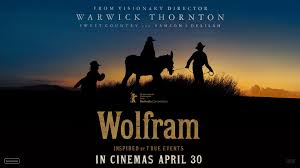
WOLFRAM
Australia, 2026, 100 minutes, Colour.
Deborah Mailman, Pedrea Jackson, Thomas M.Wright, Errol Shand, Matt Nable, Anni Finsterer, John Gibson, Natasha Gorey Furber, Eloise Hart, John Howard Ferdinand Hoang. Aidan Du Chiem.
Directed by Warwick Thornton.
Over the years, writer-director, Warwick Thornton, has become one of Australia’s most important indigenous filmmakers. For almost 20 years, his dramas have highlighted these themes, especially in central Australia, award-winning films like Samson and Delilah, Sweet Country, The New Boy, and, now, Wolfram.
Sweet Country were set in the 1920s, confrontations between white landowners and black uprisings, the police… Wolfram is set in the 1930s, prospectors, white Australians and a number of Chinese, in Central Australia, prospecting for Wolfram/tungsten. They have leases, have charge of aboriginal children, who are able to go down into the mine shafts, small, working in the narrow dark, sending up samples. They are quite young,have lost connection with their parents, now at the mercy of these white men, harsh, drinkers. The re-creation of these mining settlements, out in the harsh desert, is disturbing.
But the drama has several chapters, introducing a range of characters then gradually bringing them together for final confrontations, and some reconciliations.
In many ways and visual styles as well as in the action, Wolfram is in the vein of American westerns. There is the local town, the pub version of the American saloon, the women at the bar, the men customers. And in ride two characters, sinister in look and manner, one, who is ruthlessly violent, played by Errol Shand, and his young associate, naïvely absorbing the racism and enjoying the violence, Joe Bird. They want information about a contact who has a lease, Kennedy, played by Thomas M. Wright. Kennedy is retired now, has a young indigenous man working for him, Philomac, played by Pedrea Jackson, showing the taken-for-granted contempt for the aborigines and the demands made on them.
In the meantime, there is another story element, the aboriginal mother with her baby, played by Australia’s leading indigenous actress, Deborah Mailman. She is travelling with a Chinese miner, but cutting her hair, leaving the tufts and beads on trees, hoping that her children will find them and follow her. She is quiet, sad, another victim of racism in the 1930s. (On the other hand, the Chinese characters, out searching for Wolfram, are sympathetic – and, the audience appreciating their martial skills when they tangle with the white villains of the drama.)
For Warwick Thornton, this is dramatising the harsh past, acknowledging the truth for aboriginal people, holding up an often unwanted mirror to the behaviour of brutal and racist Australians. And, sadly in the time of the Uluru Statement from the Heart, films like this are still a needed challenge.
- Title, the metal, mining, prospectors, labour, white owners, and Chinese working?
- The films of Warwick Thornton, indigenous themes over two decades, Australian indigenous history? Racist? Critique of the remnants of convict culture? Christian and religious references?
- The various strands of the plot, the signalled chapters of the film, the range of characters, connections, coming together?
- The opening, the hammer and the chisels of the rock, mining for Wolfram? The young children, the audience assuming through the film that they were boys, the hard work, the treatment, Billy, his hold over them, his drinking, harshness, the later collapse and his death? The flashbacks and his relationship with Pansy? The children taken from their mother? The back story?
- Pansy, with the baby, grieving, sitting contemplating, patting her hair, the beads, leaving the signs on the trees and branches for her children, her partner, his racial background, travelling the sulky, over the countryside, searching, not going to Queensland? The recurring images of Pansy?
- Kennedy, his lease, his home, the shed, living alone, except for Philomac, servant, Kennedy and his demands, Philomac and his age, no explanation of his background, his work, the treatment? Subservient? Yet intelligent young man?
- Casey Martin and Frank, Casey Martin and his appearance, sinister, rough, riding into town, the pub, the woman at the bar, her dress, attitude, payments, chitchat, the young girl persisting? The men in the pub, attitude towards the visitors? Going to the store, supplies, the owner, his aboriginal wife and their reaction? The issue of the lease, his giving information about Kennedy?
- The couple riding through the countryside, coming to the mining area, the various workers, the tense, the diggings, explosions, the explosions underground? The encounter with Billy? With the children? Riding, finding Kennedy, his paranoia, the reunion, the humiliating Philomac, staying in the shed?
- The children, their hard work, going down into the mines, the gelignite the explosions, Billy, his collapse? The child with the donkey, riding through the countryside, the picture of the child wandering? Finally meeting at Kennedys? The child finding the charred remains of the old aborigine, his having worked for Kennedy, Martin and Frank killing him?
- The presence of the indigenous tribes, suddenly appearing, the Elder, the young girls, the water, the women washing, the young girl watching, Martin and his brutality, the killing? The aborigines meeting with Philomac, not helping, walking away? The ultimate confrontation with Martin, the violence, the women, his being killed?
- Martin and Frank going into the town with Kennedy, searching for Philomac and the children, their ability to hide in the caves, observing the brutality with the aboriginal women? The steering of Kennedy, his collapse, injuries?
- In town, in the bar, the woman at the counter, the discussions with the owner, treating Kennedy, breaking the binding?
- Philomac and the children, encounter and the Chinese, the friendly reception, the meals, sleeping, intending to leave, the work, the discovery that the children were girls, the toilet scene, the laughing, going down into the shaft, the rope, the girl falling down, Philomac falling, the young Chinese falling down? The rescue, the injuries?
- The intention to move, to Queensland, going into the town, the Chinese and his encounter with Frank, the fight, martial arts, the strangling? Martin discovering this, his leaving town with vengeance, his own death?
- Pansy, the travel, seeing the sulky coming through the fields, the happy reunion, including with Philomac?
- The 1930s, Australian history, the treatment of the indigenous people, the brutal white people, exploiting, humiliating, yet their racist attitudes, low intelligence, and brutality? Warwick Thornton’s films and their challenge to the interpretation of post-1788 Australia?
