Displaying items by tag: Elle Fanning
Sentimental Value/Affeksjonsverdi
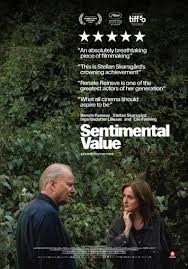
SENTIMENTAL VALUE/ Affeksjonsverdi
Norway, 2025, 135 minutes, Colour.
Renata Reinsve, Stellan Skarsgaard, Inga Ibsdotter Lilleaas, Elle Fanning, Jesper Christensen, Lena Endre, Lars Varinger.
Directed by Joachim Trier.
After watching Sentimental Value , we realise that the English title does not do justice to the drama which has moved and challenged us. One can note that there is the tone of affection in the Norwegian title. A more telling nuance.
Norwegian director, Joachim Trier, has made films in Norway and in the United States. Earlier he had made the film, The Worst Person in the World, with actress Renata Reinsve, to much acclaim. He works with her again in this film, teaming her with Swedish and international star, Stellan Skarsgaard. This makes for a very strong and tangled relationship between daughter and father.
The film opens, strikingly, with the daughter, Nora, full of nerves, having a tantrum before going on stage. But, once there, a superb performance and acclaim. She is a woman of uncertainties as well as talent, craving relationships, alienated from her father, depending on her sister, based on their bonding during their childhood, their parents’ divorce and, later, their mother’s death and the absence of their father.
The film works very well on these themes of family and relationships, even going back to the 1930s, the Nazi invasion, the war, Gustav’s mother in prison as a resistance fighter during the occupation, impact on her later life. Then, Gustav and his wife, the clashes with his daughters, and the focus on the house in which they lived, a house with the girls identify with and are continually return to, but the scene of tragedy.
Gustav has not made a film for a long time, is ageing, not always well. He has a screenplay and encounters a talented American actress, Rachel, played by Elle Fanning. Gustav invites her to play the leading role in his film, rehearsing lines, explaining some tragic sequences, the suicide, but Rachel turns out to be an actress of integrity, questioning whether the film should be made in English, wondering about her capability for playing the part, making the decision of principle.
This is quite a long film, divided into chapters with each section cut into black, pause, then the next chapter. With the range of characters, so well performed and delineated, the audience becomes more and more involved in this family story. Renata Reinsve commands the screen even in the moments where she underestimates herself. Her sister, Agnes, is impressively played by Inga Ibsdottor Lisseaal. We are drawn into the emotional tangles, not always approving at all of some of the characters’ behaviour, but always hope that there can be honest reflection, honest expression, reconciliation.
Sentimental Value won the Grand Prix at the Festival of Cannes, 2025, and received many nominations for Best Picture in the international 2025 awards.
- The title, sentiment, the notion of perfection in the Norwegian title? And? Tone?
- The Norwegian settings, quality perspectives, Nordic filmmaking? Family stories? Back to the wall, post-war, secret in the past?
- The initial focus on the house, symbolising the sisters, the return to the house, is history, furnishings and look, ownership of the house, the daughters, the father? The action taking place within the house?
- The focus on Nora, her performance, the tantrums before going on, nerves, staff, pressure, threats, wanting the slap from the actor? The set, the audience, darkness and pores, her entry, the performance, the claim? Revelations about Nora’s character?
- Agnes, the bond with Nora, her marriage, her husband, love for her son? Nora enjoying the boys company? The home sequences?
- Gustav, his story, the film director, a claim, the screening of the classic film, the audience response, the interview? And this starring in the film? Her not wanting to be in films? During research for her father?
- Plan to make a new film, the screenplay, giving to Agnes, her reluctance? Her reading it, change of heart? Giving it to Nora, Nora reading it and her reaction? Memories of their mother? Going back to Gustav and his history, his mother and the resistance, imprisonment during the war, coming out, giving birth to staff? Pessimism? Suicide?
- Rachel, American actress, watching the screening, the conversations with staff, on the beach, his offering her the part, their discussions, reading the script, testing out the lines, with Ingrid, the emotion? The story of the suicide, the knocking over of the store (actually from IKEA)? The overall impact on Rachel, meeting the family, the conversations? The issue of the film in English or not? Her coming to the conclusion that she should withdraw, the conversation with Gustave, her integrity in appreciating the situation and her role?
- Nora, her continued acting, performances, the relationship with the actor, his being married, the break and his leaving? The background of her suicide attempt?
- Gustav, his moods, in the house, the divorce, memories of his wife, of his mother, the screenplay? The impact of the experience with Rachel? Wanting Eric in the film, and his not wanting him in? The scenes with Eric, at home, with Nora, packing the lunch, going to school?
- Nora, the script, going through the motions, the suicide sequence, the stall, Erik returning, the abrupt stop?
- The alteration of the house, audience puzzle as to what was happening, Nora and her going through the scenario of the suicide attempt, the revelation that it was a set, her performance, the response of staff, Agnes, and the resolution of the family difficulties? The future?
Predator: Badlands
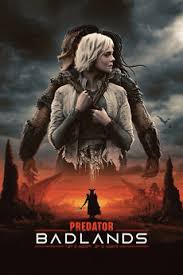
PREDATOR: BADLANDS
US, 2025, 107 minutes, Colour.
Elle Fanning, Dimetrius Schuster-Koloamatangi, Cameron Brown, Reuben de Jong.
Directed by Dan Trachtenberg.
Since Arnold Schwarzenegger appeared in the original Predator in 1987, there has been an ever-increasing franchise with the title, all kinds of variations on the theme, here on earth as well as in outer space and conflicts with aliens. Which, in fact, is the case in this story.
One of the first aspects to commend is that of the re-creation of space, the universe, planets, beauty, crags and mountains, weather, moods, sinister atmospheres, worlds of science fantasy and science fiction – and, with a comment for fans that this film definitely needs to be seen on a big screen in the cinema. And this is the case for a huge industrial complex on a far planet, a world of advanced technology as well as some desperate fighting.
On the first mysterious planet, a strange humanoid creature is wanting to assert himself, looked down on by his warrior father, helped by his brother, then going on a mission to save his planet.
On the other hand, when he arrives at another distant planet, there is already a group of investigators, sharing the same quest. But, while the characters on this mission look human, they are in fact what is called Synthetics. It is surprising to see Elle Fanning as one of the synthetics, humane in her attitudes and teaming up with the stranger, then her also appearing as her sister-Synthetic, female but heartless.
There is also a large squad of male Synthetics all mass-produced on an assembly-line, all looking the same.
There is a quest, a search for a deadly creature. But there is also a power struggle in who controls the technology and how it is exercised.
While a lot of the plot ingredients seem familiar, the screenplay is put together more intriguingly than usual and the non-human characters mirroring human behaviour. And, even though the characters do not have actual hearts, the heartlike elements prevail.
- The popularity of the franchise for almost 40 years? The variations? On Earth, aliens, in space, the future?
- The visual impact of this film, the widescreen, the landscapes, crags and mountains, countryside, suggestions of an alien planet, the huge industrial centre, the technology, the weather and moods, battles, hand-to-hand fighting? The musical score?
- Science fantasy, the future, beyond Earth in space? The references to Earth?
- The characters, Synthetics, the females synthetics and their control, the male synthetics as warriors? The contrast with the creatures from the other planet, aliens from the human point of view, their appearance, warriors, face, teeth/fangs/tasks? Clothing and armour? Their own language and communication, subtitles?
- The planet, the Yautja, Dek and his place in the clan, younger, the relationship with his brother, designated as the weakest? His father, giant, relegating Deck, his brother’s defence, their fight, his father killing his son? The impact on Deck, his determination to make his mark? The actor within the costume, the language, creating a credible character?
- Space, vehicles, deck going to the death planet, the flora and fauna, discovering the dangerous plants, explosions? The encounter with Fear? The female synthetic? Her legs severed? Her being trapped? Her mission? Deck releasing her, carrying her? The encounter with the creature, Barbed, collaborating, marking territory, the relationship with Deck? Theo, wanting to contact Tessa, Dick and the concept of sister? Theo liking it?
- The Earth mission, the range of synthetics, Tessa, Elle Fanning’s alternate characterisation? Relentless, the mission for all, to capture the Callous? Theo and her wanting to be reminded with her legs?
- The comic perceptions along with the action, the legs walking by themselves, the strategies and techniques, contribution to the fight? Theo and the confrontation with Tessa?
- Deck, barbed, the hunt for the bison, the uniting on the mission, deck as intentions, his trophy?
- Tessa, the machines, the confrontations, the sympathetic soldiers, all looking the same? The battles, the confrontations?
- The callous, barbed and the mother, the fighting, the contributions, Tessa’s destruction?
- Deck, having his trophy, Theo restored, Barred growing larger? The return to the original planet, deck and his confronting his father, the battle?
- And the future…? Sequel…?
Complete Unknown, A
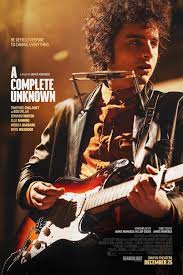
A COMPLETE UNKNOWN
US, 2024, 141 minutes, Colour.
Timothee Chalamet, Edward Norton, Elle Fanning, Monica Barbaro, Eriko Hatsune, Scoot McNairy, Dan Fogler, Boyd Holbrook.
Directed by James Mangold.
For audiences with long memories, singer-songwriter, Bob Dylan, has been a constant presence since he first went to New York City, aged 20, in 1961, made contact with Pete Seeger, admired Woody Guthrie, was given opportunities to sing in clubs, at festivals, and to record. And, he has done so ever since, awarded the Nobel Prize for Literature in 2016 for having created new poetic expressions).still at work in his 80s.
For younger audiences, becoming aware of the Bob Dylan of later years, memories of his songs, his contribution to folk music, his developments and musical talent, may have made a strong impression.
Which means that this two-hour 20 film about Bob Dylan’s earliest years, from a complete unknown in 1961 to a star, acclaimed, also criticised for his transition from folk to electric instruments in developing music styles at the Newport Festival in 1965, will be a significant experience.
And, there is the performance by Timothee Chalamet as Bob Dylan, a physically slight figure, characteristic wavy hair, intent on singing, writing his lyrics, always with a cigarette in his mouth, bringing Dylan to life. (In 12 months to Timothee Chalamet has been Wonka, Paul Atreides in Due 2 and now Bob Dylan, indicating that in his talent, Chalamet is a screen chameleon. It is worth seeing him in interviews as his ordinary self to appreciate his versatility )
Not that Bob Dylan in his early years was always an attractive character to meet. He was self-obsessed, ambitious, intent on writing and composing at all times and all places, fickle, often casual and of-hand, in relationships, especially with singer Joan Baez – but this is a young man in his early 20s. But he knows what he wants for himself and his creativity and career.
However, one of the great values of director, James Mangold’s film is situating the early songs, including some songs from Woody Guthrie and Pete Seeger as well as Blowing in the Wind, The Times are Achanging and quite a catalogue of other songs. And, impressively, Timothee Chalamet sings all the songs himself, plays the guitar and harmonica. In fact, all the supporting cast do their own singing, Monica Barbaro impressive with a beautiful voice as Joan Baez, Ed Norton in a very impressive performance as a sympathetic Pete Seeger, Boyd Holbrook as Johnny Cash. (Incidentally, James Mangold directed the film portrait of Johnny Cash in 2005, Walk the Line.)
There are some moving moments at the beginning of the film and at the end with Pete Seeger present and singing for a chronically ill Woody Guthrie in hospital.
Bob Dylan has been a significant figure in American and world music for more than 60 years. This is a welcome opportunity for us to go back to this introduction to a complete unknown.
- Audience response to Bob Dylan? In the early 60s, from unknown to celebrity, 1965 and his changing of music style, the succeeding decades of success, Nobel Prize for Literature, continuing into his 80s?
- The focus of this film, 1961-1965? Audience knowledge of the period, in the world, the Berlin Wall, the Cuban crisis, the assassination of Kennedy, the March on Washington, the Vietnam war…? The insertion of this information into the narrative?
- The music styles of the 1950s, popular songs, the place of folk, the influence of Woody Guthrie, Pete Seeger, Joan Baez and others? The influence of Bob Dylan, his music, lyrics? The peace movement? (And other movements in this time, The Beatles, Elvis Presley, The Rolling Stones…?)
- The opening and Woody Guthrie’s So Long…, Pete Seeger in court, the judge, the song, the support, This Land is my Land…?
- The atmosphere of New York City in the 1960s, the venues for concerts, the Newport folk Festival, Monterey? Recording studios? Flats and apartments?
- The music, the range of Bob’s Dylan songs throughout, their insertion, the film as a collection of his songs? Woody Guthrie’s songs? Pete Seeger’s? Guitars, harmonicas? The transition to electric, bands and the range of instruments?
- Audience response to the character of Bob Dylan, in these four years, aged 20 to 25, unknown, the way he presented himself, his obsession with music, his ambitions, relationships with Joan Baez, with Sylvie, how committed? The focus on his self-absorption, the consequences, some arrogant behaviour, his devotion to Woody Guthrie, appreciation for Pete Seeger, the clash with him at Newport? Not a character one would like to meet in ordinary life?
- Sympathetic portrait of Woody Guthrie, ill, no speech, Pete Seeger’s visits, Bob’s admiration, the hospital, the song, his final visit to the hospital and complaining orderly?
- His background, enigmatic, Zimmerman, changing to Dylan, the story of the carnival, keeping his life in mystery? The opening, arrival in New York, wanting to see Woody Guthrie, going to the hospital, encountering Pete Seeger, singing the song, the response? Pete Seeger and his wife helping out, his composing, the children? The continued friendship with Seeger and his family?
- The opportunities, his continued singing, the scenes of his composing, the music, the lyrics, writing, typing? His being introduced by Pete Seeger, the response? Joan Baez and her singing, her response, his acclamation? The beginning of the relationship, Joan’s attitude, sharing the songs with him, at Sylvie’s apartment? The later relationship, the clashes, even on stage, his turning up at her apartment, composing, her ousting him? Her later accounts of the relationship? The songs?
- Meeting Sylvie, at the church, talking, together, seeing Now, Voyager, the cigarettes, the comparisons with the story? (And the prevalence of cigarettes throughout the film?) Sylvie, her personality, her art, the attraction to Dylan, the relationship, going to the concerts, her time away and his infidelity, her suspicions, the breakup, his returning, on the bike to Newport? The influence of The Times are Achanging?
- Going success, the records, the producer, latching onto him, staying with him, the other executives and their hopes? The record companies, the takes, the initial song and his missing the microphone, his increasing competence and success? Appearances, a claim? People seeing him in the street pursuing him, escaping the taxi? The claim at the concerts, applause, standing ovations? His later speech and denunciation and people’s puzzle?
- The discussion with the young musician, going to see him play, their working together, the transition to electric guitars, bands?
- The background of the Newport Folk Festival, the personnel, the discussions, the tradition, Pete Seeger and his investment? Successful years? 1965, Dylan and his choices, the public wanting Blowin’ in the Wind and other classics? His refusal, the clash with Joan Baez? Sylvie departing and the final talk with her? His concession to a popular song?
- The clash with Pete Seeger, the interventions of his wife? Dylan, his friends, going to the new phase of his life, wanting to continue and develop the music?
- The final information, his relationship with Pete Seeger and reconciliation, with Joan Baez, the continued success? His career, the Nobel Prize and his not attending? Into his 80s and his approval and consultation for the film?
