Displaying items by tag: Peter Malone's Movie Reviews
National Anthem

NATIONAL ANTHEM
US, 2023, 99 minutes, Colour.
Charlie Plummer, Eve Lindley, René Rosado, Mason Alexander Park, Robyn Lively, Joey DeLeon.
Directed by Luke Gilford.
One might wonder about the title and what would emerge. There is a rather soul-felt rendering of the national anthem towards the end of this film.
The themes are complex. The focus is on Dylan, an effective performance by Charlie Plummer, Lean on Pete, Words on a Bathroom Wall. He works on construction sites, lives with his alcoholic and rather slatternly mother, looking after his younger brother. He is quiet and introverted.
Lining up for work one day, he is hired to clean up an area, occupied by a rodeo group. And, this is where the film is unexpected. The group is a gay group of riders and followers. They follow the rodeos, some of them riding, Dylan even having the opportunity to sit on a bull.
He becomes infatuated with Sky, Eva Lindley, one of the troupe, sexually attracted. However, he also gradually becomes involved in the lifestyle of the rodeo group, sexual liaisons, awakening all kinds of ambitions in Dylan, wanting to leave, buying a trailer, clashes but reconciliation with his mother, the continued care of his brother and introducing him to the group which the young boy relishes.
The scenario is open-ended, the issue of Dylan moving away and achieving a life of his own. However, the film does introduce its audience to an unexpected and unusual subcultural group.
- The work of the director, photography, music videos, his first feature film, based on his photography monograph, National Anthem, the focus on the rodeos and queer culture?
- The New Mexico setting, the towns, homes, construction sites, the countryside, the rodeo, the camp, clubs and bars? The musical score?
- The title, the American way of life, for all? And the final singing of the anthem with strength?
- Dylan’s story, the absent father, his mother, drinking, men, lacking care of her children, his confrontations with her, her stealing his money, ups and downs, reconciliations? His care for his brother, coming home from work, the meals, homework, talking, consoling him, the bed, day by day?
- Dylan’s age, a sheltered life, introverted, guitar and his music? Looking for jobs, Pepe choosing him, going out to the house in the fields, carrying the bales? Returning home? The encounter with some of the personalities?
- The audience discovering the queer culture with the group, the various members, cross dressing, drag queen, songs, the gay community? Pepe and his leadership?
- Dylan, the encounters with Sky, fascinated, the sexual response, out on the rocks, his fantasy of her, the American flag, on the horse? Sky in real life, trans person, the continued meetings with Dylan, the attraction, riding out into the desert, dancing, song?
- The rodeo, the crowds, the queer group, the different personalities, flamboyant, supported, Pepe and his riding the bull, the offer to Dylan, his riding, the fall, breaking out, his sense of exhilaration?
- Becoming more and more involved with the group, Carrie and life story, background, orientation, clothes, female identification, conversations, sympathy, friendship with Cassidy, helping him?
- The communal sexual behaviour, Dylan caught up, the threesome, its effect? Questions to himself, sexuality? Comfortable with the group, the visit to the supermarket, Sky touching up his eyes blue, going home, Cassidy’s response? Later Cassidy going with the group, blue eye line, make up? Dylan and the dress, and his drag performance, surprising the audience, surprising the cinema audience, surprising himself?
- His returning home, discussions with his mother, his money, her taking it, her change of heart, the reconciliation?
- Dylan, wanting to go by himself, the money, buying the trailer, Sky and her just wanting friendship and sexual association, by herself, Carrie, the farewell – and Dylan going to an uncertain future?
Shelter

SHELTER
UK, 2026, 107 minutes, Colour.
Jason Statham, Bodhi Rae Breathnach, Bill Nighy, Daniel Mays, Harriet Walter, Naomi Ackie, Michael Schaefer.
Directed by Ric Roman Waugh.
The popularity of Jason Statham’s thrillers over more than 25 years is quite extraordinary. He has a rather taciturn screen presence but somehow rather convinces audiences of his integrity, intensity, physical abilities, an action hero for every occasion.
This thriller has been directed by Ric Roman wall, director of several of Jerry Butler’s action thrillers. But, it has a British setting and, surprisingly, quite a strong supporting cast of British character actors, with Bill night he has the head of MI6, ultimately a sinisterly shrewd character, working with Harriet Walter as the Prime Minister. Naomi and is a second in charge forced to face and sold ambiguous situations. Daniel Mays has a very good role as a retired computer expert who has set up a hyper surveillance program.
It emerges that Jason Statham is Mike this is a the demands of loyalty and executions by the head of MI6 and the arrangement was made in the program that he was dead. However, his picture in the AI has been substituted with that of a terrorist, meaning the invasion of his lighthouse island where he has hidden away.
The complication and the tone of the title is that a teenage girl delivered the food to his island, has to be rescued from a storm, is sheltered by Mike and witnesses his demolition of the invading true.
Complications, Chase, identities, moving to London, contact with the human traffic who was protected in the past and who can obtain passports, meanwhile the Mac nations of Bill Nye and drawing on the members of his task force, leading to the invasion of London night club – and the young girl, now very attached to Mike, unwilling to leave him, escaping to Spain and Mike having his final confrontation with the head of MI6.
And epilogue with the young girl insane – and some indications that Mike has survived. No problems there is a Shelton 2.
- A Jason Statham action show? Compared with his others? Action, humanity? And British intelligence?
- The title, the islands shelter for Michael Mason? His finding shelter for Jesse?
- The island, the Lighthouse, remote, the Outer Hebrides? The sea and its roughness? The transition to the town stone away, the roads, the farms? Shops? The transition to London? The city, MI6, acknowledging in espionage, the club, the wharf? The epilogue in Spain?
- The mystery about Michael Mason, living alone, with the dog, his sketches, his friend bringing the suppliers, Jesse Carrington the door, asking questions, will Mason abrupt? The storm, her uncle, her rowing, the capsise, the boat going down, his being tracked? Mason, his vote, the rescue?
- The relationship between Mason and Jessie, looking after her, her ankle, the questions, named the dog Jack, the meals, playing chess? Minimal revelation of himself?
- Transition to Westminster, the Prime Minister, her background with manifold, MI6, the special squad, the rules, loyalty, the Prime Minister and dismissing Montfort, the political manoeuvre, his freedom?
- The attack on the island, Mason and his preparations, the traps, the fight, the deaths? The threat to Jessie? The death of the dog?
- British intelligence, Montfort and his role, controlled, Roberto, her being in charge, the young woman assisting her and her intelligence and discoveries, Roberto being used, the technical equipment and surveillance, Mason and his mission, getting information, sparing the line, who they think his death, the changing of the photo, the wrong target?
- Mason, the attachment to Jessie, by the clothes, the medication? The attack, the escape, at the farm, the pursuit, the attack, the father and his son, calling the police, the police, the assassins? The shooting the farmer?
- Going to visit, his past, setting up the program, concealing Mason’s death, Mason want him to care for Jesse, the discovery of his cancer? The car, fleeing, Booth and his being in contact? The limitations of his equipment?
- The travel to London, the continued pursuit and surveillance, Roberto the puzzle, discovering the truth about Montfort, Mumford and his own equipment, his eyes, his mentality, control and loyalty?
- Going to the club, the owner, protected, trafficking, Mason persuading him to arrange the documents and vote for Jesse? The attack in the club, the shootouts? The escape to the war, Jessy wanting Mason to come with her, the attack, on the boat, her escape?
- Mason, the confrontation with the assassin, the fight, his death? Mason then going to Montfort, the confrontation, the explanations, Mason not shooting the past, shooting Montfort?
- Roberta, the revelations, the role of British intelligence?
- The epilogue, Jessie in Spain, waiting from Mason, his setting in the chest piece, happy ending – and Mason vanishing?
Ti Presenta Sofia/ Let me introduce you to Sofia
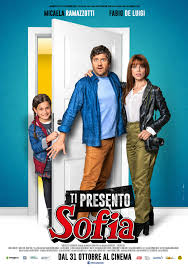
TI PRESENTA SOFIA/ LET ME INTRODUCE YOU TO SOFIA
Italy, 2017, 97 minutes, Colour.
Fabio De Luigi, Micaela Ramazotti, Caterina Sbaraglia.
Directed by Guido Chiesa.
An Italian story about a mother and daughter that could take place in most societies.
The film creates the atmosphere of an Italian town, setting the characters within this context – husband, his pregnant wife, his friendship with a photographer who goes on travels. Then, 10 years later, divorce, the wife remarried and pregnant to her new husband, the daughter aged 10, moving between her father and her mother.
The complications are that the photographer returns after 10 years, Gabriele, the father is friend, they start a relationship, the trouble is that the photographer does not like children. Gabriele does not tell her. In the meantime, the lively daughter, Sofia, has a strong life of her own, preparing for a new brother, making demands on her father.
The further complication is the arrival of Gabriele’s father after a long absence and neglect in the past (and Gabriele refusing therapy because he has had so much in the past!. The grandfather is a singer, dancer, conjurer, wanting to make contact again with his family, meeting Sofia but her not realising who he was, bonding with her.
So, family crises, the affair between the father and the photographer, his brother at work and his girlfriend, and bringing all this to a resolution.
- A light story of father and daughter, marriage, divorce, new relationships?
- The Italian atmosphere, the city, homes, school, judo class, parks and gardens, the photography class, atmosphere…? The musical score?
- Gabriele and his story, his marriage, his wife’s pregnancy, giving birth, years passing, her leaving, the divorce, her remarriage, pregnant again, the new father? Gabriele and his personality, reserved, his friends and discussions, his relationship with his daughter?
- The past, Mara, friendship, the talk, her photography, her job, her travels, the invitation for him to come, the passport photo, outside the booth, the old lady, and Mara going off, 10 years passing?
- Gabriele, with Sofia, part of the time with her mother and stepfather, anticipating the new brother, devotion to her father, with him, his friends, the outings, her strong mindedness?
- Mara and her return, the notice about the course, his going, looking in, the man in charge ousting him? Mara, her personality, coming back, with the students, the photos? The new encounter with Gabriele, the relationship, developing, not liking children, her manager and the scenes critical of children, screaming in the restaurant? Gabriele, trying to tell her about Sofia, unable? And the commitment of the relationship?
- Gabriele and his father, absence, his father’s job, singing, dancing, conjuring, his many children, Gabriele and Chicco, their work together, Chicco his girlfriend? Therapy, explaining how much therapy he had had at various stages? The challenge to his father, walking out?
- Sofia, the party, the conjuring, admiring the old man, bonding with him – and the eventual revelation that he was her grandfather?
- Sofia, the encounter with Mara, friendship? His not wanting father new relationship?
- Mara, friendly, the relationship, her future? Gabriele, his future, Sofia? And the final resolution?
Once Upon My Mother

ONCE UPON MY MOTHER/ MA MERE, DIEU ET SYLVIE VARTAN
France, 2025, 104 minutes, Colour.
Lila Bekhti, Jonathan Cohen, Josephine Japy, Lionel Dray, Jeanne Balibar, Sylvie Vartan, Naim Najy, Anne Le Ny.
Directed by Ken Scott.
An unexpected cinema experience, highly emotional.
It opens with a middle-aged man, Roland Perez, sitting at his computer, typing, the voice-over explaining that he was born in 1963. And, then he continues to tell his story. The English title evokes something of a fairytale, once upon… However, the French title is more direct, Roland’s focus very much on his mother, the fact that she is very religious in her beliefs and practice, God, and, more familiar to French audiences, the reference to the singer-actress, Sylvie Vartan (who, herself, actually appears in the latter part of the film, turning 80 when the film was made).
The Paris family, originally from Morocco, settled in France, is a tight knit family, five children and their mother, Esther, pregnant. Independent-minded, having everything under control, even travelling by bus to the hospital, and crying out loud, to the hospital where she gives birth.
To her shock, again voiced out very loud, then to the dismay of audience expectations, the baby, Roland, is born with a club foot. Hence the emotions. The first part of the film focuses on Esther, a really high-powered performance by Leila Bekhti, vigorously young, ageing and looking and sounding like a variation on Bette Midler (this is a compliment), and her absolute refusal to accept that her son will not walk faith that he will walk unaided.
She opens up the telephone book, searches out every possible specialist, loudly rejects their realistic assessments about Roland, draws on her Sephardic Jewish piety, praying out loud at unexpected moments, a shrine in the house, initially demanding a miracle and gradually accepting that a miracle might take some time. In the meantime, the children support the younger brother and, especially, complimentary word to the actors portraying Roland through his ages, especially Naim Najy who has the task of showing us the little boy who cannot stand, cannot walk, sliding around the floor of the house.
For those in the know, and audiences who do, not know but appreciate where they are being led, Roland will eventually stand and walk. On the one hand, there are the authorities demanding that he go to school and except his disability. On the other hand, Esther discovers the wife of a healer and commits herself and Roland to a lengthy treatment.
There is a later scene of vindication when Mayor Jacques Chirac of Paris actually presents a medal of honour to Esther, in the presence of family and neighbours, recommended by the woman who had demanded that the boy go to school.
The latter part of the film moves rather more speedily, Roland forced to go to a dance class, collapsing, Esther, loudly angry, confronting the ballet teacher. At home, difficulties in reading, but Roland forced to watch so much television, discovering the singer Sylvie Vartan and relishing her songs (and all the children, dad at work, the neighbours all joining in).
This review would not have minded a longer film, greater filling out of Roland’s later life, some acting on television, then studying law, the encounter with Litze, his future wife, an opportunity to interview Sylvie Vartan herself, the scenario rather quickly passing over his marriage, the birth of children, his work in the law, challenges, and the significant encounter, hence the title, with an ageing Sylvie Vartan, his idol, and becoming her legal adviser.
But, pervading the whole film is Esther’s presence and her absolute commitment to her son. It is not only love but, we appreciate even before Roland does, that it is very high-powered smother love, an all-consuming passion of the mother for her son, and, we appreciate before Roland himself does, that she has committed herself to controlling his life and, that as he grows older, she doesn’t really let go, even some controlling beyond the grave.
Which means, then, that this is a conflicted emotional cinema experience, sharing the life of Roland as he looks back, wondering about Esther and the exceeding stubbornness and determination that her son will walk, and then the joy that he does. But, the long-term repercussions of the control and the son, who is indebted to his mother, having to break free from that control.
So, an unexpected and unusual true story, worth experiencing.
- The original title, the focus on rolling’s mother and her importance, the religious dimension, God and miracles, and the role of singer simply light and for the young boy and his family and for his later career? And the English title with the application of the beginning of a fairytale…?
- The opening and expectations, Roland, his age, typing, the voice-over, born in 1963, a story initially of the 1960s and 70s – and then the later decades?
- Paris, the 1960s, the city, homes, hospitals, shops and markets, the atmosphere? The musical score? The continued range of popular songs, French and English-language corresponding to each of the decades? And the songs of Sylvie Bertin?
- The establishing of the family scene, the parents, strong-minded mother, Esther, at home, in control? The children and their various ages? The quiet father, at work? Her pregnancy, the neighbours, independent, getting the bus to the hospital, crying aloud in the bus, the experience of the birth, the child taken, the revelation of the club foot?
- Esther and her immediate response, crying out, denial, determination? Roland and his early years, he attempts to straighten out his clubfoot, the huge range of doctors and specialists, their realistic/pessimistic diagnosis? Esther, growing louder, more demanding, absolutely stubborn? Prayer, the Sephardic tradition, the order in the house, her pausing for praying? The father and the issue of Roland having a brace, taking him to a doctor? Esther not wanting to have a brace? The boy, unable to stand, on the floor, sliding around the house? His confinement, watching so much television, the appeal of Sylvie Vartan, the whole family with the records, the neighbours, everybody singing? And the brother teaching Roland how to Read with the stories of Sylvie Vartan?
- The years passing, Esther becoming more strident? The visit to the doctor, finding he had died, the encounter with his wife, the wife then reaching out, the fact that her husband was a healer, who using his methods, strict, confined, Roland loosening the bobds and moving around, the cheating, the widow almost giving up, persevering, his eventually moving his foot, the scene of his gradual standing up, then the scenes of his Walken, slowly, more quickly, backward…?
- The issue of his schooling, the Inspector, her visits, her demands, Esther and her fears defiance, the new treatment, being allowed the time, the Inspector and the police arriving? His standing, being said to ballet school, the pirouette the fall, the reaction of the ballet teacher, to remove his tights, see his foot, Esther her arriving, denouncing the ballet teacher? (If the scenes of him doing television commercials, some moving moments?)
- Go to school, on his own, and sport, his mother always warning him to not speak to strangers? The scene of his later telling her not to say this when he was an adult?
- The second part of the film, moving quickly, sketching the episodes in comparison with the first part of the film?
- His decision to do law, at the University, his mother intervening and chatting with the professor, using his personal name, well distracted, seeing Litze, the attraction, inviting the group home, Esther seeing her, deciding she was the best wife for Roland, the friendship between the two, their chatting?
- Knowledge of Sylvie Vartan, the record shop, his work, and the arrangement of the interviews, his nervousness, is able to talk to her about her ideas, the further interviews, as a boy seeing her with Johnny Halliday at the television station?
- The overview of Lionel’s adult years, courtship of Litze, the wedding, the preparations, the dance, the discovery that she was pregnant? Esther and her tantrum, on the floor, and the mean you with the shrimp, the reaction of the rabbis, in trying to reassure her?
- The overview of his marriage, the children, their growing up, alienation from Harold? His wife, the doctor, the cancer, her decisions, her death?
- Roland and his work, success of the law, his mother as receptionist, trying to city, but keeping confidential information to herself, especially about one client, the new offices, his not providing an office for her, her reaction and not wanting to be known that she was fired? His going away from his mother, trying to get free of her control? And so the disappointment for Esther later in life, the absence of her son?
- The birthday party, Sylvie Vartan as his client, the speeches, his mother with the story about his childhood, his taking the letter that his mother had slipped to Sylvie? But, having told people,, knowledge?
- Roland deciding to write his story, is memories, his disability, his mother, her determination, to possessive, the difficulties of breaking free, his career, his wife and family? And sharing this story to his book and this film?
Follemente/ Somebody to Love
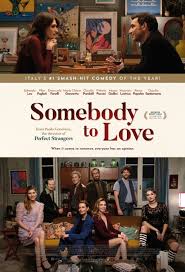
FOLLEMENTE/ MADLY/ SOMEBODY TO LOVE
Italy, 2025, 96 minutes, Colour.
Eduardo Leo, Pilar Fogliati.
Directed by Paolo Genovese.
Italian writer-director, Paolo Genovese, had critical and commercial success with his 2016 film, Perfect Strangers. With Follemente, almost a decade later, he had a great commercial success in Italy.
The basic premise of the film reminded audiences and reviewers of Pixar’s Inside Out films. There is a central human character while, dramatised behind the scenes, are the various aspects of character, personified, giving their views, influencing, guarding and ID the behaviour of their central character.
That was animation. This is live action. And, there are two central characters, man and a woman, both middle-aged. He is divorced with a daughter. She has had many relationships. They meet, go to her apartment, and the intimate drama of their interaction.
Meanwhile, there are four women and four men, representing the various facets of the consciousness of the couple. Which means then that there are many sequences of interactions amongst the four women, younger middle-aged and one younger, and among the four men, rather older, though one younger.
If audiences are able to accept this set up, there is a drama, comedy, mixups, interactions and clear and muddled motivations, and how these discussions going to play with the minds and the behaviour of the two central characters.
This scenario was very popular at the box office, less so with some bloggers and critics, some finding the sequences tedious, others not finding them so funny, some irritation with the various aspects of consciousness.
The response to the film will very strongly depend on the experience of the member of the audience in terms of relationships, but more especially of intimacy, sexual encounters, attitudes of sexuality, casual, more committed, the psychological and emotional consequences, the physicality of sexual encounters. And, audiences of different ages and experience will identify/ not identify with the situation, the central couple, the conflicting ideas and emotions influencing their as dramatised.
As with this kind of scenario, some of the women in the group, some of the men in their group, will be more interesting and identifiable with than others. But, there is always some kind of provocation in their arguments, interactions and the audience seeing how the couple put their influences, emotions, conflicting perspectives into action.
And, taking it further, there is a finale with all the women and men meeting each other, arguments, attractions, challenges.
Enjoyment of this cinematic experiment with dramatising the human psyche, and the various emotions presented inside out, will be very subjective according to what each member of the audience brings of their own experiences to watching the film.
(The American title for release was Madly, translating the Italian title. However, in the middle of the film there is an elaborate performance by a band of the song, English lyrics, Somebody to Love.)
Best Pair of Legs in the Business, The
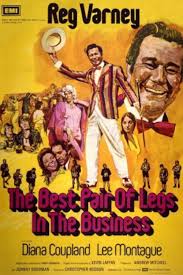
THE BEST PAIR OF THE LEGS IN THE BUSINESS
UK, 1973, 88 minutes, Colour.
Reg Varney, Diana Coupland, Lee Montague, Jean Harvey, David Lincoln, George Sweeney, Geoffrey Chater, Jane Seymour.
Directed by Christopher Hodson.
A little-known British film of the early 1970s. 21st century audiences looking through lists of titles on streaming services and noting this title might decide to neglect it (or indulge a little prurient curiosity). And, reading the cast list and seeing the name, Reg Varney, at the top, and remembering his very broad popularity on British television in the 1960s and 1970s, The Rag Trade and, especially, On the Buses (and the three Buses movies at this time) might decide to give it a miss, considering it just a variation on these television programs.
But, surprisingly, it is not.
It is based on a television played by Kevin Lafan, now broadened out for the big screen. And, it has a surprising plot, some humour, some moments of pathos, some tragic moments.
It is the story of an entertainer – and many of the critics and commentators noted the similarity to Laurence Olivier, the film version of John Osborne’s The Entertainer. Varney is Sherri Sheridan, more than 20 years into the entertainment business, neglected by his agent, a vain man trying to survive, playing at a summer camp, song and dance routines, and some female impersonation. He does have a following at the camp but it is a mixed group of British holidaymakers who take it for granted to go to the club for some evening’s entertainment and a drink.
Sherri Sheridan tries very hard, is playing to the gallery and to the manager of the camp (Lee Montague). But, there is his long-suffering wife, played by Diana Coupland (at the same time as on television she was playing Sid James’s wife in Bless This House). There is also an alienated son who appears later in the film, avoiding his father, embarrassed by him, about to be married to a Minister’s daughter (in fact, Jane Seymour in a very early role).
The wife, patiently looking after her husband for so many years, is in love with the camp manager and wants to leave with him. When it is revealed, Sherri has an emotional collapse, and her son, and with a connection to the church, is disappointed and disapproving. And a tough partner has come in to take over the camp.
The film offers Reg Varney an opportunity for a lot of entertainment pieces which he relishes. But, he is an unlikeable character, an emotional conman, prone to anger and outbursts, angry with his son, eventually going to the afternoon tea to meet the religious parents – so an emotionally confronting sequence where he plays himself up, more and more angry, defying the religious parents, an emotional collapse.
Which means that, despite the title and its reference to summer camp competitions for judging best legs, male and female, there is a great deal to reflect on in this unexpected drama.
- The tone of the title and its impact? Audience expectations? The reputation Reg Varney in the 1960s and 1970s, television, On the Buses, popular and lowbrow humour?
- The surprise of the screenplay, the variation on the fading entertainer? Life and career in show business, hopes and ambitions, disappointments? Marriage, wife? Alienation of son? Relationship with employers? Surviving a kind of dead-end life?
- The summer camp, the club, the entertainment space, the drinking space, offices, accommodation, caravans? Old British style for holidays?
- The musical score, the range of songs, popular, familiar, created for the film?
- Sherri Sheridan, a Reg Varney character, his age, experience, show business, song and dance, female impersonation, rapport with the audience? The scenes of performance? His relationship with his wife, taking her for granted, her falling out of love long since? His son, his neglect of him as a boy, his son’s alienation and avoiding him? Complaints about his agent, not getting bookings? Living in the past, and the royalty occasion and his magnifying it?
- Mary, the marriage to Sherri, her son, the humdrum life, her supporting her husband, wanting to leave him, in love with the manager, preparing to leave? Her son’s visit and encountering his father? Going to the afternoon tea, Sherri making a fool of himself, the return, her son’s disappointment with his mother’s behaviour? The new manager, deliberately giving out the information, the repercussions?
- The manager, his life, the camp, caravans, with Mary, the business aspect, the new partner coming in, ruthless, taking over, his plan to leave with Mary? The revelation? His stance?
- The subplot of the young men, the young women, extraneous to the main theme, the style of the summer camp, the young men, attitudes to the girls, buying the condoms, their embarrassment, the young girls, enjoying the holiday, the entertainment, friendship with Sherri? Eager for the boys? But the boys making full of themselves, their rejection?
- Future for Sherri, going to the caravan, his disappointment, the performance as Queen Elizabeth, the men setting on him, rescued by his son? What kind of future?
SIX

SIX
UK, 2025, 81 minutes, Colour.
Aimie Atkinson, Alexia McIntosh, Millie O’Connell, Natalie Paris, Maiya Quansah-Breed, Jarneia Richard-Noel
Directed by Liz Clare.
Six (stylised SIX ) is a musical with music, book, and lyrics by Toby Marlow and Lucy Moss. It is a modern retelling of the lives of the six wives of Henry VIII, presented in the form of a singing competition/pop concert. In the show, the wives take turns telling their stories to determine who suffered the most from their shared husband, but ultimately seek to reclaim their individual identities and rewrite their stories.
That is the opening of the Wikipedia article. What follows is an enormous amount of information, much more than anticipated, on the various productions of musicals since 2017, in the UK, covid history, the US, an enormous range of world tours including Australia.
Six has been very popular with those who have come to know the music and lyrics, and this film version, produced in London in 2022, was released in 2025 with some success with fans of the musical.
Interesting information suggests how each of the six wives of Henry VIII was influenced by contemporary singers and dancers:
- Catherine of Aragon: modelled on Beyoncé and Jennifer Hudson
- Anne Boleyn: modelled on Avril Lavigne and Lily Allen
- Jane Seymour: modelled on Adele, Sia, and Celine Dion.
- Anna of Cleves: modelled on Nicki Minaj and Rihanna.
- Katherine Howard: modelled on Britney Spears and Ariana Grande.
- Catherine Parr: modelled on Alicia Keys and Emeli Sandé.
The running time is quite brief, the focus is on the stage, the six singer-dancers, four piece band with women musicians, colourful costumes, an exuberant singing and dancing style (with some quiet moments), giving some information about each of Henry VIII’s six wives, the King himself and his behaviour, the fate of Katherine of Aragon, still angry with being discarded), Henry VIII’s role in the Reformation with the issue of his divorce, a rather flighty Anne Boleyn almost boasting about her execution, a rather more staid Jane Seymour who gave birth to the desired male heir, Edward VI, but who died young. Anne of Cleves was rejected because she was ugly but she compensates here by exuberant singing and dancing. Katherine Howard came late into the group of Henry VIII’s wives and, as seen above, she seems somewhat slight, modelled on Ariana Grande. Catherine Parr was the survivor.
Not exactly a history lesson but it does raise the issues of Henry VIII, the issues of succession, his wives, the Reformation.
Beyond Reanimator
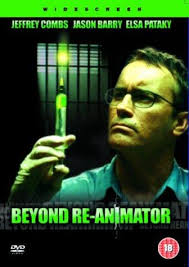
BEYOND RE-ANIMATOR
Spain, 2003, 96 minutes, Colour.
Jeffrey Combs, Jason Barry, Elsa Pataki, Angel Plana, Lola Herrero, Simon Andreu.
Directed by Brian Yuzna.
A brief synopsis from the IMDb: After 13 years in prison, the mad scientist from Re-Animator (1985) gets a new chance to experiment with the arrival of a young prison doctor, who secretly hopes to learn to reanimate dead people. Good intentions turn to horror.
Dr Herbert West, played by Jeffrey Combs, was introduced in Re-Animator in 1985, the film being a successful blend of science-fiction and horror. This led to a sequel in 1989, again with Dr Herbert West, Bride of Re-Animator, not only playing on the initial film as a variation on the Dr Frankenstein theme but also the themes of Bride of Frankenstein. The sequel was directed by Brian Yuzna (who also directed the bizarre science fiction social critique, Society).
Brian Yuzna returns to direct this film with his original star but filmed in Spain with a Spanish cast.
Dr West has been in prison for 13 years – audiences remembering his experimentation with reanimating, creating zombie characters, and consequent horror mayhem.
This film has a prologue with two little boys and their older sister, a zombie attack, her death, the little boy aware of Dr West and growing up to become a doctor himself, get himself appointed to the prison where Dr West is serving his sentence, wanting to team with him and continue the experiments.
And, this is what happens. As with the previous films, there is an opening with someone brutally dying, this time in prison, and the experimenting reanimation – with some dire results in the brutality of the revived prisoner and his aggression. In the meantime, there is the sinister character of the warden, imperious, with a cane, dominating the doctors and the prisoners, and especially towards an eager young journalist, played by Elsa Pataki (some years before she met Chris Hemsworth and married him!). She is attracted to the new young doctor but also trying to infiltrate herself, discover information for her work, supplying information to the warden.
And, the development of the serums for reanimation and some of the prisoners injecting themselves with horror results.
When the journalist is killed, after a relationship with the young doctor (more explicit in 2003 than in the 1980s), he is desperate for her reanimation, collaborating with Dr West. Again, some dire results, for her, deaths, reanimations, changes of moods. And the same, with the warden.
There is a great deal of attention given to the huge prison, the yard, the number of prisoners, the wardens, lockdowns, and then vicious fights throughout the prison.
So, many dead at the end, quite an amount gruesome mayhem, the young doctor surviving – Dr West moving out to continue his experiments (though, so far, no sequel).
Red Sonja/2025
RED SONJA
 US, 2025, 110 minutes, Colour.
Matilda Lutz, Robert Sheehan, Wallis Day, Luca Pasquilino, Michael Bispoing, Ben Radcliffe, Trevor Eve, Rhona Mitra, Veronica Ferres..
Directed by MJ Bassett.
Red Sonja had her origins in the 1930s, stories by Robert E. Howard, especially Conan the Barbarian. Later their stories were taken up by Marvel Comics. And, with the success of Arnold Schwarzenegger as Conan the Barbarian, the Conan film was followed up with Red Sonja, Brigitte Nielsen starring. It was action adventure for the fans rather than an awards-seeking.
The 1980s saw some popularity with this kind of adventure, nicknamed Sword and Sandals, with touches of Sorcery added in. Then, in the 1990s, some respectability for these ventures into warlike pasts, Oscar winners like Braveheart, Gladiator.
Now, after many attempts, here is a new version of Red Sonja. She is played by model, Matilda Lutz, entering wholeheartedly into the action, quiet for the drama and emotion, certainly fulfilling all the script requirements for battles.
There is the creation of many periods mixed together, some prehistoric aspects, especially with lumbering special animals. There are the primaeval forests and humans surviving despite the inroads of ambitious and vicious kings. Then there is a “civilisation” which resembles the Roman Empire in many ways, an absolute Emperor, played eccentrically by Robert Sheehan, thinking he is Marcus Aurelius when he is really something of a Caligula. And, there are slaves imprisoned, the Dominati, battles to the death in the arena, variations on gladiatorial combat.
Sonia, an orphan, growing up in the wilderness, is captured, imprisoned, defying the Emperor in the arena. With some flashbacks, there is a history between them, he a little boy slave, about to be helped by Sonja but their being separated. He has grown up resentful, with half of a book which reveals to how to build up a culture, putting into practice to develop his empire – but he is desperate in his zeal in looking for the second half.
Revolutions, rounding up of rebels, battles and the forests, Sonja relying on her favourite horse, pursuit of the rebels, some heroic characters amongst the rebels, some sinister advisors to the Emperor, and a woman who has been a slave, vanquished opponents, hears voices and wants to the Empress.
The film mixes all these ingredients together using an action antiquarian pulp fiction style that is not designed for cineastes but for the popular audience.
Meet Nero Wolfe
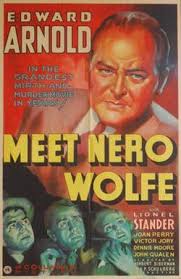
MEET NERO WOLFE
US, 1936, 73 minutes, Black-and-white.
Edward Arnold, Lionel Stander, Joan Perry, Victor Jory, Nana Bryant, Dennie Moore, Walter Kingsford, Boyd Erwin, John Quayle and, Rita Hayworth, Frank Conroy.
Directed by Herbert Bibberman.
In the 1930s, the detective novels by Rex Stout were very popular. And is detective was Nero Wolfe, large, sedentary, fond of eating, drinking a particular kind of beer, not going outside, but always interested in the force of a mystery. His associate, Archie Goodwin, is played by Lionel stander (though there was complaint that this character was rough and ready, rasping voice, much less sophisticated than the original in the novels). And, Archie has a girlfriend who is forever asking when they are going to get married.
The film opens in a golf course, a professor having a heart attack and dying. There is a complicated background to this episode, events in Argentina, the wife of the professor formally married in blackness Iris and her former husband charged with murder. There is an industrialist, accused of murder of the time, years later returning to Argentina and bonding with his son.
Rita Hayworth makes her first screen appearance as a young woman who supplies Nero Wolfe and his beer but whose brother has mysteriously died. And, it emerges, that working in munitions, he has prepared a weapon in the golf club, reaction to release and.
Many suspects, especially Victor Jory who can always look sinister, a very haughty widow who loses in some kind of all knowing dignity, daughters and sons, the industrialist.
Comedy sequences with Lionel Stander, his all the footwork while Nero Wolfe stays at home, ease, drinks, thinks. And, of course a setup where everybody arrives and the killer is unmasked.
There was a sequel but Edward Arnold was not available and Walter Connolly, much more bubbly and grandfatherly, took his place.
The film is interesting in terms of the Dir, Herbert Bitterman, a writer making few films, comic best affiliations with his wife, actress, Gail Song to guard, accusations against him, his being one of the Hollywood 10 and imprisoned, blacklisted, but making a famous social criticism film outside the US, And of the Earth, in 1964. But when his principal accusers in the Hearings with the son of Bud Schoenberg, the producer of this Nero Wolfe film.)
