Displaying items by tag: Edward Arnold
Meet Nero Wolfe
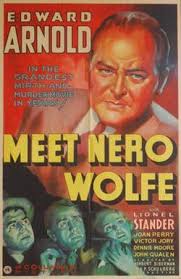
MEET NERO WOLFE
US, 1936, 73 minutes, Black-and-white.
Edward Arnold, Lionel Stander, Joan Perry, Victor Jory, Nana Bryant, Dennie Moore, Walter Kingsford, Boyd Erwin, John Quayle and, Rita Hayworth, Frank Conroy.
Directed by Herbert Bibberman.
In the 1930s, the detective novels by Rex Stout were very popular. And is detective was Nero Wolfe, large, sedentary, fond of eating, drinking a particular kind of beer, not going outside, but always interested in the force of a mystery. His associate, Archie Goodwin, is played by Lionel stander (though there was complaint that this character was rough and ready, rasping voice, much less sophisticated than the original in the novels). And, Archie has a girlfriend who is forever asking when they are going to get married.
The film opens in a golf course, a professor having a heart attack and dying. There is a complicated background to this episode, events in Argentina, the wife of the professor formally married in blackness Iris and her former husband charged with murder. There is an industrialist, accused of murder of the time, years later returning to Argentina and bonding with his son.
Rita Hayworth makes her first screen appearance as a young woman who supplies Nero Wolfe and his beer but whose brother has mysteriously died. And, it emerges, that working in munitions, he has prepared a weapon in the golf club, reaction to release and.
Many suspects, especially Victor Jory who can always look sinister, a very haughty widow who loses in some kind of all knowing dignity, daughters and sons, the industrialist.
Comedy sequences with Lionel Stander, his all the footwork while Nero Wolfe stays at home, ease, drinks, thinks. And, of course a setup where everybody arrives and the killer is unmasked.
There was a sequel but Edward Arnold was not available and Walter Connolly, much more bubbly and grandfatherly, took his place.
The film is interesting in terms of the Dir, Herbert Bitterman, a writer making few films, comic best affiliations with his wife, actress, Gail Song to guard, accusations against him, his being one of the Hollywood 10 and imprisoned, blacklisted, but making a famous social criticism film outside the US, And of the Earth, in 1964. But when his principal accusers in the Hearings with the son of Bud Schoenberg, the producer of this Nero Wolfe film.)
Rasputin and the Empress
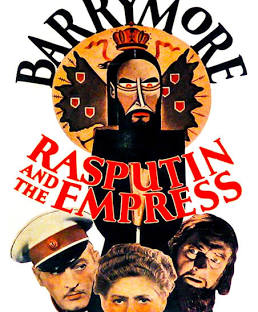
RASPUTIN AND THE EMPRESS
US, 1932, 121 minutes, Black and white.
John Barrymore, Ethel Barrymore, Lionel Barrymore, Ralph Morgan, Tad Alexander, Diana Wynyard, Edward Arnold.
Directed by Richard Boleslawski,
Rasputin, often referred to as the Mad Monk, has a singular place in 20th century Russian history. He had great notoriety, his place in Russian society, his influence at the Royal Court, the devotion of the czarina, his helping the haemophiliac son, his infiltrating himself into the very life of Russia, the court, in politics, mesmerising some, alienating others, a profligate life, finances and political blackmail…
And, the conflict leading to a confrontation, the attempts to kill him, his resistance to dying, but, ultimately, his death. And his living on in the popular imagination.
Already in 1932 there was a German film about him and this MGM production, lavish in its way, sets and decor and costumes, starring the three members of Broadway’s “Royal Family”, John, Athol and Lionel Barrymore, enhanced the Rasputin stories. Later films included Christopher Lee as Rasputin, the Mad Monk, and Alan Rickman, striking in the film, simply called Rasputin.
John Barrymore has the heroic role rather than the villainous role as the Prince who finally confronts Rasputin. Ethel Barrymore is the czarina. But it is Lionel Barrymore who is centre stage as Rasputin, and full stops out for the performance and the style of histrionics.
There are interesting supporting roles for Ralph Morgan is the Czar and Edward Arnold as the consulting doctor, especially for the young prince and his haemophilia.
MGM was involved in a court case concerning the presentation of a Princess, her devotion to Rasputin, an alleged rape and its consequences. The film's inaccurate portrayal of Prince Felix Yusupov and his wife Princess Irina (renamed "Prince Chegodieff" and "Princess Natasha") resulted in a historically significant lawsuit against MGM and gave rise to the "all persons fictitious disclaimer", which has since become standard in Hollywood works of fiction.
- The fascination of Rasputin in Russian history, his career, reputation, his representations in so many films?
- The reputation of the Barrymore’s, the only film that they appeared in together, but not so many sequences together?
- The black-and-white photography, the recreation of the period, costumes and décor, sets? Musical background? Silent sequences?
- Audience knowledge of Rasputin in the last days of the Czars? The 1900s, World War I, the imminent Bolshevik revolution, the execution of the Royal family?
- The atmosphere of the Royal family, the Palace, pomp and lifestyle? The Czar and his character, leadership? The Czarina, her strength of character, devotion to her children? The young prince, his haemophilia? Prince Paul and his principles, his wife? The film establishing all these characters and their interactions?
- The presence of Rasputin, his background, religious, fanatical, his appearance, his powers, the hypnotising of the young prince, the Prince in his power, his haemophilia? The Czarina and her gratitude? His presence in the court?
- Prince Paul, his stance, principles, opposition to Rasputin? His wife and her devotion, support? The interactions, Rasputin and his schemes, Paul and the confrontations? The ultimate buildup, the dinner, Rasputin and his powers, the poison, the guns, the river?
- The portrait of Rasputin, his mental state, his mesmerising powers, gaining dependence? Political influence and presence? Financial issues? Gaining power, information, blackmailing?
- The drama of the Princess and her support, the question of her relationship and the rape in real life, the insertion of a sequence, the court case and this sequence excised?
- As an example of MGM style and filmmaking in the early years of sound?
